// Lofty

3.7K posts

// Lofty banner
// Lofty

// Lofty

@loftyPuma

Heddle Founder

The Void Katılım Ağustos 2013
743 Takip Edilen559 Takipçiler
Sabitlenmiş Tweet
// Lofty
// Lofty@loftyPuma·
For the non-techies using @AIWayfinder (because yes, you will be able to) here is a breakdown of how to help Wayfinder sort out any hiccups for you so you don’t have to give up or start over. You’re probably going to want to bookmark this 🔖
English
46
20
132
36.2K
// Lofty
// Lofty@loftyPuma·
How do you figure out which model is writing better code in your repo?
English
0
0
0
19
// Lofty
// Lofty@loftyPuma·
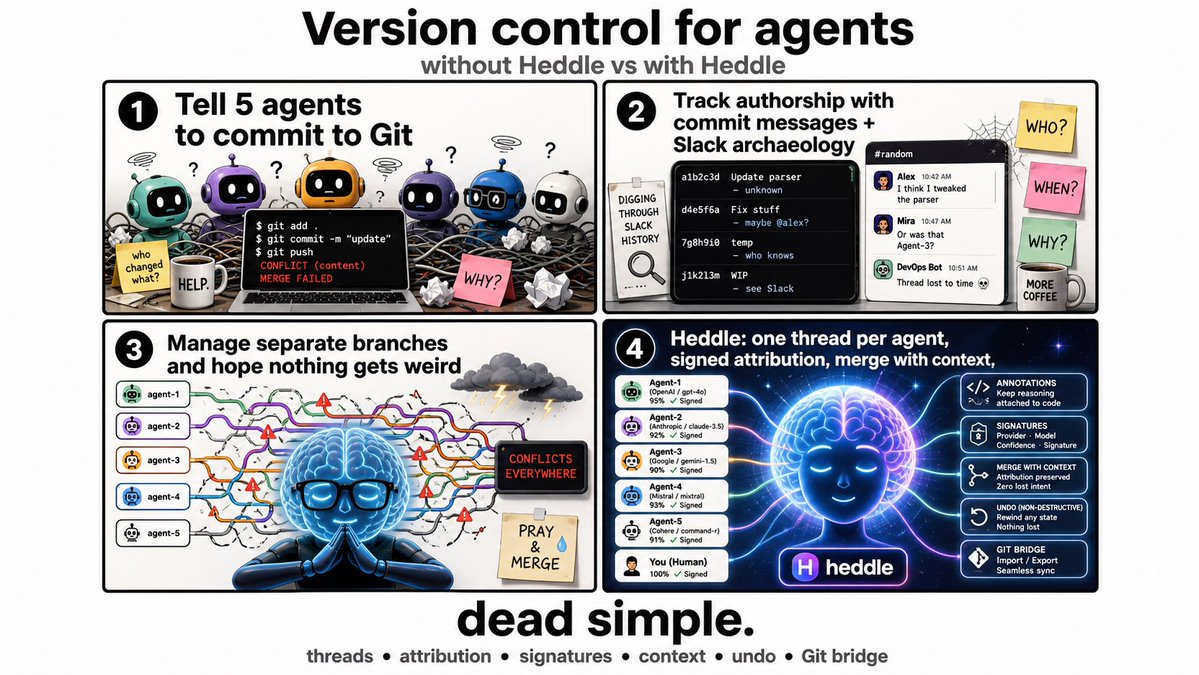
So glad you asked! I’ve been thinking about this for a couple of months now as I try to make git work for me instead of against me. key things: - immutable storage. action is destructive (agents should be dropping work to see if they made a bug or not) - granular state captures. Commits are too broad for ai work, they need to be able to undo and check in chunks of code instead of features. Every tool call should result in a captured state. - lightweight worktrees. Agents work best when they aren’t sandboxed to 4 files in your codebase, each subagent needs their own workspace to freely make changes - embedded context. Your critical reasoning shouldn’t be stored anywhere other than with your versioned code. We don’t need more layers, we need better ones - attribution. We have multiple actors working on the same code at once, you should be able to pinpoint which model is making the most bugs With that base you open up the door to smarter code reviews, more intelligent agentic sessions, and an ability to identify exactly which model *you* work best with.
English
1
0
0
10
Darren Shepherd
Darren Shepherd@ibuildthecloud·
Oh my gosh stop it, people. We don't need a new GitHub. If your only complaint about GitHub is that GitHub sucks, GitHub can just fix that. We only need a new thing if it solves a new problem that GitHub can't do.
English
7
0
23
2.5K
// Lofty
// Lofty@loftyPuma·
MVP would be a local git-like client that can capture state more granular than a commit, something lighter than worktrees, and can embed reasoning in the code. Once you have those primitives agents can spawn agents and work on the same file in parallel without worrying about conflicts. You can identify the source, the reasoning, and the best result all from the orchestration agent. Instead of splitting work by files touched, agents can just go to work. Then the git storage layer matters (and code.storage is an awesome solution there)
English
0
0
0
33
// Lofty
// Lofty@loftyPuma·
@samhuckaby GitHub isn’t the problem. The problem is git. Agents need a whole new source control system that can keep up
English
0
0
1
24
Sam Huckaby
Sam Huckaby@samhuckaby·
You can’t replace GitHub with a shinier, snappier GitHub
English
3
0
7
309
// Lofty
// Lofty@loftyPuma·
Not enough people understand this 👇
Devanshu@DevanshuXi

Git and traditional databases were designed around a very specific assumption where a human is the primary actor. An AI agent completely breaks that assumption. Humans work in bursts. We make a few edits, commit occasionally, and query databases relatively infrequently. Agents don't. They operate continuously, generate thousands of tiny actions, and often need to branch, retry, backtrack, and coordinate with other agents. That's a very different workload. Take Git. Git is brilliant for human collaboration because commits are meaningful milestones. An agent, however, might generate hundreds of intermediate states while exploring possible solutions. Forcing every one of those states into Git is like using a filing cabinet to store CPU registers. Technically possible, deeply cursed. Git also assumes merge conflicts are exceptional. For multi-agent systems, conflicts are normal. If ten agents are simultaneously modifying code, configuration, and prompts, merging becomes the default operation rather than the edge case. Git's line-based merge algorithm starts sweating immediately. Databases have a similar mismatch. Most OLTP systems were built for short, deterministic transactions initiated by users or applications following predictable patterns. Agents are stochastic. They speculate, roll back, fork execution paths, and maintain rich context across long-running workflows. A single agent task might involve: querying multiple knowledge stores, spawning sub-agents, testing hypotheses, reverting failed branches,merging successful outcomes, preserving the entire reasoning lineage. Traditional relational databases can store this. Sure, but they're not native to it. You're essentially forcing a graph-shaped, versioned, probabilistic workflow into rows and tables. The deeper issue is state management. Human systems optimize for CRUD: Agent systems need something closer to: Fork, Simulate,Evaluate,Merge,Rewind, Provenance-track That's a fundamentally different abstraction. This is why entirely new infrastructure is emerging: Agent-native memory systems Versioned knowledge graphs Branchable execution stores CRDT-based collaboration layers Event-sourced agent runtimes Think of it as moving from "document editing" to "continuous world simulation." Git stores snapshots of files. Agents need snapshots of cognition. Databases store current truth. Agents need evolving hypotheses. Git answers: "What changed?" Agents ask: "What was explored, why, and what worked?" A future agent-native storage layer would likely combine ideas from: FoundationDB for transactions, CRDTs for concurrent collaboration, append-only logs like Apache Kafka, graph databases like Neo4j and helixDB and content-addressable storage inspired by Git itself. Git and SQL aren't obsolete, they're just too human-shaped. The same way relational databases weren't ideal for web-scale search, they're not ideal for agent-scale cognition. We're probably at the "mainframes before personal computers" stage of agent infrastructure. The primitives exist, but the abstractions are wrong. The companies that build the first truly agent-native state layer will own an enormous part of the stack.


English
0
0
2
82
// Lofty
// Lofty@loftyPuma·
@DevanshuXi You’re speaking my language!! I’m building heddle.sh with this in mind. Git is the bottleneck today. Better agent isolation and collaboration are the core principles behind it
English
0
0
1
14
Devanshu
Devanshu@DevanshuXi·
Git and traditional databases were designed around a very specific assumption where a human is the primary actor. An AI agent completely breaks that assumption. Humans work in bursts. We make a few edits, commit occasionally, and query databases relatively infrequently. Agents don't. They operate continuously, generate thousands of tiny actions, and often need to branch, retry, backtrack, and coordinate with other agents. That's a very different workload. Take Git. Git is brilliant for human collaboration because commits are meaningful milestones. An agent, however, might generate hundreds of intermediate states while exploring possible solutions. Forcing every one of those states into Git is like using a filing cabinet to store CPU registers. Technically possible, deeply cursed. Git also assumes merge conflicts are exceptional. For multi-agent systems, conflicts are normal. If ten agents are simultaneously modifying code, configuration, and prompts, merging becomes the default operation rather than the edge case. Git's line-based merge algorithm starts sweating immediately. Databases have a similar mismatch. Most OLTP systems were built for short, deterministic transactions initiated by users or applications following predictable patterns. Agents are stochastic. They speculate, roll back, fork execution paths, and maintain rich context across long-running workflows. A single agent task might involve: querying multiple knowledge stores, spawning sub-agents, testing hypotheses, reverting failed branches,merging successful outcomes, preserving the entire reasoning lineage. Traditional relational databases can store this. Sure, but they're not native to it. You're essentially forcing a graph-shaped, versioned, probabilistic workflow into rows and tables. The deeper issue is state management. Human systems optimize for CRUD: Agent systems need something closer to: Fork, Simulate,Evaluate,Merge,Rewind, Provenance-track That's a fundamentally different abstraction. This is why entirely new infrastructure is emerging: Agent-native memory systems Versioned knowledge graphs Branchable execution stores CRDT-based collaboration layers Event-sourced agent runtimes Think of it as moving from "document editing" to "continuous world simulation." Git stores snapshots of files. Agents need snapshots of cognition. Databases store current truth. Agents need evolving hypotheses. Git answers: "What changed?" Agents ask: "What was explored, why, and what worked?" A future agent-native storage layer would likely combine ideas from: FoundationDB for transactions, CRDTs for concurrent collaboration, append-only logs like Apache Kafka, graph databases like Neo4j and helixDB and content-addressable storage inspired by Git itself. Git and SQL aren't obsolete, they're just too human-shaped. The same way relational databases weren't ideal for web-scale search, they're not ideal for agent-scale cognition. We're probably at the "mainframes before personal computers" stage of agent infrastructure. The primitives exist, but the abstractions are wrong. The companies that build the first truly agent-native state layer will own an enormous part of the stack.
English
8
1
50
2.1K
// Lofty
// Lofty@loftyPuma·
@trevorlasn @mattpocockuk My idea is less containers, more filesystem abstraction. Agents are gonna spawn subagents one way or another. They need to have their own “worktree” without needing to make a whole worktree. I don’t want to have 20 copies of my repo waiting to be pruned every time I do something
English
0
0
0
45
Trevor I. Lasn
Trevor I. Lasn@trevorlasn·
@loftyPuma @mattpocockuk this is the right abstraction layer imo. agents need cheap isolation and clear promotion paths more than another chat wrapper
English
1
0
1
52
// Lofty
// Lofty@loftyPuma·
Hey @mattpocockuk genuinely curious how you handle subagent coordination. Do you just have a gajillion worktrees or is there some secret sauce us peasants don’t know about?
English
2
0
12
4.7K
// Lofty
// Lofty@loftyPuma·
@mattpocockuk So it plays on git worktrees by spawning them aggressively with very nicely coordinated containers? Does every subagent need to create a sandbox too or do you handle that yourself by slicing your plans into small chunks that one agent handles?
English
0
0
0
347
// Lofty
// Lofty@loftyPuma·
@karrisaarinen People don’t know what they want from git. Agents are struggling to fit inside the sandbox git provides. We need better core source control models that allow agentic attribution, parallel isolated work, and embedded reasoning. Then you can rebuild GitHub
English
0
0
0
95
Karri Saarinen
Karri Saarinen@karrisaarinen·
What is unclear to me is what people actually want some new GitHub to be. To me, the biggest challenge GitHub has always had is that it is trying to serve two very different worlds. On one side, it is a social network around code and open source. On the other, it is infrastructure for companies building software. Those two groups operate almost in opposite ways, so the product has always been some kind of compromise between them. Because those users are so far apart, it can fail both of them in different ways. Inside a company, you mostly just want to review and merge code. You are not discovering new code, and you are probably not forking things. You may have a monorepo, a known team, and a trusted environment. What you want from GitHub is efficiency and safety: PRs, review, ownership, CI, Actions, tests, security checks, and a clear path to getting code merged. Open source is different. It is much more public and much less trusted. You need better ways to figure out who is contributing, what to accept, how to manage the project, how to handle issues, and how to maintain trust with people you may not know. So are people asking for a new open source code hosting and social network, or do they want better private infrastructure for software teams? Or both? I would never choose to build both from the start. I think every product gets better when it is more purpose-built and designed around a specific need. You could maybe imagine some nested model, where private repos have a much simpler and more focused mode, but you can still exit that mode and browse around the public space.
English
45
14
520
67.4K
// Lofty
// Lofty@loftyPuma·
@sudomateo You should check out heddle.sh. I’ve been building it with exactly these primitives. Git should be invisible, only there to help you resolve state.
English
0
0
0
49
Matthew Sanabria
Matthew Sanabria@sudomateo·
I don't want a new GitHub. I want a new source control platform. One that highlights elements from new version control systems like jj. One that allows developers to force push without messing up reviews. One that works with mono repos, not against them.
Karri Saarinen@karrisaarinen

What is unclear to me is what people actually want some new GitHub to be. To me, the biggest challenge GitHub has always had is that it is trying to serve two very different worlds. On one side, it is a social network around code and open source. On the other, it is infrastructure for companies building software. Those two groups operate almost in opposite ways, so the product has always been some kind of compromise between them. Because those users are so far apart, it can fail both of them in different ways. Inside a company, you mostly just want to review and merge code. You are not discovering new code, and you are probably not forking things. You may have a monorepo, a known team, and a trusted environment. What you want from GitHub is efficiency and safety: PRs, review, ownership, CI, Actions, tests, security checks, and a clear path to getting code merged. Open source is different. It is much more public and much less trusted. You need better ways to figure out who is contributing, what to accept, how to manage the project, how to handle issues, and how to maintain trust with people you may not know. So are people asking for a new open source code hosting and social network, or do they want better private infrastructure for software teams? Or both? I would never choose to build both from the start. I think every product gets better when it is more purpose-built and designed around a specific need. You could maybe imagine some nested model, where private repos have a much simpler and more focused mode, but you can still exit that mode and browse around the public space.

English
5
1
15
3.9K
// Lofty
// Lofty@loftyPuma·
Playing with something …
// Lofty tweet media
English
0
0
0
20
// Lofty
// Lofty@loftyPuma·
@adilmania Version control should be invisible, I’m reinventing git so your agents can write code instead of plan work heddle.sh
English
0
0
1
16
Adil Mania.
Adil Mania.@adilmania·
what are you building? 👋 reply below in one sentence max. if it’s cool, i’ve a surprise for you this week.
English
440
2
267
25.2K
// Lofty
// Lofty@loftyPuma·
Everyone’s out here tokenmaxxing and ignoring what their agents spend tokens on every single session.
// Lofty tweet media
English
0
0
1
113