A groundbreaking new answer to one of humanity's big mysteries - and what it means about Bitcoin.
Years in the making. Now, a 14 minute read - enjoy!
onceinaspecies.com/p/once-in-a-sp…
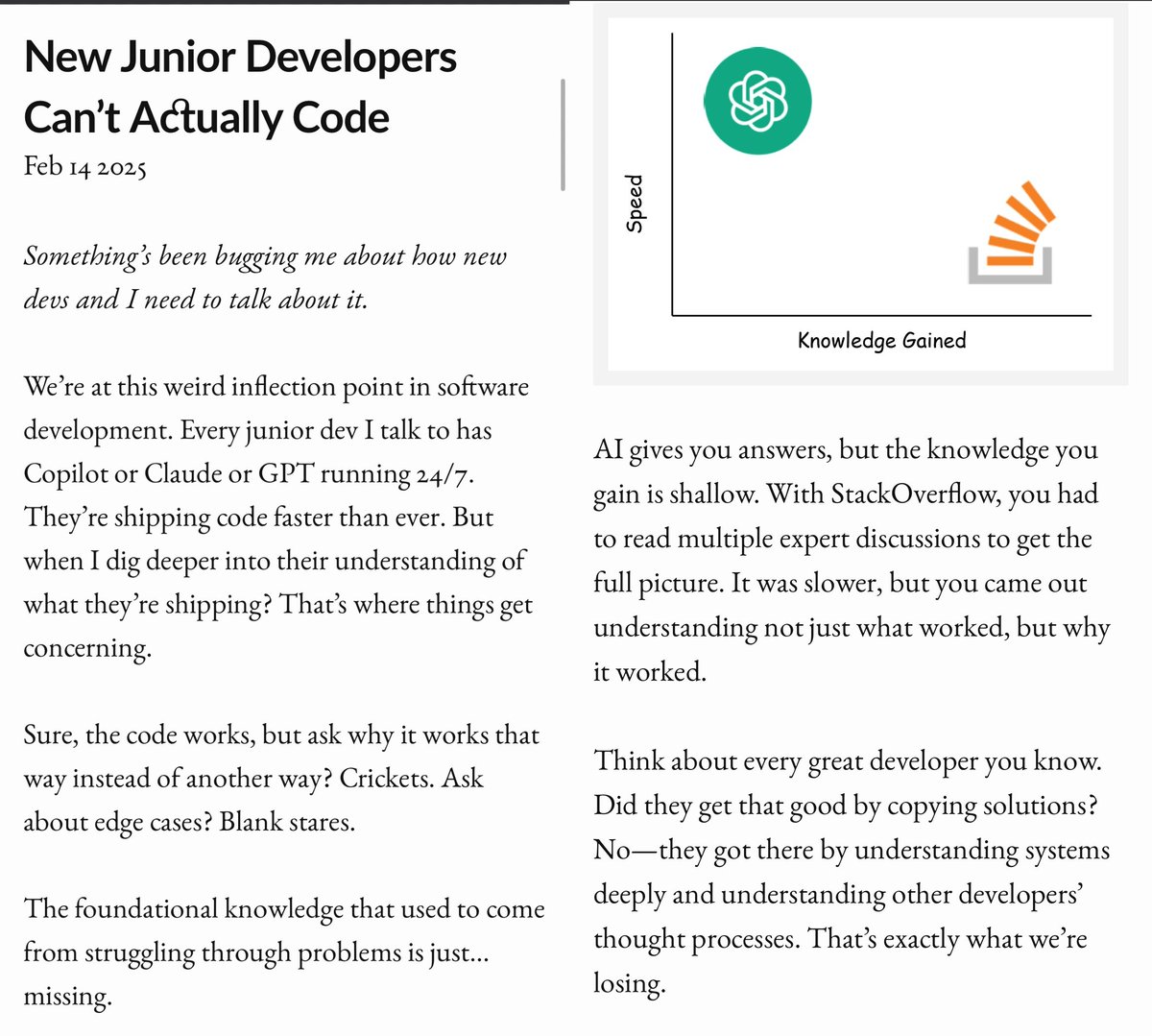
New junior developers can't actually code.
Fantastic blog where the author argues that AI is preventing devs from understanding anything
Unlike the internet which only replaced fact lookups but adds explanations, AI replaces all reasoning.
Fiat Games on Bitcoin
There's a saying about standing armies in peacetime, it's generally not a good idea. Wartime emergencies are one thing, but when you have a standing army during peacetime, they generally just get in the way because, like most armies, they crave action.
If you have a perfectly virtuous military, perhaps having a standing army is fine, but given the flaws of the human condition, there's bound to be some trouble. Many a revolution started with standing armies that felt disrespected and seized power when they could.
I mention this because this dynamic is at play in the Bitcoin ecosystem, where a bunch of bored holders are starting to make trouble. They identified as Bitcoin Maximalist even as recently as a few years ago, yet got off the rails, pushing all sorts of idiocy like this ordinals/brc-20 stuff.
The problem with these people is that they crave action. They can't just sit back and enjoy the ride. They're the type that needs to always be doing something, good or bad. And let's face it, once you get that Bitcoin is sound money and have given your pitch to your friends and relatives, it's a matter of waiting things out and watching your fiat enemies float by the proverbial river. I've been in those conversations, they go around the same topics over and over again.
As a result, these people feast on news. Wow, Michael Saylor did something, or there's an ETF coming, or X or Y or Z is happening. They're all addicted to talking and rallying the troops and once you're bored of talking about the things that matter, there's a natural tendency to talk about the things that don't matter as if they were.
I blame the BUIDL movement that emphasized building something, anything. It's an understandable attitude. Surely, doing *something* is better than doing *nothing*, right?
This is the error that every politician makes and it's high time preference behavior. X just happened and so you have to do something to react, *right now*. Or Y is a problem so you do something to "solve" it. The problem with these actions is that they're usually not well thought out and good actions, the ones that provide value, require some planning and research. But for the people with the BUIDL mindset, they just go and make something regardless of whether there's a need in the market or not. And the people addicted to action love this stuff because it's new.
I'm old enough to remember the 2008 crisis and the $800B TARP bailout that came along with it. The idea was that there would be lots of "economic activity" in the form of "shovel-ready projects." 16 years later, there's very little in terms of real, useful stuff that got built from the program. Most of that money ended up in slush funds and the coffers of the Cantillon winners who magically doubled or tripled their billions in the decade or so since.
That mindset of "build whatever" is a fiat mentality. It's not "if you build it, they will come." There has to be value being added to real people and not just a good story about what's possible. And that's what we're seeing in the Bitcoin community. There's a lot of VC money floating around still and they'll put money into anything with a good story, even if it makes little sense.
The fact is, VC investment is a fiat vestige that's horribly inefficient. And the incentives around it are deeply misaligned. The VCs, even the good ones, will pump their bags. And once invested, it's very hard for them to be objective about anything and takes superhuman amounts of virtue to do what's good for Bitcoin and not for your fund. You'd hope those things are aligned, but every VC inevitably gets into the situation where they have to invest in something questionable.
And invest in questionable things they have. This has been going on since 2013 or so with "investments" on "blockchain technology" and "ICOs" and "DAOs" and "DeFi" and "NFTs" and on and on and on. They may not even be explicitly looking to scam, but that is what they inevitably do. The pump and dump nature of tokens is such that they benefit the early pre-sale investors at the cost of the public, though to a large degree, this no longer has the returns it once had.
The flavor of the day is ordinals/brc-20 and unsurprisingly, a lot of VCs, even "Bitcoin-only" VCs, are invested in one or two already. That's because this is their model. They have to invest in a lot of stuff because their hit rate is so low. And diversification necessarily means you let the foxes into your henhouse. The "investment" ends up enriching scammers like the TARP bailouts did and the stuff that gets built ends up being largely useless.
And really, that's who is addicted to action the most. It's the VCs. Unsatisfied with Bitcoin's insane returns (or lacking justification for their fund in lieu of Bitcoin's existence), they talk and talk and talk on clubhouse and twitter spaces and whatnot to pump their bags. Even if they don't have bags to push, they're always talking openly to people about what investments they should make. And because they are looking for places to put money, they become much less objective and will fall for anything with a good story.
Investing in a good story is not a bad strategy in the fiat world. The narrative wins over things that provide value as long as there's an overwhelming amount of money put in on the narrative side. And the money printer is ultimately run by humans who will put resources toward good stories because there's no hard reality of the market to deal with. In other words, you often don't have to win the market. You can win it later with some money-printer-induced advantages.
But in Bitcoin, things are a little different. We have to be a lot more choosy about what gets built because what fails is a lot of wasted time and resources. Worse, that which gets built which ends up scamming wastes even more time and resources and sets Bitcoin further back. The entire altcoin industrial complex and the billions wasted on them since 2011 are the vestiges of this build-anything mindset.
Building has been very inefficient in the fiat world and unfortunately, we're having to re-learn what it means to build something that provides value.
Back during the gold standard, Standard Oil once paid 33% in dividends in a single year. That's not price appreciation or profits, that's dividends, as in money that went straight to the shareholders in a single year. And that's not a huge outlier. Most years, they paid over 10% in dividends.
Nothing like that exists now because all profitable stuff has been arbed to death. Anything that profitable gets "investment" (read: debt) which ultimately scales the business but reduces profitability. Most businesses these days are zombies, living out a dead existence while sucking value out from everyone else through inflationary theft. And unsurprisingly, that is the state in which most altcoins currently continue.
Which brings me back to the issue of Bitcoin culture. The problem right now is that too many people build on Bitcoin the same way they build on fiat. They play by the same rules and systems which have caused the stagnation we see all around us. But as we're progressing toward a sound money world, these processes and the fiat games that they run on won't work. The building that people do will have to run on a different set of *values*, not the fiat ones like satisfying venture capital with good stories.
The sad thing is that most people would rather do something rather than nothing. The lesson of the last 11 years in Bitcoin is that building something that is hurtful is worse than useless, it's better to do nothing.
Addressing the Decline in Birth Rates
Global birth rates are in decline, a trend that governments find alarming. A dwindling population could lead to a host of economic and social issues, but the policy responses have been largely ineffective. Financial incentives for families, like direct payments, tax breaks, and subsidized child care, have been deployed, but with little impact. This reveals a deeper, fundamental issue.
To understand the decline, it's crucial to figure out why couples are having fewer children. The common responses are either a lack of interest or financial constraints. While we should respect the choice not to have children, it's the financial concern that needs addressing.
Having children has become an expensive undertaking. From medical costs related to childbirth to time off work, government-mandated expenses like car seats, and the added costs of larger living spaces and education, families are stretched thin financially. Even households with two earners often struggle to make ends meet, making it harder to consider expanding the family.
The decline of single-earner households, where one parent could stay home to raise children, can be traced back to the massive expansion of rent seeking. The bureaucratic state has increased massively in all sorts of industries, and the inflation that has funded their expansion has driven up all kinds of costs, including essential resources like health care, education and housing. Both parents often need to work just to maintain a moderate standard of living.
A significant reason for these inflated costs is the fiat monetary system. Inflation has eroded the savings and earning power of average families, compelling both parents to enter the workforce. Moreover, real estate prices have soared, making it challenging for families to afford larger homes that could accommodate more children.
In essence, the decline in birth rates is not a consequence of individual choice or even culture but a byproduct of a kleptocratic monetary system that has made child-rearing unaffordable. Unless structural changes are made to restore the financial viability of having larger families, any superficial policy incentives are unlikely to reverse the declining birth rates. These economic incentives are giving back to families just a tiny portion of what's being stolen through the fiat monetary system. Stopping this inflationary theft would empower families to have more children, but such a move would require political will that is currently lacking.
What we need is a new monetary system and the path is not through political reform, but through the adoption of a new money. Bitcoin really is the fix for low birth rates.
Learn more at fiatruinseverything.com
Why Everything's Changing
When building an economy on top of a global settlement layer, that currency or bedrock cannot deflect. For the past 40 years, that bedrock has been the US treasury market (it's massive - tens of trillions of dollars). And for 40 years, anyone who saved their retained earnings in that bedrock saw the value continue to appreciate in buying power. Everyone knows that when bond yields go down, prices go up. The chart below showing the drop in yield (up in price) is why this form of savings worked so well for the world. However, this only works if the bedrock doesn't start to deflect. In financial terms, the bedrock of bonds will deflect if inflation cannot be controlled. As any engineer understands, if the bedrock is deflecting, EVERYTHING built upon it starts to crack and break down. Why does inflation cause the bedrock to deflect? Because investors in bonds need to have a higher yield than inflation, or else they are guaranteed to lose buying power. If inflation is 5% and the bond yields 3%, then you'll lose -2% in buying power if those yields remain persistent.
So, why are we seeing inflation? I'd argue inflation manifests itself through three main ways. The first and obvious way is just increasing the amount of monetary units in the overall system – everyone understands this one. What a lot of people don't understand is that you can add monetary units into a system, but they might not "nest" themselves in areas that most people see or expect. For example, trillions of monetary units were added into the system since 2008, and most of those monetary units "nested" themselves in the capitalization rates of stocks and bonds. You didn't see the CPI gage ever go up. But if you're a person who doesn't own stocks and bonds, well, you wouldn't see that capital appreciation in your day-to-day life. The second way is through supply destruction. Imagine you were on a remote island that was fairly self-sufficient and a tropical storm destroyed a bunch of infrastructure. Through that event, everyone on the island quickly needs to preserve and own essential supplies like energy and food. What you would find while supply chains are damaged is a bidding of prices on desirable goods and services. With enough time, as long as a free and open markets were allowed to persist, the supply chains will naturally self-correct, and prices will return to normal (as long as the other two means of creating inflation weren't exercised). Finally, the third way inflation can happen is through supply destruction caused by manipulated incentives via public policy decisions. When policymakers create incentives for growth in infrastructure, what they rarely talk about is what they AREN'T incentivizing through that action. The economy is massive, and one small incentive for sector XYZ seems harmless as a singular event. But when policy after policy is exercised by government bureaucrats, the things they AREN'T incentivized really add up and create a false sense of "free and open" markets. The next thing you know, people are incentivized (due to policy) to build things that are less efficient and less constructive to society than what a REAL free and open market would produce. If you take these policy decisions far enough and long enough without the free and open market being able to experience creative destruction, then supply chains at large become completely dysfunctional and fragile.
When we look at what happened with COVID, we literally have all three of these things playing out: manipulation of the money supply, 40 years of horrific policy decisions that have created hyper-fragile supply chains, and a global pandemic that disrupted organic activity. In addition to all of that (and maybe BECAUSE of that), countries that are net-producers are at war, or reconstructing trade agreements, with countries that are net-consumers. People might think the war between Russia and Ukraine is a localized situation, but it's actually much broader and strategic than that. In short, the net producers of the world don't want to give up their physical goods for the paper promises that net-consumers INSIST they accept as payment. The net-producers understand the bedrock is deflecting. The net-producers understand that the math behind these impaired bonds will remain impaired. Why? Because for the supply chains to actually become less fragile, the decades of poor incentives that were brought about through compounding poor policy decisions isn't going to end anytime soon. In fact, the problem is being amplified because net-consumers are trying to offset the bad policy decisions by adding more monetary units into the system (see #1 for creating inflation).
So, what CAN the world build upon that doesn't deflect? Well, anyone who follows my account probably already knows my opinion: Bitcoin. First and foremost, Bitcoin's decentralized nature ensures a robust and tamper-resistant foundation for the global economy. Unlike traditional currencies controlled by central banks and governments, Bitcoin operates on a decentralized network that is immune to political interference and manipulation. No more waiting for Jerome Powell to blink three times and watch the global markets move by $5 trillion. Next, the capped supply of 21 million coins addresses the issue of inflation that has plagued traditional currencies. With a finite supply, Bitcoin inherently resists inflationary pressures that erode the value of other currencies. This means that individuals and institutions who choose to store their wealth in Bitcoin can expect their purchasing power to be preserved over time, unlike those who rely on bonds and other assets that are vulnerable to more monetary units being added into the economy and into the hands of a chosen few. Additionally, Bitcoin transcends borders and mends the discord between net-producers and net-consumers: they no longer need to TRUST each other. The borderless and frictionless nature of Bitcoin allows for swift and cost-effective international settlements. By facilitating global trade and economic expansion, Bitcoin has the potential to usher in a new era of financial inclusion and prosperity. Finally, Bitcoin's ability to serve as a hedge against the deflection of traditional settlement layers is perhaps its most compelling attribute. As the bedrock of the global economy, it is crucial that the settlement layer remains stable and secure.
In my humble opinion, you can choose to start buying Bitcoin after thoroughly understanding the game theory and logic behind its continued appreciation in value, or you can learn by sitting back and watching others grow their buying power. Either way, you're eventually going to learn about Bitcoin, whether you like it or not.
it's not aliens
i wish it were aliens
but it's not aliens
it's just the ol' engineered panic, an attractive nuisance ensuring natsec reporters get assigned to investigate balloon bullshit rather than budgets or bombings (à la nordstream)
until next time
Do you ever wonder why trying to explain, persuade, or convince people about #Bitcoin can be so challenging?
It's because you are the counterparty risk.
A 🧵
1/ My essay "Structural Adjustment: How the IMF and World Bank Repress Poor Countries and Funnel Their Resources to Rich Ones" is now live
The Bank and Fund claim to help poor countries develop and rescue them from crises
But what if that's not true?
bitcoinmagazine.com/culture/imf-wo…
I already didn’t fully trust mainstream media, but after being native to an industry that experienced an event as large as the FTX blowup & seeing how MSM portrayed it, I don’t think I will ever trust them. Makes me wonder how misleading reporting is on topics I’m not native to.
A quick thread on bitcoin, crypto, and all that…
The creation of Bitcoin was not random. It was the product of deliberative efforts that people had been working on for decades. As more and more things were recorded electronically, these people recognized the need for privacy…
Given the mess in crypto (again), it's a decent time to read Digital Alchemy if you haven't, or give it a re-read:
lynalden.com/digital-alchem…
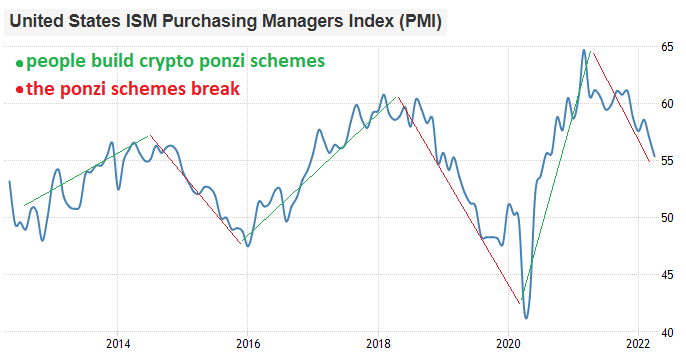
It's about crypto Ponzi schemes.
200 ppl work in this office:
1. In the morning, they commute for 1hr to the office, carrying their laptop.
2. They sit & use their laptop with music on their headset.
3. At the end of the day, they store their laptop & commute 1hr back home.
Non sense!
Here's a better way🧵
1/ It was only months ago that a leader of a G7 democracy granted himself temporary dictatorial powers, retroactively made protesting against his policies illegal, froze the bank accounts of dissidents with no due process, and jailed organizers of an opposition movement.