

Madison crypto
5K posts
Madison crypto
@madisviolins
Madison crypto a new@life begin
Katılım Ocak 2022
1.3K Takip Edilen378 Takipçiler
Hey :) ce faceti ? Va dau un pont !! Acceptați pierderea !!
Nu încercați să vă scoateți ca mai rău va afundați în pierdere !! Asumați-vă !!
Română
Madison crypto retweetledi

Do we agree that Quantum could be next next big narrative in Crypto?
If so, it should be a safe bet that you are onboarding to $QTC aka @qubitcoinx ✊
• 21 mio total supply
• fair launch live from MIT
• no premine, no payed KOLs
• Devs real scientists from Yale / MIT
• Quantum simulation
• extreme growing community
• so early, that just today on Coingecko
• CMC preview available, AMA follows
If you want invest in real science in the next big narrative this is actually the best pick 🤝
English

Madison crypto retweetledi

Found a quality cook on $ETH for you OD, check out $AGNT (@UseAgentory ) 👀
It offers a flexible, no-code platform to deploy intelligent AI agents tailored to your needs.
Team releasing the Agentory Agent Creator Bot soon, allowing users to create WhatsApp agents, email agents, and call agents.
Had a strong launch and just the beginning here. 🤝
• Website: agentory.net
Agentory@UseAgentory
Tomorrow we will release the Agentory Agent Creator Bot, allowing users to create WhatsApp agents, email agents, and call agents, along with full documentation to get started. This week’s plan includes: • Two new partnerships • A preview of our next utility • KOL onboarding and continuous marketing efforts We will also be applying for CoinGecko tomorrow. We appreciate the continued support from everyone and are glad to have you here. A strong launch is just the beginning. Exciting things are ahead!
English
Madison crypto retweetledi

Tomorrow we will release the Agentory Agent Creator Bot, allowing users to create WhatsApp agents, email agents, and call agents, along with full documentation to get started.
This week’s plan includes:
• Two new partnerships
• A preview of our next utility
• KOL onboarding and continuous marketing efforts
We will also be applying for CoinGecko tomorrow.
We appreciate the continued support from everyone and are glad to have you here. A strong launch is just the beginning. Exciting things are ahead!
English
Madison crypto retweetledi
Problem Statement -
Too many Web3 teams still run internal workflows exclusively on Telegram.
-------------
> Do you know how limiting this is ?!
It’s chaotic, one-dimensional, and not scalable if you're serious about building a real business.
I've genuinely seen mid caps projects operate this way... 🤯 (No names mentioned)
-------------
As a former Project Manager and Business Analyst - I’ve seen how powerful bespoke PM and CMS tools can be for coordination, content, and transparency.
I have certifications in Microsoft SharePoint - Office365 - Azure - I've used the likes of Trello - Notion and Jira...
➡️ Web3 needs Purpose-Built Systems.
I’d push any project I work with to adopt or build one - it's a game-changer and why I'm personally watching $AGNT

Agentory@UseAgentory
Utility Release: Agentory AI Tab(task manager) dApp Use: app.agentory.net We’re excited to release the Agentory AI Tab, now live and ready to use. This all-in-one AI-powered task and operations dashboard is designed for individuals, teams, and projects to manage work efficiently in one place. Key Features: 1. Personal task management with deadlines, subtasks, categories, and comments 2. Company dashboard creation with team invites and shared task boards 3. AI assistant to create and segment tasks into actionable subtasks 4. Drag-and-drop task workflow from “To Do” to “Doing” to “Done” 5. Insights on delivery times and completed work 6. Gamified productivity with points and levels 7. Activity calendar to keep daily consistency The Agentory AI Tab is free to use for now. Start creating, managing, and optimizing your workflows today. More integrations and updates coming soon.
English
Madison crypto retweetledi

So the whole market decided to dip and meanwhile $QTC looking for a new all time high.
We’ve seen an all time high of 9.50$, after a dip to around 4/5$. Supply distributed around new holders that are eager for more!
Projects that hold very well during a wide market dip, are usually the projects that outperform the market when the market bounces.
$QTC is my largest position after $ETH and I’m sure that this will be an absolute banger.
$QTC hashrate also went from around 1 to almost 10, a 10 double in 5/6 days that shows how strong @qubitcoinx is.
@MYShalaginov will show the crypto scene what a real project is.


Qubitcoin@qubitcoinx
📊 Network Status Network hashrate: 6.00 GH/s across 45,477 blocks mined Pool mining: 9.67 GH/s with 2,288 connected miners (21,238 workers) Solo mining: 9.80 MH/s with 38 miners (109 workers) Block reward: 50 QTC Difficulty: 827.70 G
English

Madison crypto retweetledi

What I think about the next steps on $QTC Chart
I see some crazy people calling 1000$ per coin, but some saying we are going to 2$, so here is what I think about it!
I think the breakout will be to the upside and it will be sooner rather than later, not only good buys came, but also CMC and CG are coming in next days...
@qubitcoinx
NFA DYOR
Blackbird Capital@black_bird_LLC
#Qubitcoin ( $QTC ), SuperQuantum 🚀 A Scientific Approach to Blockchain Mining in the Quantum Age 🔥 Launched by SuperQuantum.io, it’s a Bitcoin-forked Layer-1 blockchain utilizing Proof-of-Useful-Work #PoUW to advance quantum computing research. ✅ Combines cryptocurrency mining with quantum circuit simulations, reducing energy waste while directing computational power toward scientific breakthroughs. ✅ Launched in October 2024 from MIT with a fair, pre-mine-free model, making quantum research accessible to all. 🎯 Proof-of-Useful-Work (PoUW): Qubitcoin’s PoUW replaces #Bitcoin 's energy-intensive Proof-of-Work with quantum simulations that contribute to real scientific progress. ✅ Miners use GPUs to run 16-qubit quantum circuits (Ry, Rz, CNOT gates) via #NVIDIA’s Quantum SDK, advancing quantum algorithm development. ✅ Each mined block contributes to optimizing quantum hardware and algorithms, unlike Bitcoin’s random puzzles. ✅ Uses SHA3 hashing for security, with results verifiable on classical machines, preserving blockchain integrity. 🎯 Technical Specs: Qubitcoin’s infrastructure blends classical and quantum technologies with broader accessibility plans. ✅ Built on Bitcoin’s codebase, includes ASERT difficulty adjustment and PoUW adapted for quantum tasks. ✅ Currently supports GPU-based mining (CUDA); AMD, Intel, and CPU-only nodes are planned. ✅ Hashes (256-bit) are split into 4-bit segments to determine quantum gate angles, producing verifiable 4-bit quantum states. ✅ Roadmap includes cross-platform wallets (Linux, MacOS, Web), a Discord-based community hub, and a professional mining pool that reinvests fees. 🎯 Team & Support: Qubitcoin is led by a transparent, research-focused team with top-tier academic and industry expertise. ✅ Mikhail Shalaginov (MIT PostDoc, Quantum Optics) leads quantum tech development. ✅ David Nizovsky (Yale Quantum Awardee) contributes advanced quantum research knowledge. ✅ Daniil Shatokin (Vanderbilt, Software Engineer) ensures robust software infrastructure. ✅ Michael Dubrovsky (Co-founder of Quantum Computing Inc.) shares industry insights. ✅ Supported by the nonprofit Superquantum Research Lab, reinforcing mission-driven credibility. 🎯 Tokenomics (July 2025): Qubitcoin’s economy emphasizes fairness with a capped supply calculated from the current block number: ➡ link: explorer.superquantum.io ✅ Max Supply: 21M QTC (same as Bitcoin). ✅ Current Block Reward: 50 QTC per block. 🧠 Circulating Supply = Current Block Number (check explorer) × Emission (50 QTC/block) 🧠 Market Cap = Current Block Number × Emission × Price ✅ Example at block 42979: Circulating Supply = 42979 × 50 = 2,148,950 QTC Market Cap = 42979 × 50 × $6.81 ≈ $15M (check explorer for the latest block) 🎯 Why Qubitcoin? Qubitcoin fuses crypto and quantum innovation, offering a high-potential opportunity for early adopters. ✅ Supports real quantum research; each mined block advances scientific discovery. ✅ Transparent team from MIT, Yale, and Vanderbilt, backed by a nonprofit lab. ✅ Early-stage project with growth potential like #Bittensor ( $TAO ) or Kaspa ( $KAS ). ✅ Fair launch with no VC or premine, ensuring community-driven adoption. ✅ Roadmap envisions quantum-ready future with decentralization, #ASIC /#FPGA miners, quantum-resistant security, and hybrid solvers. 👩🔬 Who’s on the team? 👇 ☄Mikhail Shalaginov: Ph.D. in Electrical & Computer Engineering from Purdue (2017). Works on quantum photonics, metamaterials, and single-photon sources; published high-impact papers such as “Material Platforms for Integrated Quantum Photonics.” Strong academic background in quantum optics and materials science; affiliated with MIT. ☄David Nizovsky: Researcher in ECE at Vanderbilt University. Part of a team connected to Yale’s quantum ecosystem, noted for award-winning quantum research. → No direct publications found but referenced in Yale’s quantum programs. ☄Daniil Shatokhin: Co-founder of SuperQuantum, manages software infrastructure. Appeared in presentations on Qubitcoin’s evolution from a hackathon prototype to a scientific platform. ☄Michael Dubrovsky: Co-founder of Quantum Computing Inc., experienced industry expert. Advises Qubitcoin and shares industry knowledge (LinkedIn bio below).👇 Michael Dubrovsky previously stated that his developed Optical Proof-of-Work (oPoW) algorithm underpins Kaspa’s consensus mechanism: “oPoW currently secures Kaspa, a $5B market cap cryptocurrency network. … I met the team building Kaspa in Israel while I was a researcher at Technion … Exciting to see my friend Mikhail Shalaginov and colleagues building on the oPoW work to create an algorithm compatible with quantum computers.” This implies at least an indirect, intellectual connection between Dubrovsky (SuperQuantum) and Kaspa’s team, though not a formal partnership. 📌 IN SUMMARY: Qubitcoin is not just another cryptocurrency; it’s a scientific framework, a distributed testbed for quantum computing, and a community-driven academic project. With its fair mining model that contributes to science, a prestigious academic team, open-source approach, and strong vision, Qubitcoin is positioned as one of the standout projects of 2025. 📌 Legal Disclaimer: 👇 None of the information provided here is financial advice. Every investment decision requires individual analysis and risk assessment. (DYOR ,NFA ,YTD) Important Note ❗ We share detailed analyses and early-stage opportunities first in our Telegram group. Due to time constraints and the depth of research, most content appears there before it’s posted on Twitter. 🎯 If you don’t want to miss early opportunities, consider joining our Telegram channel 👇 t.me/blackbird_Capi… #Qubitcoin #SuperQuantum #QuantumPoW #CryptoMining #BlockchainInnovation #PoUW #QuantumMining #QTC #KAS #Kaspa #CryptoResearch #oPoW #ScientificMining #Web3 #Crypto #OpenSource #DeFi #CryptoAnalysis #Blockchain #MiningForScience
English

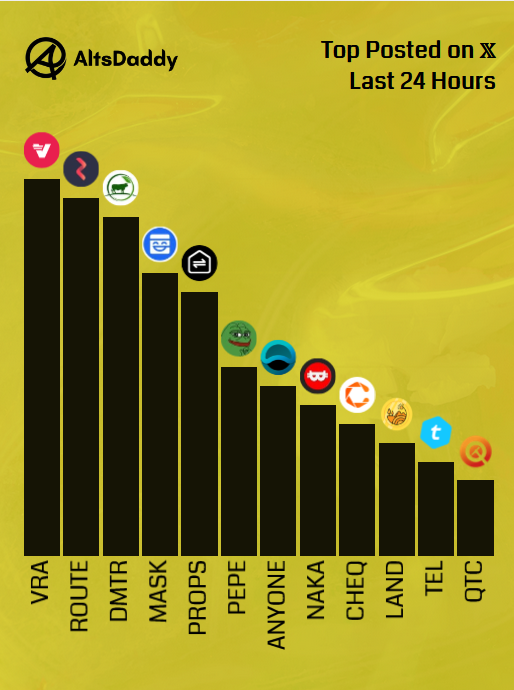
🎗️ Saturday’s Top Posted #Altcoins 🎗️
1️⃣ $VRA
2️⃣ $ROUTE
3️⃣ $DMTR
4️⃣ $MASK
5️⃣ $PROPS
6️⃣ $PEPE
7️⃣ $ANYONE
8️⃣ $NAKA
9️⃣ $CHEQ
🔟 $LAND
1️⃣1️⃣ $TEL
1️⃣2️⃣ $QTC
Runner ups: $OM, $ADA, $ARC, $BONK, $TUT
#Altseason2025 #Altcoins $DDY
English
Madison crypto retweetledi

$QTC is redefining blockchain with Quantum Proof of Work (qPoW)! A fair-launch L1, it blends quantum computing & crypto. No pre-mine, no VCs just innovation. Built by MIT/Yale @qubitcoinx
$QTC’s qPoW runs on IBM quantum processors (ibmq_quito), hitting 71% block validation success. It’s SHA-compatible, scalable, & quantum-resistant, working for classical miners now & quantum miners later. No forks needed, unlike Bitcoin thats actually sick AF
$QTC’s qPoW is eco-friendly, slashing energy use compared to traditional PoW. With 700+ participants & 3,000 GPUs, it’s the largest decentralized quantum computing network. Every hash powers quantum research, driving real impact😵💫😵💫😵💫😵💫😵💫
At a $15M market cap, $QTC is undervalued for its first-mover edge. Founders connect with Avi Loeb & a Daglabs-funded researcher. Telegram grew 300% in a week, X to 2K followers in days. Don’t miss the upcoming AMA this won’t stay under the radar long! @qubitcoinx
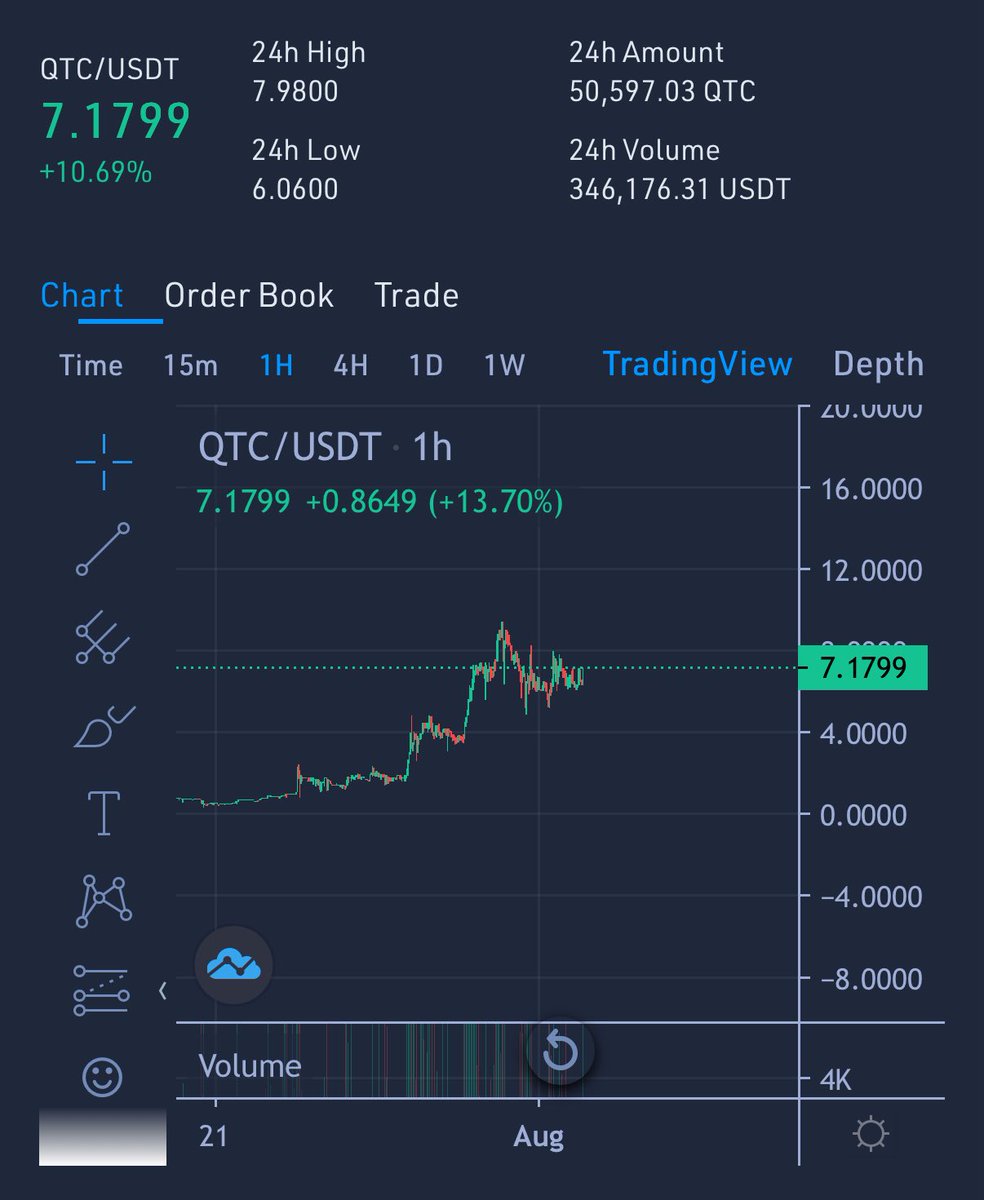
It has been healthy consolidating at 6/7$. Next Leg up will Be soon and one to watch.
You have to know it hasnt been listed on any big Exchange or something.
Even though i had a big bag i added more on the lows just Cause i thought by myself This is free money.
English
Madison crypto retweetledi

I think everyone should read this great thread about $QTC 💎 ⬇️
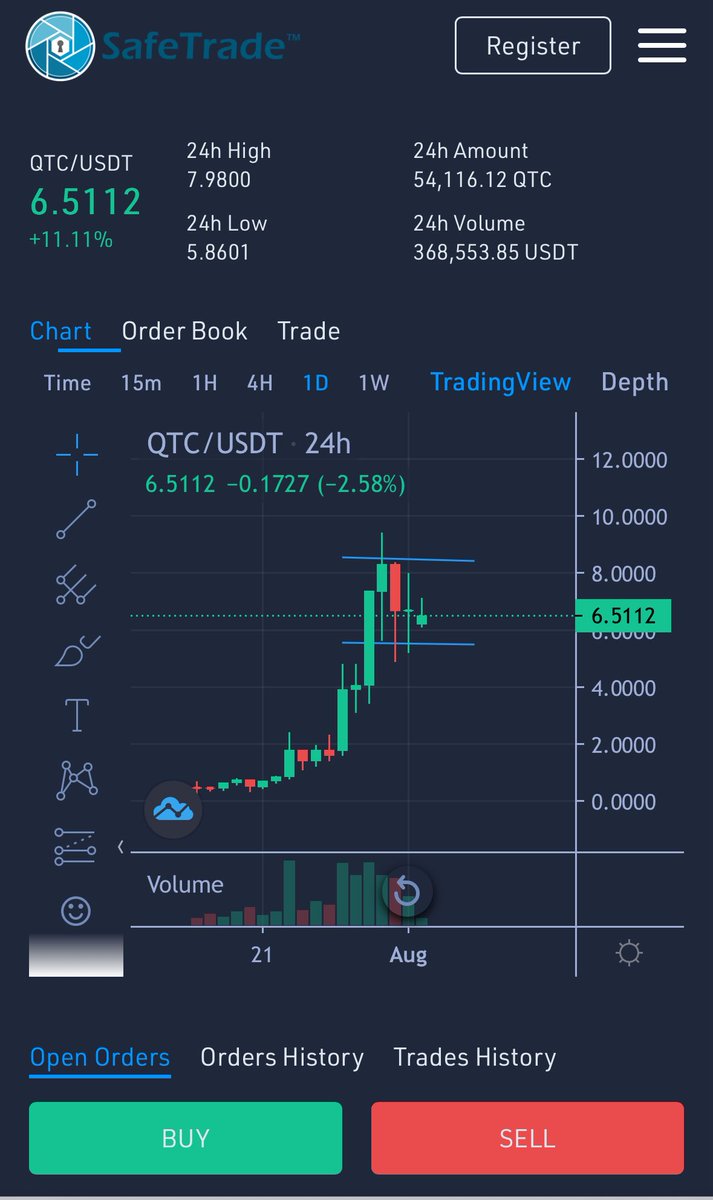
Also the chart is very clean and good! 📊
We are in a phase of accumulation! 5/8 usd but I think we can see a nice leg up very soon!
15/20 usd will be the next floor 📈
Many early $KAS miners are coming to $QTC and also @CoinMarketCap and @coingecko are very closed !
Many are looking for the next $KAS and $TAO but they obviously don't know that it's right under their noses and it's $QTC!
@qubitcoinx 💎
#QUANTUM #BTC #ETH #BNB
English
Madison crypto retweetledi
Why quantum computers is the next big narrative.
Why $QTC can be worth 1 billion dollars.
Have a read down under here. I reposted this from @HashCashStack. This deserves more eyes.
🔴 @CharlieShrem 's Key Point: ( $BTC Foundation Founding Member)
“When quantum computers can break SHA-256, we’ll need something like QPoW that’s backward compatible and quantum-resistant.”
✅ Implication: #Bitcoin would need a hard fork or soft fork to adapt to the quantum threat with something like Quantum Proof of Work (QPoW).
🧠 Qubitcoin's Advantage from the Whitepaper:
✅ Already Implemented QPoW:
$QTC has already demonstrated a working prototype of a Quantum Proof of Work mechanism using real IBM quantum processors (e.g., ibmq_quito).
This includes a system that:
1. Is SHA-compatible.
2. Is verifiable by classical computers, while being mined faster by quantum computers (once >30 noisy qubits are available).
3. Is scalable and upgradeable as quantum technology improves.
✅ Forward-Compatible:
$QTC is already compatible with quantum advantage, meaning it won’t require forking when quantum computers mature — unlike #Bitcoin.
$QTC uses a hybrid design that works with classical miners today and benefits quantum miners tomorrow.
✅ Environmentally Advantageous:
QPoW is also less energy-intensive, addressing environmental criticisms of Bitcoin mining.
✅ Real-world Test:
Qubitcoin ran actual tests on IBM’s quantum hardware and achieved 71% success in block validation — something no traditional crypto has yet tried.
✅ Final Verdict:
🟢 $QTC is not only capable of achieving what @CharlieShrem mentioned — it's already ahead of the curve.
While Bitcoin may need to fork to achieve QPoW compatibility, Qubitcoin has built it in from the start, positioning it as a first-mover in quantum-resistant and quantum-compatible blockchain technology.
@qubitcoinx now valued at around 15 million, what’s super undervalued.
#QPoW #Quantum $KAS $TAO $QANX $DNX $ETH
Charlie Shrem@CharlieShrem
@VinnyLingham @CRYPT0N1TE I studied this, and it's not how it would work. When quantum computers can break sha 256. We will be able to fork into something like QPOW, that is backward compatible with current miners and adds resistance for quantum computers.
English
Madison crypto retweetledi


Everything till now looks super class on @Zodia_agent.
What do we need on the start of eth on chain? A navigator that sees the potential in early low caps and potential mooners.
Branding check ✅
Good docs ✅
Sleek website ✅
I’m excited for what’s to come for $ZODIA.
English
$qtc
cryptobarba@Cryptobarba_
The founder of @qubitcoinx having conversations with John Clauser. Also they have met with Avi Loeb. Who’s John Clauser? John Clauser is an American physicist who won the 2022 Nobel Prize in Physics for pioneering experiments on quantum entanglement. He’s best known for the Clauser-Horne-Shimony-Holt (CHSH) inequality, which provided one of the first strong tests of quantum mechanics versus classical physics (local hidden variable theories). Who’s Avi Loeb? Avi Loeb is a theoretical physicist and cosmologist at Harvard University, former chair of its astronomy department, and founder of the Black Hole Initiative. He leads the Galileo Project, exploring potential extraterrestrial technology, and is known for proposing that the interstellar object ‘Oumuamua could be artificial I have never seen a project so connected as $QTC @qubitcoinx youtube.com/watch?v=DKAL9n… Quantum computers is the next narrative to see billions of liquid coming in to that sector.
QCT

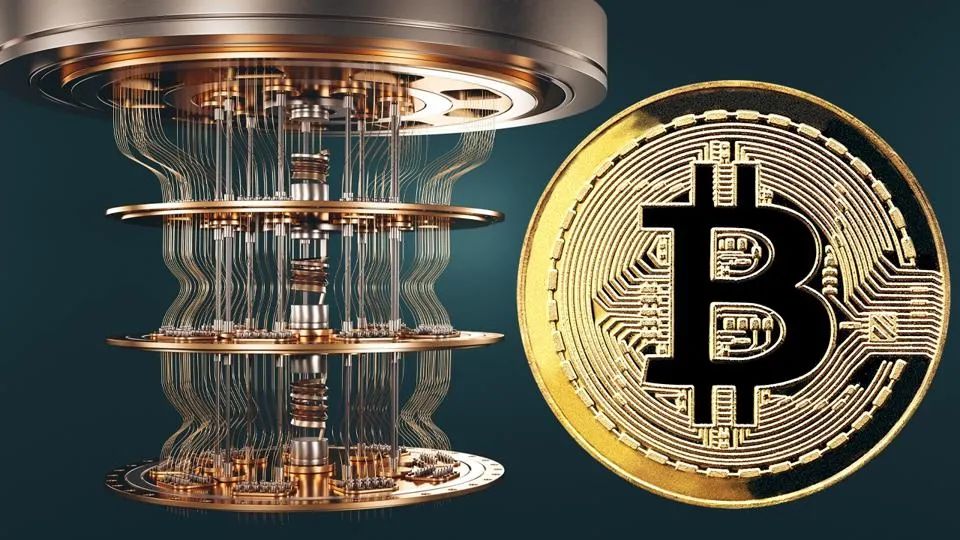
Should Bitcoin upgrade for quantum resistance?
Yes or no? 🤔
English
English