Sabitlenmiş Tweet

Religiously gave dedicated 6 months of my life to Frontend Web Development and here's the outcome :
English
Maitra Khatri
1.5K posts

@maitrakhatri
Software Engineer @fileverse

dDocs Weekly Update 𝗧𝗔𝗕𝗦 are here, stack ur docs 𓅹 | No more scattered notes & chapters └Tabs are sub-docs inside ur main doc └For structured navigation when u write/read └For free collaborative writing spaces w/ peers └For creating one document link to many stories
dDocs Weekly Updates.. Ryōiki Tenkai 🦀👩🍳 >Activating: API, CLI, /mcp and skill, for e2ee .md docs available from anywhere >Expanding: sovereign online spaces, accessible from any interface to Sync through, Store on, Create in, Collaborate on ↓API for Multiplayer Privacy↓
2026 is the year we take back lost ground in computing self-sovereignty. But this applies far beyond the blockchain world. In 2025, I made two major changes to the software I use: * Switched almost fully to fileverse.io (open source encrypted decentralized docs) * Switched decisively to Signal as primary messenger (away from Telegram). Also installed Simplex and Session. This year changes I've made are: * Google Maps -> OpenStreetMap openstreetmap.org, OrganicMaps organicmaps.app is the best mobile app I've seen for it. Not just open source but also privacy-preserving because local, which is important because it's good to reduce the number of apps/places/people who know anything about your physical location * Gmail -> Protonmail (though ultimately, the best thing is to use proper encrypted messengers outright) * Prioritizing decentralized social media (see my previous post) Also continuing to explore local LLM setups. This is one area that still needs a lot of work in "the last mile": lots of amazing local models, including CPU and even phone-friendly ones, exist, but they're not well-integrated, eg. there isn't a good "google translate equivalent" UI that plugs into local LLMs, transcription / audio input, search over personal docs, comfyui is great but we need photoshop-style UX (I'm sure for each of those items people will link me to various github repos in the replies, but *the whole problem* is that it's "various github repos" and not one-stop-shop). Also I don't want to keep ollama always running because that makes my laptop consume 35 W. So still a way to go, but it's made huge progress - a year ago even most of the local models did not yet exist! Ideally we push as far as we can with local LLMs, using specialized fine-tuned models to make up for small param count where possible, and then for the heavy-usage stuff we can stack (i) per-query zkp payment, (ii) TEEs, (iii) local query filtering (eg. have a small model automatically remove sensitive details from docs before you push them up to big models), basically combine all the imperfect things to do a best-effort, though ultimately ideally we figure out ultra-efficient FHE. Sending all your data to third party centralized services is unnecessary. We have the tools to do much less of that. We should continue to build and improve, and much more actively use them. (btw I really think @SimpleXChat should lowercase the X in their name. An N-dimensional triangle is a much cooler thing to be named after than "simple twitter")
In 2014, there was a vision: you can have permissionless, decentralized applications that could support finance, social media, ride sharing, governing organizations, crowdfunding, potentially create an entire alternative web, all on the backs of a suite of technologies. Ethereum: the blockchain. The world computer that could give any application its shared memory. Whisper: the data layer. Messages too expensive for a blockchain, that do no need consensus. Swarm: the storage layer. Store files for long-term access. Over the last five years, this core vision has at times become obscured, with various "metas" and "narratives" at various times taking center stage. But the core vision has never died. And in fact, the core technologies behind it are only growing stronger. Ethereum is now proof of stake. Ethereum is now scaling, it is now cheap, and it is on track to get more scalable and cheaper thanks to the power of ZK-EVMs. Thanks to ZK-EVM + PeerDAS, the "sharding" vision is effectively being realized. And L2s can give additional and different kinds of gains in speed on top. Whisper is now Waku ( docs.waku.org ), and already powers many applications (eg. railway.xyz, status.app just to name two I use). Even outside of Waku, the quality of decentralized messaging has increased. Fileverse (decentralized Google Docs and Sheets alternative: fileverse.io ) has seen massive gains in usability over the past year. IPFS is now highly performant and robust as a decentralized way of retrieving files, though IPFS alone does not solve the storage problem. Hence, there is still room to improve there. All of the prerequisites for the original web3 vision are here, in full force, and are continuing to get stronger over the next few years. Hence, it's time to buidl, and buidl decentralized. Fileverse is an excellent example of the right way to do things: * It uses Ethereum and Gnosis Chain for what they are good for: names, accounts and permissioning, document registration * It uses decentralized messaging and file storage to store documents and propagate changes to documents * The application passes the walkaway test: github.com/fileverse/walk… (even if Fileverse disappears, you can still retrieve them and even keep editing them with the open source UI) This is what we mean by "build a hammer that is a tool you buy once and it's yours, not a corposlop AI dishwasher that requires you to register for a google account and charges a subscription fee per month for extra washing modes, and probably spies on you and stops working if you get politically disfavored by a foreign country". If you think this criticism of corposlop is hyperbolic, well turns out, it's literally a concatenation of these three: * mein-mmo.de/en/user-buys-n… * theguardian.com/technology/202… * irishtimes.com/world/us/2025/… In 2014, decentralized applications were toys, hundreds of times more difficult to use in web2. In 2026, fileverse is now usable enough that I regularly write documents in it and send them to other people to collaborate. The decentralized renaissance is coming, and you can be part of making it happen.

Weekly update for dDocs and dSheets🧑🎄💃 💛Social ZKovery: account recovery made privacy-enhancing, social & serverless One security upgrade before we start the new year: -Setup: add 2 trusted people to ur recovery set -Recovery: together they can help u recover ur account 1/3


Weekly update for dDocs and dSheets🧑🎄💃 💛Social ZKovery: account recovery made privacy-enhancing, social & serverless One security upgrade before we start the new year: -Setup: add 2 trusted people to ur recovery set -Recovery: together they can help u recover ur account 1/3
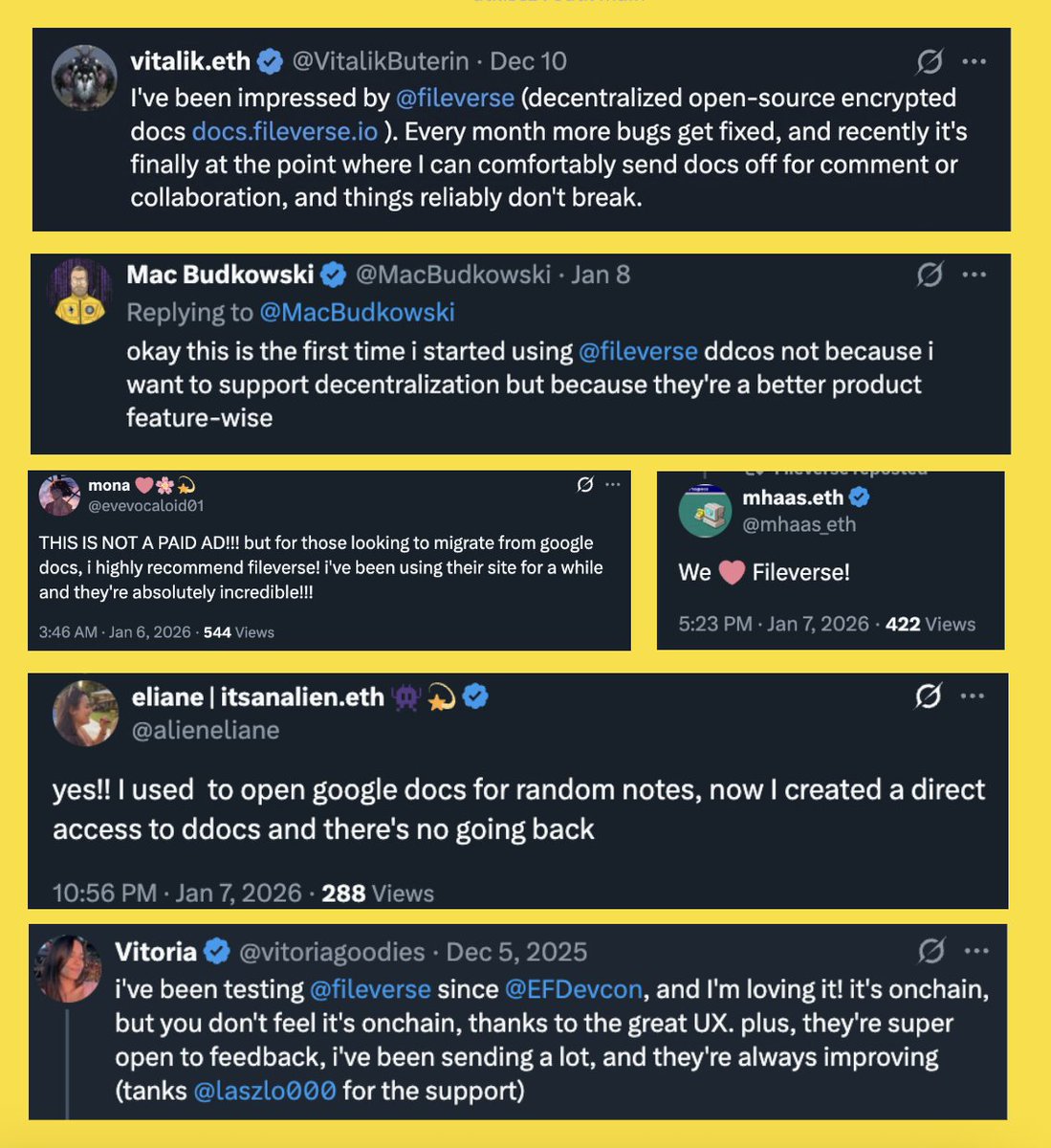
I've been impressed by @fileverse (decentralized open-source encrypted docs docs.fileverse.io ). Every month more bugs get fixed, and recently it's finally at the point where I can comfortably send docs off for comment or collaboration, and things reliably don't break.