Luis Carlos Cárdenas 🌟

20K posts

Luis Carlos Cárdenas 🌟 banner
Luis Carlos Cárdenas 🌟

Luis Carlos Cárdenas 🌟

@makesurfer

software engineer doing software architecture

Guadalajara, Jalisco Katılım Ekim 2007
511 Takip Edilen498 Takipçiler
Matilda ✨
Matilda ✨@NoSoyGreciosa·
Hay que hacer un hilo de las excusas/mentiras más pendejas que les ha dicho un hombre, empiezo yo: Mi ex tenía una foto en su buró con quien me engañó al preguntarle se sacó esta mamada del culo. CLARO CAMPEOM QUE DOÑA MARY LA PUSO UN PORTARETRATOS Y LA DEJÓ AHÍ 🙄🙄🙄🙄 JAJA
Matilda ✨ tweet media
Español
11
3
103
24.5K
Luis Carlos Cárdenas 🌟
Luis Carlos Cárdenas 🌟@makesurfer·
Que culera está la autopista Salamanca - Querétaro. Parece la Tepic - Mazatlán.
Español
0
0
0
56
Luis Carlos Cárdenas 🌟
Luis Carlos Cárdenas 🌟@makesurfer·
Han sentido a veces que al más pendejo le dan la chamba? Creo que ahora soy ese pendejo 😅
Español
0
0
0
20
Luis Carlos Cárdenas 🌟
Luis Carlos Cárdenas 🌟@makesurfer·
"te sientes incómodo por qué estás haciendo cosas nuevas" Repetirlo 100 veces cada hora
GIF
Español
0
0
1
38
Luis Carlos Cárdenas 🌟
Luis Carlos Cárdenas 🌟@makesurfer·
Yo: que chido es ser arquitecto ** Tres Doritos después ** Yo: por qué hicieron eso???
GIF
Español
1
0
0
26
Luis Carlos Cárdenas 🌟 retweetledi
Addy Osmani
Addy Osmani@addyosmani·
Every time we've made it easier to write software, we've ended up writing exponentially more of it. When high-level languages replaced assembly, programmers didn't write less code - they wrote orders of magnitude more, tackling problems that would have been economically impossible before. When frameworks abstracted away the plumbing, we didn't reduce our output - we built more ambitious applications. When cloud platforms eliminated infrastructure management, we didn't scale back - we spun up services for use cases that never would have justified a server room. @levie recently articulated why this pattern is about to repeat itself at a scale we haven't seen before, using Jevons Paradox as the frame. The argument resonates because it's playing out in real-time in our developer tools. The initial question everyone asks is "will this replace developers?" but just watch what actually happens. Teams that adopt these tools don't always shrink their engineering headcount - they expand their product surface area. The three-person startup that could only maintain one product now maintains four. The enterprise team that could only experiment with two approaches now tries seven. The constraint being removed isn't competence but it's the activation energy required to start something new. Think about that internal tool you've been putting off because "it would take someone two weeks and we can't spare anyone"? Now it takes three hours. That refactoring you've been deferring because the risk/reward math didn't work? The math just changed. This matters because software engineers are uniquely positioned to understand what's coming. We've seen this movie before, just in smaller domains. Every abstraction layer - from assembly to C to Python to frameworks to low-code - followed the same pattern. Each one was supposed to mean we'd need fewer developers. Each one instead enabled us to build more software. Here's the part that deserves more attention imo: the barrier being lowered isn't just about writing code faster. It's about the types of problems that become economically viable to solve with software. Think about all the internal tools that don't exist at your company. Not because no one thought of them, but because the ROI calculation never cleared the bar. The custom dashboard that would make one team 10% more efficient but would take a week to build. The data pipeline that would unlock insights but requires specialized knowledge. The integration that would smooth a workflow but touches three different systems. These aren't failing the cost-benefit analysis because the benefit is low - they're failing because the cost is high. Lower that cost by "10x", and suddenly you have an explosion of viable projects. This is exactly what's happening with AI-assisted development, and it's going to be more dramatic than previous transitions because we're making previously "impossible" work possible. The second-order effects get really interesting when you consider that every new tool creates demand for more tools. When we made it easier to build web applications, we didn't just get more web applications - we got an entire ecosystem of monitoring tools, deployment platforms, debugging tools, and testing frameworks. Each of these spawned their own ecosystems. The compounding effect is nonlinear. Now apply this logic to every domain where we're lowering the barrier to entry. Every new capability unlocked creates demand for supporting capabilities. Every workflow that becomes tractable creates demand for adjacent workflows. The surface area of what's economically viable expands in all directions. For engineers specifically, this changes the calculus of what we choose to work on. Right now, we're trained to be incredibly selective about what we build because our time is the scarce resource. But when the cost of building drops dramatically, the limiting factor becomes imagination, "taste" and judgment, not implementation capacity. The skill shifts from "what can I build given my constraints?" to "what should we build given that constraints have in some ways been evaporated?" The meta-point here is that we keep making the same prediction error. Every time we make something more efficient, we predict it will mean less of that thing. But efficiency improvements don't reduce demand - they reveal latent demand that was previously uneconomic to address. Coal. Computing. Cloud infrastructure. And now, knowledge work. The pattern is so consistent that the burden of proof should shift. Instead of asking "will AI agents reduce the need for human knowledge workers?" we should be asking "what orders of magnitude increase in knowledge work output are we about to see?" For software engineers it's the same transition we've navigated successfully several times already. The developers who thrived weren't the ones who resisted higher-level abstractions; they were the ones who used those abstractions to build more ambitious systems. The same logic applies now, just at a larger scale. The real question is whether we're prepared for a world where the bottleneck shifts from "can we build this?" to "should we build this?" That's a fundamentally different problem space, and it requires fundamentally different skills. We're about to find out what happens when the cost of knowledge work drops by an order of magnitude. History suggests we (perhaps) won't do less work - we'll discover we've been massively under-investing in knowledge work because it was too expensive to do all the things that were actually worth doing. The paradox isn't that efficiency creates abundance. The paradox is that we keep being surprised by it.
Aaron Levie@levie

x.com/i/article/2004…

English
125
616
3.3K
553.9K
Luis Carlos Cárdenas 🌟 retweetledi
Umberto León Domínguez 🧠 🤖
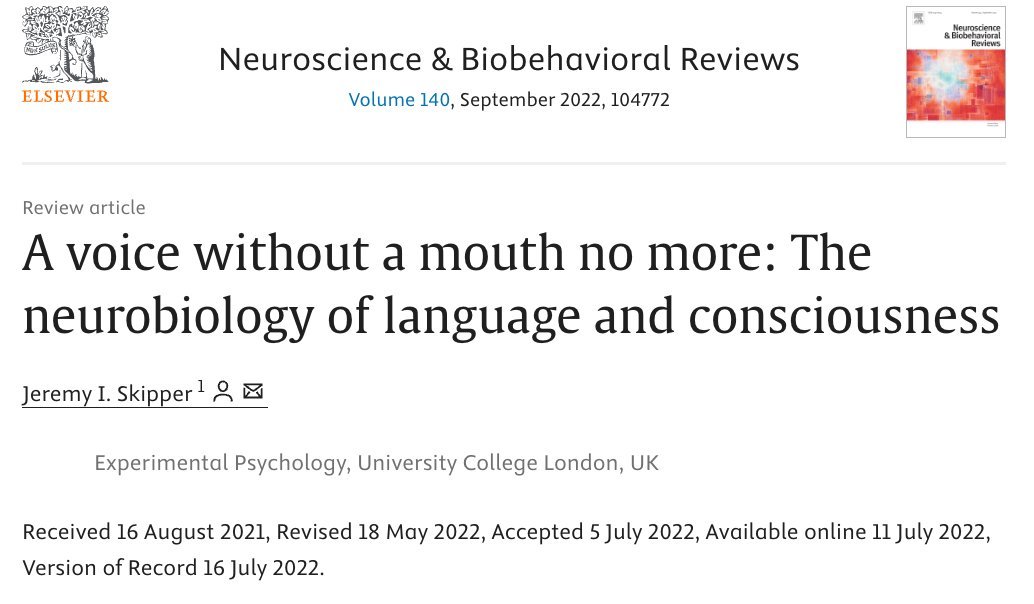
Este artículo sostiene algo que vengo diciendo con anterioridad y es la importancia del Inner Speech en la auto-conciencia de orden superior... En el artículo de Skipper de la University College London se menciona que la conciencia de orden superior (como la auto-conciencia) emerge a partir del lenguaje interno, gracias a una red neurobiológica que involucra tanto regiones motoras del habla como redes distribuidas relacionadas con emociones, memoria, motivación y sentido del yo. El artículo cita múltiples testimonios y estudios de personas que sufrieron afasia. Claude S. Moss, psicólogo clínico que padeció afasia, relata que después de su derrame cerebral perdió la capacidad de hablar consigo mismo, lo que le impedía pensar en el futuro, preocuparse o anticipar, al menos no mediante palabras, y durante ese tiempo simplemente existía. Esta pérdida del lenguaje interno lo sumió en un estado sin proyección del yo hacia el futuro ni capacidad de evaluación o planificación, elementos fundamentales de la conciencia de orden superior. Por su parte, Lauren Marks, autora que sufrió afasia tras un aneurisma, describe que al inicio de su recuperación tenía una mente vacía, enfocada por completo en el presente, sin sentirse a sí misma como un “yo”, sino más bien como parte de todo lo que la rodeaba. Más adelante expresó que le resultaba muy difícil acceder a un sentido del yo sin tener una voz interna, ya que el ego está parcialmente ligado a la capacidad lingüística de expresarlo. En ambos casos, la pérdida del lenguaje interno no solo afectó la comunicación, sino que disolvió temporalmente el sentido de identidad individual, reforzando la idea central del artículo, que el lenguaje funciona como un organizador esencial del yo consciente. Otras de las evidencias revisadas hay experimentos que proporcionan datos empíricos controlados que vinculan el uso del lenguaje con la emergencia o modulación de la conciencia, especialmente en su forma primaria (la que se refiere a la percepción consciente del entorno). Diversos estudios han demostrado que escuchar o leer palabras relacionadas con colores, movimientos u objetos facilita la detección de esos estímulos visuales. Por ejemplo, si se presenta la palabra “zebra” antes de mostrar brevemente una imagen de una cebra a un ojo (mientras se suprime la imagen con otro estímulo al otro ojo, en un paradigma de "flash suppression"), los participantes detectan la imagen con mayor probabilidad que si no hay palabra o si se presenta una palabra no relacionada como “kangaroo”. Esto sugiere que las palabras activan representaciones mentales que, a su vez, potencian la percepción consciente de los estímulos congruentes. Entre otros experimentos se sugiere que el lenguaje organiza, categoriza y prioriza la información sensorial, actuando como una especie de "filtro" o "puerta" hacia la conciencia. Así, el lenguaje no sólo sirve para expresar pensamientos, sino que constituye una herramienta cognitiva activa que modela lo que llegamos a percibir conscientemente. Por lo que el lenguaje, y particularmente el lenguaje interno, no es un mero acompañante de la conciencia o una herramienta comunicativa, como sugieren otros estudios, sino un mecanismo constitutivo de ella. Para sustentar esta hipótesis, el autor propone un modelo denominado HOLISTIC (Higher Order Language and Inner Speech To “I” Consciousness), el cual detalla mecanismos mecánicos, funcionales y lingüísticos que generan la conciencia. Este modelo involucra regiones encargadas de la producción del habla interna, las cuales generan experiencias auditivas y somatosensoriales internas, haciendo que las palabras "se sientan" y "se escuchen" dentro de la mente. Estas experiencias son enriquecidas por redes periféricas distribuidas a lo largo del cerebro, que aportan contenido emocional, conceptual y motivacional a esa actividad lingüística. Además, el modelo incluye la participación de la default mode network, el tálamo y regiones prefrontales, que se encargan de seleccionar las respuestas más relevantes y sostener la actividad consciente en el tiempo. En conjunto, se argumenta que la actividad cíclica de la habla interna, al combinarse con la carga afectiva de los recuerdos y la activación de memorias autobiográficas, da lugar al estado consciente del "yo", es decir, a la experiencia de ser un sujeto con identidad, continuidad y auto-reflexión... Y ya, con esto cierro el capítulo de la auto-conciencia, la cual, indudablemente, para por nuestra capacidad de lenguaje y aleja esta función de su percepción como una herramienta de comunicación meramente. Como siempre, gracias por leer hasta aquí y os dejo el enlace a la fuente: sciencedirect.com/science/articl…
Umberto León Domínguez 🧠 🤖 tweet media
Español
22
348
1.7K
70.3K
Luis Carlos Cárdenas 🌟
Luis Carlos Cárdenas 🌟@makesurfer·
Aprendí a decir "that's a good question" y ya me pusieron de arquitecto 🤣
Español
0
0
1
17
hersch
hersch@tittyrespecter·
computer science is a scam btw there are no computers and there's no science it's just math all the way down
English
519
3.6K
53.1K
1.4M
El Juli 📷📸
El Juli 📷📸@The_Tripman·
A Mtv no lo mató YouTube, a mtv lo mataron los realities.
Español
315
3.4K
40.4K
658.8K
Luis Carlos Cárdenas 🌟
Luis Carlos Cárdenas 🌟@makesurfer·
Me encanta la función ew Gemini, que toma nota de las reuniones por ti, las transcribe y te da insights de lo que se ha discutido en los últimos minutos o la lista de los puntos importantes. 🥰
Español
0
0
0
28
Ayushi☄️
Ayushi☄️@iyoushetwt·
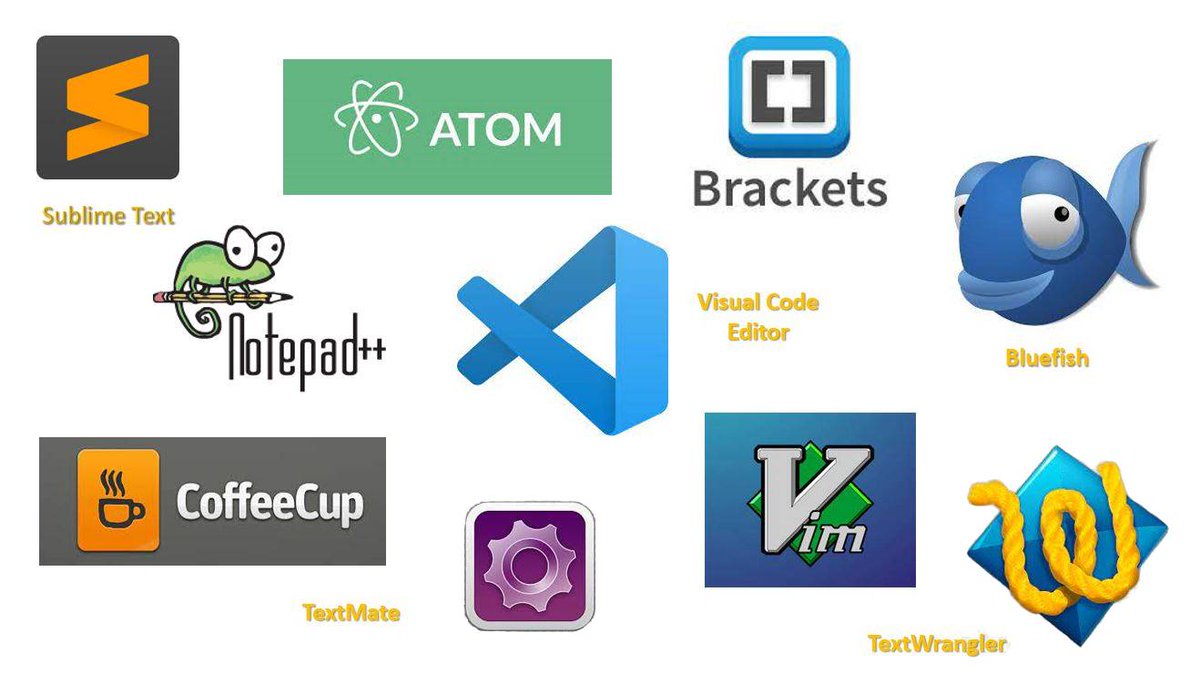
What was the first code editor you ever used? Mine was Sublime Text
Ayushi☄️ tweet media
English
3.4K
191
5.2K
667.7K