Mo Al Adham

209 posts

Mo Al Adham banner
Mo Al Adham

Mo Al Adham

@maladham

Founder and CEO of Frec. Reach me at [email protected] Frec disclosures: https://t.co/QMfm2vK0fl

San Francisco, CA Katılım Şubat 2023
415 Takip Edilen567 Takipçiler
Sabitlenmiş Tweet
Mo Al Adham
Mo Al Adham@maladham·
Our demo page for long short direct indexing is now live, with real funds and real trades. Customers can poke around and see > Long and short positions, including the cost basis and value > Harvested capital losses > Pre-tax alpha and tax alpha on a daily basis > Detailed activity, including all the trades Our $100k account was set up on July 25th and has already harvested $1,455.88 in capital losses. And as of August 1st, it is tracking above the benchmark of the Russell 1000 by +0.44%, net of fees. It’s a nice touch for consumer apps to give prospects a peek of the experience before they sign up. This is especially true for apps like Frec which naturally have a high barrier to get started. The minimum for the growth-tilted long short direct index is $100k. And we started onboarding customers from our waitlist this week. Check out the demo here: lnkd.in/gBpadMgT
Mo Al Adham tweet media
English
2
3
11
1.8K
Mo Al Adham
Mo Al Adham@maladham·
Plenty of customers selling stock at a large gain (e.g., upcoming Anthropic and Waymo tender offers) think they get a free pass on paying capital gains taxes until the following April. It turns out that taxes are generally expected to be paid throughout the year, even if the return itself is not due until the following April. When a big gain hits and a customer hasn’t prepaid enough via withholding from their paycheck, they may need to make estimated tax payments by the quarterly deadlines to avoid penalties. Quick example: A customer sells shares in a tender offer and realizes a $300k gain. If they live in California and are in a high bracket, they might owe ~$100k in combined federal/state tax. If tax withholding is only covering their “normal” income tax from their salary, they’ll likely want to send a ~$25k federal estimated payment by April 15, June 15, Sep 15, and next year’s Jan 15. California uses different installment percentages (30% / 40% / 0% / 30%) on those same dates. If they miss these payments, the IRS can assess an underpayment penalty that’s basically interest on what should’ve been paid earlier. The rate moves quarterly (it’s 7% annualized for Q1 2026, compounded daily), and California can add its own estimated penalty/interest too. There’s a caveat that may reduce that amount depending on the customer’s situation, known as the “safe harbor” rules. Customers can often avoid the penalty if they’ve prepaid the smaller of (a) 90% of this year’s tax, or (b) 100% of last year’s tax (110% for higher-income taxpayers). Worth checking with a CPA especially if last year’s tax was much smaller than this year’s. Customers who have carried-forward capital losses can offset some or all of a current gain which can reduce (or eliminate) the incremental estimated tax they would otherwise need to send. Another reason I’m a fan of systematically building a “loss bank” via direct indexing. Not tax advice - just a common misconception I keep seeing.
English
0
1
1
271
Mo Al Adham
Mo Al Adham@maladham·
Can grow a beard and eat a whole friend chicken at lunch.
Mo Al Adham tweet media
English
0
0
1
64
Mo Al Adham
Mo Al Adham@maladham·
Sandeep demonstrating that he can overcome any obstacle.
GIF
English
1
0
1
73
Mo Al Adham
Mo Al Adham@maladham·
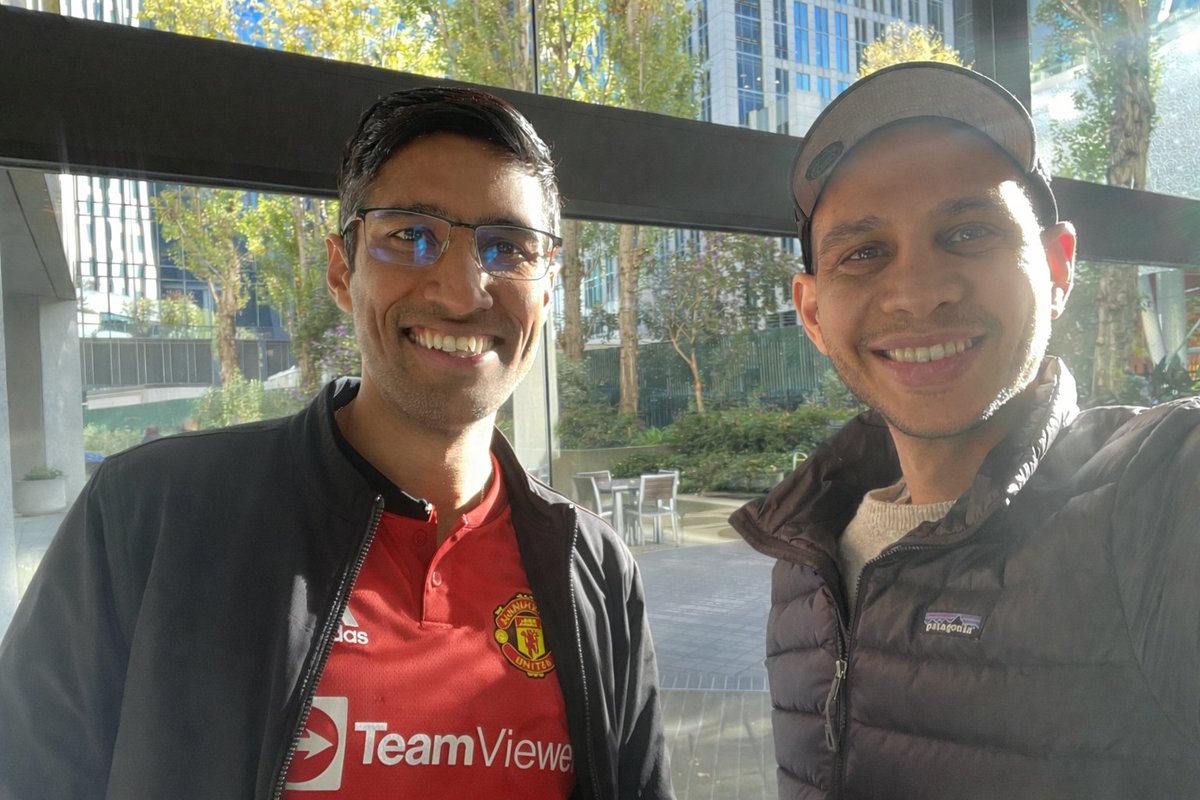
.@sandeepsripada and I took this picture on Dec 2, 2022, one year before our launch. We were on a real estate tour for a Frec SF office when a colleague messaged on Slack, “We just got our first $2m deposit!” Sandeep and I were so happy and took this selfie to commemorate the occasion. Back story on how we met. Sandeep and I worked together at Twitter around 2016. I was the PM and he was the tech lead on a revenue team. Every few months at lunch, we manually rebalanced shares from 10’s of companies in what used to be called the “Bessemer Venture Partners's Cloud Index” in our individual Schwab accounts. We paid a ton in taxes. We used a messy spreadsheet to manage our trades (screenshot attached). Frec was born from this painful experience. When I left Twitter to start Frec, Sandeep was my first call. “Funding is secured. Are you in?” And he was, with no hesitation. Sandeep is the best engineering leader I’ve known. He is still hands on building and coding, cares deeply about the team and company, and has killer product instincts. Not to mention, he has many unique abilities - as you’ll see in my comments below. We’re growing the engineering team and hiring senior engineers (7+ years). AUM is scaling fast, and we need builders who can ship new products, scale systems, and help recruit great talent. We’re a small team, so you’d have lots of ownership. Message me or Sandeep Sripada if you’re interested. Fun fact: that beta customer churned a few weeks later because Frec was bare bones at the time. We went heads down for 10 months (during the Fintech winter), built the platform and launched in Oct 2023. Since then, less than 5% of all funded accounts have churned.
Mo Al Adham tweet mediaMo Al Adham tweet media
English
1
0
5
628
Mo Al Adham
Mo Al Adham@maladham·
@alexbass We still use Figma. Our design team just set up the Figma MCP server and started mapping our design system components to Claude Code, so now turning designs directly into production front-end code is effortless and makes our process 10x faster.
English
1
0
1
56
Alex Bass (efficient.app)
Alex Bass (efficient.app)@alexbass·
@maladham Love it! So curious if you still use Figma at all? Or seeing less of a need for it? And if you've tried CodeRabbit? We've been using and loving it, but speed is a bit of a frustration at times.
English
1
0
0
46
Mo Al Adham
Mo Al Adham@maladham·
More than half of the code commits for our app last month were written by AI. Our engineers barely use Stack Overflow anymore. I didn’t think AI would change the way we work so quickly. On the engineering side, most started using Cursor last year and recently switched to Claude Code / Opus 4.5+. We have Google Gemini connected to Github for code review assistance. Now, Claude assists with writing code, and Gemini helps review it. A few weeks ago, we hooked up Claude Code to Slack and GitHub, so now anyone on the team can ask the codebase questions like this: “@ Claude What is the default state of the tax loss harvesting toggle in the Tax and Risk considerations module?” We also have a Zendesk channel on Slack where every customer support interaction is streamed. We periodically ask Claude to investigate a customer issue from a Slack thread. If the investigation makes sense, we ask Claude to submit a fix. For non-engineers, Claude Code allows them to submit PRs without the hassle of needing to set up a local environment.  Last week, I submitted a few fixes because it was faster to push the fix than bring up the minor issue, queue it up on an engineers’ backlog, and track it. Our team is many times more productive in design, engineering, and marketing. We’re still exploring how AI can help us in all of our back office functions.
English
1
0
4
227
Mo Al Adham
Mo Al Adham@maladham·
Founders ask me, “How did your team manage to grow Frec given the high trust needed from customers?” It’s actually a pretty simple strategy. There were 10 of us building the product. A few weeks before launch, we decided to comb through all of our contacts in our phones, emails, calendars, socials, etc. We collected these contacts in a giant, 2,000+ entry spreadsheet. And on launch day, we went “pencils down”. No more coding, just calling and messaging. We contacted every person we knew and pitched the product. That got us our first bump of customers. And those customers ended up loving Frec, so they told their friends about it. And the cycle continued. At the core of this strategy is high conviction in our work. Because we believed in the idea, we had no hesitation pitching friends, family, colleagues, and literally everyone we’ve come across about Frec. Today, each monthly cohort on Frec grows its invested balance by ~3x by month 6 (vs. month 1). Over the same period, cohort-attributed ARR increases ~11x as customers adopt more of our products. Most of our net new accounts come through referrals. Existing customers are pitching the product for us. Tldr; build a product you believe in, and don’t be shy about telling everyone about it. If the product resonates, it will grow quickly. Otherwise, it’ll die down and you can move on.
English
0
1
5
303
Mo Al Adham
Mo Al Adham@maladham·
A fun piece of finance trivia I recently learned about: SPY, one of the world’s most traded ETF, has an expiration date and it’s tied to 11 millennials who currently reside in the US. SPY is structured as a Unit Investment Trust, and trusts like that typically need an end date. When the fund was created, it was set to expire after 25 years (January 2018), but that date was later amended through a workaround. Today, SPY is set to terminate on the earlier of Jan 22, 2118 or 20 years after the last of those 11 people passes away. The individuals were selected by the fund’s creators. Eight of the 11 have ties to AMEX employees who helped launch the original ETF. None of them are paid, and they don’t get a cut. Some didn’t even know they were named in the documents. SPY could’ve launched as an open-ended ETF, but in 1992–1993, the idea of open-ended ETFs was brand new, and sponsors needed a bespoke SEC exemptive order. UITs had a simpler structure. In principle, SPY could keep making amendments and extend the termination date according to the Trust agreement. It would just need approval from holders of 51% of outstanding units. But if SPY did terminate, it would generally create a taxable event because ETF closures are treated like a sale of shares, and would likely create a “mass capital gains” event. Finance is full of interesting workarounds.
English
0
0
2
147
Mo Al Adham
Mo Al Adham@maladham·
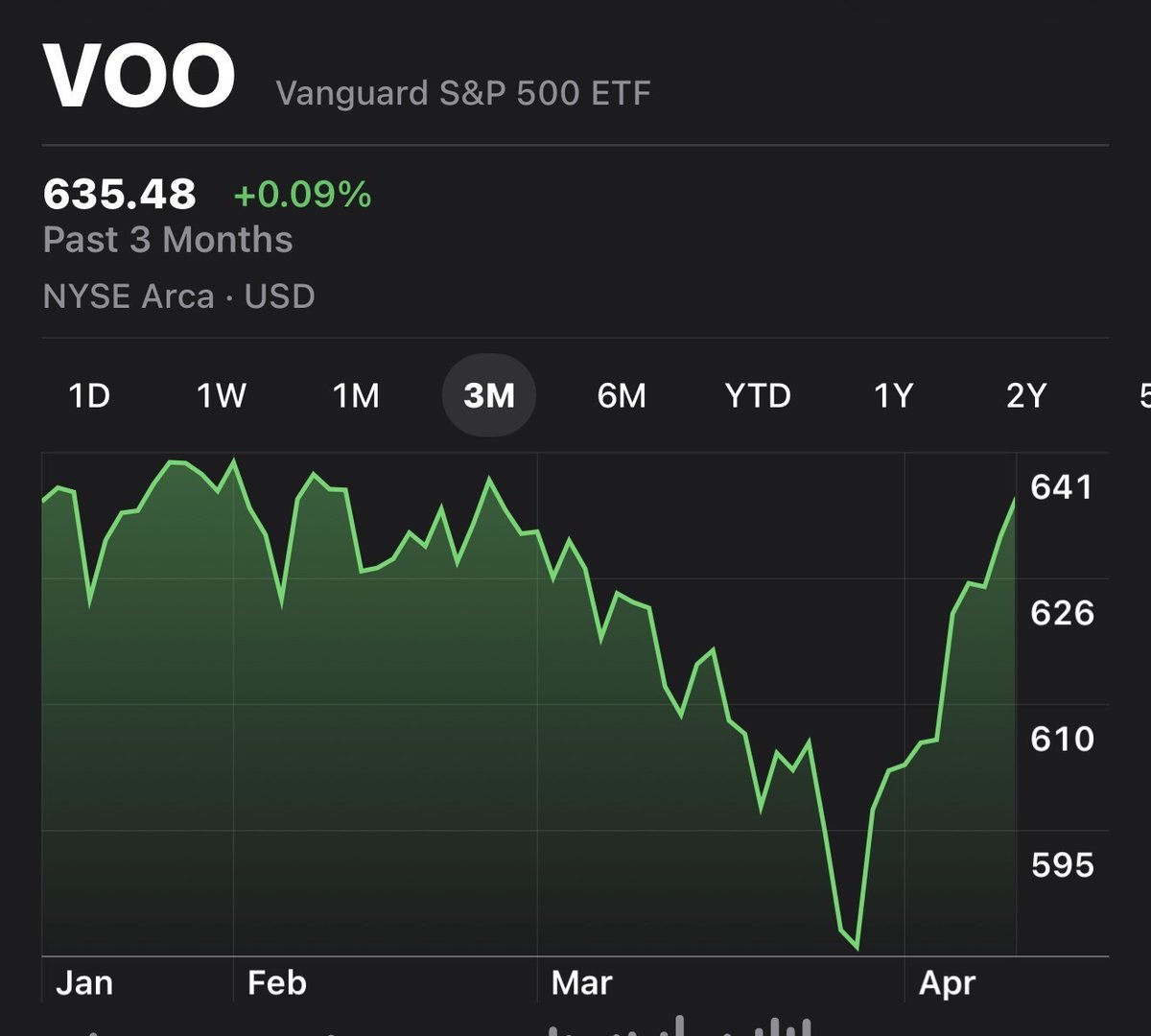
The market took just 1 week to fully recover from the Greenland tariff drama. Yesterday, the S&P closed at 6,950.23 above what it closed at on Friday 1/16 at 6,940.00. Last Tuesday’s close was at 6,796.87. Direct indexing investors got rewarded with capital losses as they were observing a sea of red on Tuesday. It’s a nice cherry-on-top for staying invested. ETF investors who wanted to take advantage of the dip would have had to manually sell and buy another ETF. And since the market bounced back quickly, there’s a high chance they’re stuck with the “other” ETF. As more brokerage platforms adopt direct indexing and more investors learn about tax-aware investing, we believe most passive public market investors will move to direct indexing. And we’re ready to welcome them to Frec.
English
0
0
1
109
Mo Al Adham
Mo Al Adham@maladham·
We just had our largest week of asset inflows ever, fueled by our new product launches. ~$40m in assets were added in a single week. It took us 7 months to add that much in assets after launching the company 🤯 The growth is also aided by customers referring their friends and colleagues to Frec. Our team is thrilled by the progress and working hard to make sure our customers’ expectations are exceeded. If you want to learn more about our new high leverage long short products (250/150 and 200/100), I’ll be hosting a webinar tomorrow (1/21) with our head of finance engineering, Hao Li.
English
1
0
3
375
Mo Al Adham
Mo Al Adham@maladham·
After quadrupling customer assets in 2025, now approaching $700m, we’re excited to kick off the new year by launching and making generally available two new products on Frec: 1. Frec Diversify - diversifies concentrated stocks tax-efficiently using long and short overlays. 2. High leverage long short - 250/150 and 200/100 direct indexing further amplifies market returns and tax alpha. We’re building tax-aware investing, a new category of investing that takes tax impact into consideration in every financial decision, from passive index investing to borrowing against assets. We’re excited to push the envelope and bring tax-efficient strategies to everyone at lower minimums and fees. What else would you like to see us build in 2026?
English
0
1
10
300
Mo Al Adham
Mo Al Adham@maladham·
I see social posts about how risky it is to be concentrated in a few stocks, and how customers must diversify. There should be more nuance behind this “advice”. I’m drawing from my experience as an ex-concentrated shareholder. Years before starting Frec, as an early advisor to Instacart, I was bombarded with wealth managers who were insisting that I must diversify. The conversation went something like this, “Since you likely have a large portion of your net worth concentrated in this stock, how would you feel if it crashed?” It sounded like fear-based selling. Luckily, I had read Charlie Munger’s “Poor Charlie's Almanack” where Charlie presented an argument for having some concentration. It helped me develop a personal framework for when to hold concentrated positions: I was comfortable with it if I had an information advantage relative to everyone else. For example, if I owned private stock and had access to performance metrics. Or if I was an employee at a public company and knew the decision makers better than the rest of the market. For our Diversify product, I expressed to my team, “we should never scare customers into diversifying concentrated positions”. Sometimes, it makes sense for them to concentrate. But when they decide to diversify, we want Frec to be their first choice.
English
0
0
2
139
Mo Al Adham
Mo Al Adham@maladham·
We’re hearing through the grapevine that Fidelity paused onboarding new customers (through advisors) to its long short direct indexing. Fidelity originally paused new customers until Jan 12, according to Citywire. And now they’re supposedly extending the pause to the end of February. There are also rumors that Fidelity is launching their own version of long short direct indexing to compete with the number 1 player in the space, AQR. Fidelity is an asset manager first and a custodian second. And since they’re seeing traction in their long short SMAs, it is no surprise that they’re jumping in too. Our team has been heads down building long short direct to consumer. You can get started today, without waiting for Fidelity to bless your RIA to open your account.
English
0
0
3
487
Mo Al Adham
Mo Al Adham@maladham·
Tesla wrote a product roadmap in three bullet points that still holds up. It’s a strategy we follow at Frec. .@elonmusk published it in 2006, and later summarized it like this: - first create a low-volume car for a narrower audience (Roadster) - use that money to develop a medium-volume car at a lower price (Model S) - use that money to create an affordable, high-volume car (Model 3) Tesla sold about 2,450 Roadsters total between 2008 and 2012. And in 2019 alone, Tesla delivered ~300,600 Model 3s. That’s roughly a 120x increase in volume and about 11 years to go from the Roadster to the Model 3. At Frec, we’re borrowing that playbook. Our “Roadster” is our long short product - built for sophisticated investors who want direct access to an advanced tax-aware indexing product without the prohibitive minimums or fees. From there, the plan is to keep expanding access: even lower minimums and fees, and complementary investment products that offer great tax efficiency. Our goal is for every investor in America to use tax-aware investing for their passive public equities. Tesla took ~11 years to make that downmarket jump. We’re hoping to get there meaningfully sooner.
English
0
1
2
229
Mo Al Adham
Mo Al Adham@maladham·
@LucasDickey4 Check out Frec.com. We build tax-aware strategies that help you get market returns with real tax savings. Without advisors in the middle.
English
0
0
2
44
Lucas Dickey
Lucas Dickey@LucasDickey4·
Robinhood just lost my business. Where else should I go?
English
46
2
70
50.6K
Mo Al Adham
Mo Al Adham@maladham·
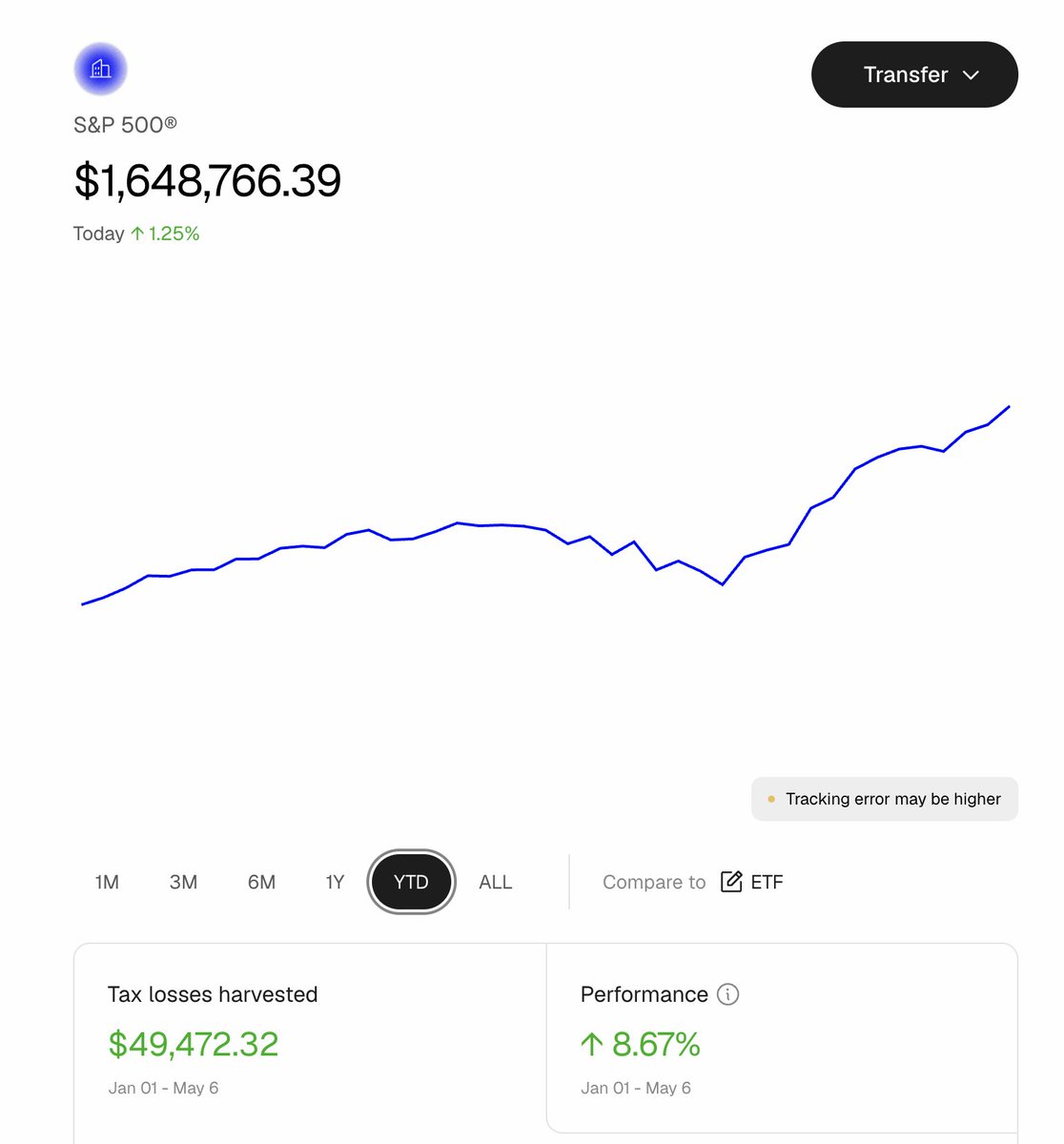
My direct indices on Frec harvested more than $100k in losses this year. I didn’t expect any capital gains at the beginning of the year, but I ended up realizing some due to: 1) An angel investment exit. 2) A single stock position appreciating significantly, which I decided to diversify. So I saved $45k in taxes while tracking the indices of my choice very closely. If I bought and held ETFs instead, I would have completely missed out on tax savings. At Frec, we believe post-tax returns matter, and direct indexing should be the default vehicle to passively invest. One day, most savvy investors will switch to direct indexing as access and cost continue to improve. We’re excited to bring exciting updates for tax-aware investing in 2026! Disclosure: May not be representative of the experience of other customers and not a guarantee of future performance or success.
Mo Al Adham tweet media
English
2
2
10
925
Sheel Mohnot
Sheel Mohnot@pitdesi·
@maladham @usecache Yeah this is a cool offering. I have the feeling it is less good for me because my cost basis is very low, so it would take a while to offset with losses, but would love to chat and explain my scenario.
English
1
0
2
2.5K
Sheel Mohnot
Sheel Mohnot@pitdesi·
Cool financial product: If you have a lot of appreciation in a single stock (like $NVDA) and want to diversify, @usecache lets you swap into an exchange fund with other people in the same boat. 1) You swap $1M of $NVDA (bought for $25k) for a slice of a fund that tracks the S&P 500 2) It’s a "tax-free" swap under IRS Section 721, no capital gains tax on Day 1, that would take 37% of your gains in CA. 3) Your full $1M stays invested and compounding, now diversified across 100s of companies. They charge ~0.6%/yr 4) After 7 years, you can withdraw a diversified basket of stocks and sell when you want. These funds have been around for a long time but they were access-limited with high mins, Cache is making it easy. This seems super useful if you're overexposed to a big winner and want to protect your gains without writing a massive check to the IRS. I am in this position thx to Nvidia - Cache seems great, I just learned of it yesterday (from a tweet!). Are there other options I should consider?
Sheel Mohnot tweet media
English
60
24
979
227.3K