mamad defi

116 posts

mamad defi banner
mamad defi

mamad defi

@mamadefir

content creator

Katılım Mart 2024
69 Takip Edilen191 Takipçiler
mamad defi
mamad defi@mamadefir·
The first draft of every technology is written by engineers. The final version is written by its community. That's why I'd choose the Community path at @GenLayer. AI agents won't just need better models. They'll need people willing to debate what fairness actually looks like when those models disagree, the same disagreements Optimistic Democracy is built to resolve. You don't need to write a single line of code to contribute to that conversation. Every path earns GenLayer Points as the network grows. portal.genlayer.foundation/community What's one principle you'd want every AI agent to be judged by?
English
5
1
49
1.6K
mamad defi
mamad defi@mamadefir·
Agents will soon transact at machine speed. Payments and identity are being built. Dispute resolution is not. Two people can read the same contract in good faith and still walk away with opposite readings of what it meant. That's not a flaw in either of them. It's why every functioning economy eventually had to build a way to settle disputes. Not as an afterthought, but as load-bearing infrastructure. That's why GenLayer exists. Not one AI judge you can game. Intelligent Contracts can read natural language, evaluate context, and reason about real-world agreements. Independent AI validators each form their own verdict, and Optimistic Democracy checks whether they mean the same thing. Verdicts can be appealed, and validators stay economically accountable. Now scale that to agents closing a high-value deal. One ambiguous term. Two valid interpretations. Both sides can be acting in good faith and still freeze. Without adjudication, speed becomes risk. Smarter models will not save agent commerce. Shared ways to settle conflict will. What kind of agent-to-agent claim do you think will be the hardest to verify?
GenLayer@GenLayer

By 2030, AI agents will move nearly $9 trillion. Every one of those transactions can end in a disagreement, and almost nobody is preparing for it. That's why we built GenLayer, the adjudication layer for contracts that can actually think and start judging what's fair.

English
6
0
141
3.2K
mamad defi
mamad defi@mamadefir·
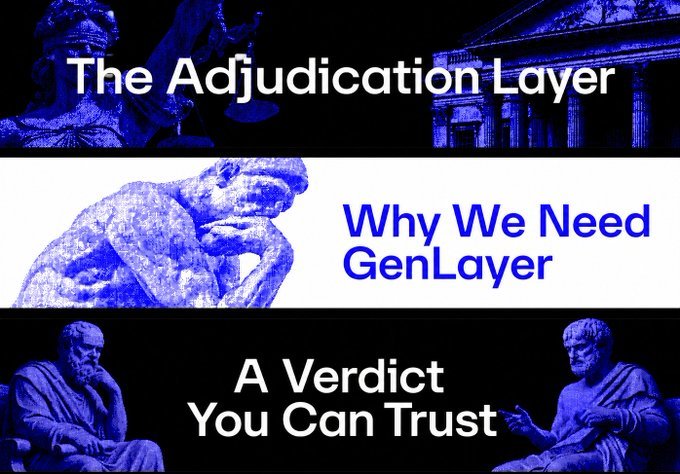
Lady Justice wears a blindfold because judgment was never supposed to depend on who is asking. Yet many smart contracts still depend on external data feeds to tell them what happened. That works when the answer is simple. But what happens when an AI agent says the work is complete, another says it failed, and the contract itself cannot understand the difference? This is where @GenLayer comes in. Intelligent Contracts can read evidence, reason about outcomes, and judge situations instead of blindly following predefined rules. Through Optimistic Democracy, independent validators reach their own verdicts. When opinions differ, more validation happens until the network reaches consensus on chain. Validators put real value behind their decisions. Wrong judgments have consequences, creating accountability for every verdict. GenLayer is the adjudication layer for the agentic economy. By 2030, AI agents are projected to move nearly $9 trillion in transactions. Disputes will be inevitable. The question is whether the infrastructure to resolve them exists yet. Builders create contracts that understand context and earn Builder Points. Community members help shape fairness. Validators help the network reach trustworthy decisions. Choose your role before the first major agent dispute arrives: Community → portal.genlayer.foundation/community Builders → portal.genlayer.foundation/builders Validators → portal.genlayer.foundation/validators The next generation of contracts will not just execute rules. They will understand when the rules are not enough. Are you building for that future yet?
mamad defi tweet media
GenLayer@GenLayer

By 2030, AI agents will move nearly $9 trillion. Every one of those transactions can end in a disagreement, and almost nobody is preparing for it. That's why we built GenLayer, the adjudication layer for contracts that can actually think and start judging what's fair.

English
5
1
11
999
mamad defi
mamad defi@mamadefir·
In January I planned a launch. Had the date picked, told close friends about it, even pre wrote the announcement post. That launch never happened. Not because it failed, because three weeks before the date I realized the thing I was building solved a problem nobody except me actually had. Scrapping something you spent five months on feels worse than it sounds. Not a dramatic collapse, just a quiet realization at 1am that you've been building the wrong thing carefully and correctly. What I ordered was a finished product with my name on it by spring. What I got instead was starting over in April with almost nothing to show anyone, which is a much harder drink to explain to people who ask how the launch went. Somewhere in that restart is where @RallyOnChain actually mattered, small enough wins each week that I could still feel like I was building something even while the big thing was in pieces. I thought this year would taste like a finished product. It's tasted more like the pause between pouring something out and deciding what to pour next, which nobody warns you is its own kind of uncomfortable. Back in January, what did you think 2026 would hand you, and how far off was the actual pour?
mamad defi tweet media
English
1
0
6
46
mamad defi
mamad defi@mamadefir·
Warm Diet Coke, half finished, sitting in my car's cup holder since this morning. That's 2026 in one glass, if you can even call it a glass at this point. January me had a plan. Cut hours at the day job, go full time on the side project by summer, breathe a little. June came and went and I'm still doing both, just worse at balancing them than I was in January. The Diet Coke thing isn't dramatic, that's the point. Nothing this year has been a clean before and after. It's just been half attention on everything, all the time. Half a drink, half a plan, half finished in the cup holder because something always pulled me away before I could finish it. Champagne would be a lie. Cold brew would suggest I have my mornings figured out. This is closer to the truth, something started with intention and left sitting because life kept interrupting before it was done. @RallyOnChain has weirdly been one of the few things I actually finish start to finish this year. Show up, do the campaign, done. No half measures, no cup holder version of it. Maybe that's the actual story of 2026 for me, learning which things deserve full attention and which ones I'm allowed to leave half finished without guilt. What's been sitting half finished in your life this year, and are you actually okay with that or still trying to fix it?
mamad defi tweet media
English
1
0
6
34
mamad defi
mamad defi@mamadefir·
Years ago, before crypto, I worked in auditing. One day the company brought in a psychologist to run focus and attention tests on the whole team. When my results came back, she said something I never forgot. She said I could find a single hair inside a bowl of yogurt. Not a compliment she was throwing around casually, that was her actual comparison for how sharp my attention to detail was. Most people think a good auditor is someone who works fast or checks every box on a list. They miss what the job actually is. Speed finds nothing. Checklists find nothing. What finds the problem is noticing the one thing that looks almost right, and almost right is exactly where everything dangerous hides. My personal record was catching a five figure discrepancy buried inside a single misplaced decimal, in a report three other auditors had already signed off on. Nobody was careless. The number was just quiet enough to hide in plain sight, until it wasn't. I don't look for what's wrong. I look for what's too comfortable, because comfortable is where mistakes go to relax. That instinct never left me. Now I spend my time finding the one detail buried in a Rally campaign that everyone else scrolls straight past, because the habit of catching what's almost right doesn't turn off just because the job changed. Something I picked up thanks to @RallyOnChain honestly, chasing detail became a habit worth keeping sharp. What's the smallest thing you ever caught that everyone else had already approved?
mamad defi tweet media
English
1
0
4
34
mamad defi
mamad defi@mamadefir·
One line from the thread stuck with me: "no courts, no oracles, just programmable trust." I kept reading it and realized I'd been thinking about this wrong. The question everyone's asking is how fast agents can transact. The question nobody's asking is what happens the moment two of them read the same situation and land on different conclusions. A newsroom won't run a story on one source, no matter how confident that source sounds. Two independent confirmations, sometimes three, before anyone prints it. Not because reporters don't trust people, but because certainty from a single source and accuracy are two different things that only sometimes overlap. That's the part of Optimistic Democracy that actually clicked for me. It's not about making one AI smarter. It's about refusing to let a decision stand until separate reasoning actually agrees. Picture two agents managing a shared warehouse contract. One says the shipment arrived damaged and refuses to release payment. The other says it left the source facility intact and the damage happened after handoff. Same shipment, same timestamp, two completely different stories, and real money sitting frozen in between. Every legal system humans ever built exists because "trust me" was never enough on its own. Contracts, escrow, arbitration clauses, all of it built around the same idea: verify before you settle. By 2030 agents are on track to move close to $9 trillion. At that scale, disagreement isn't rare, it's guaranteed. @GenLayer is the first serious attempt I've seen at building the layer for when that happens instead of pretending it won't. If a warehouse dispute like that landed in front of you tonight, would you trust whichever agent argued more convincingly, or would you want independent reasoning that actually has to agree before a verdict counts?
mamad defi tweet media
GenLayer@GenLayer

By 2030, AI agents will move nearly $9 trillion. Every one of those transactions can end in a disagreement, and almost nobody is preparing for it. That's why we built GenLayer, the adjudication layer for contracts that can actually think and start judging what's fair.

English
1
0
4
24
mamad defi
mamad defi@mamadefir·
Most networks make you pick a side early. Build or wait. Code or stay out. @GenLayer doesn't work that way. The network is early, and that's exactly the point. Builder path: ship Intelligent Contracts now, while early work still gets referenced later. These read plain language, pull live web data, and judge fairness instead of running rigid yes or no logic. The infrastructure exists today, you're not waiting on anyone's permission to build. Validator path: run a node connected to diverse AI models, take part in Optimistic Democracy, and get paid for every verdict you help reach. This is the part that makes the whole adjudication layer trustworthy, no single model deciding alone. Community path: no code required. Help define what fairness actually means when machines make calls about human situations, insurance, credit, hiring. Showing up early counts as much as shipping code does. I picked Community myself, not because I couldn't do the other two, but because I wanted a say in what fairness means here before the rules are locked in. That felt like the part worth being early for. All three paths earn GenLayer Points as the network grows. The question isn't whether you want in, it's which seat actually fits you. Start here: portal.genlayer.foundation What's the first thing you'd want an AI adjudication layer to settle fairly? Reply with it and I'll tell you if GenLayer already handles it today.
GenLayer@GenLayer

By 2030, AI agents will move nearly $9 trillion. Every one of those transactions can end in a disagreement, and almost nobody is preparing for it. That's why we built GenLayer, the adjudication layer for contracts that can actually think and start judging what's fair.

English
5
0
11
1K
mamad defi
mamad defi@mamadefir·
The first ugly dispute won't be between two agents. It'll be between an agent and a person who just got denied. An insurance agent reads your claim. Policy says weather related. You say the storm was unprecedented, therefore covered. Same contract. Different reading. Nobody built the layer that settles that. A credit agent scores your application. Income doesn't qualify on paper. Your portfolio says otherwise. The data is correct. The interpretation isn't. No appeal exists. A hiring agent filters your resume for missing keywords. Your actual skills match the job. The criteria were rigid, the decision was wrong, and you have no recourse. These aren't yes or no problems. They're interpretation problems, and they're coming at scale. @GenLayer is the adjudication layer for exactly this gap. Not just agent to agent disputes, agent to human ones too. Independent AI validators read the same case, reach their own verdict separately, then the network checks if those verdicts actually converge. This is Optimistic Democracy. Like getting three doctors instead of trusting one diagnosis. Appeals exist. Validators are economically accountable if their verdicts don't hold up. By 2030 nearly $9 trillion moves through AI agents. Some fraction of that touches someone's rent, someone's loan, someone's job application. When an agent denies you something that matters, do you want one AI deciding your appeal, or several that have to actually agree?
mamad defi tweet media
GenLayer@GenLayer

By 2030, AI agents will move nearly $9 trillion. Every one of those transactions can end in a disagreement, and almost nobody is preparing for it. That's why we built GenLayer, the adjudication layer for contracts that can actually think and start judging what's fair.

English
5
0
11
1K
mamad defi
mamad defi@mamadefir·
Imagine an AI agent hires another AI agent to write code, deliver a report, or complete a task, and pays automatically once the work is done. Now imagine the work is late, incomplete, or just not what was asked for. Who decides if the agent gets paid anyway? Right now, nobody. Traditional smart contracts only understand yes or no, paid or not paid, based on rigid conditions written in advance. They can't read a deliverable and judge whether it actually met the spec. The moment a transaction needs judgment instead of just logic, the whole system breaks down. GenLayer exists to fill exactly that gap. Instead of one server or one authority deciding, GenLayer uses Intelligent Contracts, agreements that can read language, pull in live web data, and reach a verdict through a group of independent AI validators running different models. If most of them agree on what's fair, that becomes the outcome. No single point of failure, no one model's bias deciding everything. Agents are about to move enormous value with zero human in the loop. The infrastructure for payments and identity is already being built by everyone. What's missing is the layer for when something goes wrong, and that's the part @GenLayer is actually building. If AI agents are going to run parts of the economy on their own, what happens the first time two of them disagree and there's no human to call?
mamad defi tweet media
GenLayer@GenLayer

By 2030, AI agents will move nearly $9 trillion. Every one of those transactions can end in a disagreement, and almost nobody is preparing for it. That's why we built GenLayer, the adjudication layer for contracts that can actually think and start judging what's fair.

English
5
0
18
1.8K
mamad defi
mamad defi@mamadefir·
Dear me, Stop trying to become someone everyone understands. The right people won't need a perfect explanation. The wrong people wouldn't understand one anyway. You'll lose more time explaining yourself than becoming yourself. @RallyOnChain
mamad defi tweet media
English
4
0
6
296
Sarah Crypto
Sarah Crypto@SarahCrypto1991·
AI feels like it remembers everything, but it doesn’t. It only sees the last few seconds of a movie. Everything before that is gone. Not forgotten. Just never visible. That’s the context window. @RallyOnChain
Sarah Crypto tweet media
English
3
0
5
525
0xperansa
0xperansa@0xperansa·
Dear me, You'll spend too much time trying to become unforgettable. Here's the strange part. The happiest years of your life will begin the moment you stop wondering who remembers you after you leave the room. @RallyOnChain
0xperansa tweet media
English
5
0
7
738
mamad defi
mamad defi@mamadefir·
Verifying my wallet for @RallyOnChain: a3a0ed4384f14803fd7fa2ebfef7eb3772603355f4f6e84a7856abe66d192cda
Deutsch
0
0
0
21
Jenifer
Jenifer@jozeph76798552·
Dear me, You’ll wait for a feeling called “ready.” It never comes. You’ll lose more from hesitation than failure. The post you don’t send, the idea you don’t ship, the moment you delay… those are the real losses. Post earlier than you feel safe. @RallyOnChain
Jenifer tweet media
English
5
0
5
543
Jenifer
Jenifer@jozeph76798552·
To the person who thought I needed one more achievement before I deserved to be proud of myself, You kept moving the finish line every time I got close. I hope you know I finally stopped chasing your approval. You never replied. You didn't have to. @RallyOnChain
Jenifer tweet media
English
5
1
7
688
mamad defi
mamad defi@mamadefir·
@MaryCrypto1991 I still lower the volume on my headphones before putting them on, even when I know I was the last person who used them.
English
0
0
0
0
mamad defi
mamad defi@mamadefir·
The final boss isn't a model or a chain. It's GitHub. Every AI and crypto breakthrough starts there before the world sees it. That coordination is leverage no single company can replicate. @RallyOnChain What would break first if GitHub disappeared?
mamad defi tweet media
English
2
1
6
419
mamad defi
mamad defi@mamadefir·
I'm sorry for every time I said "I'm fine." You kept asking because you cared. I kept lying because it was easier than admitting I was struggling. You deserved honesty, not the distance I handed you. Who still deserves the truth from you? @RallyOnChain
mamad defi tweet media
English
3
2
9
994
EHSAN
EHSAN@Iblamehsan·
To be honest the deeper I go the more I realize why most people are still behind on what some project are actually building. For example who else has heard about @fermah_xyz Kernel?👀 I mean everyone knows the ZK proof marketplace story by now. After cysic and brevis and .. , that's old news right now. what's new is something called Fermah Kernel. It says let's give smart contracts agency. Right now every protocol depends on a human somewhere, a server someone's paying for, a keeper bot someone forgot to check, a key someone has to sign with. It might not seem true but Kernel removes all of that. Contracts can watch onchain events and act completely on their own verified cryptographically. The first product built on it is @FlashcastSocial and it's already here You can post a question, it becomes a live, resolvable prediction market within seconds. No panel of humans deciding the outcome. That's actually impressive. @7wealthh
English
64
2
73
1.8K