Freedom@ActionFixesFear
$IBRX Thirty-six days. Same FDA.
March 13: warning letter to Patrick Soon-Shiong for citing peer-reviewed IL-15 evidence. April 18: Makary, beside Trump, calls two veteran testimonies and a Rogan text scientific data. Executive order signed.
One agency. Two rulebooks.
APRIL 18, 2026.
Oval Office. Saturday morning. President Trump signs an executive order expediting FDA review of psychedelic therapeutics. The target drug is Ibogaine. Schedule 1 under the 1970 Controlled Substances Act. Zero FDA approvals in American history.
Trump, from the opening remarks, on how the executive order came to be:
"I got a call from a number of people, including the great Joe Rogan. And he said, we have to do something about this. I looked into it. I called Bobby, I called Oz, I called Marty and Jay. It was uniform support. And I said, so why would we wait three or four years to get it done? Well, for ten years, frankly. Let's get it done immediately."
"This has probably never been anything happened so quickly."
Two Navy SEAL testimonies served as the scientific case. Marcus Luttrell: "Five years ago I got my life back." Rob O'Neill: "It saved my life and then it saved my wife."
FDA Commissioner Marty Makary, standing next to the President: "The stories of those individuals with dramatic results, that is data. That is scientific data, even from a single individual."
Trump's moral case for the speed, from the same remarks: "Since 9/11, we've lost over twenty-one times more veteran lives to suicide than on the battlefield."
MARCH 13, 2026.
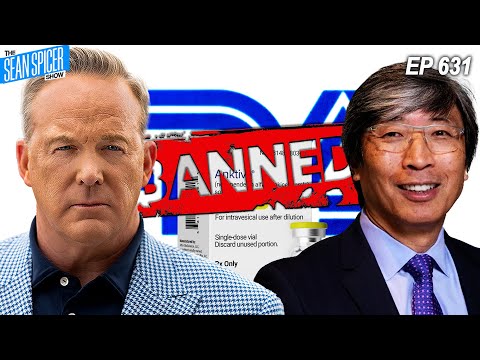
The same FDA's Office of Prescription Drug Promotion sent Patrick Soon-Shiong a warning letter. The violation: citing efficacy data in a @seanspicer podcast, and a television commercial that ImmunityBio had voluntarily submitted to the FDA for pre-airing review. The ad never aired. Instead of review notes, the agency issued a public warning.
The evidence he cited was the compounding record of IL-15 across four diseases.
Bladder cancer: ANKTIVA FDA-approved since April 2024 for non-muscle invasive disease that had failed BCG. Now approved in thirty-four countries.
Lung cancer: Saudi Arabia granted first-line approval for non-small cell lung cancer in January 2026. QUILT-2.023 Phase 2 showed a statistically significant increase in absolute lymphocyte count versus checkpoint inhibitor alone, p=0.0065.
Sepsis: Hotchkiss lab at Washington University, 2010, Journal of Immunology - IL-15 reverses immune cell apoptosis and improves survival. Two hundred thousand Americans die of sepsis every year. No approved immunotherapy exists. Hotchkiss followed with a 2014 call to action in the New England Journal of Medicine. Nobody built it.
Long COVID: UCLA and Mount Sinai clinicians presenting at AACR 2026 - COVID-induced lymphopenia driving cancer recurrence in patients previously in remission. The same collapse mechanism. The same molecule that restores it.
Four diseases. One molecule. Documented since Sinkovics in 1969. Cloned by the NIH in 1995. Ranked number one by the NCI in 2007. Buried by the American government for fifty-seven years.
The same FDA that declared single-patient stories are scientific data six weeks later called this evidence misleading.
Same agency. Same commissioner. Opposite standards.
In that same Oval Office, a Stanford researcher praised the administration's goal: "The United States will be the first country in the world to treat mental health like we do cancer."
The one American company treating cancer with the precision standard Stanford was praising had been sanctioned by the same FDA thirty-six days earlier.
THE MOLECULE THE GOVERNMENT KNEW
Joseph Sinkovics was running cytotoxicity assays at MD Anderson in 1969. The experiment needed a healthy control. He used himself. His own lymphocytes attacked and killed a patient's chondrosarcoma cells. Not slowly. Not partially. They surrounded the tumor cells and lysed them.
On December 3, 1969, he photographed what he saw under the microscope. The first images in human history of NK cells attacking human cancer.
The National Cancer Institute sent site visitors. They could not comprehend how immune reactions could exist without pre-immunization. They called it an in vitro artifact. They canceled his grant.
Fifty-seven years later, on April 18, 2026, the successor to that same FDA declared a single veteran's Ibogaine testimony scientific data. Thirty-six days earlier, the same agency had warned Patrick Soon-Shiong for citing published evidence of exactly what Sinkovics had photographed.
He died on January 24, 2022, at ninety-seven. He had spent half a century proving them wrong. He never saw the day the FDA admitted he had been right.
THE PROPHECY
1995: the NIH cloned IL-15. The American government owned the molecule.
July 12, 2007: the National Cancer Institute gathered America's top cancer immunologists for one question: of 124 candidate molecules, which would cure cancer?
The molecule ranked number one was IL-15.
Above anti-PD-1 - the class that would become Keytruda, the top-selling drug in the world.
Above every molecule that would become a multi-billion-dollar cancer drug over the next seventeen years.
The workshop wrote its own failure condition into the manuscript, before any ranking was discussed: "If a year or two goes by and the list remains substantially unchanged, it would be a signal that the current system for developing immunotherapeutic agents is not working optimally."
Seventeen years passed.
In 2010, Richard Hotchkiss at Washington University published in the Journal of Immunology that IL-15 reverses immune cell apoptosis and improves survival in sepsis. In 2014, he wrote a call to action in the New England Journal of Medicine: greater collaboration required between oncologists, infectious-disease specialists, translational immunologists, and pharmaceutical companies.
Nobody built it.
The NIH knew. The NCI knew. Hotchkiss knew. The United States federal government knew what IL-15 did in 1969, 1995, 2007, and 2010.
It refused to build the drug for fifty-seven years.
On April 18, 2026, the same federal apparatus - the same FDA, the same NIH, the same president who ten years ago had considered Patrick Soon-Shiong for NIH Chief - gave Ibogaine its first-ever FDA clearance to test on American patients and three National Priority Vouchers in a single Oval Office signing, on the strength of two veteran testimonies and a Joe Rogan text message.
The NCI's number one molecule is still waiting.
THE BUILDER
In 2008, one man read Joseph Sinkovics's chapter. He had made his fortune developing Abraxane. He had the resources. He read the 2007 NCI workshop manuscript. He understood that manufacturing IL-15 at clinical scale was the bottleneck.
@DrPatrick started building.
2012: N-803 development begins. 2013: first patient dosed. April 2024: the FDA approves ANKTIVA for non-muscle invasive bladder cancer. Seventeen years after the 2007 workshop. Twelve years of clinical trials. Two decades of peer review.
The same FDA would grant Ibogaine its first-ever clinical-trial clearance in one Oval Office signing.
January 2026: Saudi Arabia approves ANKTIVA for non-small cell lung cancer, the first country outside the United States. Part of Crown Prince Mohammed bin Salman's Vision 2030 biotech strategy.
February 2026: the Saudi National Guard Healthcare Ecosystem announces a robotic manufacturing partnership with ImmunityBio. Sovereign-scale IL-15 production.
April 2026: Portugal. The Health Minister personally requests a meeting. A new integrated next-generation immunotherapy center treating a thousand patients a day. PSS on-site: "Never seen anything like this."
April 15, 2026: Cleveland Clinic partnership. CAR-NK cell therapy infused with ANKTIVA - the next chapter of the Bioshield Platform, built with America's most-trusted hospital system.
Greece calling. UAE moving fast. The United Kingdom next.
Today ANKTIVA is approved in thirty-four countries, from the United States to Macau.
The country that built it sent its developer a warning letter for saying so.
TWO CASES
On April 18 the President accelerated a drug with zero FDA approvals, supported by Phase 2 observational data and two veteran testimonies delivered on camera.
In that same Oval Office, an advisor told the room of reporters: "In 2016, the lead professor at Johns Hopkins said this was the most promising therapy he's seen in his career. There's been a hold. There's been incentives against this. And the bravery and leadership of President Trump." A reporter asked what he meant. "Artificial barriers," he answered.
ANKTIVA is already approved. Already in thirty-four countries. Already the product of fifty-seven years of federal government research conducted at the NIH, the NCI, and academic medical centers funded by taxpayers. Already tested in Phase 3 for sepsis and first-line lung cancer.
Already the molecule the American government unanimously ranked number one in 2007 and then failed to build for seventeen years while one man built it alone.
For Ibogaine, the hold broke on April 18. For IL-15, the hold is an OPDP warning letter dated March 13.
THE RELATIONSHIP
November 2016: President-elect Donald Trump interviewed Patrick Soon-Shiong for NIH Chief during the first presidential transition. Discussed a health care czar role with broad portfolio over the entire U.S. healthcare system.
May 2017: PSS was placed on the Health IT Advisory Committee.
May 2025: Patrick Soon-Shiong met President Trump and Crown Prince Mohammed bin Salman in Saudi Arabia. He addressed them both directly. The curing of cancer, he told them, is the best foreign policy a nation can have. Not left. Not right. A humanitarian tool that is also a diplomatic instrument.
November 18-19, 2025: Trump and MBS held their White House summit.
January 2026: Saudi Arabia approved ANKTIVA.
The President did that.
THE SIGNAL - Part 1
April 18, 2026. The pen is down. The room is still full.
FDA Commissioner Marty Makary, on camera, answering a reporter about timeline:
"The fastest FDA approval was forty-two days during the HIV epidemic. On our national priority voucher program under President Trump, we are now down to that timeframe on a routine basis instead of a year."
"In my opinion, we need the same level of urgency we had with HIV for PTSD and depression and anxiety and our mental health disorder and cancer and heart disease and so many other conditions."
"You're going to see decisions out from the FDA later this summer as soon as we get the applications."
Thirty-six days after the warning letter, the same Commissioner committed his agency on live television to forty-two-day cancer approvals.
THE SIGNAL - Part 2
Hours later, Patrick Soon-Shiong posted nine words:
"The President can make huge advances in transforming the health of Americans."
That evening, Commissioner Makary posted on X:
"FDA is moving proactively to advance potential therapies. It's time for new approaches."
Patrick Soon-Shiong retweeted it.
Before midnight, he posted one more:
"News will break tomorrow. Evidence of an increase of over two times the risk of distant recurrence of breast cancer in patients in remission with lymphopenia. ALC matters."
Then one more again - quote-tweeting the WIN Consortium's rare-cancer personalized-medicine meeting:
"So glad to see that awareness of this IL-15 superagonist is beginning - yet it had awareness through evolution 450 million years ago, then again in 2007, almost 20 years ago by NCI and NIH. And now 2026. Science enlightenment takes time."
A global oncology consortium openly discussing ANKTIVA in rare cancers. The 2007 NCI moment being re-litigated by the medical establishment itself. On the record.
ALC is absolute lymphocyte count. The molecule that restores it is ANKTIVA. The Commissioner committed to forty-two-day decisions.
The applications are the only thing missing.
THE RECKONING
The FDA that blocked IL-15 for fifty-seven years just declared that single-patient stories are scientific data.
The President who opened Saudi Arabia for Patrick Soon-Shiong just demonstrated on live television that he can accelerate the FDA at will.
The man the NCI's own 2007 workshop unanimously ranked above Keytruda is already approved, already in thirty-four countries, and already running two Phase 3 trials.
The buried scientists - Sinkovics, Hotchkiss, Berzofsky, Monneret - documented IL-15 for five decades. The NIH cloned it. The NCI ranked it. Hotchkiss called for it. Nobody built it.
One man built it.
More to come.