marginofdanger

2.3K posts

marginofdanger banner
marginofdanger

marginofdanger

@marginofdanger

Sharing my personal views, not investment advice. Please do your own work.

Katılım Kasım 2022
119 Takip Edilen7.4K Takipçiler
Sabitlenmiş Tweet
marginofdanger
marginofdanger@marginofdanger·
This year I present a handful of my top ideas for 2026 (in alphabetical order of tickers). Some of these names are fairly uncorrelated with the market (and a few definitely are not). As a reminder please do your own work and be mindful of the low trading liquidity in many of these. $BWEL JG Boswell at $459/share (LOW RISK / HIGH REWARD) JG Boswell has been the deep value stock that even the most disciplined investors have lost patience with (including yours truly!). Despite the last year being horrible for both tomatoes and cotton, $BWEL put up ~$40mm of adj. EBITDA. It is extremely rare for both of its core crops to be bad at the same time (i.e., something good should happen with one of them this year) and their pistachio crop will generate increasingly material cash flow for the next 10 years as it matures. Creation value per acre is around ~$3k (or lower) depending on your assumptions which compares to FMV of $15k/acre. There's a lot of room for the stock to appreciate and still trade poorly! $MLP Maui Land & Pineapple at $17 (LOW RISK / HIGH REWARD) This name has seen a recent cluster of insider buying by the CEO (Race Randle), Chairman (Scot Sellers) and controling shareholder (Steve Case). The company's undiscounted land value is ridiuclously high relative to its stock price (like 8-15x) but the open question is the time to monetize. In a frothy stock market, this seems like an interesting, low risk place to deploy capital. $PLAY Dave & Buster's at $16 (MEDIUM RISK / VERY HIGH REWARD) Dave & Buster's is in the midst of a turnaround, with tangible signs of progress, but an exasperated investor base. Valuation is ~4.5x EBITDA which compares to its long history of 6-10x+ EBITDA. It's also worth pointing out that within this business is a bowling business called Main Event which is ~half of the company's TEV and worth ~8-10x if sold separately. $PLAY is going through a capital intensive remodel phase (with mixed results). The company recently put in a new CEO and results are turning, but the street is rightly worried about the staying power of the improvement. 2026 could be disappointing on the topline, but my gut is that there is a lot of low hanging fruit that will result in nicely improving results in 2026. There are no near-term liquidity issues and this is a nice multi-year option. I think it's highly asymmetric, wherein downside should be limited given b/s duration + low hanging fruit on costs with colossal upside on any real turnaround (every ~1x EV/EBITDA revaluation upward is around 100% on the stock). Don't waste your time on this one if you can't handle the volatility. $TIPT Tiptree at $18.27 (SAFE PLACE TO PARK CASH) This is by far my lowest beta pick. $TIPT is essentially doing the opposite of a de-SPAC. It is morphing from an operating company to a cash shell. It has agreements to sell its assets and will have $24.60/share in net tangible book value upon closing of Fortegra in 1H26. Post closing, the company will return the cash, make a large acquisition or a combination thereof. One of $TIPT's directors recently bought stock at $18.21/share and most importantly insiders own ~35% of the company. Upon completion of the Fortegra divestiture, I expect this to pull toward 85-95% of TBV ($20.91-23.37/share) representing a 14-28% return. Further upside potential when they announce an acquisition. If this were a true SPAC (with a 24 month put) I think this management team would trade at a premium. $WEBC Webco at $218 (warning: VERY ILLIQUID) Webco ended the year near its ATH, however, it is incredibly cheap at ~0.5x TBV and ~4x EBITDA. About a year ago, the company did a privately negotiated buyback of ~15% of its stock at $200, which was a premium to the prevailing $185/share trading price. No surprise, but in the last few quarters, the results have turned and the company should generate meaningful FCF in 2026. I believe the take private valuation for this company is ~$350-400/share. And a few other old favorites that I'll throw in here: $CBBI CBB Bancorp at $11 (LOW RISK + HIGH REWARD) This name has been discussed on FinX extensively and I'm not going to break new ground here. But I will say that the new board member gives me some hope that something will happen in the name in the short-term. $FMBL at $8,349 + $QUCT at $2,100. (LOW RISK) Both of these names had an amazing 2025 due to the company taking shareholder friendly actions (for FMBL, raising a $200mm pref, for QUCT signalling asset sales and having improved results). Both of these names continue to very cheap relative to their take private valuations. And, due to conservatively positioned balance sheets they both have little downside. $FPH at $5.59 (LOW RISK + HIGH REWARD) It feels like hubris to re-recommend $FPH as a top pick for the upcoming year and I do think that at this price it's not as interesting (obviously). However, there are a lot of good catalysts coming with this name, including the announcement of JV partners in both Valencia and SF and the potential favorable resolution of the litigation against $TTEK (in addition to continued high value land sales in Irvine). $10-15/share continues to be where I think this goes to over time.
English
7
5
121
22.2K
marginofdanger
marginofdanger@marginofdanger·
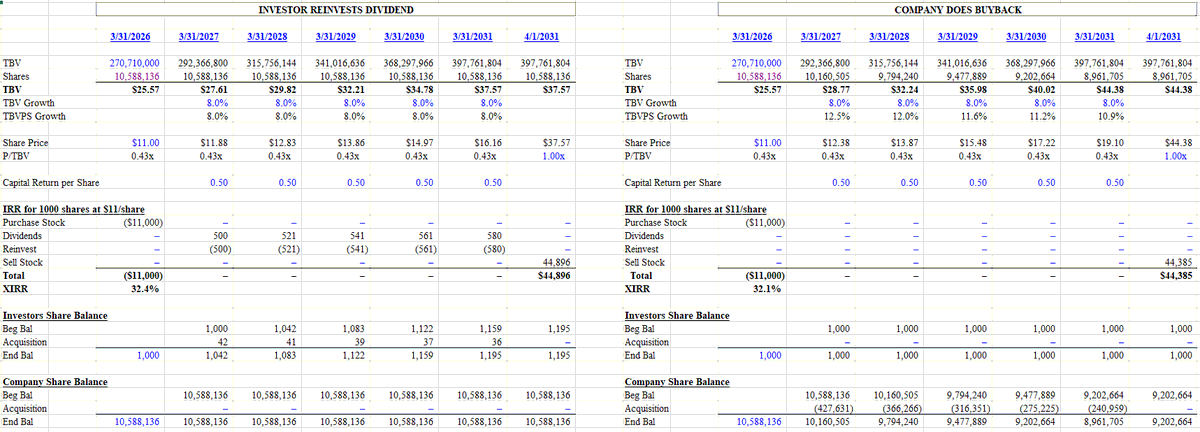
I don't know if I fully agree with that. $CBBI trades at 0.4x for two reasons: 1) OTC listing and 2) no buyback. If there was a company sponsored buyback, it would probably trade at 0.6-0.7x and therefore the buybacks would be less accretive. Also if you look at my numbers you'll see that the projected share price in the non-buyback scenario is $16.16 in five years plus $2.50 in dividends vs. $19.10 in the buyback scenario. Pretty close. If you're a short-term holder, you want the buyback to re-rate this to 0.6-0.7x. If you want to long-term compound, it's not clear the buyback is that much better to me.
English
2
0
0
35
Fred
Fred@Fred67878821579·
@marginofdanger the difference is with a buyback you dont need the assumption of a sale in 5 years to earn an adequate return. also the assumption of a constant rate of the same book value growth every year here while the equity piles up faster than an adequate rate it can be reinvested at...
English
2
0
0
24
marginofdanger
marginofdanger@marginofdanger·
$CBBI followers- the tables below show two scenarios assuming a sale in 5 years at 100% of TBV: 1) Investor reinvests the .50/yr dividend into more shares 2) CBBI suspends dividend and instead does a share repurchase The analysis shows that the results are roughly the same (BEFORE TAXES). The point here is to show that if you reinvest your dividend you can somewhat replicate the economics of a buyback. One assumption that is likely optimistic in the company buyback scenario is that they'd continue to be able to buy back at 0.4x TBV. If you tinker with that, the buyback is less valuable. cc: @mwphnh
marginofdanger tweet media
English
1
0
6
1.3K
marginofdanger
marginofdanger@marginofdanger·
I’m going to send you a spreadsheet later which will lay it out. The cheap stock price is a gift to investors. If they were more aggressive on a buyback, the stock would trade higher and the buybacks wouldn’t be as accretive. If you take your after tax dividend and buy back stock at sub 0.5x TBV you will do very well.
English
1
0
0
52
marginofdanger
marginofdanger@marginofdanger·
$CBBI continues to do its thing. TBVPS up to $25.57/share. Run-rate earnings probably around $2 implying a mid 5x P/E. If you don't like the lack of buyback, reinvest the dividend into more shares. Biggest discount of its peers due to OTC listing and lack of buyback. $OPBK raises dividend and reports slight improvement in EPS vs. last quarter. Seems to be trading in the mid 7s P/E. $PCB reports and trading maybe in the 8s on P/E. $HAFC trading around 10x P/E and hitting ATH. A premium vs $OPBK and $PCB for a larger balance sheet. All very cheap.
English
3
1
20
2.7K
marginofdanger
marginofdanger@marginofdanger·
@mwphnh The ratios won’t change - you’re right about that, but you can replicate the economics by reinvesting the dividend (adjusting for dividend taxes).
English
1
0
0
53
marginofdanger
marginofdanger@marginofdanger·
@mwphnh I never said it was the same. But if you take your dividend and reinvest it, you get most of the benefit.
English
1
0
0
54
N #HamasisISIS #FreeJimmyLai
@marginofdanger My buying more shares is not even close to as effective as the company buying back shares. These are totally different things with different effects. Don't be clueless.
English
1
0
0
43
marginofdanger
marginofdanger@marginofdanger·
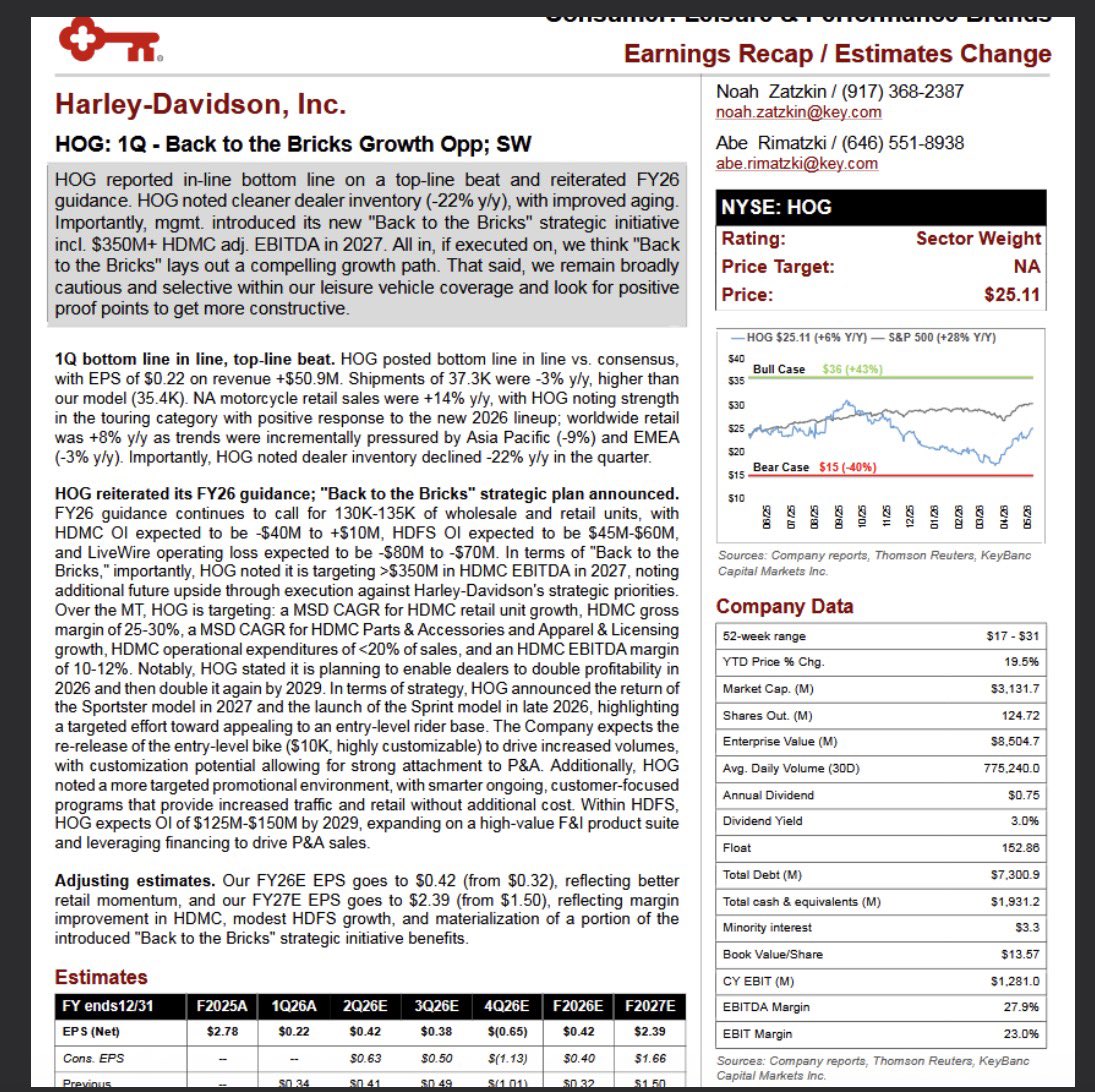
@leevalueroach I opened up the 10-Q files today and looking at footnote 5. It shows 110mm S/O, which includes 5mm shares associated with the the HDFS business.
English
0
0
0
526
Lee Roach
Lee Roach@leevalueroach·
These sell side idiots are using wrong enterprise value and the WRONG SHARE COUNT on $HOG. KeyBanc claiming 125mm shares outstanding. Off by 20%.  UBS says 114mm - still 9mm too high.  They are an embarassment to their parents.
Lee Roach tweet mediaLee Roach tweet media
English
15
1
62
22.4K
marginofdanger
marginofdanger@marginofdanger·
@Noalgos Your guess is as good as mine. Doesn’t really add up.
English
0
0
1
76
Zed
Zed@Noalgos·
@marginofdanger Apart the fact valuations makes no sense, what do you think has been responsible of the crazy rally. It looks like a big short squeeze but it can't be since it's a new offering!
English
1
0
0
75
marginofdanger
marginofdanger@marginofdanger·
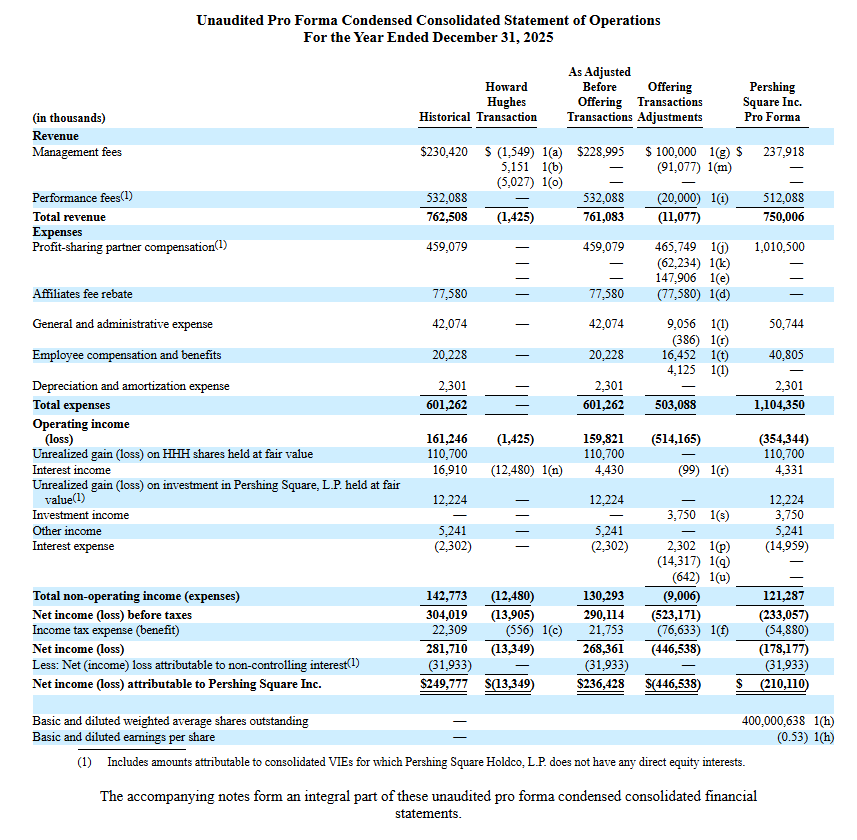
I pasted two screenshots from $PS's 424B4. If you look at fee paying AUM, it's $16 bn excl HHH which has a de minimis mgmt fee/carry. Add in $PSUS and you are at $21 bn of fee paying AUM. $PS discloses pro forma mgmt fees of $238 mm but that is net of $91 mm of non-cash amort related to the IPO. So I'm going to give them credit for $329 mm of mgmt fees. Assuming a 65% operating margin and a 20% tax rate, that gives me effective fee paying earnings of $171 mm. $PSH.LN has a 16% incentive fee and $PS is entitled to the performance fees on the first 5% (the team gets beyond that). On $15 bn, this is $15 bn * 5% * 16% = $120 mm or $96 mm after tax. Add up the mgmt fee and performance fee share, and I get $267 mm of expected earnings or $0.67/share. Implies $PS is trading at around ~50x EPS vs. $KKR at 17x, $ARES at 20x, $BX at 21x. Of course you can layer in some minor $HHH economics and it takes down the multiple a couple of turns. But you could also layer in a few years of sub 5% returns and that takes away the performance fee too. Certainly a 50x EPS valuation is pretty common for a fast growing higher ROIC biz. But it's by no means cheap. The question is, how will Ackman raise any money from here? $PSH.LN is at a discount to NAV, $PSUS is at a discount to NAV and $HHH is at a discount to NAV. One thing that will allow $PS to grow into its valuation is great results as that will 1) scale up the earnings (as it's based on % of AUM) and 2) facilitate new investors. Another way to contextualize the valuation is to simply look at fee paying AUM of $21 bn and compare that to the equity value of $13 bn. That is pretty unprecedented in the land of asset managers but reflects in part the permanent capital and the limited float (I think its just the 20mm shares given in the IPO). Could easily see a lot of price pressure once the 380mm non-IPO related investors are free to sell.
marginofdanger tweet mediamarginofdanger tweet media
English
10
2
51
16.6K
marginofdanger
marginofdanger@marginofdanger·
@thewritser This is pulling toward the low end of your 2028 target(!). Been a good one.
English
0
0
2
184
Writser
Writser@thewritser·
Wrote a little something about $HOOK, yet another biotech liquidation. Looks attractive to me. Check it out here: stocksandstuff.com/p/hookipa , feel free to point out any glaring errors!
English
7
1
40
6.9K
marginofdanger
marginofdanger@marginofdanger·
@valwithcatalyst We had about two weeks of a pause in new IPOs, so it makes sense that the underwriters are bringing 15 deals this week
English
0
0
2
457
marginofdanger
marginofdanger@marginofdanger·
$PSUS opening delayed until Ackman pulls his last few relationship cards. Going to be UGLY!
English
12
1
12
5K
marginofdanger
marginofdanger@marginofdanger·
Seems like $PSUS and $PS going to trade worse than I expected. Looks like PSUS could open at a 20% discount to NAV and PS to trade below the $10 bn valuation from the latest 3rd party pre-IPO raise. x.com/marginofdanger…
marginofdanger@marginofdanger

Ackman's closed end fund $PSUS will begin trading on Wednesday. For every 5 shares of PSUS, IPO investors (only) will get 1 share of $PS (the GP). It sounds like the PSUS offering will be 100mm shares at $50/share or $5 bn. Ackman thought this was going to be a $10 bn offering and he previously was targeting $25 bn or some ridiculous amount. The PSUS IPO investors will end up owning 20mm shares or 5% of PS (based on 400mm pf s/o). I expect that PSUS, like many closed end funds, will settle at a 5-10% discount to NAV, implying a trading price of $45-47.50/share. PS will begin trading as well (via a direct listing) and I anticipate a valuation of $5-10bn, implying that the PSUS IPO investors will get a "bonus" of $250-500mm on the $5 bn IPO or 5-10%. Therefore their loss on the PSUS shares should be mostly offset by the free shares in PS. Given this is a direct listing, I expect WILD price movements in PS stock and would stay far away from that one. I used $10 bn as the high end valuation for PS because that is where investors invested back a year or so ago (predicated upon significant growth in AUM), but I tend to believe that was a high watermark and not realistic given that Ackman can't seem to raise $. In terms of $PSUS, I don't see a compelling reason to own this at 90-95% of NAV. If you put a 15x on the 2% fee, that alone is a 30% drag. Also, Ackman has high volatility and there is no prospect to ever get repaid (and no incentive for Ackman to do so). Like $PSH.LN I would personally only step into $PSUS at a 25-30%+ discount to NAV and probably not in any real size.

English
6
2
27
13.1K
marginofdanger
marginofdanger@marginofdanger·
I agree with you that the TRA is problem re: the insiders deciding to sell the company to a third party. This is an increasingly a moot point given that the stock is at all time lows. Your retort may be that this gives the insiders the perfect chance to take the company private, which my retort would be: insiders can always screw you, but if you look at their actions, the TRA was not designed to be poison put, but rather a pretty standard thing that is done these days when there are special tax attributes in a company going public. I think it's pretty much a zero % chance that a board would ever approve a takeunder right now. Give me any example of a company that did an all-cash transaction for less than the NET cash on the balance sheet.
English
1
0
1
325
Dalius - Special Sits
Dalius - Special Sits@InvestSpecial·
The timing is the issue. The TRA acceleration clause makes the entire obligation due immediately at closing, while the tax benefits that were supposed to fund those payments still amortize over the remaining decade or so schedule, if I remember correctly. Whether the company has earnings potential stable enough to fully realize that benefit is the question every buyer would ask. This is one of the reasons TRAs have been significantly criticized as a corporate structure choice over the last 10-15 years.
English
1
0
2
405
marginofdanger
marginofdanger@marginofdanger·
@EricTheUmpire If you want exposure, buy $PSH.LN (or $PSHZF) which is trading at around 70% of NAV (implies $35/share for $PSUS).
marginofdanger tweet media
English
1
0
1
560