Emil Marklund

134 posts

Emil Marklund

Emil Marklund

@marklundem

Assistant Professor at @scilifelab and @Stockholm_Uni. Intrigued by what makes life work at the molecular level.

Stockholm, Sweden Katılım Şubat 2018
288 Takip Edilen364 Takipçiler
Sabitlenmiş Tweet
Emil Marklund
Emil Marklund@marklundem·
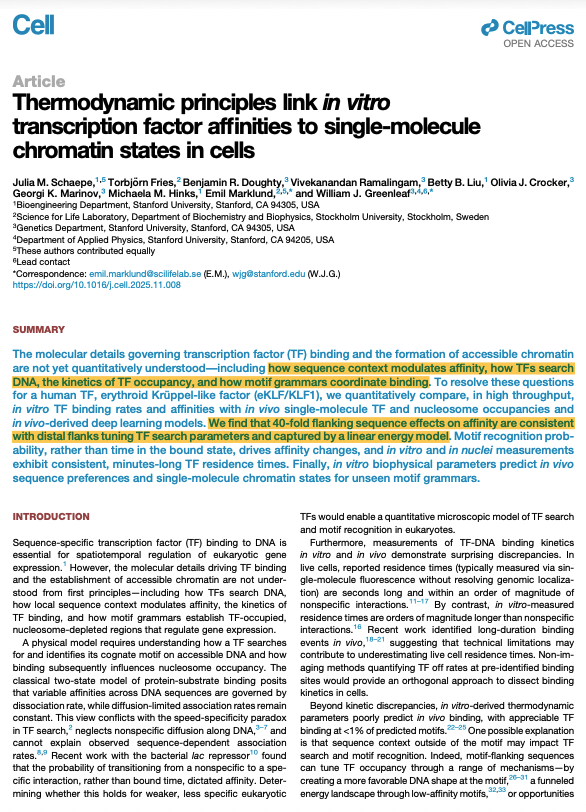
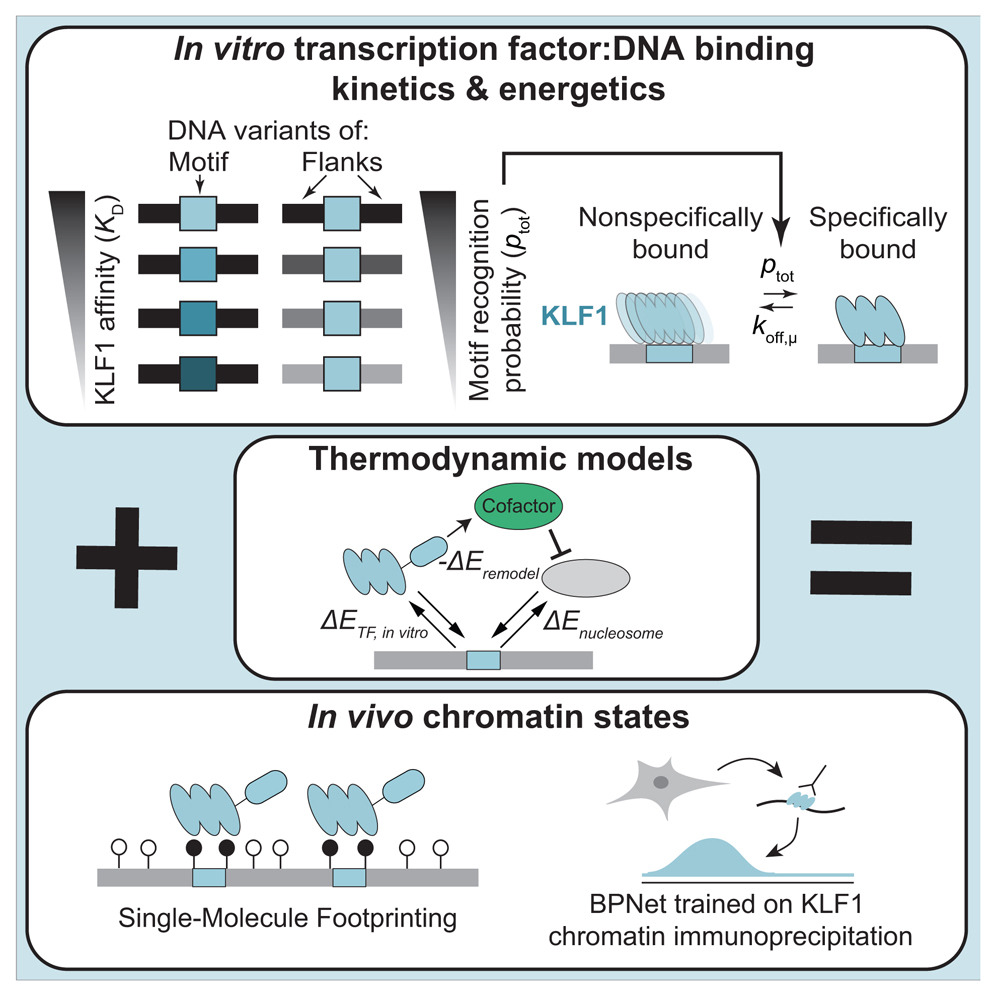
📣 I am happy to announce that our work linking DNA binding affinities and kinetics 𝘪𝘯 𝘷𝘪𝘵𝘳𝘰 and 𝘪𝘯 𝘷𝘪𝘷𝘰 for the human transcription factor KLF1 just got published in @CellCellPress: cell.com/cell/fulltext/… (1/2)
Emil Marklund tweet media
English
2
1
11
373
Niko McCarty.
Niko McCarty.@NikoMcCarty·
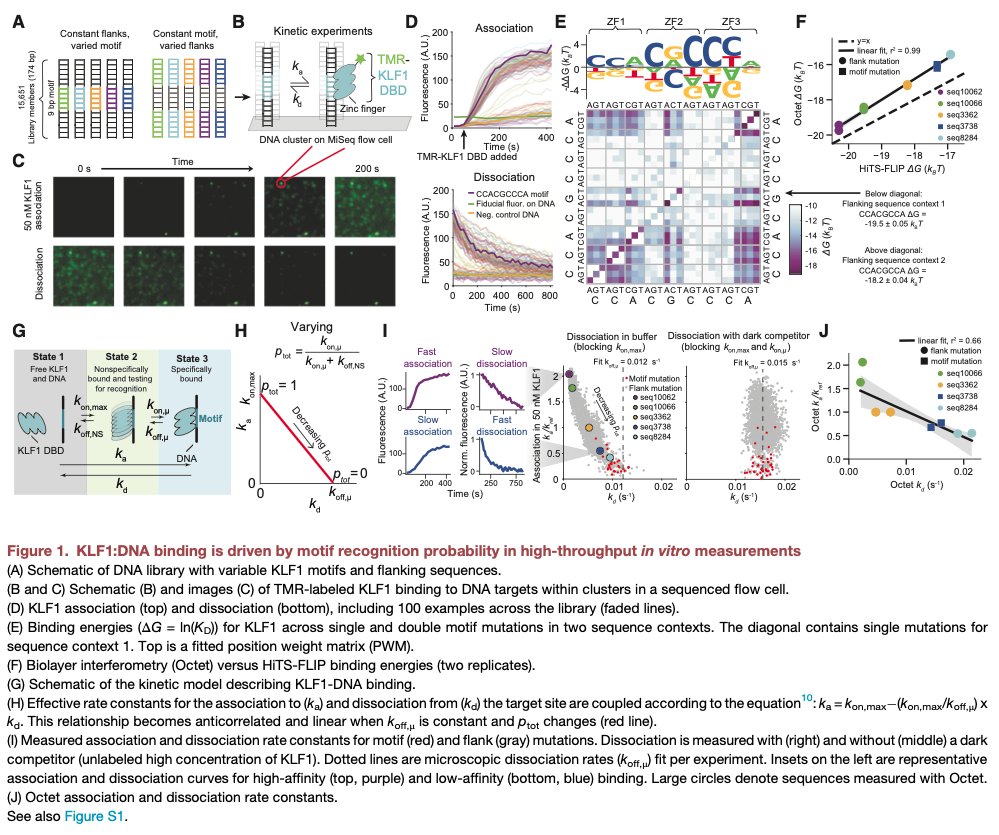
The model of gene expression taught in school is highly misleading! Transcription factors are proteins that bind to DNA and then help repress, or activate, the expression of genes. Cells have hundreds of different types of transcription factors, each tuned to regulate different genes based on short snippets of DNA located near those genes. The basic model, taught in school, says that these transcription factor proteins float around the cell and, when they bump into a DNA sequence, either latch onto it strongly (CORRECT SITE!) or fall off quickly (WRONG SITE) and keep searching. All the other DNA in a cell is basically abstracted away as unimportant or irrelevant; mere background noise. But again, this model is naive! And a new paper, published in Cell, beautifully shows how the sequences SURROUNDING a transcription factor's binding site also matter a great deal. This won't be surprising to many biologists, as "cracks" in the standard two-state model began emerging decades(?) ago. Biologists have tagged transcription factors with fluorescent tags and then watched them move around living cells. And they have noticed that when transcription factors land in a "wrong" location in the genome, they skip or hop to a nearby location and repeat this until finally connecting with the "correct" sequence. So in other words, there are actually three states that a transcription factor can exist in: free-floating, "searching", or "bound." (More technically, transcription factors first do a 3D search, then latch onto DNA and do a 1D search to find the correct location.) For this new paper, though, scientists exhaustively quantified *how* the sequences flanking a transcription factor binding site influence the search of the protein. They did a huge in vitro experiment, wherein they placed a specific transcription factor with a known binding site, called KLF1, in a huge library of 11,812 different DNA sequences. These sequences had mutated "core" binding sites and variations in the flanking sequences. They also prepared negative controls. Then, these researchers measured the binding kinetics of KLF1 with each sequence to understand which bases in the flanking sites impact the 1D search. What they found is that KLF1 has a basically flat disocciation rate from its core sequence, but that the PROBABILITY that it finds this sequence depends a lot on the surrounding context. Even mutations located dozens of bases away from the core site matter a lot, either pushing KLF1 to "hop" faster to find the site, or "trapping" KLF1 and slowing down its search. These flanking sequences can cause up to a 40-fold variation in the affinity of a transcription factor for its target site! This is just one small part of the paper, though, so I encourage anyone interested to read the whole thing. It is challenging throughout.
Niko McCarty. tweet mediaNiko McCarty. tweet media
English
19
241
1.2K
126.5K
Emil Marklund
Emil Marklund@marklundem·
📣 I am happy to announce that our work linking DNA binding affinities and kinetics 𝘪𝘯 𝘷𝘪𝘵𝘳𝘰 and 𝘪𝘯 𝘷𝘪𝘷𝘰 for the human transcription factor KLF1 just got published in @CellCellPress: cell.com/cell/fulltext/… (1/2)
Emil Marklund tweet media
English
2
1
11
373
Emil Marklund
Emil Marklund@marklundem·
🔬 We use and develop state of the art methods for quantifying binding of different proteins in high-throughput. Different backgrounds are encouraged to apply! We use biochemistry, fluorescence microscopy, image analysis, machine learning, etcetera. (2/3)
English
1
0
1
79
Emil Marklund
Emil Marklund@marklundem·
‼️We are recruiting Postdocs in Stockholm‼️ 🧬Scientific questions in projects can involve studying specificity in transcription factor - DNA binding, detecting protein - protein interactions or enzyme optimization. Link to apply in comments (1/3) @scilifelab @Stockholm_Uni
English
1
0
1
105
Emil Marklund
Emil Marklund@marklundem·
Congrats also to Torbjorn, @bgrdoughty, Olivia, and @MichaelaThinks. We're thrilled that physical principles can explain in vivo chromatin configurations, and excited about the possibilities this opens. We'd love to hear your thoughts! Marklund Lab is hiring, email me! [9/9]
English
0
0
0
304
Emil Marklund
Emil Marklund@marklundem·
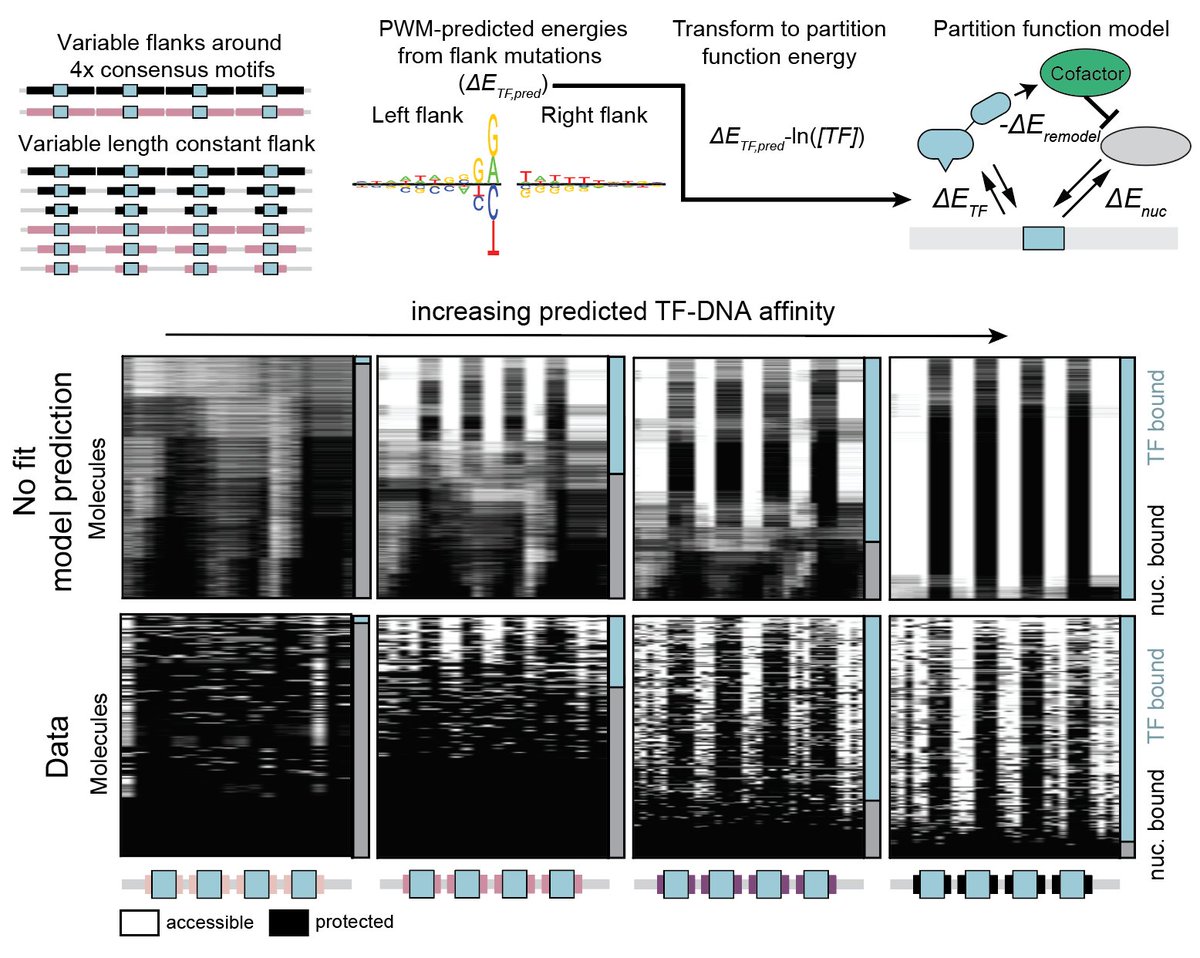
By combining the in vitro linear energy (PWM) model for flanking sequence effects with the in vivo thermodynamic model, we can accurately predict single-molecule chromatin configurations from completely nucleosome-bound to completely TF-occupied across flanking sequences. [8/9]
Emil Marklund tweet media
English
1
0
1
338