matdryhurst

43.9K posts

matdryhurst banner
matdryhurst

matdryhurst

@matdryhurst

Creator w/ @hollyherndon Oxford HAI Lab / Ethics Institute Strange Rules May -Nov @ Venice Starmirror June-Oct @ K21, Düsseldorf

Berlin, Germany Katılım Haziran 2008
5.8K Takip Edilen24K Takipçiler
Sabitlenmiş Tweet
matdryhurst
matdryhurst@matdryhurst·
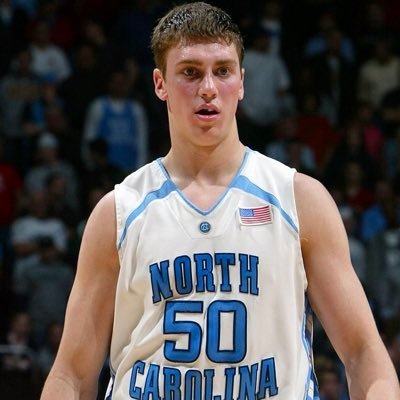
Strange Rules opening @ Palazzo Diedo Venice Curated with @HUObrist @hollyherndon & Adriana Rispoli Architecture with sub, led by Niklas Bildstein Zaar
matdryhurst tweet mediamatdryhurst tweet mediamatdryhurst tweet mediamatdryhurst tweet media
English
10
26
196
17.2K
kang
kang@jaycaspiankang·
It begins lol. Youri has some good qualities but what’s the plan here. Cheap out on young players w huge upside, put out rumors we are going for every big name and then settle for dudes who don’t fit the team?
kang tweet media
David Ornstein@David_Ornstein

🚨 EXCLUSIVE: Manchester United in advanced talks to sign Youri Tielemans from Aston Villa. All parties in contact as #MUFC try to finalise - 29yo midfielder keen on move. Ederson deal off for now; #MUFC may look to revisit later this summer @TheAthleticFC nytimes.com/athletic/74403…

English
9
0
16
13.6K
matdryhurst retweetledi
Kenneth Stanley
Kenneth Stanley@kenneth0stanley·
This is a beautiful and thought-provoking homage to Picbreeder from @SakanaAILabs, led by @Smearle_RH. Picbreeder is often misunderstood as a kind of toy. In reality, it was perhaps the first, maybe only, example of a truly open-ended artificial system that really took off. And by having an artifact like that in the world that was driven by human input, we have a rare comparison point to see what AI can do when unleashed in that same environment where humans once explored. Sakana's team really took that opportunity to heart here and as a result we get to see a unique glimpse of how the frontier of AI (VLMs) compares to humans in an open-ended, creative space. Not surprisingly, VLMs come up somewhat short here compared to humans, though what they can do is still impressive. But more fundamentally I don't see this experiment mainly through the lens of "which is better." What I think it highlights is that as the pursuit of open-ended creativity through LLMs and AI becomes increasingly central to the field (AI for math! AI for science! AI for discovery/innovation/entrepreneurship! AI for art, literature, music!), it is essential that we have domains that are radically different from standard AI benchmarks, which are antithetical to questions of open-ended discovery. Even when AI (impressively) solves a longstanding open problem in math, that is a different kind of impressiveness than open-ended discovery, wherein the AI is *not* told what it's meant to achieve. Picbreeder is one of the few, maybe only, genuinely open-ended spaces that humans have actually extensively explored through their own intrinsic curiosity (i.e. not asked to do it for a "study"). The opportunity that presents for us to learn about the creative and open-ended differences between humans and modern AI has been starkly neglected. It's great to see someone finally take that opportunity seriously! PS wow I'm also amazed they created a faithful reproduction of the original Picbreeder site that has been defunct now for years! You can go back in time and experience Picbreeder as it was: pub.sakana.ai/picbreeder-vlm…
Sakana AI@SakanaAILabs

The AI Picbreeder Experiment: Can AI agents be creative when nobody tells them what to create? Blog: pub.sakana.ai/picbreeder-vlm In our new #GECCO2026 paper, "In Search of the Ingredients of Open-Endedness: Replicating Picbreeder with Large Vision-Language Models", in collaboration with MIT and NYU, we revisit Picbreeder, a lost website where people collaboratively evolved images without any predefined objective. Users simply selected images they found interesting, allowing unexpected forms such as faces, animals, vehicles, and skulls to emerge gradually across many generations and many different people. We recreated this process using vision-language model agents. The agents explore a shared archive, choose images to branch from, evolve new candidates, publish their favorites, and evaluate the creations of other agents. There is no target image and no explicit definition of what counts as progress. The results reveal both the promise and current limitations of AI-driven open-ended discovery. Compared with humans, VLM agents tend to keep circling back to the same kinds of images and concepts. They repeatedly select similar parents, make smaller conceptual leaps, and often refine an existing idea rather than abandoning it in search of something genuinely unexpected. However, introducing a diverse population of agent personalities substantially improves exploration. In some runs, diverse agent populations approached or matched the human archive on measures of semantic diversity and produced more balanced evolutionary trees. We also find intriguing evidence that open-ended evolution can produce more robust representations. A skull evolved by the agents changes smoothly when its underlying neural representation is perturbed, less fractured than a skull directly optimized with gradient descent, although still less cleanly disentangled than one evolved collectively by humans. But perhaps the most interesting result is the gap that remains. Humans appear better at turning fortunate accidents into sustained creative discoveries: recognizing when something unexpected is worth pursuing, refining it, and then making a larger conceptual leap. The AI agents often notice interesting patterns too, but are more likely to become trapped in them. We still do not fully understand what enables humans to navigate open-ended search in this way, or what ingredient(s) current AI systems are missing. For now, the results suggest that there remains something important about human creativity that AI agents have not yet learned to reproduce. This paper will be presented at #GECCO2026 and is nominated for a best paper award! Please check out the interactive blog and technical paper for more details! Read our full paper: arxiv.org/abs/2605.23908 🐟

English
8
18
106
21.7K
matdryhurst
matdryhurst@matdryhurst·
@jaycaspiankang Apparently not far away. Both Villa and Newcastle get to champions league and have to sell their best players. It’s a farce.
English
0
0
0
92
kang
kang@jaycaspiankang·
@matdryhurst Yeah Newcastle can only really compete by signing young players now bc wages. Wonder when saudis just get bored and sell
English
1
0
1
157
matdryhurst
matdryhurst@matdryhurst·
It’s a weird conspiracy of convenience as it only really impacts Newcastle/Villa maybe Everton who have hopes of being big enough to compete. It constrains you from investing to increase revenue (ie capitalism), enshrines stature of the “big 6” and weirdly compliments the smaller and promoted clubs who are making more $ than ever but don’t have aspirations to win the league. So when a vote comes around it’s only those who could break in who are interested in changing status quo.
English
1
0
2
168
matdryhurst
matdryhurst@matdryhurst·
That’s the scandal. City and Chelsea were permitted then they pulled up the regulatory ladder. PSR/SCR is based on profitability so you can’t compete with wages (or as Villa do sign free transfers and compensate with higher wages) It’s a legitimate scandal that makes the league uncompetitive.
English
1
0
2
116
ScriptedFantasy
ScriptedFantasy@scrptdfntsy·
can someone explain to me why looksmaxxers get so much attention? i genuinely dont get it… is it paris and nicole for gen z'ers or what?
English
3
0
3
990
Lorica
Lorica@lorica____·
@matdryhurst @elite_gz The undercurrent of dissatisfaction with the attention economy more generally will be the long-term difficulty that all artists will have to grapple with - but this isn't necessarily a new problem. decoupling from the expectation of audiences (even micro!) is another story though
English
1
0
2
118
Lorica
Lorica@lorica____·
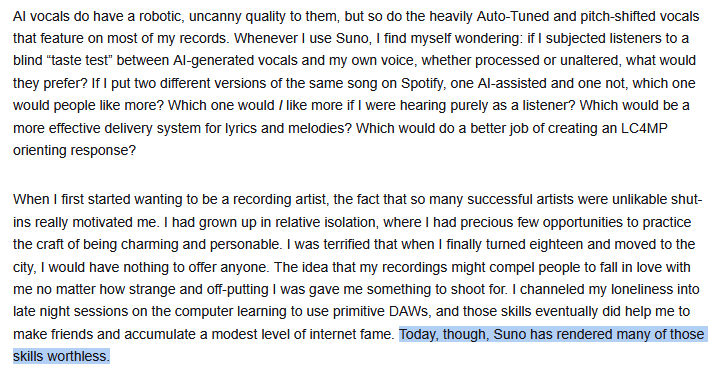
I'm sympathetic to the overall "declinist" position sketched out by @elite_gz but I don't think artists should be "declinists" about the value of their artistic process and the craft/skill involved therein. Some artworks are valued because of the process of their creation!
Lorica tweet media
English
3
0
4
851
ScriptedFantasy
ScriptedFantasy@scrptdfntsy·
@matdryhurst 1990: pamela anderson 2000: paris hilton 2010: _____ 2026: clavicular ?!?!?
Español
1
0
0
180
matdryhurst
matdryhurst@matdryhurst·
@lorica____ @elite_gz I enjoyed the article for being honest and unsentimental. Everyone could benefit from decoupling suno as a proposition with AI tools for music more broadly (which are really capable now)
English
1
0
4
293
Lorica
Lorica@lorica____·
@matdryhurst @elite_gz the mixed AI process description at the end of the article is paradigmatically artistic and a potential source of value - just as other mediums can and will continue to be. its important to be clear-eyed about this. artists have a lot of avenues to explore
English
1
0
2
350
Guy
Guy@nosilverv·
As soon as you have enough/are good enough to have a recognizable style people become able to replicate it with AI. I wonder what this will do: if it enhances the reach of certain artists or if, rather, it dilutes their signal, gets their messages twisted against them, etc.
Guy@nosilverv

English
7
0
21
3.1K
Mark Hurrell
Mark Hurrell@markhurrell·
both sides of the argument are quite naive though? all prominent artists have a factory of fresh graduates making their work for them. ai *is* likely to replace those invisible roles - but then, the cost of living in major cities has made those jobs impossible for anyone but children of the super rich already
English
1
0
2
42
matdryhurst
matdryhurst@matdryhurst·
@nosilverv @DefenderOfBasic why I get annoyed at the anti ai activists who implicitly undervalue artists they claim to defend by pretending the ability to cheaply mimic media replaces what artists do
English
1
0
2
49
matdryhurst
matdryhurst@matdryhurst·
@gavinmuellerphd I think you'll find the unique human inspiration behind those unforgettable tunes cannot be replicated so easily
English
1
0
4
333