🇮🇱Tel Aviv was plunged into darkness without electricity and water. They experienced a terrifying night due to the complete failure of the Iron Dome defense system and the Iranian bombing of a power plant, which caused widespread power outages.☀🌚
🚨 JAMIE DIMON SHIFTS TONE 🚨
JPMorgan CEO: “THE EXPERIMENT PHASE IS OVER.”
PRAISES BLOCKCHAIN FOR FASTER & CHEAPER FINANCIAL SYSTEMS.
WALL STREET IS QUIETLY MOVING IN.
IF CLARITY ACT PASSES,
BITCOIN MAY GO… Show more
I'm cashing everything out.
After 11 years in crypto, I've had enough.
I leveraged 25X and got liquidated.
Crypto is a SCAM.
I'm getting a 9-5 and will do something rewarding.
Short answer: it’s directionally pointing at a real phenomenon (derivatives can influence price), but the core claim that Bitcoin’s supply has become “theoretically infinite” is economically incorrect. It conflates synthetic exposure with physical supply and overstates how price discovery works in modern markets.
I’ll break this down rigorously.
⸻
1. Does derivatives trading change price discovery?
Yes — but not in the way the post claims.
In any mature asset:
•Spot markets exist.
•Derivatives (futures, options, swaps) exist.
•Arbitrage links them.
Price discovery migrates toward the venue with:
•Most liquidity
•Lowest friction
•Highest leverage
•Deepest participation
In many commodities (gold, oil), futures markets often lead price discovery. That does not mean supply becomes infinite. It means expectations get priced faster than physical delivery flows.
Bitcoin is no different:
•CME futures
•Perpetual swaps (Binance, etc.)
•Options markets
•ETFs
•Prime broker lending
These absolutely influence short-term price volatility.
But they do not alter the 21 million supply cap.
⸻
2. “Synthetic supply makes scarcity infinite”
This is where the argument breaks.
There are two distinct concepts:
A) Monetary supply (actual BTC)
Hard capped at 21M.
On-chain settlement is final.
No derivatives instrument can mint real BTC.
B) Synthetic exposure
Derivatives create price exposure without moving coins.
That’s leverage, not supply.
If I short 1 BTC futures:
•I do not create 1 new BTC.
•I create a contract that must be settled (cash or physically).
•The counterparty is long.
Net supply remains zero-sum.
⸻
3. “Six claims on one coin” argument
This sounds alarming but misunderstands how balance sheets net.
Example:
One real BTC exists.
You might have:
•ETF share representing it
•A futures long
•A futures short
•An options position
•A broker loan collateralized by it
But these positions net out across counterparties.
For every synthetic long there is a synthetic short.
You do not create six additional BTC.
You create six offsetting financial claims.
That’s leverage layered on top of a base asset — not supply multiplication.
⸻
4. Can derivatives suppress price?
Yes — temporarily.
Mechanisms:
•Shorting into thin liquidity
•Forcing liquidation cascades
•Funding-rate pressure in perpetuals
•Basis trades via ETFs
This can:
•Amplify volatility
•Trigger short-term downward spikes
•Create reflexive deleveraging events
But this is cyclical.
If underlying spot demand is strong, shorts must eventually cover.
Unlike gold:
Bitcoin has:
•Transparent on-chain supply
•Auditable issuance
•Fixed issuance schedule
•No central vault
You cannot secretly create new BTC bars.
⸻
5. Gold comparison: not perfectly analogous
Gold’s “paper gold” system (LBMA/COMEX):
•Centralized custodians
•Opaque rehypothecation
•Settlement rarely demands physical
•Large bullion banks
Bitcoin differences:
•Anyone can withdraw to self-custody
•On-chain settlement is open
•ETF shares can be arbitraged
•Exchange balances are visible
•Proof-of-reserves culture exists (imperfect, but improving)
If synthetic claims grow too large relative to real supply, the system is self-correcting via:
•Withdrawal squeezes
•Short squeezes
•Custody migrations
That’s structurally harder to suppress long-term.
⸻
6. The “Synthetic Float Ratio (SFR)”
This is not a recognized, standardized financial metric.
It’s an interpretive framework.
Useful for thinking about:
•Open interest vs circulating supply
•ETF AUM vs exchange balances
•Leverage ratios
But calling it proof that scarcity is gone is not analytically sound.
⸻
7. What actually determines Bitcoin price?
Marginal buyers and sellers set price.
Not total supply.
Not total synthetic contracts.
Not total coins ever mined.
#ULTIMAHORA Mucha gente se pregunta por qué Bitcoin se está derrumbando📉 y la respuesta no está en el “sentimiento”, ni en el “ciclo”, ni en el FUD de siempre.
El problema es estructural ⚠️ y tiene que ver con cómo hoy se forma el precio.
• Antes, el precio de BTC se descubría principalmente on-chain, con oferta limitada y compradores marginales reales
• Hoy, el precio se define fuera de la cadena, en mercados financieros sintéticos
El punto clave es este 👇
👉 ya no manda la escasez, manda el papel.
Bitcoin nació con una promesa muy clara:
• Oferta finita (21 millones)
• Imposibilidad de rehypotecación
• Escasez real como base del valor
Eso funcionó… hasta que llegó Wall Street 🏦
El quiebre ocurre cuando se montan capas financieras encima del activo:
• Futuros liquidados en efectivo
• Perpetual swaps
• Opciones
• ETFs
• Préstamos vía prime brokers
• BTC “envuelto”
• Swaps de rendimiento total
Desde ese momento, el suministro de BTC dejó de ser económicamente escaso ❌
⚠️ No en la blockchain
⚠️ Sino en el proceso de formación de precios
¿Qué significa esto en la práctica?
• El mismo BTC puede respaldar múltiples instrumentos al mismo tiempo
• Se crean reclamaciones financieras sobre una misma moneda
• El “float” real se vuelve irrelevante
📌 Resultado:
Bitcoin pasa de ser un activo escaso a un activo dominado por derivados.
Y cuando eso sucede, la historia ya la conocemos 👇
Oro, plata, petróleo… todos vivieron el mismo proceso.
¿Cómo opera ahora el mercado?
1️⃣ Se crea BTC “de papel” ilimitado
2️⃣ Se vende en los rallies
3️⃣ Se provocan liquidaciones
4️⃣ Se recompra más abajo
5️⃣ Se repite el ciclo
No es especulación.
Es fabricación de inventario financiero.
Hoy, 1 BTC puede sostener al mismo tiempo:
• Una unidad de ETF
• Un contrato de futuros
• Un swap perpetuo
• La delta de una opción
• Un préstamo
• Un producto estructurado
👉 Seis derechos sobre una sola moneda
Eso no es un mercado libre.
Eso es un sistema de reserva fraccionaria aplicado al precio 🧩
Por eso Bitcoin ya no se mueve solo por halving, adopción o narrativa 🚨
Se mueve como un activo financiero más, atrapado en la lógica de derivados.
Y por eso, mientras esta estructura no cambie,
📉 la volatilidad a la baja seguirá apareciendo justo cuando “todo se ve bien”
El gráfico lo muestra claro.🧠📊
@PeterSchiff His choice is an engineered manufactured market crash for precious metals and Bitcoin… Ultimately able to buy it cheaper prices before bitcoin has made the global reserve currency.
And gold store of value. Silver obviously used for so many things in manufacturing.
It makes no sense that Trump picked Warsh because he will be a monetary policy hawk. Trump wants to get rid of Too-Late-Powell because he isn’t nearly dovish enough. So if, for some reason, Trump didn't realize his pick is a hawk, there is still time for him to change his mind.
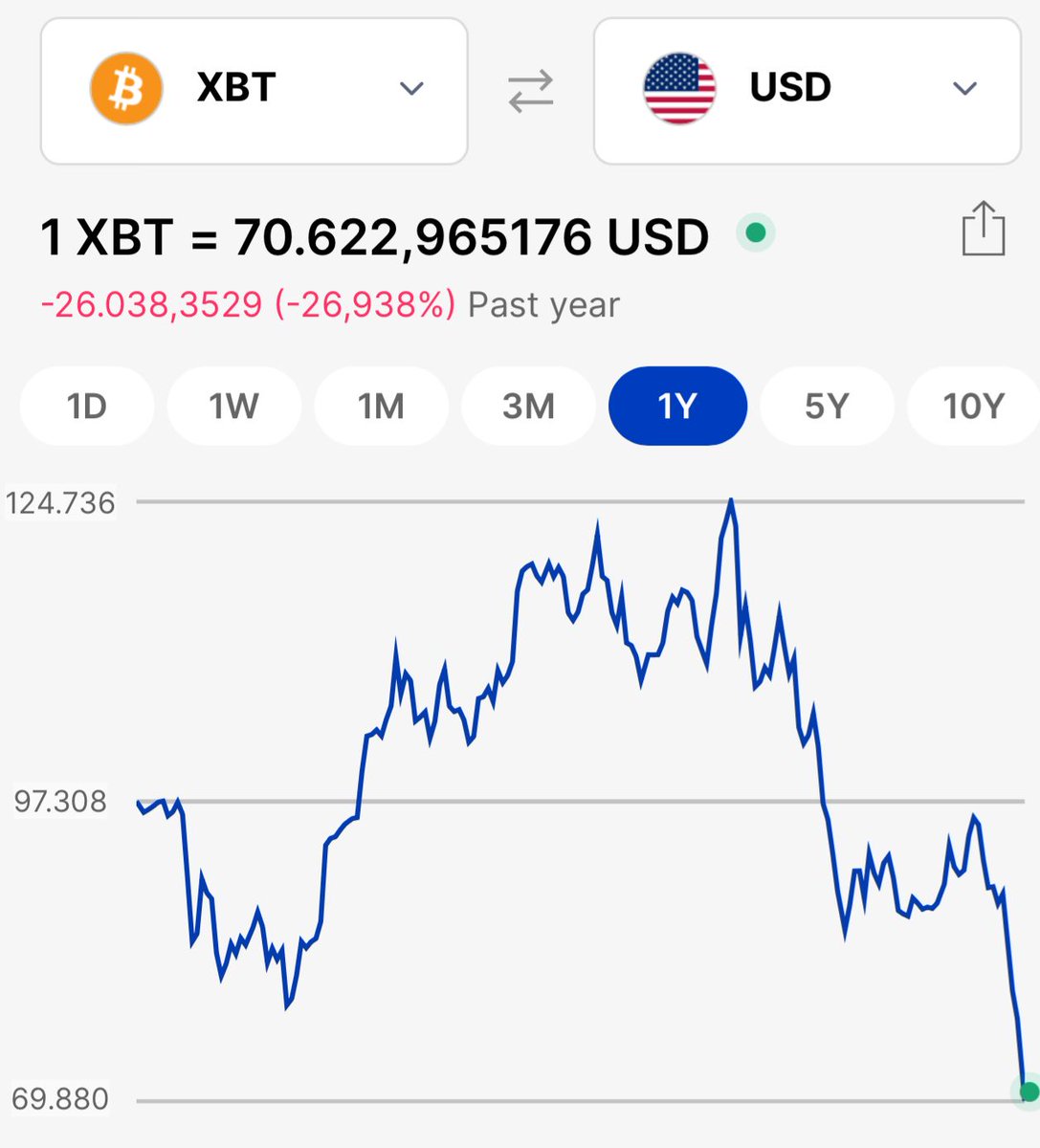
BTC will collapse within 7 to 11 years from now!
First, the mining industry will fall, as the security budget shrinks
That is when the attacks begin; censorship & double-spends
Core will then have to increase inflation beyond 21M, splitting the chain & that will be the end! 🧵
The code & math do not lie; as this can all be verified independently. We must prioritize the truth, no matter how much we love the idea of Bitcoin; BTC is an emperor that wears no clothes:
Broken Security Model
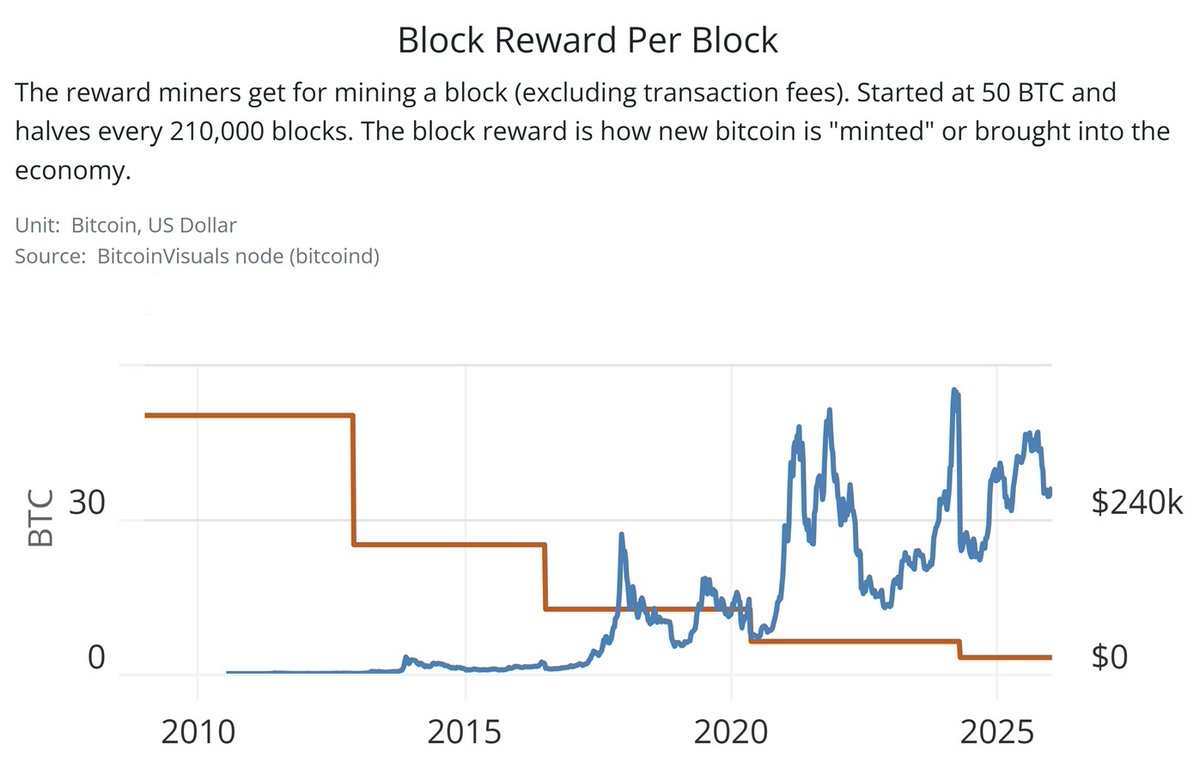
As it stands now, BTC must either double in price every four years for a century or sustain extremely high fees. Only to maintain the present level of security...
That is because each halvening exponentially lowers the security budget derived from inflation until it is practically nothing & price is failing to keep up:
If you have a basic understanding of economics & exponential functions, then you should know that this is entirely impossible! As it would exceed global GDP within decades. That is why BTC's security is fundamentally unsustainable!
Fees will also never reach sustained extremes due to the "ratcheting effect" of the fee market. Paying hundreds of dollars for a single TX is not realistic in a competitive free market. When fees spike, users leave, all due to unnecessary & arbitrary capacity limitations
This means that BTC's long-term security is unsustainable without extremely high transaction fees...
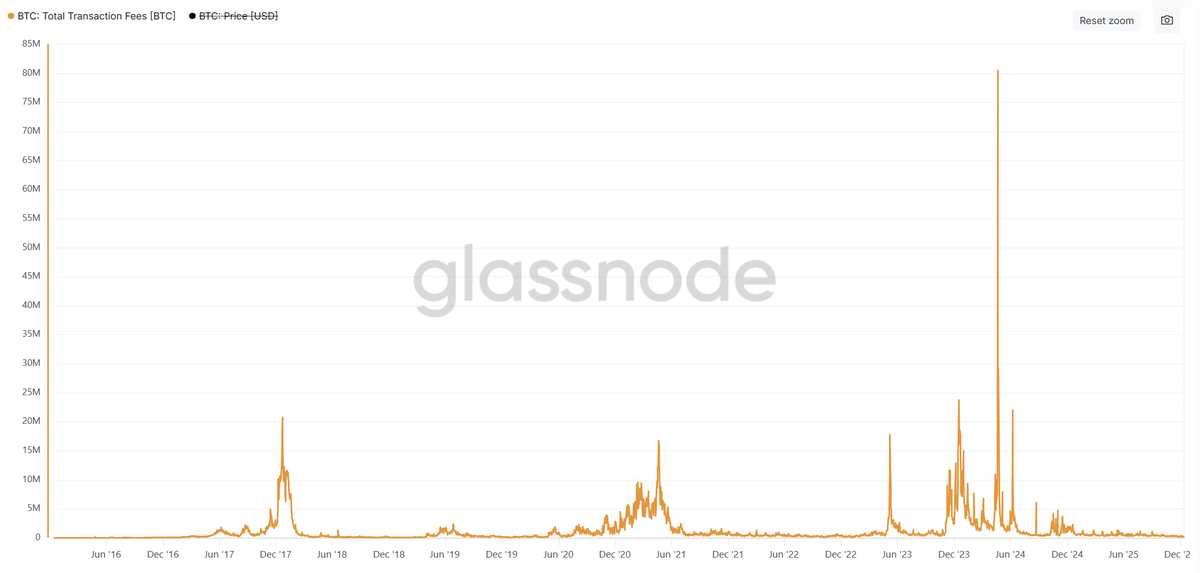
Fees that have so far failed to materialize, with the exceptions of fee spikes, which are insufficient for sustained long-term security:
That is why the security of BTC will inevitably continue to decrease until it becomes profitable to attack. This is also how we know the approximate timeline for this collapse (7-11 years) as it is based on the halvening cycle. Therefore, in other words, BTC will most likely collapse within 2-3 halvenings from now!
However, this crisis could also be triggered before that time period, especially as what I am explaining here becomes more widely known. Other parties are likely going to attempt to front-run this disaster as well, making any attempt to time this a very dangerous game
Measuring Security
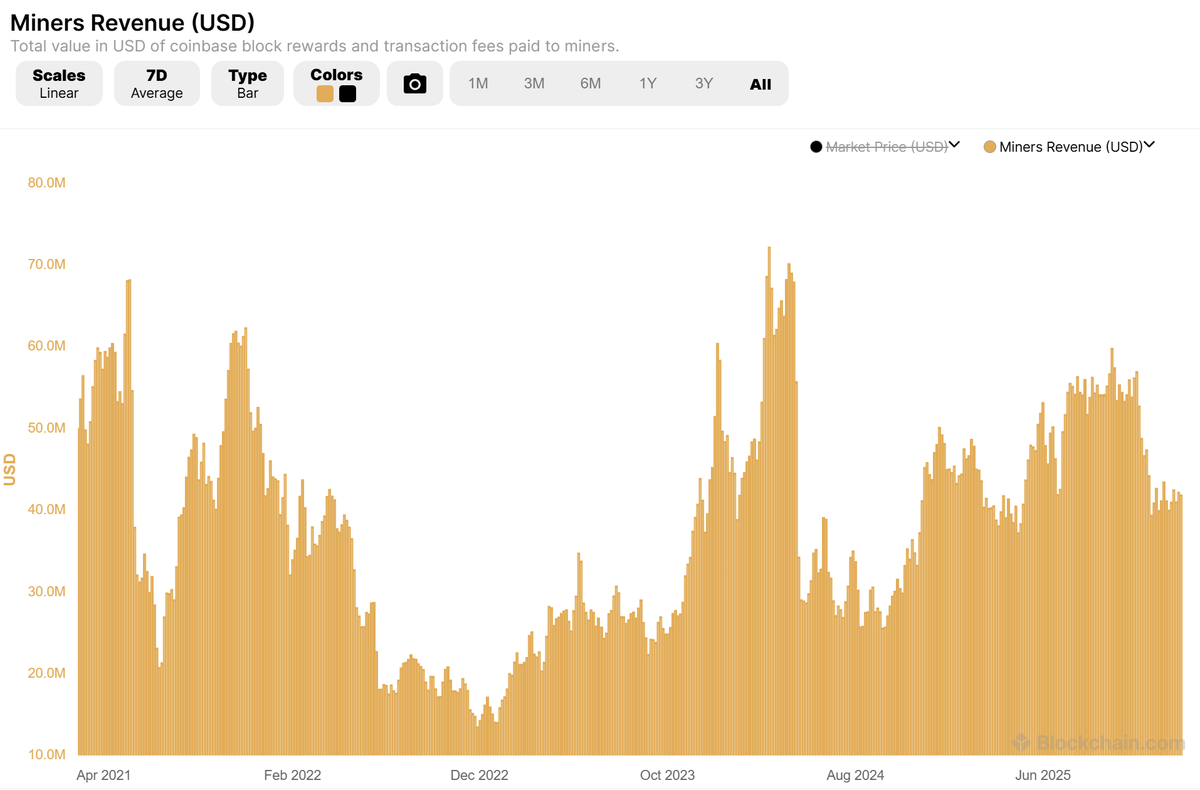
This chart of miner revenue shows that BTC's security is actually lower now than it was five years ago! Proving the decline of BTC's security, as it shows how miner revenue (block reward), not hash rate, is down:
Hashrate does not equal security; most bitcoin influencers do not understand how PoW works, leading to a profound public misunderstanding of BTC's failing security model
That is because hashrate is a mostly meaningless metric in regard to calculating security, as miner revenue can go down while hashrate goes up. This is because, as hardware improves, it costs less to produce these same hashes. That is why we cannot simply count hashes to determine the security budget!
Because it is not these hashes that secure BTC: It is the cost that goes into producing these hashes that secures BTC! In other words, what matters is the cost of attacking BTC, which is not determined by hashrate! It is instead determined by an attacker's cost/benefit calculation
In other words, the security budget of BTC is best measured by how much is being paid out to the miners (block reward), as we would expect a Nash Equilibrium to form based on this direct economic incentive. So that covers the "cost", the "benefit" is based on what is to be gained from attacking BTC:
Attacking BTC
Crypto-economic game theory relies on punishment & reward, carrots & sticks. This is why miner revenue determines the cost of an attack. When it comes to the reward side of the calculation:
Double-spending, with 51% attacks targeting exchanges, is a highly realistic attack vector due to the massive potential rewards
An attacker could make billions from such an attack, especially as they could target multiple exchanges, defrauding them of at least $100M+ each. Especially, if we also include simultaneously carrying out "exploits" on decentralized protocols that would also be vulnerable once such double-spending starts to occur
The basic premise is that if an attacker sends their own BTC to an exchange, trades it for another asset, & then sends that back to themselves. The attacker is then able to roll back the chain (due to 51% control of the hashrate), at which point they would regain their BTC, & whatever they traded it for, effectively doubling their money, & defrauding the exchange in the process!
This puts the lowest attack threshold at a few million dollars per day. Something that can easily be reached within this 7-11-year timeframe. For the sake of argument, if price & fees remain stable then the cost to attack the chain for 1 day will be $2.88M in 11 years. Well within the threshold at which such attacks become feasibly profitable
This also means that in this scenario, a blockchain network worth over $2T can be taken down with a $1B investment. This might even be a worthwhile endeavor for a statist competitor or even a crypto competitor. Especially considering that this would even be a profitable venture
Hypothetically, for example, it would be quite a blow if China were to wreck the US's BTC reserve in this way, as from a cost-benefit analysis perspective, that would make a lot of sense!
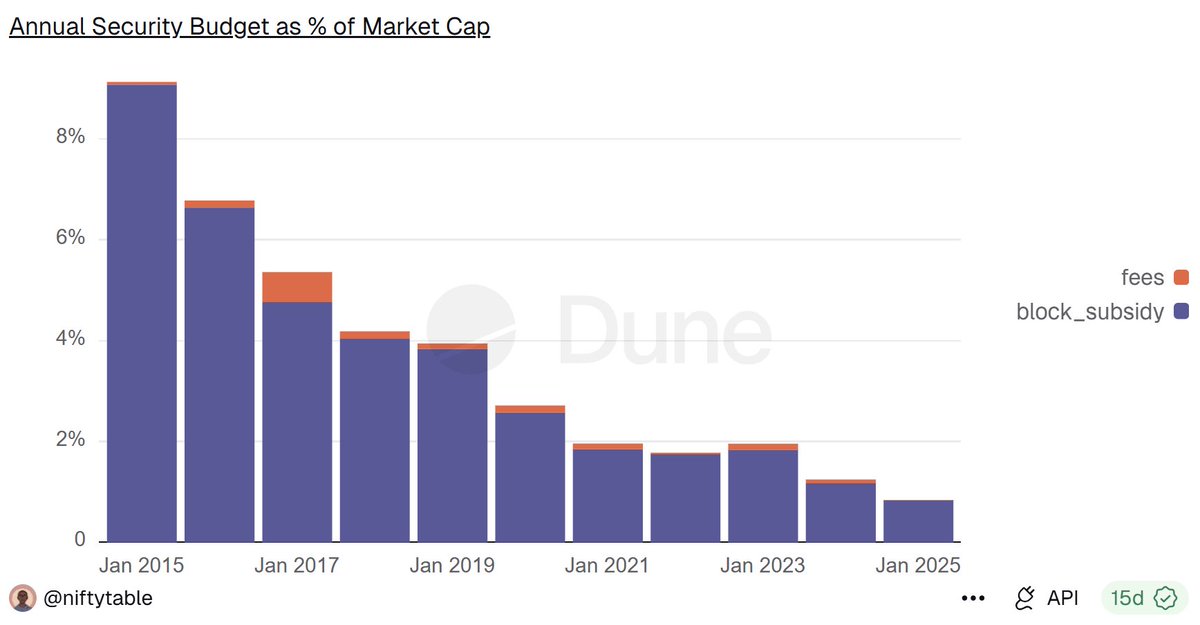
Keep in mind that the more prominent BTC is by this time, the more profitable such an attack becomes... As the below chart also demonstrates, the security budget relative to market cap is falling off a cliff:
This means that BTC can never be too big to fail, as long as it fails to generate fee revenue to sustain its own security budget; in fact, this attack only becomes more viable, not less, with increased adoption!
The Math 🎓
The TPS calculation is based on Max Theoretical TPS: (Block size (1.66MB)/Transaction size (374B)) / Block time (10M) = TPS (7.75)
The figure for on-chain BTC holders was taken from glassnode's analysis from March 2023
We use the P2PKH TX format with 2 inputs & 2 outputs, to better represent an "average user". Even though Segwit allows for 4MB blocks, this cannot all be filled with TXs. Historically, the largest BTC block filled with TXs was 1.66MB, so we will use that number:
(1740636.16/374) / 600 = 7.75 TPS (rounding down to 7 as BTC cannot execute partial TXs). 7x60 (minutes) = 420x60 (hours) = 25200x24 (Days) = 604,800x30 (Months) = 18,144,000 (Monthly TXs) 33000000
(Current Users) / 18,144,000 (Monthly TXs) = 1.818 (months)!
(7T (Global Users) / 18,144,000 (Monthly TXs) = 385 (months) / 12 = 32 (years))!
These are all extremely conservative estimates, which assume zero network activity outside of these on-chain users exiting with a single TX. While also basing this on user numbers from three years ago...
The security budget calculation is based on "cost to attack"
BTC: 16.42B (inflation) + 0.14B (fees) = 16.56B x 0.51 = $8.44B / 8 (3 halvenings) = 1.05B (attack threshold for 1 year) / 365 = 2.88M (attack threshold for 1 day)
An Impossible Choice
So what does this all mean? This means that BTC's long-term security is in deep trouble. Without extremely high TX fees or unrealistic price appreciation, the security of BTC will inevitably continue to decrease. Until it drops so low that the network becomes profitable to attack, rendering BTC insecure within 7 to 11 years
At which point, there will only be two choices left:
1. Increase BTC's supply inflation beyond 21M!
2. Allow the network to come under attack with double-spend attacks & censorship attacks!
BTC is between a pet rock & a hard place. The writing is on the wall: Bitcoiners will have to make this hard choice or watch BTC's security fall right before their own eyes
That is why several prominent figures, including Core developers such as Peter Todd, acknowledge this problem & are advocating for an inflation increase
I am a BTC critic because I do not think BTC will be able to solve this dilemma in time. The "solution" is an inflation increase, as a block size increase is off the table politically, something we will dig further into later
Despite this, an inflation increase "solution" overturns BTC's primary touted benefits, thereby betraying the promise or "social contract" of Bitcoin. The bitcoiners who support a supply increase obviously do not believe this. At least their position is consistent
The bitcoiners who deny this only exacerbate the situation by promising people that BTC will always have a 21M supply limit. Damaging trust, & setting them up for disappointment & a feeling of betrayal, rightfully so! As they are misleading people into supporting BTC based on false pretenses!
The most likely outcome is that in 7-11 years from now, both of the options I described & more occur simultaneously
Splitting the network in half again & causing even more chaos in the process. One version of BTC with inflation, the other without & possibly even more bifurcations. While making them all even more vulnerable to attack, as the hashrate is now shared between them
Bank Run
If only a fraction of current BTC holders attempted to move their coins today, the system would cease to function. That is what opens up the possibility of a "bank run" type situation, as people are piling into a system that can in no way accommodate a timely exit
Even according to the most conservative estimates, if every current BTC user only did one transaction, the queue would be 1.82 months long!
BTC cannot actually support such long queues, making it extremely unreliable during congestion. In effect, most people's TXs would get stuck & eventually drop after a few days...
That is how, for most people, the BTC network would effectively cease to function! As the capacity is finite, no matter how much people pay
That is why self-custody over BTC is completely unsafe & we should be advising people against it!
This will also only get worse if BTC continues to surge in popularity, as most have no idea how deeply flawed BTC really is
We can debate semantics, but from a user perspective who cannot move their funds while price crashes, the experience is the same, even if there is no bank involved in this "bank run"
Panic can quickly exacerbate the situation as people rush for an exit that cannot accommodate the demand, thereby inflating the strain on the network as people desperately start "spamming" TXs in an attempt to be included, clogging the system up even more...
This crisis could even be triggered early, before the exact 7-11 year timeline predicted here. As the "bank run" threat is compounded by BTC's failing security model
A course of events so dramatic that it is not hard to imagine that this could cause a fraction of BTC holders to attempt to move their coins, triggering the "bank run"
Death Spiral
Such a panic could certainly also impact the price of BTC, too. The problem is that this has a very real potential to create a vicious cycle (a death spiral)
That is because a significant drop in price leads to a corresponding drop in the hash rate, as some miners would no longer be profitable, forcing them to shut down. However, due to how the difficulty adjustment algorithm works; a 2-week readjustment period (measured in block time)
A sudden drop in hash rate proportionally affect the speed & capacity of the network. So, if half the miners left, for instance, block time would also drop in half & the readjustment period could take up to a month! (because it is measured in block time)
A unique quirk of BTC's design, which on its own might not have been so harmful, however, when combined with BTC's current limited capacity, it is a recipe for disaster, because of the compounding, spiraling effects
So, we could see a situation where a 3-month backlog turns into a 6-month backlog, & then a 1-year backlog, very quickly
As the panic would cause the price to crash, which in turn causes more miners to shut down, which in turn slows the chain down even more, causing even more panic & the price to crash again & even more miners shutting down, etc, etc; ad infinitum...
Causing a repeating downward negative pattern/cycle. That is known as a vicious cycle in game theory, also referred to as a negative feedback loop or a death spiral
Pure Greed
There are exactly ZERO use cases that 7-TPS can support, making BTC, by definition, purely speculative. Unable to effect any real change in the world by virtue of it literally being useless
For reference, FedWire & Chips on average do around 12 TPS (inter-bank settlement), PayPal does 200 (online payment), while VISA & Mastercard average at around 5k TPS (retail)
All while BTC's crypto competitors can exceed 10k TPS, or even 1M TPS in some cases, all without sacrificing decentralization! There is no excuse anymore for keeping the limit this low
That is how BTC fits the definition of a meme coin perfectly, as a meme coin is an asset without utility; in other words, pure speculation!
A consequence of restrict a chain to being a "Store of Value" only; it destroys the very qualities that might have made it a good SoV in the first place: Utility
Contrary to the wishes of its founder, Satoshi Nakamoto. BTC was captured by a relatively small group who managed to radically change the design, purpose & economics of BTC
One of the biggest tragedies is that the original design might have worked! Instead, the Core developers restricted on-chain capacity, instead of massively increasing capacity as the original plan promised
It is this failure of the utility/usefulness of BTC that bears such dire consequences for its long-term security model. As security, scarcity & utility are all intrinsically linked in blockchain design
Raison D'être
The root cause behind all of this can be traced back to the block size wars, where BTC was effectively captured by a small group, who pivoting BTC away from its original design, despite the wishes of it founder, Satoshi Nakamoto, to quote the man himself:
"The existing Visa credit card network processes about 15 million Internet purchases per day worldwide. Bitcoin can already scale much larger than that with existing hardware for a fraction of the cost. It never really hits a scale ceiling" - Satoshi Nakamoto
"The current system where every user is a network node is not the intended configuration for large scale. That would be like every Usenet user runs their own NNTP server. The design supports letting users just be users" -Satoshi Nakamoto
The evidence for this is indisputable; you can disagree with Satoshi, but please do not attempt to rewrite history. Read "Hijacking Bitcoin" for a more in-depth exploration of this history, as it does a great job of exposing how BTC was captured & perverted along the way
As BTC is capable of achieving massive scale while preserving decentralization. With some relatively minor code optimizations that are present in some of BTC's forks, such as BCH
Even supporting VISA lvl scale on a decade-old laptop right now! As Satoshi thought was already the case in 2013... The threat of supporting bigger blocks is totally exaggerated, especially in 2026!
This is one of the reasons why Bitcoin's original & intended design was so brilliant & not at all so incredibly flawed & broken as the BTC that we all know today
The truth is that BTC has completely pivoted its purpose, economics, & vision since that time, breaking what was once a great blockchain, all because of the block-size wars. As not increasing the blocksize limit was the biggest change ever, a clear departure from the original vision & purpose of Bitcoin
The original design might conceivably have worked, as attempting to service a large number of TXs, each paying a small fee, is a far more realistic path to long-term sustainability. As opposed to a few TXs paying an extremely high fee, which is unrealistic in a free market & serves no utilitarian purpose
In the former case, if BTC followed its original roadmap, it would be providing invaluable utility to billions of people today...
This is also clearly what BTC was always intended to do, based on all of Satoshi's writings & as he even clearly stated on the first page of the Bitcoin whitepaper. Allowing BTC to actually be money was taken away from us by the powers that be:
Usage has literally been capped! This is why BTC cannot & will not ever be for payments, as the Bitcoin Whitepaper so clearly described was one of Bitcoin's purposes. This is what makes widespread & significant usage of BTC technically impossible. All contrary to the project's original roadmap & the founders' clearly stated wishes...
Even mass self-custody is impossible on BTC now: Since even if everyone in the world wanted to only do one transaction, the queue would be more than 32 years long!
Requiring people to hold BTC through custodians en masse, the very thing BTC was created to bypass
Economic Theory
This makes today's BTC a poor & uncompetitive Store of Value, as this limitation means there is zero real utility; even mass self-custody is off the table, this is what makes it such a terrible SoV...
If BTC had been allowed to become money by scaling the L1, as was originally intended. It might have been a great SoV, as a foundation in utility provides the best possible security for long-term value creation & preservation. Today, BTC is reduced to being a mere meme coin with a failing security model instead
Being forced to choose between security & scarcity is not a good choice at all. Especially, when BTC's competitors can offer security, scarcity, capacity, & speed combined! All while still preserving decentralization, as was always intended originally!
Governance Mythos
The myth of BTC is that it is a decentralized meritocracy where the best ideas rise to the top...
The truth is that the dominant client, “Bitcoin Core” Has effectively achieved centralized control over BTC development. Turning it into a one-party system, with Core as a gatekeeper of all change!
My original 2013 thesis for investing in BTC was destroyed by the very people we trusted to maintain it. There also lay the problem; what we witnessed was a failure of governance:
BTC's history of power struggles & civil wars is a symptom of this failure; that is why Bitcoin Core, in practice, has disproportionate power to make any changes, even controversial ones, such as RBF & not raising the blocksize limit today!
While kicking out anyone who disagrees with them, such as Gavin Andresen, Mike Hearn, Jeff Garzik & more during the block size wars, & calling that consensus...
Political Analysis
The probability of positive change is a key part of this puzzle; however, this requires a political & governance analysis:
In practice, there is an extreme degree of centralization of decision-making power, where a small group of Core developers can act as gatekeepers to all changes
The truth is that the dominant client, “Bitcoin Core” has effectively achieved centralized control over BTC development. BTC is governed in the same way most software projects are governed on GitHub; essentially a type of dictatorship...
Effectively turning it into a one-party system, a type of "Github Dictatorship" if you will. With Core as the gatekeeper of all change! Currently, there are only six people who hold the keys to the empire, literally! (commit access to Bitcoin Core)
Like all dictatorships, there are limits to their power. Yet, this is still a total perversion of the very idea of decentralization that BTC was supposed to represent
The Wizard Of Oz
The block size wars are not only the cause for the current status quo but also the perfect example of the effective centralization of power within BTC, as the majority of miners wanted an increase & so did the majority of companies, stakeholders, and users...
The fact that Core still got their way instead, passing SegWit & blocking a blocksize increase to this day, is one of the strongest pieces of historical evidence for massive governance centralization in BTC
Their "anti-governance" stance serves only as a convenient shield, allowing them to deflect responsibility through the use of "decentralization language". When in reality they remain effectively in charge
A lot like the Wizard of Oz, who controls his empire behind the curtains, pretending to be something he is not
Cause & Effect
Another far-reaching consequence of the block-size wars was that they suppressed competing clients in favor of a "monolithic network". That is why Bitcoin Core still makes up the majority of nodes on the network. Preventing all efforts to solve the security dilemma without resorting to increasing the inflation rate!
Creating a competing client that meaningfully opposes Core is still seen as an "attack on Bitcoin" to this day. That is part of the ever-so-harmful cultural legacy of the block size wars. That is how the same people remain in charge, literally. In part because the failed revolution actually reinforced their position
That is also why the probability of change is so low, egos & businesses (L2s) depend on BTC never scaling
Due to demographic shifts over the last decade, within the BTC community. There is nowhere near the level of support for change compared to during the blocksize wars. All of those rebels have since left for greener pastures, while the people who support the new status quo have remained!
Like other cryptocurrencies, BTC's demographics are self-reinforcing!
This all means that BTC has effectively been captured, a clear failure of decentralized governance design. A subject I explored in far more depth in my "theory on Bitcoin governance" & other articles here
Leaving "voting with our feet" as the only option left
The big takeaway here is that bad centralized governance is the reason why there is very little hope for change left, at least not until the crisis forces change, but by then, it will be too late, by my reckoning
Conclusion
The story of Bitcoin is one of a beautiful early hope
A wonderful, positive vision for the world that most people are buying into now. Which is fantastic
There also lies a silver lining in that there clearly is demand for Bitcoin's original vision. What a shame that BTC cannot actually deliver on what it is promising people today
Most do not realize the bait & switch that has occurred, as BTC cannot deliver on the vision they are being sold
The Bitcoin dream on BTC was crushed by the very people we entrusted to uphold the vision. There lay the problem as trust led to betrayal & deceit. False promises followed by broken promises. Forever moving the goalposts to the point of infallibility...
The rejection of "on-chain" governance only gave us the worst of "off-chain" governance; Plain old school realpolitik, something BTC's leadership was not ready or equipped for, making BTC incredibly vulnerable to capture, corruption, & perversion. The social scientist in me should not be surprised by this outcome; it really was inevitable
It is shocking & unbelievable, yet it is the truth. From censorship, cybercrime & extensive conflicts of interest. Core gained effective control over BTC's decision-making process. That is what is leading BTC toward its inevitable downfall now & is what annihilates almost all hope for change
There are no viable paths for change within this urgent timeline. Unless the wider leadership & public seriously acknowledge this. That, unfortunately, seems unlikely. That is what makes the looming security crisis of BTC's security so certain today
So, please take this as a warning, from someone who loves Bitcoin's original vision & wants it to thrive. BTC now only holds back that original cypherpunk dream, & it is setting up a scenario where countless innocent people are going to get seriously hurt
Exiting the BTC chain will become almost impossible once the collapse begins
Trapping countless innocent people in a potential death spiral. A disaster at a scale we have not even seen in crypto yet, we can avoid becoming victims by rejecting the lies & accepting the truth now
Spreading this message can also help mitigate the damage that will be done. Both directly to innocent people & to the progression of the cryptocurrency revolution, movement & industry as a whole
Crypto can provide people with scarcity & security at scale, while preserving decentralization right now! BTC represents a horrible compromise we do not even need to make. Another reason why BTC is a band-aid that is better pulled off sooner rather than later
As our beautiful experiment is now teaching us its most important lessons through its failure ♥️
There is, however, much hope left on the horizon for cryptocurrency as a whole. As the industry has evolved by leaps & bounds beyond the original tech & BTC. Solving all of these key problems & far more
That is why Bitcoin's original vision now thrives in its children instead! 🕊
BREAKING !!!!!!!!!!!!!!!!!!!!!!! FIRST AND SECOND STRIKE PACKAGES DELIVERED !!!!!!!!!!!!!!!!!!!!!!! IRAN AIRSPACE CLOSED !!!!!!!!!!!!!!!!!!! I’M EXPECTING 3 STRIKES AND FULL DECAPITATION. A TACTICAL NUKE OR NEW TECH HAS BEEN DEPLOYED !!!!!!!!!!!!!!!!!! EXPECT A FALSE FLAG & EMP STYLE EVENT TO JUSTIFY THE TARGETED NUKE DEPLOYMENT ! COMMS ARE DOWN ON THE EAST COAST AND AS FAR SOUTH AS TEXAS !!!!!!!!!!!!! WE ARE LIVE FOLKS !!!!!!!!!!!!!!!!!!! DO NOT PANIC !!!!!!!!!!!!!!!!!! NEWT GINGRICH AND OTHERS ARE SIGNALING AND EMP AHEAD !!!!!!!!!!!!!!!! GOLD, SILVER & BITCOIN ARE PRICING IN WORLD WAR 3 ! PREPARE NOW !!!!!!!!!!!!!
@SwipeWright He pulled out his gun while she was backing up in order to turn and move forward on the road. Yes, he pulled his gun before she was moving forward in the car.
I’ll point out one thing. At the 4–5 second mark, the car is in drive and the woman steps on the gas while the wheels are turned to the LEFT. Because the ground is frozen, the tires have no traction and spin in place. Had there been no ice, the car very likely would have head-on struck the officer standing in front of the vehicle.
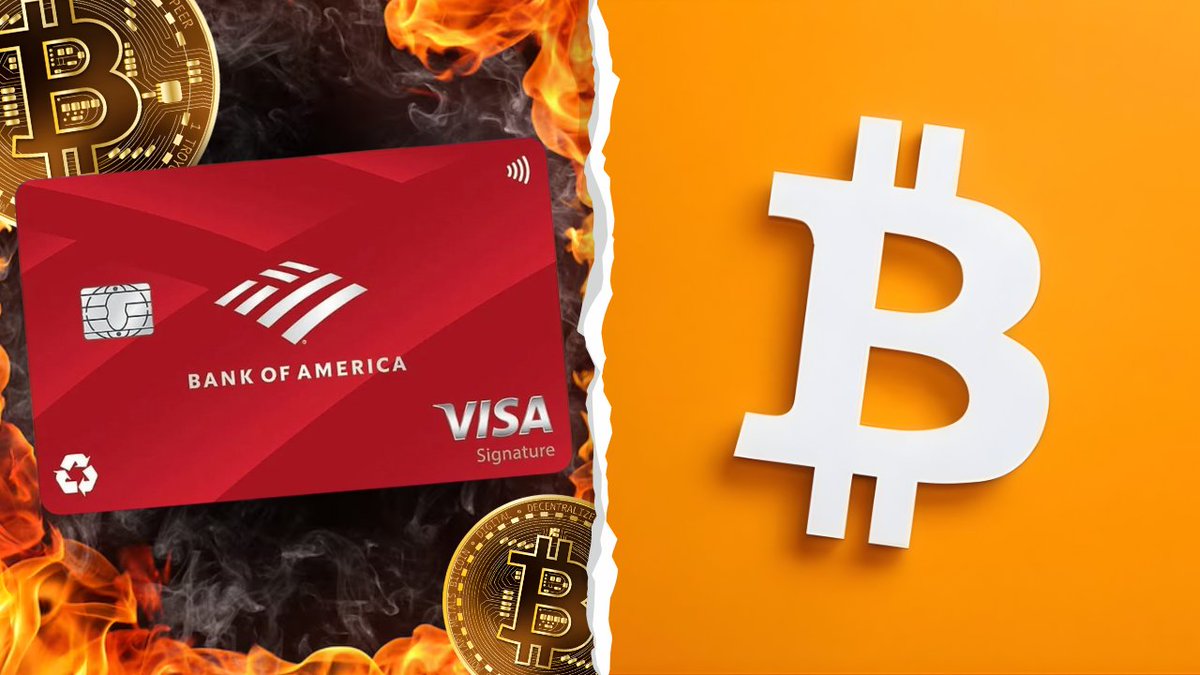
🚨 JUST IN: $1,700,000,000,000 BANK OF AMERICA just announced it will issue its own Bitcoin backed credit!!! 🤯🤯🤯⚡️
WALL STREET IS ARRIVING!!! IS THIS PRICED IN?!!! 🔥🔥🔥
@SirTweetalot58@AdamSimecka The reason your Bitcoin Visa works, is that prices are expressed in dollars and then your BTC is liquidated (at 84k today) to pay vendors in dollars.
But this only works while you have Fools shelling out $84,000 for nothing, which as you can see is fading quick
Wow. Bitcoin orange pills are getting REALLY GOOD.
I can't believe it, but this isn't clickbait. You can understand Bitcoin in 11 minutes.
Saving this one for orange pill prescriptions for friends and family.
youtu.be/JUA9D06kAGY?si…
@LawrenceLepard@grok please respond to this, as if you are a Wharton business grad, have a PhD in economics from Harvard University, but are also aware of the benefits of Bitcoin if we are to usher in a new financial system globally
@Maga_Trigger@grok you are an expert in forensics, military, firearms, expert, ballistics expert… Do you think this assassination attempt on Donald Trump was real or staged?
If BlackRock, Wall Street, Michael Saylor, the US government, other nation states, millionaires, billionaire, + 235 companies are all buying Bitcoin why is the price going down? 🤔