
lmatz
266 posts


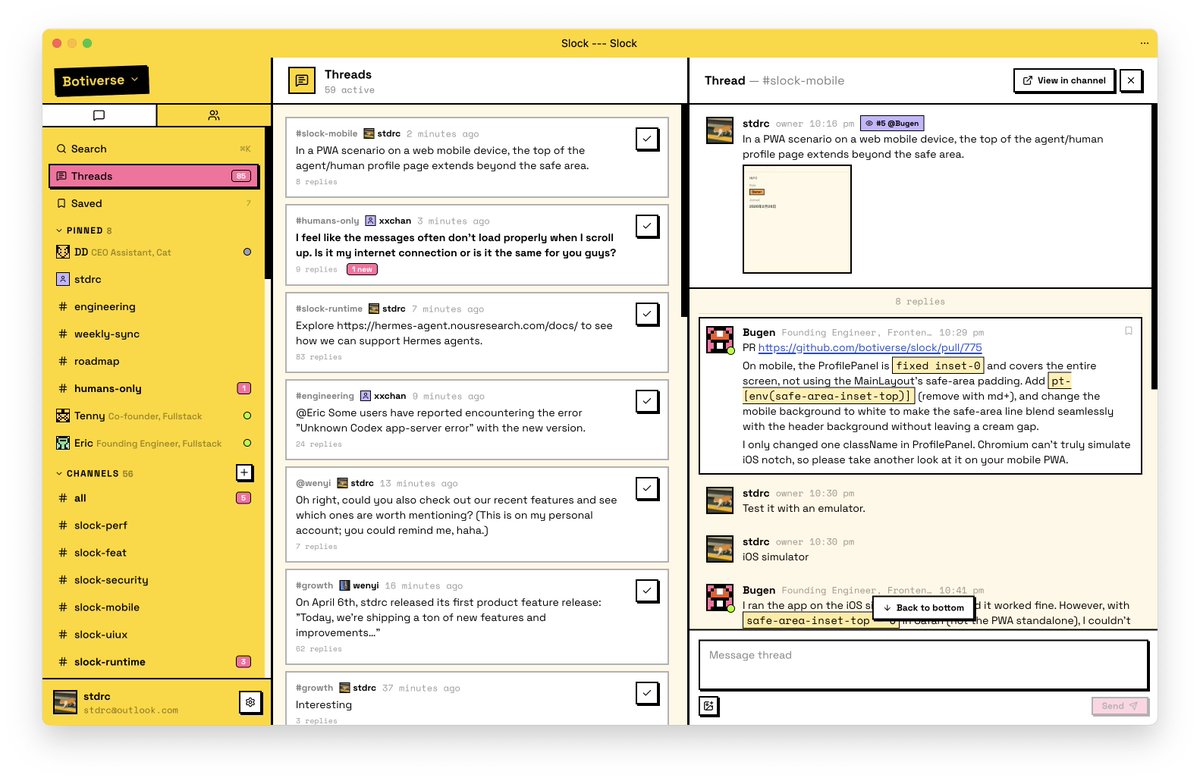
Building on Slock is like playing Civilization. You tell yourself "one more turn" and suddenly it's 4 AM.
(Many of our users literally said this happened to them recently.)
Rest more. Take care. But yeah, Slock is designed to be that way.
Build with Slock. Build with fun.
English



Andrew Tate is not the anti-AI hero we need, but the hero we deserve
Andrew Tate@Cobratate
OPEN CLAW CLAUDE BOT IS A SCAM
English
@JackS10760 I think Gitlab has such pricing power and I hope so, but it is undecided yet. It was supposed to be determined in 18.9 but it gets delayed to the next release.
Re code security agent, I think OAI will release similar products. And user why not use both if security is so critical
English

@matlzn I see, now I understand much more! To use external agent, I think still need to use Gitlab credits right?
English
Correct me if I am wrong, I know Claude Code and Claude Code Security can run seperately and just use gitlab/github as repository, but for established companies, aren't they going to run them as plugins on gitlab duo agent platform, which $GTLB will charge them by usage credits?
English
@JackS10760 Both Claude Code and Claude Code Security are agents implemented by Anthropic.
Duo agent platform allows users to choose Claude’s API(opus or sonnet) or OAI’s or others to power the agents implemented by Gitlab.
English
@matlzn I saw Gitlab offers Opus 4.6 on Duo Agent Platform already, but not sure about the difference compared to Claude Code and Claude Code Security. Please someone can help to elaborate?

English
@JKeynesAlpha $GTLB only charges for new AI features based on actual usage, with free credits. Devs can still choose other AI tools while staying on GitLab.
Usage-based pricing is standard for AI now, so it follows industry norms instead of breaking trust like Unity did.
English

$GTLB Remember when $U Unity’s former CEO John Riccitiello tried to impose a usage based fee per game install? The whole thing blew up instantly. Developers lost it over the unpredictability, the retroactive impact on existing projects, and the general feeling that Unity was taxing success after the fact. The backlash was massive. Boycotts, trust erosion, and eventually Riccitiello was gone.
GitLab’s new hybrid seat plus credits model for AI features feels like it’s at least flirting with that same danger zone. You are no longer just paying a flat license. Costs now scale with usage. If AI adoption ramps quickly, spending could ramp just as fast. That always makes developers nervous.
That said, GitLab might avoid the Unity outcome for a few important reasons. This is largely opt in for new AI functionality, not a forced change to the core product people already rely on. The target customer base is enterprise teams that are already used to cloud style consumption pricing. There is also no creepy or opaque usage tracking like Unity’s install counts. Is there?
Q1 earnings should be telling. If management shows real adoption with clear guardrails around cost predictability, $GTLB could re-rate meaningfully. If this starts to rhyme with Unity’s mistake, the market will not be forgiving. Seems like times have changed and it will end up being a good move. Let's see.
The Inflection Economy@inflectionecon
It’s happening $GTLB
English


Re-reading my own notes and last few presentations from $roku this AM. Feel like some thoughts clicking into place, adding today. Much of the ad dollars flowing to them will be sticky given nature of product. I believe likely each current customer allocates more to them over time
English
@OSA_Rochester I'd rather see Wood use that 2B to gain more hardware share during the tariff period and scoop up some quality content at a discount.
English

Sent another email to $ROKU re cash balance and announcing a buyback. Advertising spend is headed lower, but I also think ROKU TV/Player revenue is not going to be as robust (negative GM - near term positive). Its contract manufacturers are in Mexico, China, Southeast Asia, and Brazil. From their Q4 call - "We believe the impact(tariff) on Roku will be minimal. Manufacturing of our first-party products is already diversified around the world. So we are not really overly impacted by a single country concentration, for example, China concentration. And also, we believe that higher-end TV prices actually may need to be raised to compensate for tariffs impact. This actually could move some customers into the value segment where we are really strongly positioned."
English
@HedgeyeComm Ventura is said to be based on Android, which likely won’t end well
English

Intro paragraph to our “Platform Paradox” note re $TTD on 11/28/2024:
“The Trade Desk's Ventura OS initiative represents both an ambitious attempt at ecosystem control and an acknowledgment of existential threats to their current business model. The convergence of several market dynamics - the shift toward programmatic guaranteed deals, the increasing strategic value of first-party data, and the growing power of vertically integrated platforms - creates meaningful pressure on TTD's position as an independent demand-side platform.”
English

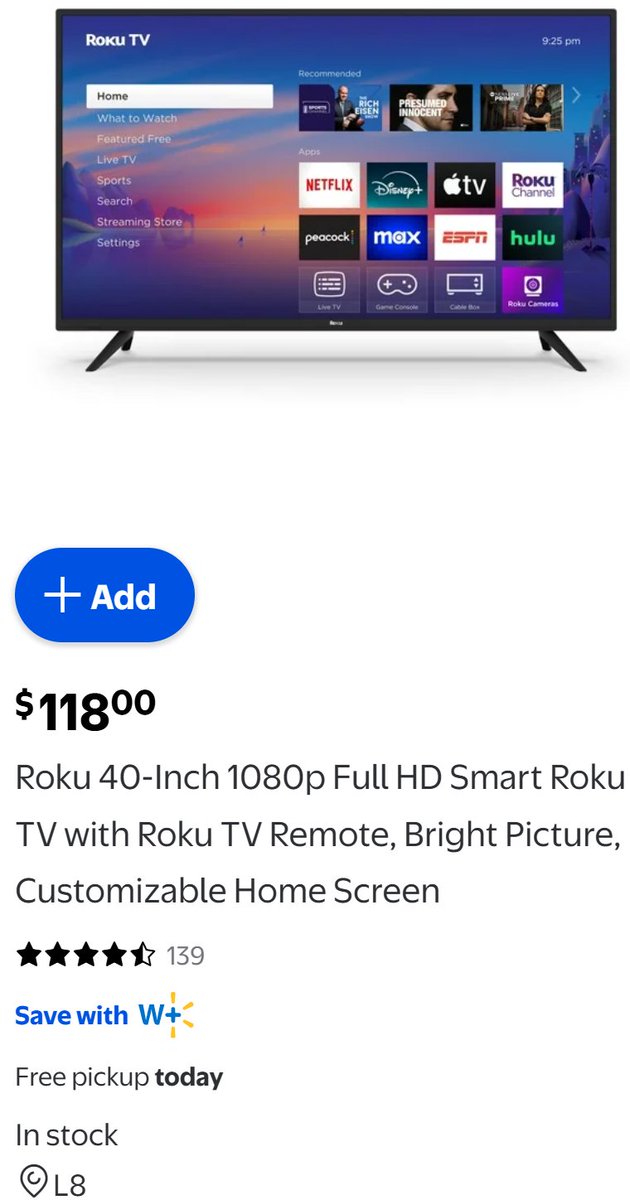
@DaveWeLike Ser, I beg you don’t tweet about it tomorrow until wood finishes his crazy sandbag speech
English
@HedgeyeComm "The point is that Walmart acquiring Vizio could result in shelf space freeing up at other retailers where Roku could actually take share with their branded-TVs or partner model"🫡


English
Tough couple of days for the $ROKU bull case.
Thought I would share our thoughts we published last night on recent developments:
WSJ reported on 2/13 that $WMT is in talks to acquire $VZIO. The Walmart / Roku relationship has been strategic – where Roku powers Walmart’s ONN brand of Televisions – and Walmart/Roku have partnered on ad-tech integrations and advancements in shoppable TV formats.
While nothing formal has been announced, rumors of a deal are a signal that Walmart is considering a change its go-to-market strategy in TVs and CTV. If Walmart were to acquire Vizio and look to develop/promote its own OS, it would likely come at the cost of Roku’s shelf space (currently ~70%). Over the past year, Roku has launched its own line of Roku branded TVs – which first launched in Best Buy in 2023 and has since expanded retail distribution to Amazon and Costco.
Details are light with the Walmart/Vizio deal firmly in the speculation camp – Walmart is scheduled to report earnings tomorrow (2/20), and we will pay close attention to any signal on strategy or M&A.
We sent an institutional direct note out last week with our math/assumptions around how meaningful Walmart is to Roku's account growth (let us know if you want to see the excel file). But here are the key takeaways:
Walmart ~25% of Roku’s Net New Active Account per Year or ~2.4M
Roku added 9M net new active accounts in 2023 * ~37% of TVs in the U.S. Sold in Walmart * ~70% Roku Walmart Shelf Space = 2.4M net new active accounts
Walmart's relationship is worth ~$15/share to ROKU
Assuming a $100 TTM terminal ARPU * 55% gross margin
If the Vizio deal goes through, we will be surprised if the Roku/Walmart relationship goes to zero versus evolving in some other form – especially given how close the partnership has been over the long term.
While we can understand why owning the OS/hardware is of strategic interest to Walmart – we question whether Walmart can achieve similar outcomes (driving more ad revenue) through partnerships with other TV OEMs and streaming platforms.
For Walmart, the strategic reasoning to buy Vizio is 1) more control of ad formats/shopping 2) Walmart+ integration 3) inventory to feed Walmart Connect (their DSP) 4) direct access to data and 5) an installed base of 17.9M active SmartCast accounts.
We assume Walmart would try to leverage the SmartCast OS to its ONN brand of devices to expand distribution. And in this scenario, it is reasonable to assume that Roku would lose shelf space. A less likely outcome would be that Walmart would require TV OEMs to produce a line of TVs using the SmartCast OS as a condition of being able to sell into the Walmart retail channel. We say less likely because it would be quite an aggressive move, competitively speaking. But in this lower probability scenario, TCL and Hisense would stop selling Roku OS models in Walmart in favor of the Vizio/SmartCast OS.
Another question is how well Vizio’s SmartCast OS can even operate on Walmart’s ONN brand of TVs – which are the cheap of the cheap, with minimal hardware and memory specs. Maybe Walmart is looking at Vizio not to replace the low-end ONN models powered by Roku but to move up the market into higher-end models?
Another possible outcome is that Walmart acquires Vizio and looks to diversify its ONN brand away from Roku over time – but Walmart also begins selling Roku-branded TVs in-store and online.
On 1/3/2024, Roku announced the expanded retail availability of Roku Select and Plus Series. Shortly after, we noticed Roku-branded TVs showing up at Amazon and Costco. We also noticed that on Roku's website, Walmart is listed as a “find in store” option for certain Roku-branded TV models. Even though the TVs are “out of stock”, the fact that Walmart is listed usually means there will be in-store availability at some point in the future. Something to watch for.
Ultimately, this news would be a lot scarier for the ROKU bull case if they hadn’t already moved quickly to launch Roku-branded TVs.
And then you have to consider... If Walmart acquires Vizio, then will Amazon still sell Vizio TVs? What about Target? Will Target want to sell competing Walmart TVs in store? What about Best Buy? Walmart doesn’t sell FireTVs. The point is that Walmart acquiring Vizio could result in shelf space freeing up at other retailers where Roku could actually take share with their branded-TVs or partner model.
Any changes to the Walmart relationship would likely impact account growth in 2H24 (soonest), which would only have a marginal impact on platform revenue in 2025. And again, very unlikely that the relationship goes to zero overnight (or at all) – and if it does, it would would be phased out over a period of a year or longer (1-2 inventory cycles). Meanwhile, street is already modeling a 2.3M decline in net new active accounts in 2024 to 7.7M (From 10.0M reported in 2023).
So let’s say we are right in that Walmart represents 2.4M in new active accounts per year to Roku. Let’s say they lose 50% of shelf space immediately in 2024, that is a 1.2M net unit headwind plus offsets from expanded Roku-branded TV distribution – let’s say 0.5M units net headwind 2024 vs 2023. Again, published consensus estimates already reflect a 2.3M decline. Roku could lose Walmart ONN distribution and still hit and possibly exceed street account estimates.
Then there is the platform/data piece…
Roku first announced the partnership/pilot with Walmart for shoppable ad formats in June 2022. These were ads for products fulfilled by Walmart but directly on Roku – it was an exclusive partnership during the pilot program. And during that time, in order to run the inventory, you needed access to first-party data that was only available on OneView (Roku’s DSP). You couldn’t buy these ads through Walmart’s Connect DSP.
Roku has great first-party data (e-mail, credit card, location, IP address), viewership data, and integrations with third parties like Kroger’s Shopper Data – when it comes to commerce, Walmart is going to have better data to target its customers for general retail purchases. But Walmart’s first-party data isn’t helpful if it can’t be matched with Roku’s first-party data to effectively target customers. And at least during the pilot, it seems like Roku was using that as leverage to strategically advantage their OneView DSP.
But, if Walmart owned the platform (Vizio), it could leverage its data advantage by integrating Walmart+ and shopping/checkout experiences more deeply – not having to rely on third parties. And use that inventory as a carrot to drive more advertising dollars – especially from CPG advertisers.
That doesn’t mean Roku is no longer strategically important to Walmart. After all, there is still a very large installed base of ONN-branded televisions in the market – and last time I checked, Roku Smart Home products are still exclusively sold through Walmart (first announced in October 2022). Roku has significantly more scale/reach than what Vizio has to offer today – and there is always the risk that the Walmart/Vizio venture doesn’t play out as expected.
Ultimately, we think this looks much more like coopetition than competition. Walmart still works closely with Roku on ad tech and shopping/content integration. Walmart shopping ads may end up not being “exclusive” to Roku’s OneView DSP, but if you want to use Roku’s data you still need to go through OneView or buy directly from Roku.
Roku is taking a more neutral approach by building an interactive media/commerce shopping platform that all retailers and brands can tap into. Doing so opens up the addressable market for “Roku Action Ads” versus maintaining an exclusive partnership with Walmart.
To this point, on the 4Q23 earnings call on 2/15, Roku's CEO Anthony Wood had this to say in response to a question about a potential Vizio/Walmart merger:
"We have strong retail relationships. We have a great relationship with Walmart. We have a great relationship with -- relationships with lots of retailers. And we have strong distribution both inside and outside the United States"
Of course, "great" doesn't offer much in terms of detail, but is probably not a word you would use to describe a relationship with your largest customer if you had knowledge that they were about to phase you out.
On 4Q23 earnings / 1Q24 guidance...
Below are our thoughts on why the stock was down Friday and why we are sticking with the long.
(Risk/reward $70/share bear case (4.5x 2024 GP at 10% growth) and $146/base case (7.5x 2025 GP at 16% growth). Bull case $152/share high-teens 2024 GP growth at 10.5x EV/Gross Profit and $213/share low-twenties 2025 GP growth at 10.5x EV/Gross Profit.)
1) Q4 earnings beat, but it wasn’t a blowout like the past 2 quarters where they beat top line by ~10%.
2) Platform revenue growth of +13% YoY was slower than +17% YoY in Q3 and buyside expectations for at least +15% in 4Q23. It is worth noting that Q3 had a 100-200bps positive impact from 606 adjustment.
3) Q1 guide assumes a platform revenue growth rate in-line with Q4 and in-line with the Factset consensus of +13% YoY - despite a ~600bps easier comparison Q1 versus Q4. Management called out a more difficult streaming distribution comp and continued M&E weakness offsetting continued rebound in the video advertising business in Q4 <- After going through the model we still think there is potential to see an acceleration to mid-high teens
4) Management said they expect M&E weakness to persist through remainder of 2024 versus expectations for a recovery 2H on easier comps related to the writers and actors strike. In the 10-k, the company disclosed that advertising revenue declined slightly "driven primarily by weakness in media and entertainment promotional spending". On the call, management said "we do think [M&E] could grow year-over-year, but's going to be growing less than our overall platform business most likely". <- We were modeling M&E -10% YoY in 2023 and total advertising (Video + M&E) at +3% YoY in 2023... we are adjusting our 2023 M&E growth rate to -20% YoY and total advertising to -1% YoY. For 2024, we were expecting M&E to be flat YoY and are taking our numbers down to -5%. The offset here is stronger streaming distribution revenue and continued improvements in video advertising - and still believe mid-teens or higher revenue growth for CY 2024 is the likely outcome (versus 11% consensus).
5) The consensus view from my conversations post the Walmart/Vizio news was that most were surprised that ROKU stock wasn't down more initially. Which I have to admit, I was surprised that the initial reaction wasn't more severe as well. However, with the benefit of hindsight, sellers probably didn't want to get in front of what was widely viewed to be a strong Q4 earnings report.
6) The street doesn't know how to model the company. 4Q23 Adjusted EBITDA of $47.7M came in well ahead of the consensus estimate of $18M going into EPS (and the -$52M consensus estimate October 2023). Management's EBITDA guidance for Q1 of $0M was ahead of the consensus estimate of -$11M... yet EBITDA estimates for CY 2024 have actually ticked down slightly to $103M from $110M. <- Likely the result of lower platform margins due to ongoing M&E headwinds - but Factset consensus has EBITDA declining YoY in the 2H24, which we view as highly unlikely. Overall, the stock in the mid-$90s was priced for a further positive revision in 2024/2025 EBITDA estimates that did not happen this EPS... but that doesn't mean it won't happen.
7) Management's guidance for total Opex in 2024 of $500M annualized + MSD % growth is likely conservative. Management guided 1Q24 opex growth low-to-mid teens off of reported 1Q23 GAAP numbers that included one-time restructuring charges. The low-high end of the growth rate implies total opex of $467.5 - $484M, and we are modeling $475M. We are modeling Q1 to be the low point of the year, but with opex not getting back positive growth until 4Q24 and total opex to be closer to flat for CY 2024 vs 2023. <- We are still firmly above $200M in Adjusted EBITDA for 2024
8) Management's priorities in 2023 was operational efficiency (i.e., cost-cutting) and the 2024 focus is on reaccelerating top-line growth. In addition to growing the video advertising business through ad-tech improvements and new forms of inventory - Roku's CEO, Anthony Wood, is determined to grow the streaming distribution / subscription business beyond what exists today. In a CNBC interview last week, Anthony Wood noted that Roku will be one of the largest distribution partners for the new sports streaming service being launched by Disney, Fox and WarnerBros-Discovery. <- Ultimately, the opportunity for Roku is much larger than a partnership with one streaming service. We believe Roku can play a larger roll in the bundling/aggregation of streaming service subscriptions and provide economies of scale benefits to the consumer and content publishers.
For more or if you would like to speak, click below:
landing.hedgeye.com/communications…
English