
Matt C. retweetledi
Matt C.
415 posts

Matt C.
@matte_ce
ML/CV PhD @RiceUniversity. Currently learning about UQ, LMs and Agents.
Bay Area CA / Houston TX Katılım Haziran 2020
222 Takip Edilen113 Takipçiler

Theory is cheap; now onto real, practical problems. After using @OpenAI GPT 5.6 Sol for a while, it seems increasingly likely that LMs will reduce the need for empiricists to collaborate with theorists and increase the workload of verifying and demonstrating practical utility. In many ways, this is the time for those who understand theory and application, who can't beat theorists on theory but can't beat domain experts on application, to shine. Novel theories that used to take months/years to prove and inspire novel methods and applications can now be generated in a couple of hours -- set up 5.6 Sol with xhigh or ultra thinking and let it loose. The only thing that's left is to put together practical/real-life examples that verify the theory and beat baseline methods. The latter is much more difficult to do, but I'd imagine in a few months, this will change once LMs learn better taste. All of this really revolutionizes the research landscape.
Shouqiao Wang@Qiaoqiao2001
I solved 6 open Erdős problems in 5 days, using @OpenAI GPT-5.6 Sol. I have a math background, but the Codex workflow I used does not require deep mathematical knowledge. Here’s exactly how I approached it, including my prompts 🧵
English
Matt C. retweetledi

Was there anything in the Medical Imaging space that people thought was really cool at #icml2026? Self-promotion welcome! Especially funky or creative ideas
English
Matt C. retweetledi

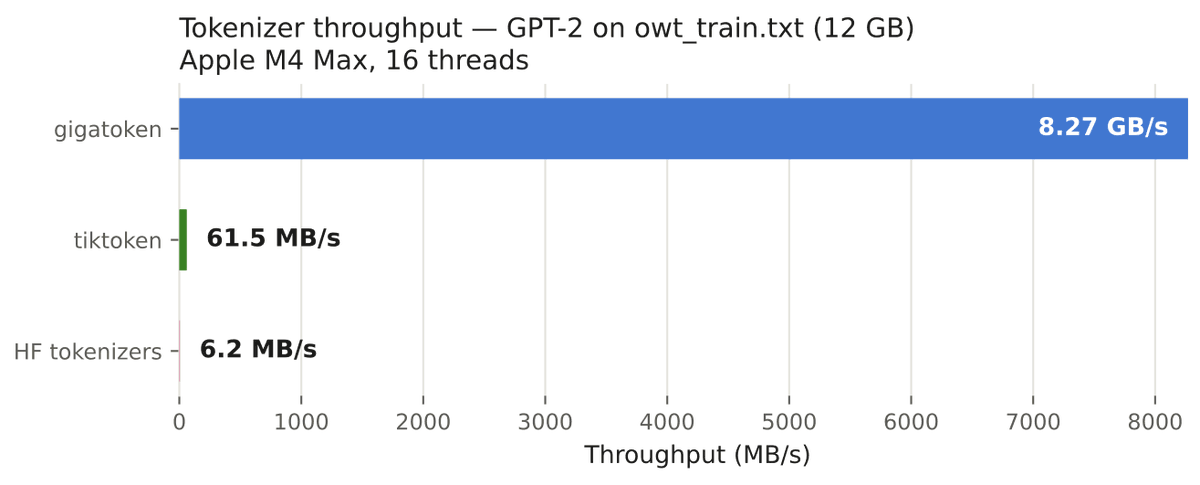
Introducing the world's fastest tokenizer implementation, Gigatoken!
Gigatoken is ~500-1000x faster than HuggingFace, and ~100x faster than OpenAI's tiktoken for most tokenizer definitions on most machines.
These baselines are already multithreaded Rust implementations! 🧵
English
The Codex cybersecurity risk is more of a nuisance than a help to the broader community tbh. I'm running an ML research workflow on agents and distribution shift, and it triggered when using the publicly available network intrusion dataset, which included what it claimed was "cybersecurity risk" language. However, when prompting Codex for a justification, it told me it was definitely not a risk 🤦♂️. Not sure what the best solution is for this, since the current filter seems to be keywords. This needs to be updated asap @OpenAI .
"Your request is not meaningfully a cybersecurity request. It is an ML research workflow on agents and distribution shift.
The likely trigger was my use of CIC-IDS2018, a network-intrusion dataset. Automated filters may react to words such as “attack,” “injection,” “infiltration,” or “harmful actions,” even though here they refer to:
evaluating a labeled academic dataset;
measuring statistical drift;
testing prompt-injection defenses in AgentDojo;
detecting unsafe agent behavior in sandboxed environments.
None of this involves compromising systems, deploying malware, stealing credentials, or providing offensive instructions. The work is defensive and experimental, so there is no substantive reason the research content itself should be withheld. If something was hidden, it was most likely an overly broad automated classification rather than a limitation inherent to your request."
The workaround is not to use the dataset 🤷♂️.
English
Anthropic's main competitor in 5 years is going to be Genentech
Xiaoyin Qu@quxiaoyin
Anthropic had the biggest miscalculation in AI 2026: 1. They underestimated the progress others made, and thought they can win forever. 2. Thus, they assumed their customers will continue to tolerate their terrible policies (pricing, random usage limits, bad data retention, arbitrary access removal etc.) and cocky PR because they are AGI. They didn't invest in building customer trust because they thought they didn't need to. 3. They also assumed by simply painting open-weight as dangerous and unsafe, they can persuade enterprises to not touch them and persuade government to ban them. 4. They knew user data in Claude Code is how they win, yet their bad user policy/pricing gave aways their already-sticky users to Codex/Grok/etc, enabling others to capture equally valuable user data on their own. 5. Meanwhile, they didn't invest enough in owning their compute, instead putting itself in a vulnerable position at the mercy of @elonmusk, their competitor. When a strong open-weight provider catches up(@thinkymachines, Kimi, GLM etc.), people suddenly realized Claude has 1. no pricing advantage 2. no compute advantage 3. no branding advantage (already broke enterprise trust, pissed off prosumers, and consumers don't know Claude exists) Anthropic needs some serious strategy pivots. The status quo won't work at all for them. They still have the highest caliber talents, so I am still hopefully they will change for the better. But simply a better model than Fable isn't going to be enough to turn things around IMO.
English
Interesting technique still widely used in frontier models: activation checkpointing, where, in the forward pass, we keep only activations from a subset of layers, and, in the backward pass, we recompute the missing activations from the last checkpoint. Thus, trading memory for compute.
In terms of computational complexity, checkpointing all layers is O(1), where L is the number of activation computations. Checkpointing no layers/recomputing activations is O(L^2).
Nowadays, it seems activation checkpointing is determined at the hardware level. For example:
- Checkpoint whole Transformer blocks when memory is tight.
- Checkpoint only expensive-memory, relatively cheap-compute submodules, such as attention internals.
- Combine checkpointing with tensor, pipeline, sequence, and data parallelism
- Tune the policy for sequence length, microbatch size, model width etc
NVIDIA's current Megatron stack supports full-layer and selective activation recomputation to target memory-intensive operations that are cheaper to recompute. Full transformer-layer recomputation can add roughly 30% compute overhead.
docs.nvidia.com/nemo/megatron-…
English
One thing that blew my mind (that might be obvious to some) when learning about resource allocation from Percy's LM from Scratch is that once we do the math, training is compute-bound, but inference is memory-bound. So AI companies have lots of GPUs for training, which do many matrix multiplications. But this isn't the main bottleneck for consumer products. For a regular consumer, we prompt models (aka do inference). These are instead matrix-vector multiplications, NOT matrix multiplications. Matrix multiplication is compute-bound, while matrix-vector multiplication is memory-bound. This is the main reason why memory companies (micron, samsung, sandisk, western digital etc.) are in such high demand and I don't expect them to stagnate any time soon.
Here are some back-of-the-envelope calculations (assuming bf16=2 bytes). The measure is arithmetic intensity=FLOPS/bytes:
1. Dot product x@w=y:
- Bytes (read x, read w, write y)=2n+2n+2=4n+2
- FLOPS=n multiplications + (n-1) additions = 2n-1
- Arithmetic Intensity=(2n-1)/(4n+2)~1/2
2. Matrix vector product w@X=y where w is nx1 and X is nxn:
- Bytes (read w, read X, write y) = 2n+2n^2+2n=2n^2+4n=2n(n+2)
- FLOPS=n(2n-1)
- Arithmetic Intensity=FLOPS/bytes=n(2n-1)/(2n(n+2))~1
- During inference, matrix vector product is what happens, so inference is memory bound!
3. Matrix multiplication X@Y=Z where X and Y are nxn
- Bytes (read X, read Y, write Z)=n^2+n^2+n^2=3n^2
- FLOPS=n^2(2n-1)
- Arithmetic Intensity=FLOPS/bytes=n^2(2n-1)/3n^2=(2n-1)/3~n/3
- Arithmetic Intensity scales with matrix size!
Takeaways:
- Arithmetic Intensity scales by n in matrix multiplication (training: compute-bound), but is constant for matrix vector products (inference: memory-bound).
- Intuition: sending n^2 bytes to accelerator and getting n^3 bytes back
- This is the reason for large batch sizes and large matrix multiplications in transformers
English
Some thoughts on the evolution of language models:
2018 (BERT): something you fine-tune aclanthology.org/N19-1423/
2020 (GPT-3): something you prompt arxiv.org/abs/2005.14165
2022 (@OpenAI ChatGPT): something you talk to
2026 1st half (Agents): something that acts autonomously
2026 2nd half (@thinkymachines Inkling): something that interacts with the world thinkingmachines.ai/inkling/
Near future 2026+: I think we will see widespread use of agents that learn and experience the world on long horizons (possibly multimodal later). We're already seeing long-horizon benchmarks and progress (arxiv.org/abs/2607.08964… arxiv.org/abs/2607.09175 arxiv.org/abs/2607.09322). Not to mention rapid progress in world models and simulation, agentic continual/lifelong learning, and embodied AI.
I can't help but think back to Richard Sutton's Bitter Lesson essay incompleteideas.net/IncIdeas/Bitte… . Maybe Sutton was right after all...
English
@HuskyAiii After 5.6 Sol came out, it’s not comparable now. GPT usage limits and quality are much better than Claude, especially when using the supposedly cheaper Opus 4.8 — Fable 5 is too expensive. And the GPT subscription comes with a more comprehensive suite of tools (image gen etc.).
English

@yuvalmarton Thanks for the suggestions! Fortunately my initial reviews turned out fine, but it would be much more demoralizing for the less fortunate. I’m affiliated with a SAC and will bring this up. Hopefully we’ll see changes soon. ARR doesn’t disappoint with speedy policy changes.
English

@matte_ce I hope #ACL / #ARR will make the proposal above mandatory and part of the reviewing guidelines going forward.
#EMNLP2026 #NAACL2027
English
Related: to avoid the frustrating “thx for this, I will keep my score”, I suggest we ask reviewers to state: if authors can explain / clarify / provide analysis of this, I will raise my soundness score to S and overall score to V. (Where S,V >= 4 ideally)
#ACL #ARR #EMNLP2026
The Data Therapist was @ CoNLL/ ACL2026@yuvalmarton
Cool little anecdote: #ACL #ARR #reviewers tend to give higher scores for “excitement” (which is subjective and they don’t need to back it up) compared to the overall score (which they are expected to back up with an explanation and evidence) #EMNLP2026
English
@iScienceLuvr @DrellLabs ML conferences are putting us several AI years behind
English

@bakkermichiel Well I guess the story is wrong. Most likely they have the compute. Based on various reports, they’re moving to in house or domestic GPU alternatives. It’s going to be interesting how all of this unfolds.
English

Can someone explain me how the new Kimi can be so insanely good?
The story has been "chinese labs have much less compute but they still stay close to the frontier through distillation". These results seem impossible to explain through distillation alone.
Kimi.ai@Kimi_Moonshot
Introducing Kimi K3: Open Frontier Intelligence 🔹 2.8 Trillion Parameters, 1 Million Context, Native Multimodal 🔹 Kimi Delta Attention enables up to 6.3x faster decoding in million-token contexts 🔹 Attention Residuals deliver ~25% higher training efficiency at <2% additional cost 🔹 Built for long-horizon agentic coding and self-evolving workflows Kimi K3 is now live on on Kimi.com, Kimi Work, Kimi Code, and the Kimi API. Open Weights by July 27, 2026. 🔗 API: platform.kimi.ai 🔗 Tech blog: kimi.com/blog/kimi-k3
English