Matter

60 posts

Matter banner
Matter

Matter

@MatterGlobal

Generalist Investor, CFA, views are my own

New York, NY Katılım Kasım 2022
0 Takip Edilen5 Takipçiler
Matter
Matter@MatterGlobal·
$AMD Lisa Su talks about how Anthropic is likely a multi-generational customer of AMD GPUs beyond MI455X. It’s too much work to get teams integrated and just to adopt for a single generation. Implies the deal is beyond just initial 2 GW.
English
0
0
0
36
Matter
Matter@MatterGlobal·
On the flip side, if depreciation schedules remain unchanged, the residual value of GPUs go higher and generate revenues at much higher incremental margins after fully depreciated
English
0
0
0
11
Matter
Matter@MatterGlobal·
Incredible that even ~3-4 year old GPU models ($AMD MI300, $NVDA H100) rental prices are still going up ~30% per $DOCN. Possibly +ve to useful life estimates for GPUs likely beyond ~5 years, reducing D&A expense + boosting margins for hyperscalers. Disproves AI overbuild fears
Matter tweet mediaMatter tweet media
English
1
0
0
127
Matter
Matter@MatterGlobal·
@SemiAnalysis_ Also Anthropic’s own compute constraints are clear with recent $SPCX and now $META providing monthly compute rentals via excess capacity. So using $AMD MI455X would only make sense for Anthropic. Has anyone heard of SpaceXAI being a potential customer of Helios also?
English
0
0
0
103
Matter
Matter@MatterGlobal·
@SemiAnalysis_ This doesn’t mean AMD has won Anthropic yet, but it’s def one of its highest priority accounts for software engineering resources, increasingly the likelihood of a win. Anthropic also has a history of focusing on heterogeneous XPUs (I.e. models running on Trainium, TPU)
English
1
0
1
241
SemiAnalysis
SemiAnalysis@SemiAnalysis_·
ANTHROPIC WILL BE AN AMD CUSTOMER, ACCORDING TO THE PUBLIC GITHUB OF AMD’S SENIOR DIRECTOR OF AI 🚨🚨 We explain the GitHub code and nuances below👇️ 1/4🧵
SemiAnalysis tweet media
English
47
83
1.2K
357.2K
Matter
Matter@MatterGlobal·
@jukan05 The use of Nangate 45nm matters enormously. It is an open academic standard-cell library, not a production 2nm or 3nm foundry environment. A 45nm design faces dramatically less complexity
English
0
0
0
181
Jukan
Jukan@jukan05·
EDA is cooked.
Jukan tweet media
English
77
95
1.2K
247.9K
Matter
Matter@MatterGlobal·
7/7 Bottom line: LTAs protect the downside. HBM/AI DRAM drives the upside. NAND moving from cold storage toward warmer AI memory/storage tiers adds optionality. The next memory downturn can still happen, but it may not look like the old cycles. $MU $SNDK
English
0
0
0
197
Matter
Matter@MatterGlobal·
1/7 Memory LTAs may be more important than the market appreciates. The key change: these are not old buyer-friendly LTAs. They increasingly include volume/price commitments, cash deposits or LOCs, and multi-year terms. That could structurally dampen memory cyclicality.
English
6
0
0
51
Matter
Matter@MatterGlobal·
6/7 HBM makes this more interesting. Micron is not just a commodity DRAM/NAND story anymore. HBM4/4E/5 require tighter customer qualification, advanced packaging, custom base dies, power/thermal co-design, and scarce qualified supply. That should support +ve pricing durability
English
0
0
0
117
Matter
Matter@MatterGlobal·
5/7 The biggest Micron implication is not that downside disappears. It is that trough gross margin and EPS may be structurally higher than prior memory cycles. If true, the old “peak earnings deserve a very low multiple” framework may be too punitive.
English
0
0
0
40
Matter
Matter@MatterGlobal·
4/7 Also protection improves over time. As customers purchase under the contract, remaining obligations decline. The same deposit/guarantee then covers a larger % of the remaining contract value. So LTAs may be most powerful later in the cycle, when downturn risk is higher.
English
0
0
0
12
Matter
Matter@MatterGlobal·
3/7 I would give much more credit to cash deposits/LOCs than potential legal damages. Legal recoveries may be possible, but they are slow, uncertain, and relationship-sensitive. The immediate financial commitment is the real first-loss protection investors should underwrite.
English
0
0
0
15
Matter
Matter@MatterGlobal·
2/7 The breach math is different now. A customer cannot simply compare contract ASP vs spot ASP for DRAM/NAND They must compare contract ASP vs spot ASP + forfeited deposit/LOC + legal/friction costs + future supply access risk. That raises the hurdle to walking away.
English
0
0
0
52
Matter
Matter@MatterGlobal·
@jukan05 If this is true then doesn’t GUC (Global Unichip Corp) benefit as they do backend design, and are strategic partners of TSM who is the top shareholder? They already do the backend design for Microsoft MAIA XPU
English
0
0
0
581
Jukan
Jukan@jukan05·
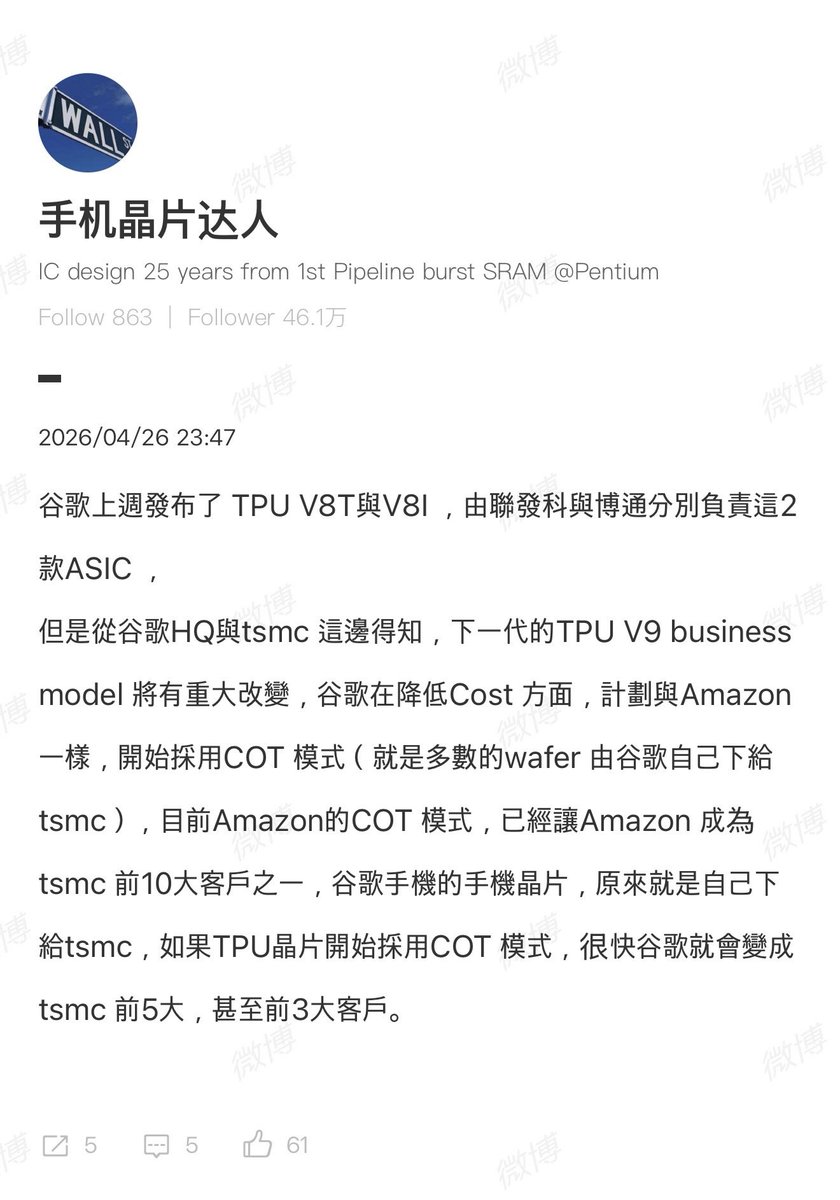
Rumor: Google to shift to a COT model starting with TPU v9, downgrading the role of MediaTek/Broadcom. This would be a major negative for Broadcom and MTK. According to this rumor, starting with TPU v9, Google plans to move to a model similar to AWS’s Annapurna, where Google directly places wafer orders with TSMC. In other words, Google would be doing COT directly. What does that mean? Google would become TSMC’s direct customer, while Broadcom and MediaTek would be downgraded to IP support / design service roles. Ownership of the chip and control over supply would shift toward Google. In other words, Broadcom/MediaTek’s per-chip margin would fall, if this is true. Instead of recognizing the full chip ASP as revenue, the model would shift toward design service fees / margin. That makes me more worried about Broadcom than MediaTek. $AVGO
Jukan tweet media
English
46
86
723
201.2K
Matter
Matter@MatterGlobal·
@jukan05 If Intel is targeting 30% price hike this yr, can we assume AMD does on similar level, plus strong unit growth, and add share gains on top due to Intel near capacity constraints = AMD Datacenter CPU rev growth could be 50%+ this yr? (Vs street ~40%)
English
0
0
0
361
Jukan
Jukan@jukan05·
A very spicy piece of information here. A must-read for everyone (especially if you're interested in the CPU shortage). - Intel has carried out two rounds of CPU price hikes since the start of 2026. The first round in February was 10–15%, and the second on March 16th was 15%, bringing the cumulative increase to ~20% vs. January. - The full-year target is a cumulative 30% price increase, aimed at recouping investment and meeting capital market expectations. - A third round of price adjustments is reportedly planned for May. - Server CPU demand is strong globally, with orders already up 50% YoY vs. 2025. - Chinese CSPs in particular are placing additional orders — Tencent is scaling its server CPU procurement from ~300K units in 2025 to a 2026 target of 900K–1M units, deploying them toward AI infrastructure buildout. - Alibaba has the largest procurement scale among Chinese CSPs, and is also expected to grow 30–35% YoY. - Consumer CPU shipments are also picking up, driven by local AI PC demand, with a projected ~20% YoY increase in shipments (though I find this one a bit dubious). Intel's consumer CPU share remains stable at 65%. - Intel's production line utilization has reached 95%, but is not yet physically at full capacity. Server market deliveries are smooth (China Q1 orders +60%, deliveries +27%), but on the consumer side, despite orders doubling (+100%), deliveries actually declined 3.8%. This is due to PTL yield issues and new product supply being prioritized for North America — Intel is managing this by extending lead times to 3 months. - Intel's consumer CPU market share remains stable at 65%. - On the server side, Intel's share has dropped from 65% in 2025 to 50%, primarily due to AMD's stable supply and superior price-performance. - A particularly noteworthy point: the CPU-to-GPU ratio in AI servers has risen from 1:12 to 1:8, with a target of 1:4, meaning the share of CPU procurement is increasing. Very important. - Cloud providers' AI servers generally have excess compute capacity, and there are no plans for large-scale traditional server expansion for the time being. - AI applications are expected to drive ~10% of incremental demand for consumer CPUs, with long-term growth dependent on product usability. $INTC $AMD $ARM
駿HaYaO@QQ_Timmy

CPU紀要 漲價情況 Intel 2026年已執行兩輪CPU漲價:2月首輪漲10-15%,3月16日第二輪漲15%,累計較1月上漲約20%。目標是全年累計漲30%,以回收投資並滿足資本市場預期。5月計劃第三輪調價,但受AMD與ARM競爭影響,進一步大漲空間有限。 需求表現 - 伺服器CPU:全球需求強勁,訂單較2025年增長50%,中國區商用CPU出貨量預計增長60%。主要驅動來自騰訊等大廠加單(騰訊2025年約30萬顆,2026年目標90-100萬顆,用於AI布局)。阿里巴巴採購規模最大,預計成長30-35%。 - 消費級CPU:受雲端AI成本上升影響,用戶轉向本地AI PC,預計全年出貨增長20%以上,增量主要來自高端輕薄本與遊戲本。全球消費級CPU年出貨約7700萬顆,Intel市佔率65%並維持穩定。 產能與交付 Intel產線利用率已達95%,但尚未滿載。交付呈現分化:商用市場交貨良好(中國一季度訂單增60%,交貨增27%);民用市場訂單增100%,但交貨量反而下降3.8%。主因是良率問題及新品優先供應北美,目前以拉長交期至3個月緩解壓力。無新增擴產計劃,最晚交付已排至6-7月。 市場份額變化 - 消費級:Intel市佔率穩定在65%左右。 - 伺服器:從2025年約65%下滑至50%,主因AMD供貨穩定且性價比更高(同價位提供更多核心)。 AI相關影響 AI Agent技術帶動本地AI需求,但仍屬小眾。AI伺服器CPU與GPU配比從1:12提升至1:8,目標1:4,推升CPU採購數量占比。雲廠商AI伺服器普遍存在算力冗餘,暫無大規模擴產傳統伺服器計劃。預計AI應用可為消費級CPU帶來約10%額外需求,長期增長取決於產品易用性。 成本傳導與其他 CPU與存儲漲價已開始影響終端:DIY市場出貨下滑60%,整機市場二季度後同檔筆電預計漲500-1000元。存儲DIY市場出現囤貨商拋售,價格鬆動;商用存儲需求仍強勁。

English
22
64
609
105.2K
Matter
Matter@MatterGlobal·
@shanaka86 It makes sense inventories are ramping also as they’re ramping Blackwell Ultras (B300s) in 2HCY25. Inventories always tend to ramp early in a product launch. These inventories will then be recognized once OEMs can ramp up rack capacity
English
0
0
0
14
Matter
Matter@MatterGlobal·
@shanaka86 This doesn’t spell “doom”. It’s known there’s an upstream/downstream mismatch between the OEMs who build racks, and NVDA’s supply of chips. These OEMs/ODMs are scaling up their capacity however. NVDA and others therefore hold finished goods inventories
English
1
0
0
263
Shanaka Anslem Perera ⚡
Shanaka Anslem Perera ⚡@shanaka86·
The $33.4 Billion Shell Game: How Silicon Valley’s Greatest Fraud Unravels in 40 Days Nvidia reported something devastating yesterday that nobody caught. Days Sales Outstanding jumped to 53 days. Historical average: 46 days. That seven day difference represents $10.4 billion in revenue Nvidia collected on paper but never in cash. Here’s what’s actually happening: Nvidia invests in AI startups. Those startups buy cloud services. Cloud providers use that money to buy Nvidia chips. Nvidia books it as revenue. But it’s the same money going in circles. The proof is mathematical: • Accounts receivable: $33.4 billion (doubled since last year) • Inventory: $19.8 billion (rising during a “shortage”) • Cloud commitments: $26 billion (doubled in 90 days) Total capital trapped: $79.2 billion. Total cash generated last year: $64.8 billion. They’ve trapped more money than they’ve ever made. The smoking gun: Inventory rising 32% while claiming “insane demand” is impossible unless those chips aren’t actually selling. You cannot have shortage and surplus simultaneously. Basic physics. Operating cash flow is only 75% of net income. Healthy companies generate 100% or more. That 25% gap? Fake revenue that will never become real money. What happens next: December 2025: Aging schedule reveals truth February 2026: Last chance to exit April 2026: First receivables writeoff October 2026: Full unraveling begins Stock price today: $140 Price after writeoffs: $70 This isn’t speculation. It’s accounting arithmetic. When receivables age beyond 60 days, writeoffs are mandatory under GAAP. Nortel did this in 2001. Lucent in 2000. Both went to zero. The mechanism is identical: circular vendor financing disguised as growth. Verify yourself: Check any tech company’s DSO. Above 50 spells doom. The countdown has begun.​​​​​​​​​​​​​​​​ Read the super deep dive article here - open.substack.com/pub/shanakaans…
Shanaka Anslem Perera ⚡ tweet media
English
291
712
2.8K
536.1K
Theo
Theo@polemicuss·
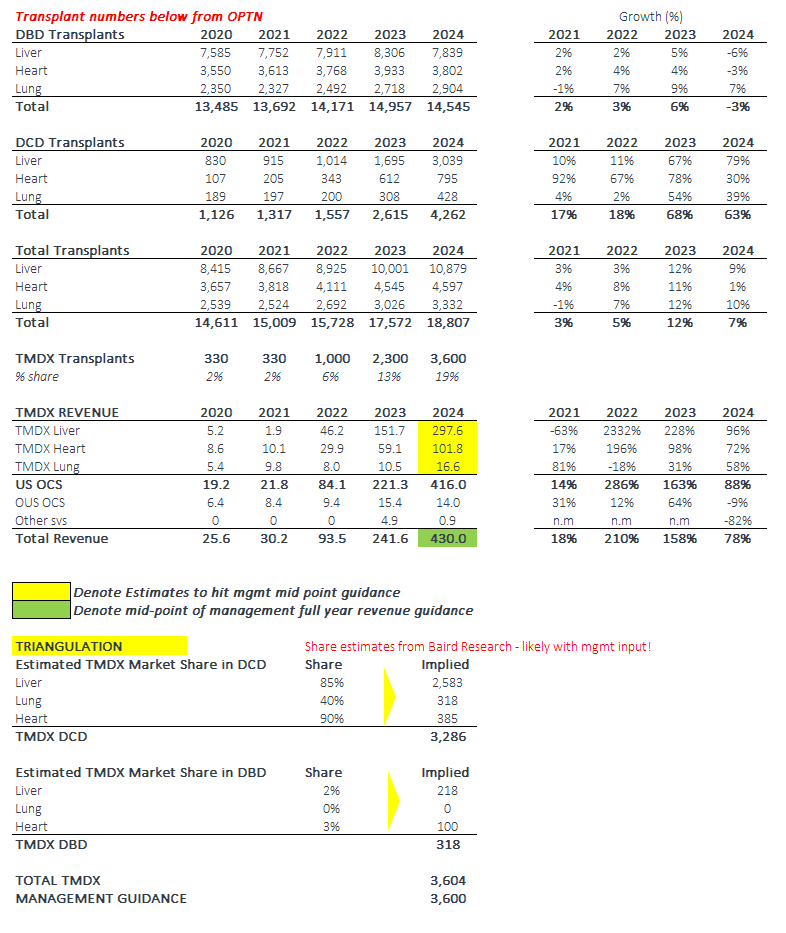
Last post I ever make about $TMDX Below are the full numbers. TMDX is expected to grow liver revenue 96% (vs. mkt at 79%), heart 72% (vs. mkt at 30%) and Lung 58% (vs. mkt at 39%). They have now 85% mkt share in DCD liver. They are quite literally the DCD liver market
Theo tweet media
English
32
44
392
98.5K
Matter
Matter@MatterGlobal·
@polemicuss @moazzam0_reddit @smallmidcaps @AndrewP64090323 Agreed. The moat is indeed the end to end service. One liver tx expert call stated that their hospital used 70/30 OCS vs OrganOx for their machine perfusion (90-95% of liver cases). Reason being OCS has NOP (full service) and OrganOx is not portable via plane
English
1
0
1
107
Matter
Matter@MatterGlobal·
@polemicuss At 10x+ was pricing towards near perfect execution for sure (I.e steady QoQ growth). But even at those levels it still wasn’t pricing in 10K Tx by 2028 and ~30% Ebitda margins at scale. Near term execution will be key for mkts to gain confidence in their mid term targets again
English
0
0
0
22
Theo
Theo@polemicuss·
@MatterGlobal I agree - all i wrote is in the context of valuation. TMDX at 10x+ was insanity
English
1
0
1
85