Matt Schellenberger

3.8K posts

Matt Schellenberger banner
Matt Schellenberger

Matt Schellenberger

@mattschellen

VP, farmer, financial advisor, husband, father, musician, lover of life, friendships and unforgettable journeys.
Edmonton, AB Katılım Ağustos 2014
3.4K Takip Edilen1.1K Takipçiler
Matt Schellenberger
Matt Schellenberger@mattschellen·
Very cool!
Massimo@Rainmaker1973

🚨 NEWS FROM NASA In a bold and decisive move, NASA Administrator Jared Isaacman just announced a $20 billion plan to build America’s permanent base on the Moon — and they’re doing it in just 7 years. Today, NASA officially confirmed it is cancelling plans for the Lunar Gateway — the small space station that was supposed to orbit the Moon as a waypoint for astronauts. Instead, those components and resources will be repurposed directly for the surface base, accelerating humanity’s return to sustained lunar presence. The goal is clear — move beyond short visits and flags-and-footprints missions. NASA wants a real, long-term foothold on the Moon: habitats, power systems, rovers, scientific labs, and infrastructure that can support crews for months at a time. This base will serve as the foundation for deeper space exploration, resource utilization (like mining lunar ice for fuel and water), and eventually — Mars. The $20 billion investment over the next seven years will reshape major parts of the Artemis program. It comes with real urgency too — China is pushing hard toward its own crewed Moon landing by 2030, and the U.S. is determined to lead, not follow. This isn’t just about science. · A permanent lunar base means:Testing technologies for Mars missions in a real off-world environment · Developing in-situ resource utilization (turning Moon dirt into rocket fuel and oxygen) · Opening the door to a true cislunar economy · Inspiring the next generation of engineers, scientists, and explorers Private industry will play a massive role, as always — with contractors already building key hardware now being redirected. This is the kind of ambitious, focused leadership the space program has needed. From the first boots on the Moon in 1969 to building a thriving outpost there by the early 2030s — what an incredible leap forward. Significanly, the Moon isn’t just a destination anymore: it’s becoming home base for humanity’s expansion into the Solar System.

English
0
0
0
9
Matt Schellenberger retweetledi
David Coletto 🇨🇦
David Coletto 🇨🇦@DavidColetto·
For the past year, @EddieShepp and I have been digging deep into a mindset shift we’ve seen in Canada that has had huge implications for consumer behaviour, politics, and the workplace. We’ve brought together all our research and spent some time working through what it means for leaders and communicators. The end product is this highly interactive website that we think every leader should bookmark. It will evolve over time as our research signals new insights and cues but we hope it serves as a valuable tool to better understand your audiences today. If you find it valuable, please share and let us know if you’d like to learn more. We are planning a webinar soon to introduce the concept and its impact. Visit it here: precaritymindset.com
David Coletto 🇨🇦 tweet media
English
25
49
284
479.2K
Matt Schellenberger
Matt Schellenberger@mattschellen·
We are living the future and it’s easy to fear change. I certainly do at times, particularly around technology and how it’s changing the traditional human experience, but this is a positive take from a world leader, much as Musk articulates the potential for these technologies. Time will of course tell, but with the progress seemingly impossible to slow, let’s hope we can incorporate things like robots and other technologies for the benefit of humanity and not the opposite. 🤞
Dustin@r0ck3t23

Jensen Huang just told you the robot-per-human ratio Elon wants is not the ceiling. It is the floor. Huang: “I’m hoping more.” Two words. Like he had been waiting for someone to ask. The entire fear narrative around robotics assumes we are trying to replace workers. We are not. We are millions of bodies short of keeping civilization running right now. Huang: “We’re millions of people short in labor today. All of these companies could grow more if they had more labor.” The global economy is not being threatened by robots. It is being strangled by the absence of them. Every factory that cannot fill a shift. Every warehouse that runs half capacity. Every construction project delayed eighteen months because the hands do not exist. That is not a labor market. That is a species hitting its biological ceiling in real time. One robot per human does not flood anything. It barely stops the bleeding. But here is where it gets dangerous. Friedberg: “When everyone gets a robot, their robot can do a lot of work for them. They can stand up an Etsy store or a Shopify store. They can create anything they want with their robot.” The car gave every human unlimited range. The robot gives every human unlimited output. You are no longer constrained by your own two hands. You are no longer priced out of manufacturing because you cannot afford a team. One person. One machine. An entire production line. The barrier to building a physical business drops to nearly zero. That is not automation. That is the largest individual wealth unlock since the engine. And then Huang described the part nobody is ready for. Huang: “I’ll be able to go into the robot at my house and virtually operate it. I’m on a business trip… walk around the house.” Calacanis: “And walk the dog.” Huang: “Yeah, walk the dog.” They laughed about it. Nobody in that room should have been laughing. You are in Tokyo. Your body is in a hotel room. But you walk through your house in Austin. You open doors. You check on things. You physically exist in two places at once. Geographic distance becomes a setting you change. You do not send a text to check in. You show up. In a frame that moves, sees, and does not need your permission to act. The people still debating whether robots will take jobs are standing in the wrong room. The real question is what happens when eight billion people each command a physical proxy that never sleeps, never stops, and never calls in sick. Huang already gave you the answer. The economy does not shrink. It multiplies. And it does not stop.

English
0
0
0
15
Matt Schellenberger
Matt Schellenberger@mattschellen·
He and his companies are operating at a crazy level, if there’s anyone who can, it’s Musk.
Dustin@r0ck3t23

Elon Musk just posted three numbers that should terrify every semiconductor company on Earth. A terawatt of chips. A terawatt of solar. Ten million tons to orbit per year. That is not a product roadmap. That is a species-level engineering ultimatum. Musk: “Build a terawatt of chips, a terawatt of solar, and 10 million tons to orbit per year.” A terawatt is roughly the entire power generation capacity of the United States. He is not asking for a bigger factory. He is asking for a second grid. The name alone tells you the scale. Terafab. Not gigafab. Tera. A thousand times the prefix. A thousand times the ambition. Every chip company on the planet currently begs TSMC for allocation. They wait in line. They negotiate quarters in advance for a fractional increase in supply. Musk looked at that line and started building the factory that makes it extinct. Vertical integration from lithography to packaging. Design to deployment. Under one roof in Texas. But the factory is not the point. The destination is. Most of this output is not staying on the ground. That is where SpaceX turns from a rocket company into the supply chain for orbital compute. You build the chips. You build the solar. You launch them into the vacuum where the Sun never sets and nothing on Earth can compete. The companies optimizing their server racks in Nevada are solving last decade’s problem with last decade’s ceiling. Musk is fusing Tesla, SpaceX, and xAI into a single organism. One builds the energy. One builds the delivery system. One builds the thing they are both feeding. Nobody has ever welded three companies together into a vertical stack like this. Because nobody has ever tried to do what he is actually attempting. Which is not building a chip factory. It is building the industrial base for a civilization that does not end at the atmosphere. And this is what separates Musk from every other CEO alive. He does not manage companies. He runs them like engineering floors where the only thing that matters is whether you can build. No committees. No twelve layers of approval. No political career tracks disguised as leadership. You either ship or you leave. That is why the most talented engineers on the planet keep walking through his doors. Not because the hours are easy. Because the mission is real and the bureaucracy is gone. Every other company on Earth makes you fight the org chart before you fight the problem. Musk deleted the org chart. Musk: “Join us on this journey.” That is the most understated recruiting pitch for the most ambitious project a human being has ever publicly committed to. And he said it the same way he says everything. Like it is already done.

English
0
0
1
29
Matt Schellenberger
Matt Schellenberger@mattschellen·
It was all a lie. 😩😆 Interesting story.
Sama Hoole@SamaHoole

In 1870, a German chemist named Erich von Wolf was analysing the iron content of various vegetables. He made a decimal point error. He recorded spinach as containing 35mg of iron per 100g. The correct figure was 3.5mg. The misplaced decimal sat in the nutritional literature for decades, entirely unchallenged, because nobody particularly felt like re-testing spinach. In 1929, the Popeye comic strip launched. The creators cited the iron content of spinach as the scientific basis for their character's powers. By this point, the decimal point error was already sixty years old and fully embedded in received nutritional wisdom. The error was identified and corrected in 1937. The correction was not issued with anything approaching the cultural reach of the original claim. Popeye continued punching things. The actual iron content of spinach, 3.5mg per 100g, roughly where it was always supposed to be, is further complicated by the fact that spinach is among the highest-oxalate vegetables known. Oxalates bind to iron and calcium in the gut and remove them before absorption. The iron in spinach absorbs at around 1–2%, compared to 15–35% for haem iron from red meat. You would need to eat roughly a kilogram of spinach to absorb the iron equivalent of a 100g beef steak. There is also the kidney stone question. Spinach contains around 970mg of oxalates per 100g: one of the densest plant sources. Chronic high spinach consumption, particularly raw in daily smoothies, is a documented pathway to calcium oxalate kidney stones. The smoothie industry has not issued a correction. Popeye is still a sailor.

English
0
0
0
46
Matt Schellenberger
Matt Schellenberger@mattschellen·
A very candid conversation about farming and its clear and present challenges with Zach Lahn, current Republican candidate for governor and a farmer. Some very salient points that have a deep impact on the future of the industry and our food. facebook.com/share/v/18Dsdh…
English
0
0
0
42
Matt Schellenberger retweetledi
Heather Exner-Pirot
Heather Exner-Pirot@ExnerPirot·
Steven Guilbeault May 15, 2025: claims less than half of the Trans Mountain pipeline’s capacity is being used, we don’t need new infrastructure Transmountain hit 96% capacity in November, volume of crude to be exported will exceed pipeline space for about a month by this summer and will consistently exceed space on export lines by summer next year financialpost.com/commodities/en…
English
53
287
868
26.3K
Matt Schellenberger retweetledi
Kirk Lubimov
Kirk Lubimov@KirkLubimov·
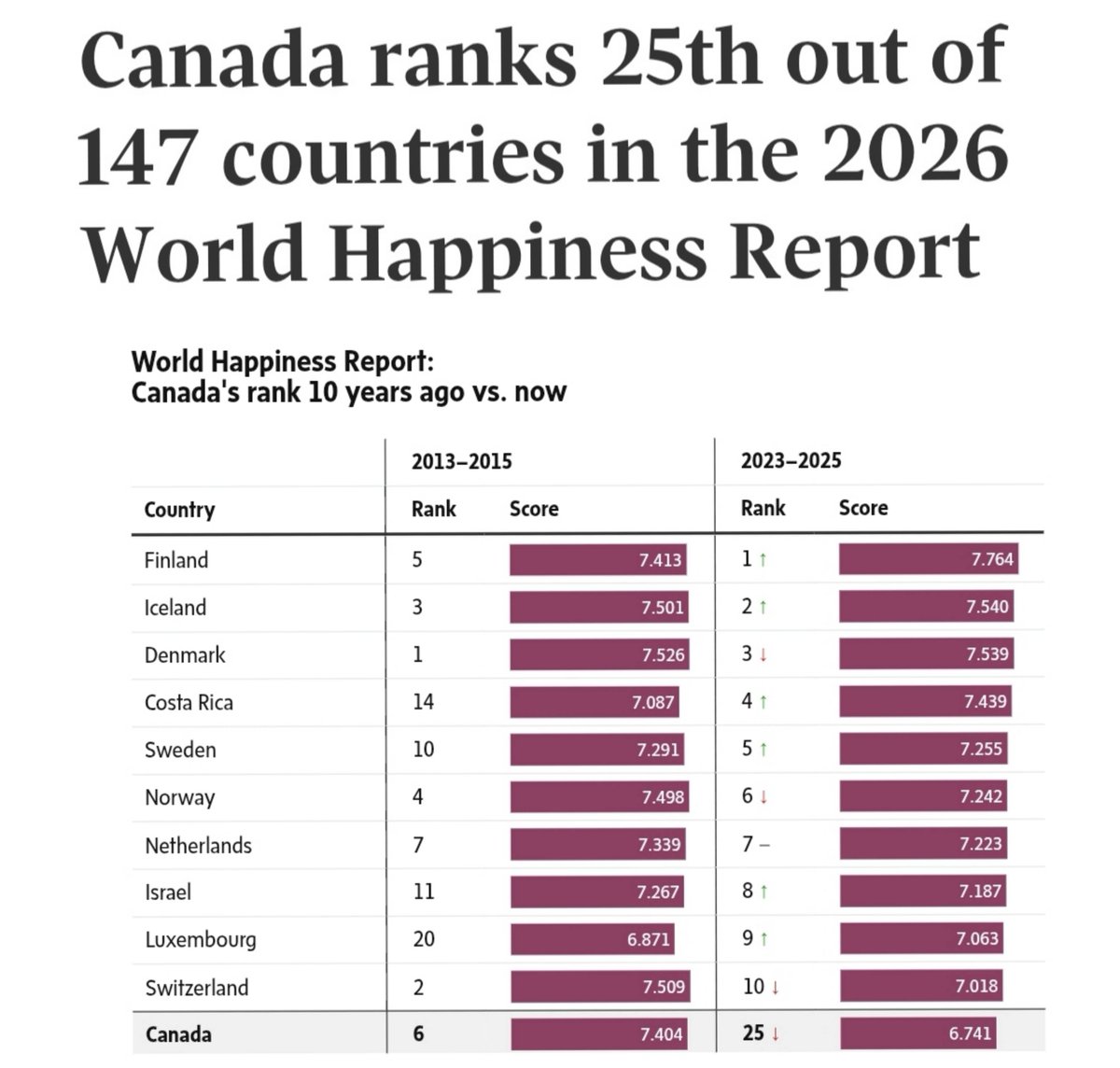
🚨Breaking: Canada TANKS in the new life satisfaction report. Canada drops from 6th place in the World Happiness Report from 10 years ago to 25th now. For under 25 year olds Canada is ranked 71st! Wow!
Kirk Lubimov tweet media
English
489
1.2K
3.5K
155.7K
Matt Schellenberger
Matt Schellenberger@mattschellen·
Wow!
Massimo@Rainmaker1973

Google’s new quantum chip is so powerful it might be tapping into parallel universes. Google's groundbreaking quantum processor, Willow, has achieved the seemingly impossible: solving an extraordinarily complex computational problem in under five minutes—a feat that would require the world's most advanced supercomputer approximately 10 septillion years to complete (10²⁵). This mind-boggling performance has revived one of the most provocative ideas in physics: could quantum computers like Willow be performing calculations across vast numbers of parallel universes? Hartmut Neven, founder and lead of Google Quantum AI, believes the answer may be yes. He argues that Willow’s results align strikingly with the many-worlds (or multiverse) interpretation of quantum mechanics, in which every quantum measurement causes reality to branch into multiple, equally real parallel universes. In this view, a quantum computer doesn’t just calculate faster within our universe—it effectively distributes the workload across countless parallel realities simultaneously. The idea traces back to physicist David Deutsch, who, as early as the 1980s, suggested that the exponential power of quantum computation could only be fully explained if the machine is exploiting resources from many coexisting worlds. Yet the interpretation remains deeply divisive. Many physicists and quantum computing experts insist that no multiverse is required. Willow’s breakthrough, they argue, is fully explainable through standard quantum mechanics—leveraging superposition (qubits existing in multiple states at once), entanglement, and the mathematics of high-dimensional Hilbert spaces—all within a single universe. So what has Willow truly demonstrated? It has pushed quantum technology into a regime so extreme that it compels us to re-examine the deepest foundations of reality itself. Whether or not Willow is quietly borrowing power from alternate universes, one thing is clear: practical, large-scale quantum computing is no longer science fiction—and it is forcing us to confront profound questions about the nature of the cosmos, computation, and existence.

QST
0
0
0
21
Matt Schellenberger retweetledi
Kirk Lubimov
Kirk Lubimov@KirkLubimov·
Which demographics of Canadians are leaving Canada? >67% of the are 20-44 year olds. >3x more likely to be in Sciences than avg population. >31.1% have a masters degree. >61.4% left to the US. In other words, it's Canada's youngest, most talented and educated population.
English
679
1.8K
10.1K
277.1K
Matt Schellenberger
Matt Schellenberger@mattschellen·
@eMTBrides Thank goodness for Bill Maher and Jon Stewart and those like them, trying to hold the mantle of sanity for their party on what has to be its darkest time, at least in my lifetime. 👏
English
0
0
2
259
Larry Conger 🇺🇸
Larry Conger 🇺🇸@eMTBrides·
Bill Maher EXPOSES Why Democrats Are Too SCARED to Face Him on Air Republicans are about #FreeSpeech 💪 Bill Maher goes straight at Democratic leaders in this viral Real Time with Bill Maher moment, asking why figures like Hillary Clinton, Bill Clinton, Kamala Harris, AOC, Elizabeth Warren, and Mamdani won’t come on his show—even though, as Maher says, he voted for them. 🤦‍♀️ but still votes for them, hypocrite much. In New Rule: Running Scared, Maher argues Democrats are more afraid of getting hit from the far left than of taking tough questions in public, while Republicans at least “show up” and take the heat.
English
8
226
1.4K
50.8K
Matt Schellenberger
Matt Schellenberger@mattschellen·
Thank goodness for Bill Maher and Jon Stewart and those like them, trying to hold the mantle of sanity for their party on what has to be its darkest time. 👏
Larry Conger 🇺🇸@eMTBrides

Bill Maher EXPOSES Why Democrats Are Too SCARED to Face Him on Air Republicans are about #FreeSpeech 💪 Bill Maher goes straight at Democratic leaders in this viral Real Time with Bill Maher moment, asking why figures like Hillary Clinton, Bill Clinton, Kamala Harris, AOC, Elizabeth Warren, and Mamdani won’t come on his show—even though, as Maher says, he voted for them. 🤦‍♀️ but still votes for them, hypocrite much. In New Rule: Running Scared, Maher argues Democrats are more afraid of getting hit from the far left than of taking tough questions in public, while Republicans at least “show up” and take the heat.

English
0
0
0
79
Matt Schellenberger
Matt Schellenberger@mattschellen·
The Dems are a mess, with no real established candidate to run. So why not Jon Stewart (no idea if he’d ever be interested)? Or Bill Maher? Or if you’re looking for a politician then Fetterman. These are the only people with the ideology, cache and political jam to test the Republicans. Unfortunately Progressives have taken over the Dems narrative and they’re getting pasted, and they’re way out to lunch. We need level headed people back leading the party. No? 🤷‍♂️
Joe Rogan Podcast News@joeroganhq

Jon Stewart pushes back against New Yorker Editor David Remnick after he tries smearing Joe Rogan.

English
0
0
0
76