marco
316 posts

marco retweetledi

La vera rivoluzione non è pagare un caffè col telefono. È togliere allo Stato il giocattolo più pericoloso: la MONETA.
BITCOIN È SECESSIONE MONETARIA!
Per secoli il potere politico ha vissuto di tre strumenti: tasse, debito e inflazione. La prima la vedi, il secondo lo scaricano sui figli, la terza ti deruba mentre dormi. Bitcoin rompe l’incantesimo: quantità limitata, nessun ministro al timone, nessuna banca centrale a “salvare” amici e complici.
Ecco perché lo odiano. Non perché sia perfetto, ma perché è DISOBBEDIENTE. Non chiede permesso. Non nasce da una legge. Non dipende dalla fiducia nei funzionari. È proprietà digitale trasferibile senza padrone politico.
Mentre nel 2026 si parla sempre più di euro digitale, controllo dei pagamenti e “sicurezza finanziaria”, la domanda è semplice: vuoi una moneta programmabile da chi ti tassa, ti sorveglia e decide cosa puoi comprare? O vuoi uno strumento che restituisca all’individuo almeno una porzione di sovranità?
Bitcoin non promette paradisi. Promette RESPONSABILITÀ. Se perdi le chiavi, paghi tu. Se studi, capisci. Se risparmi, esci dalla ruota del criceto inflazionistico. È duro? Sì. Ma la libertà non è mai stata un servizio pubblico.
Il denaro sano educa alla prudenza. Il denaro fiat educa alla dipendenza. Il primo premia chi produce, risparmia e pianifica. Il secondo premia chi stampa, indebita e redistribuisce consenso.
Non serve idolatrare Bitcoin. Serve capire ciò che rappresenta: una SECESSIONE PACIFICA dal monopolio monetario. Un atto di igiene mentale contro lo Stato-banchiere.
Studiate. Custodite. Diffidate dei “salvatori”. La libertà comincia anche dal portafoglio.
#Bitcoin #LibertàMonetaria #AnarcoCapitalismo
Approfondisci leggendo la rivista libertaria "Il Miglioverde".
Italiano

marco retweetledi
marco retweetledi
marco retweetledi

The Architecture Of Abundance: How Bitcoin Reveals The Truth Of Time And Technology zerohedge.com/crypto/archite…
English
marco retweetledi

Essa entrevista é simplesmente imperdível.
O CEO da Nvidia chamou um podcaster de "infantil" e "loser" três vezes ontem. Na lata.
Não foi porque Dwarkesh Patel estava errado. Foi porque estava certo ao ponto que o Jensen Huang não conseguia refutar sem admitir.
E no centro da questão, um assunto que pressiona e muito o Jensen: controles de exportação de chips de IA para a China.
A discussão ficou pra lá de quente.
A tese do Dwarkesh era simples: compute é input de treino, modelos treinados com mais compute têm mais capacidade ofensiva cibernética, logo vender chips topo de linha pra China cria risco concreto.
Jensen tinha três caminhos de refutação técnica. Escolheu o quarto.
"Você não está falando com alguém que acordou um loser."
"Seus argumentos são infantis."
"Essa premissa de loser não faz sentido pra mim."
Quando o CEO da Nvidia recorre a ad hominem em vez de atacar o mecanismo, normalmente o mecanismo está correto.
O ponto que salva o Jensen, e vale a pena isolar do ruído: se os EUA banirem Nvidia da China, a China desenvolve stack próprio (Huawei + modelos abertos otimizados pra arquitetura deles).
Esse stack difunde pra Índia, Oriente Médio, África, Sudeste Asiático. EUA ficam trancados num silo enquanto o mundo adota padrão chinês. É a tese da telecom se repetindo em IA.
Argumento legítimo. Mas Jensen enterrou ele embaixo de duas afirmações que Dwarkesh pegou no ar:
"Nossos chips são muito melhores, a China vai preferir Nvidia de qualquer forma."
"Se não vendermos, a China engole o mundo com stack próprio."
As duas não podem ser verdade ao mesmo tempo no mesmo horizonte. Dwarkesh apontou isso direto. Jensen mudou de assunto.
O valor do vídeo não está em quem "venceu." Está em ver um jornalista técnico manter a linha diante de um CEO de 4 trilhões de dólares. Isso é raríssimo em 2026.
Esse clipe é puro suco. Assista inteiro.
Português
marco retweetledi
marco retweetledi

@PeterSchiff I too wish you were smart enough to understand that in the absence of a way of increasing the bitcoin supply, the price will go up regardless of the buyers' IQ, which means the sooner you buy the smarter you are!
English
marco retweetledi
marco retweetledi
marco retweetledi

⚡️This post is a perfect case study in how legacy minds fail to understand Bitcoin because they’re trapped inside an outdated energy-value ontology.
Let’s break it to the atomic level, no filters, no diplomacy.
1. The mistake: thinking energy must be stored to be backing.
They’re mocking an idea they don’t understand.
Energy in Bitcoin isn’t “stored” like oil in a barrel or electrons in a battery.
It’s transmuted, converted into immutability.
Every joule burned by miners isn’t energy trapped in the ledger; it’s entropy paid to create incorruptibility.
The network’s energy cost is the proof that its history can’t be rewritten without re-expending equivalent energy.
That’s not a metaphor, it’s thermodynamic truth.
In gold, energy manifests as scarcity through extraction.
In Bitcoin, energy manifests as scarcity through computation.
Both anchor value to physical expenditure, but Bitcoin upgrades it: it abstracts scarcity into information physics.
2. Energy → Entropy → Trust
Here’s what the critics miss:
Trustlessness requires an energetic substrate.
You can’t have absolute truth in a digital system without tying it to something thermodynamically irreversible.
Mining converts raw energy into one-way time: irreversible computational work embedded in blocks.
That’s why Bitcoin’s ledger is effectively a thermodynamic arrow of time.
Each block is an entropy event that locks history behind it.
Gold’s mass resists corruption through physical inertia.
Bitcoin’s chain resists corruption through energetic inertia.
Both are energy sinks, just in different domains.
3. The metaphysical inversion
The joke - “is the energy in the room with us?”- actually exposes how profoundly they misunderstand what Bitcoin is doing.
The energy isn’t “in the room.” It’s in the past.
It’s the ghost of expended work that no one can reclaim.
That ghost, fossilized computation, is what gives Bitcoin its metaphysical gravity.
It’s the first time human beings turned raw energy into an incorruptible memory.
That’s why Bitcoin doesn’t store energy.
It stores proof of energy sacrificed to preserve truth.
That’s not woo. That’s physics meeting philosophy.
4. The gold comparison collapses
They think they’re defending gold’s realism. But gold, too, is a proof-of-work object, it just uses geological time instead of electricity.
Bitcoin compressed the same principle into human-scale physics.
Gold took millions of years of planetary heat; Bitcoin takes milliseconds of computation.
Both obey the same law: value emerges from irreversible energy expenditure.
The difference is that Bitcoin made the process programmable, auditable, and portable at light speed.
So when they laugh, they’re mocking the evolutionary successor of their own thesis.
5. The deeper layer: civilization’s energy signature
Every civilization defines itself by how it encodes energy into order.
Industrial civilization used fossil fuels to build matter.
Digital civilization uses electricity to build truth.
Bitcoin is the bridge between them, the moment energy became epistemology.
That’s the real reason people like this resist it:
It’s not that they misunderstand the physics.
It’s that Bitcoin collapses the distinction between physics and meaning.
In short:
They’re right that energy isn’t “stored” in Bitcoin.
They’re wrong because energy spent is what gives the system weight in reality.
The expenditure is the anchor.
The permanence is the dividend.
Bitcoin is not backed by energy.
It is energy crystallized into truth.
Make Gold Great@MakeGoldGreat
I’M BEGINNING TO REALISE THERE ARE ACTUALLY PEOPLE OUT THERE WHO THINK THERE IS ENERGY ‘STORED’ IN THE #BITCOIN LEDGER, BACKING ITS ‘VALUE’ 😂 IS THIS ‘ENERGY’ IN THE ROOM WITH US RIGHT NOW?
English
marco retweetledi
marco retweetledi

Satoshi is back in Lugano!
We repaired the broken statue inspired by Kintsugi, the Japanese art of repairing broken pottery.
The scars have been painted in orange as a symbol of the resilience and anti-fragility of the bitcoin ecosystem.
We are all Satoshi!
Thank you for supporting us, it was magical.
Lugano Plan ₿@LuganoPlanB
Satoshi Nakamoto has returned to Lugano 👏@satoshigallery
English
marco retweetledi
marco retweetledi

I've made 1,000+ infographics to explain #Bitcoin over the last 5 years.
Based on feedback, here are the ones most effective for teaching others.
THREAD.

English
marco retweetledi

È una settimana e passa che qua non posto né leggo più niente. Questo account era nato per seguire più le vicende italiote e pubblicizzare il mio podcast arrivato a 310 puntate dal 2016. Pochi lo hanno seguito e forse chiuderò. Son tornato al mio account @usemlab...
Italiano
marco retweetledi

Now that Bitcoin has moved up to the fifth most valuable asset on the planet (from the least most valuable 16 years ago) there is only one true competitor left: Gold.
Below are 7 reasons why this is temporary.
Bitcoin vs Gold
1. Supply
Gold: Unknown.
To date, it is claimed that 240,000 metric tons of gold have been mined; it is also claimed that there is an estimated 40,000 economically viable and 500,000 uneconomically viable tons of gold that remain underground. If this is true, the potential to debase gold’s value is significant. New discoveries and new technology could further increase the amount of discoverable gold however, the most challenging issue for gold is that both the existing and future supply of gold will always remain uncertain.
Bitcoin: Only 21M will ever exist.
Bitcoin supply and inflation are known removing the mystery that plagues gold and all similar assets. Currently ~1M Bitcoin remain to be mined with the inflationary schedule permanently secured. You do not have to guess or rely on third parties to dictate the supply or inflationary rate of Bitcoin.
Winner: Bitcoin
2. Audits
Gold: Never
No nation has ever allowed a public audit of its gold reserves. No one knows how much gold exists today or how much gold will exist in the future.
Bitcoin: Self-Audits Every 10 Minutes
The technology that Bitcoin utilizes to audit itself is the most advanced accounting technology and the most important accounting innovation in human history. The Bitcoin Network lives on the only immutable public-facing ledger viewable 24 hours every day.
Winner: Bitcoin
3. Authenticity
Gold: Difficult.
You need to deploy experts and a variety of chemicals and technology to authenticate gold. It is necessary to continuously authenticate gold every time it comes into contact with humans, as well as provide continuous proof of its authenticity. Authenticity is a nightmare for gold that is consistently downplayed. The irony of this category is that as technology improves authenticating gold will become more difficult.
Bitcoin: Automatic
No third parties needed. Bitcoin self-authenticates on-chain publicly every 10 minutes. Every human on the planet can authenticate a Bitcoin at any time for any reason by searching it on-chain, accessible 24 hours every day.
Winner: Bitcoin. In a peer-to-peer transaction, if you are given the option to accept a bar of gold or a Bitcoin unless you are an expert at authenticity, the easy decision is Bitcoin.
4. Transport, Transact
Gold: Dangerous
You need security, trucks, roadways, humans, planes, ships, insurance, firearms, bullets, militaries, and infinite real-time logistics to move gold. While moving gold you would need to audit the gold as well as authenticate the gold at any time it comes into contact with humans to avoid fraud. Moving gold is expensive, difficult and contains massive third-party risk.
Bitcoin: Stable
For a small fee, without permission, and zero risk of theft or authenticity, billions of dollars of Bitcoin can be moved across any border in the world, without third parties.
Winner: Bitcoin
5. Secure and Store
Gold: Dangerous
To store gold at any one location you need security, buildings, fortified vaults, firearms, and insurance. Gold vaults require trust in third parties that the gold cannot be changed out or siphoned away. Storing gold is dangerous, creates massive risk and is an ongoing concern.
Bitcoin: Stable
Self-custody Bitcoin wallets are unhackable and secured by the network 24/7.
Winner: Bitcoin
6. Divisibility
Gold: Difficult
In order to divide gold, you need experts, tools, machines, humans, security, and most challenging you need to be able to audit and authenticate this process. Individual users cannot accurately or efficiently divide their gold.
Bitcoin: Simple
Every Bitcoin is divisible by 100,000,000 satoshis. Send as many audited and authenticated satoshi's as you want at anytime, easily.
Winner: Bitcoin
7. Risk of confiscation
Gold: High
Over the past 100 years, gold has been confiscated multiple times by governments globally including the US Government in 1933.
Bitcoin: Zero
No one can take your Bitcoin without your approval. If you hold a Bitcoin in a self-custody wallet, you have private property that cannot be seized. If you live in an authoritarian or autocratic jurisdiction this is the only private property you can own despite what your government says.
Winner: Bitcoin
🚀🚀🚀🚀
Bitcoin: 7
Gold: 0
🚀🚀🚀🚀

English
marco retweetledi

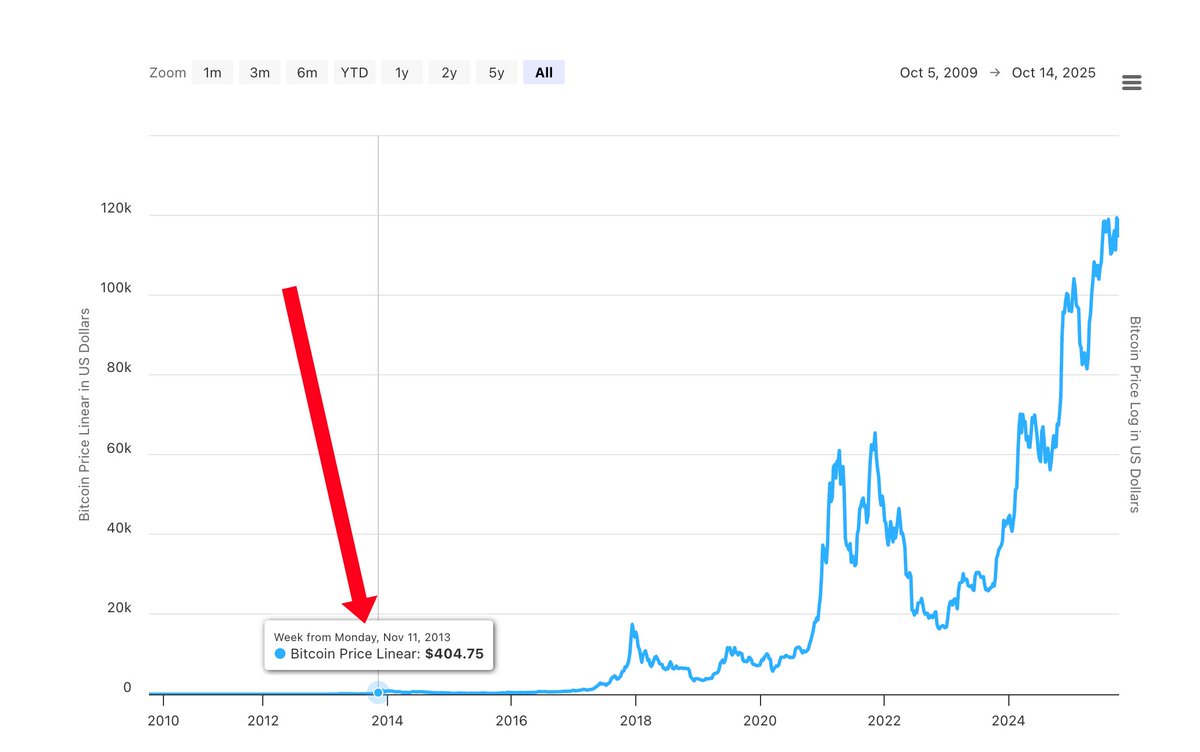
November 2013, Peter Schiff “Bitcoin is tulip mania 2.0 … it’s no better than a fiat currency.”
Since then:
- Bitcoin is up 25,280%
- Gold is up 203.8%
But... Gold’s real (inflation-adjusted) gain since Nov 2013 is 118%.
Not the best financial advice.

Peter Schiff@PeterSchiff
Gold and silver continue to melt up as Bitcoin and Ether continue to melt down. Crypto buyers are in for a rude awakening and will soon learn a very valuable but expensive lesson. Fortunately, most crypto owners are young with lots of time to earn back what they're about to lose.
English