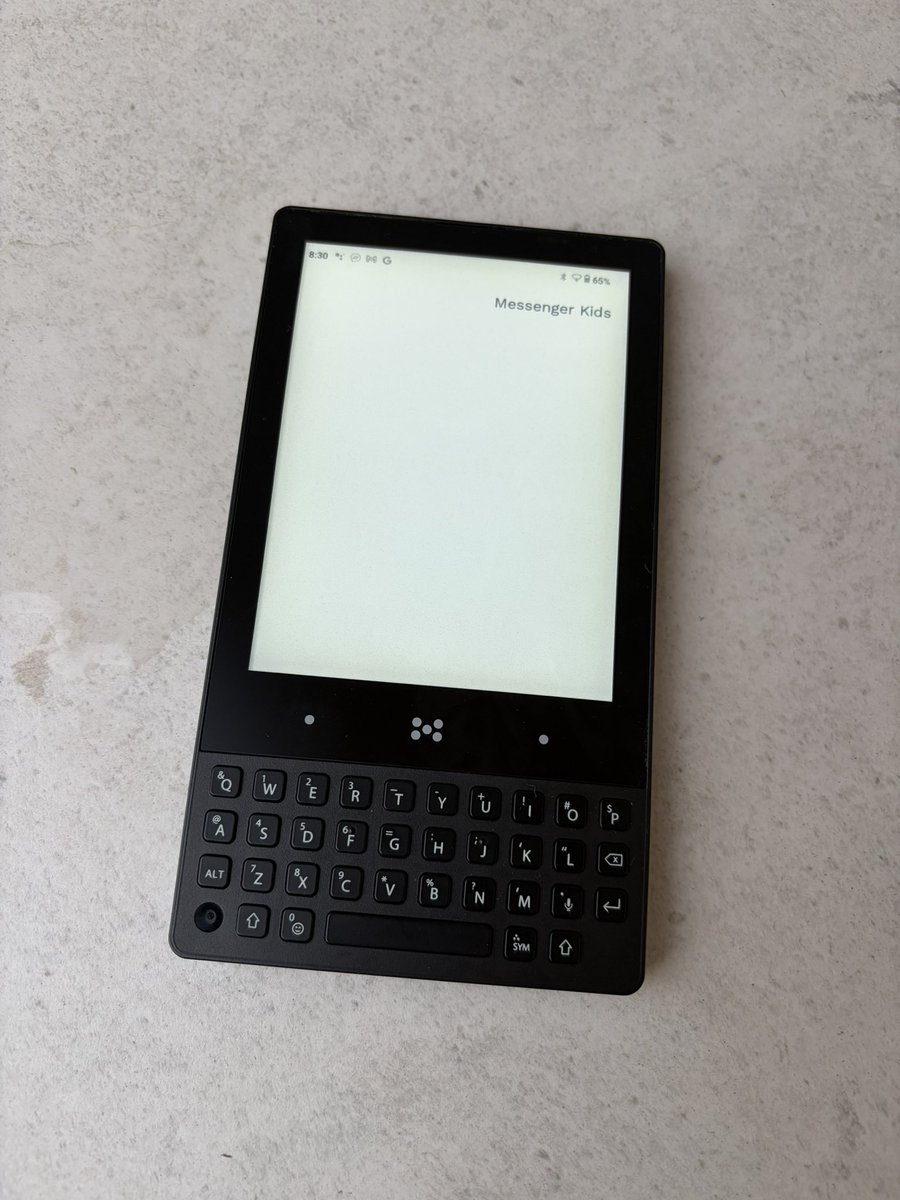
We got our 5yo a @MinimalCompany phone. Black and white, tactile, low-stim like a kindle, set up with just a texting app for family.
She now has a real use to drive her learning of letters. And side effect is I get these amazing messages throughout my work day!
I have read a LOT of technology history books.
This is by far the best one and it’s not even close.
It’s a biography that cross cuts every innovator and innovation in computing technology.
If I could recommend one tech history book, this would be it.
At @DasoComputer, we are building an AI-native computer for curious kids ages 6-12.
We reject supernormal stimuli and seek to protect kids around the world from it.
Today, we’re announcing Bonsai 27B: the first 27B-class model to run on a phone.
Bonsai 27B is the new multimodal flagship of the Bonsai family. Based on Qwen3.6 27B, it brings a new capability tier to local AI: multi-step reasoning, structured tool use, long-context workflows, and coherent agentic loops.
Until now, models in this class have been impractical to deploy locally. A 27B model occupies roughly 54 GB in 16-bit precision, and even a strong 4-bit build is around 18GB - too large for a phone and for most laptops.
Bonsai 27B changes that.
It comes in two variants:
• Ternary Bonsai 27B: 5.9 GB, 1.71 effective bits per weight, optimized for laptop-class quality.
• 1-bit Bonsai 27B: 3.9 GB, 1.125 effective bits per weight, optimized for phone-class footprint.
Everything is open-sourced today under the Apache 2.0 license.