connor ling

1.8K posts

connor ling banner
connor ling

connor ling

@conconconling

living in ambiguity & planting the seeds @neo 🌳

San Francisco, CA Katılım Nisan 2019
510 Takip Edilen2.2K Takipçiler
tinah
tinah@tinahhong·
Tech has decided that regulation is the enemy of progress, but innovation requires capital Regulation builds the trust necessary to inject billions into markets To enable free innovation, Andera raised a $37M series A led by Lightspeed to scale financial oversight with agents
English
215
123
741
193.5K
connor ling
connor ling@conconconling·
@ayushjaiswal just borrowing the parallel between soccer and startups! not a comment on mercor
English
0
0
0
256
Ayush Jaiswal
Ayush Jaiswal@ayushjaiswal·
Agree with your thought but the guy you chose to mention here built something with $2b in ARR. And as their past customer, I can promise you I really want what they’ve built. 😅 There’s definitely noise in any industry that’s expanding very quickly. But killing the industry is rarely the right call.
English
2
0
1
876
connor ling
connor ling@conconconling·
@deanwball why exactly is a future with AI as digital public infrastructure a dystopian hellscape?
English
1
0
7
260
Dean W. Ball
Dean W. Ball@deanwball·
Some observations on Kimi: 1. It's a very good model! I don't think its performance can be explained away by distillation or anything like that. In agentic coding sessions, it seems pretty much on par with the best public models of Q1 2026. In my fairly limited use, it also seemed very token hungry. It's not obvious to me that this model is actually that cheap to run. 2. I am personally surprised the Chinese state continues to allow the open sourcing of models this good, given potential risks. To be clear, I *myself* might be fine with models presenting this level of marginal risk being open weight, but I am surprised that China is fine with it. I suspect the reason they are is 75% explained by strategic blindness/lack of AGI-pilledness (the CCP is very Yann Lecun-y in its views of AI). The other 25% or so is their lack of compute for customer inference (making China's open-weight strategy an unintended byproduct of US export controls) and the normal Chinese strategy of aggressive exports. For the companies, as opposed to the government, the decision to open source is partially ideological and partially because they are behind, and they know that very few people would pay for sub-frontier models from China. 3. Open-weight models are inherently decelerationist, and I'm continually surprised to see the so-called "accelerationists" so excited about open-weight models. I suspect the reason they are is that they know open-weight models are effectively ungovernable, and they simply like the overall cloak of ungovernability open-weight models create over the whole of AI. It's not a bad strategy; it reminds me of James Scott's recounting of the hill people in "the art of not being governed." Still, in the end, open-weight models deter further AI capex. 4. One probable outcome of an open-weight-model-dominant world is full AI communism, which is precisely what China proposes: rather than a market product, AI is a "public good" which will ultimately be provided by the state as a kind of "digital public infrastructure." This future strikes me as a dystopian hellscape, but I've never met an open-weight models advocate who doesn't ultimately concede this is where things end. You'd be surprised how many 'accelerationists' lobbied me, while I was in government, to support an eleven or twelve-figure federally funded data center so that startups could train models at a subsidy and then give them away for free. There was no other way for AI to progress, they said. Perhaps this is the logical end state of things. Nonetheless, I find myself surprised to see supposed accelerationists excited about such an outcome. I think many of them just don't know what they're doing. Many accelerationists do not view the creation and serving of frontier models as a legitimate business. 5. I would guess that the Trump Administration will at some point realize that their best strategy here would be to create large amounts of regulatory risk around the use of open-weight Chinese models. You don't need to "ban open source" (one of the dumber motifs of AI policy discussion). You just need to direct every agency to issue soft law that creates FUD. "A Federal Reserve Advisory Bulletin found that there may be backdoors in Chinese AI models." It needn't be that well justified. You just create enough regulatory risk that every regulated enterprise backs off. You probably don't want to create so much regulatory risk that you scare off the hyperscalers from serving Chinese models; this will just drive startups to sketchier providers. There's a happy middle ground here. I'd assume they will do some version of this. 6. It's probably true that open-weight models of this capability make the world a bit more dangerous, but not so much more that you'll really notice. At some point the models will be capable enough that you will notice. "A nonliving, invisible, dangerous, and infinitely self-replicating agent escaped from a Chinese lab," you say? Color me shocked.
English
2.1K
909
7.5K
10.8M
connor ling
connor ling@conconconling·
i tell founders / friends to lmk if there are people i'm connected to that they want intros to -- a very small % of people actually follow through -- wonder if any learning there...
English
11
0
80
8.8K
Max Forsey
Max Forsey@max4c_·
Big tech has stolen your data, your attention span, and your critical thinking. Don't let the same thing happen to your kids.
English
2
0
11
676
connor ling
connor ling@conconconling·
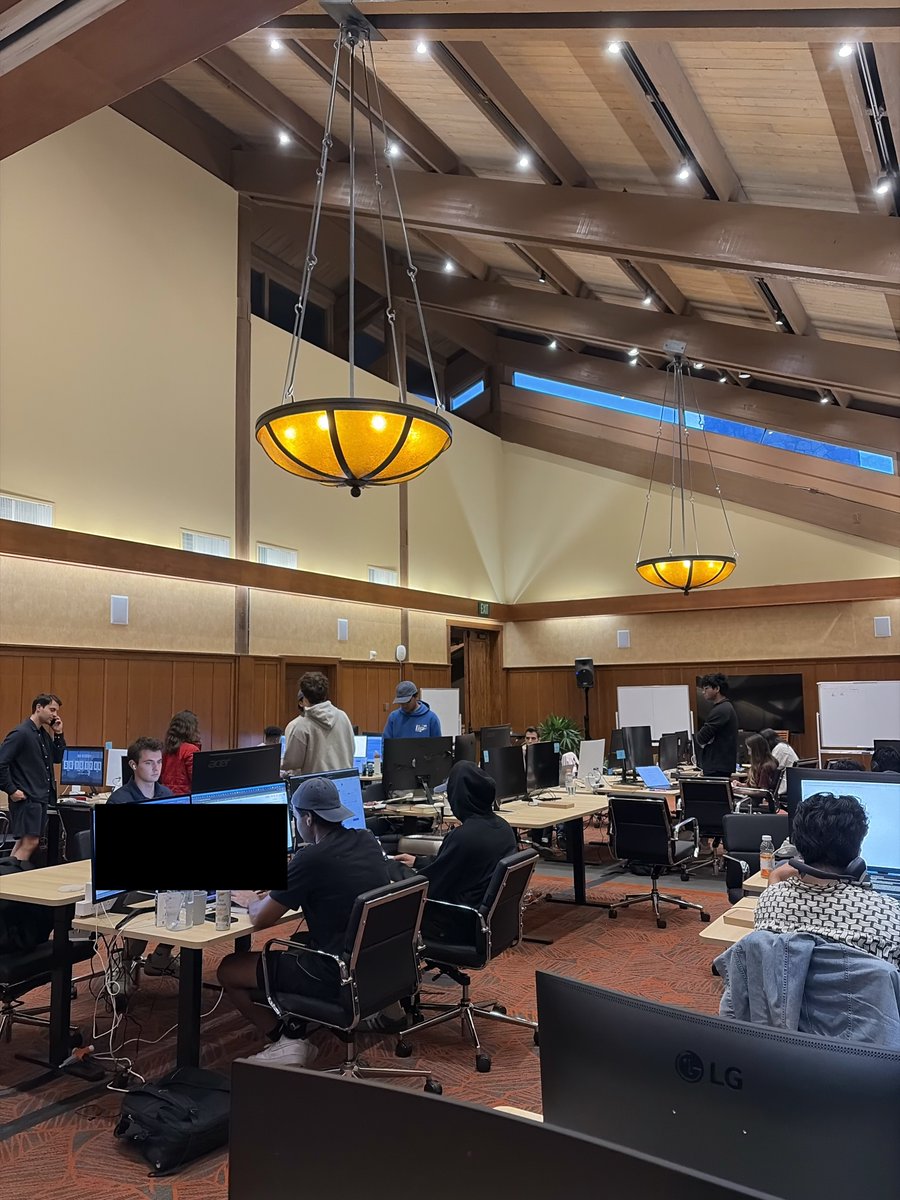
5 days into the first-ever @neo residency bootcamp -- immaculate vibes in sunriver 😌
connor ling tweet mediaconnor ling tweet mediaconnor ling tweet mediaconnor ling tweet media
English
7
8
78
6.5K
Rohan Gupta
Rohan Gupta@rohangupta_·
1/ After a few months of building in stealth, I'm excited to share more about what I've been working on and start building Telos in public! Coding with agents today still feels like managing "pets". You can run tasks over long horizons, but reliability and quality fall apart quickly 🧵
English
9
5
30
1.8K
eliott
eliott@EliottLee·
The Trojan Horse for the Odyssey right outside my balcony… only in NYC
eliott tweet mediaeliott tweet mediaeliott tweet media
English
3
0
9
1.5K
Ben Geist
Ben Geist@b_geist·
NYC is where stupid people act stupid, SF is where stupid people try and act smart. This is why i like NYC
English
8
5
152
21.7K
connor ling
connor ling@conconconling·
to assume last-gen tech enterprises and late-stage applied AI startups whose identity centers around product and GTM can sustainably have best-in-class know-how or, more importantly, talent is likely unrealistic; partnering up with specialized vendors could prove much more viable. example: x.com/nikogrupen/sta…
Niko@nikogrupen

Come help us scale @harvey’s model training team. If you’re interested in bringing frontier agent research into the Harvey product and working with: - @baseten to scale up RL to 80M+ token virtual datarooms - @PrimeIntellect to create structured agent training environments from unstructured legal data - @FireworksAI_HQ to navigate the quality <> cost Pareto frontier with inference-time routing and advisor models - @LangChain & LangChain Labs to build efficient verifiers and close the observability <> training feedback loop - @appliedcompute to post-train open weight models and high-volume agents for end-to-end legal tasks - @EngramLab to create an entire synthetic law firm and firm knowledge memory systems for better / more efficient open-world search - @trajectorylabs & @NVIDIAAI to shape the frontier of continual learning and sovereign AI for high-stakes domains - @mercor_ai & @SnorkelAI to build out Legal Agent Bench and other benchmarks across legal and other verticals and other projects like this, then this is the role for you. Apply here: harvey.ai/company/career…

English
1
0
1
635
Krish Maniar
Krish Maniar@krinetix1234·
this is probably true if the seller is a lab but it doesn't apply to the broader market. for the vast majority of cases, AI has made information asymmetry a lot more favorable to the buyer. 1. with AI, buyers are much more able (and have a strong incentive) to learn the seller's technology and bring it in-house. sometimes they'll even bring the seller's talent in-house (acquihire). we're already seeing teams like harvey decagon doordash etc. pilot a handful of vendors for model post-training (these effectively are consulting contracts), then stand up their own "labs" teams and internalize most of the tech or talent. happening everywhere now 2. AI has caused an explosion of startups - smaller teams can ship faster, build cost is near zero, some view as more financially attractive etc. so every serious buyer has many sellers competing for them and can run parallel pilots purely to glean as much as possible (ie, demos, architectures, evals, etc.) and force a race to the bottom on things like price. this is a big part of why startups in certain industries are seeing pretty low pilot → customer conversions in today's world, sellers have to think very critically about customers that (a) feel the pain but maybe as importantly, (b) don't have too strong an incentive - or ability - to build in-house.
Satya Nadella@satyanadella

x.com/i/article/2076…

English
2
1
25
5.9K
Josh
Josh@joshavata·
the @MeckaAI nyc office mural being painted
Josh tweet media
English
25
6
121
19.2K
connor ling
connor ling@conconconling·
spending this morning re-color-coding my entire calendar with the new gcal color palette drop 😌 have been praying for more options
connor ling tweet media
English
3
0
20
1.8K