
Max Gazor retweetledi
Max Gazor
509 posts

Max Gazor
@maxgazor
Partner @strikervp. Inception-stage VC, legendary founders. 5x Midas List. @reflection_ai @cribl_io @airtable @dynarobotics @ricursiveai @inferact @elorianai
San Francisco Katılım Mayıs 2009
312 Takip Edilen3.9K Takipçiler



Three years ago, we launched Theory Ventures with a simple premise : AI would reshape how software is built, sold, deployed, & operated. Within that world, we would build a concentrated, thesis-driven firm.
The market moved faster than even the most bullish expectations after the ChatGPT moment. Frontier models leapt from delicate demos to production systems. Open source models have become substitutes for enterprise workloads. Inference emerged as the dominant market in AI.
Underpinning all of this, AI compresses time. New models are released every 41 days. Companies reach $100m in revenue in record time. We all achieve more faster.
In celebration of our anniversary, we wanted to trace that mechanism through the market shifts of the last three years.
The first casualty of compressed time is the old language of venture capital. Seed, Series A, Series B categories still exist, but they describe the financial product companies seek rather than rather than company maturity. Venture firms have left the idea of offering a standard financial product to bespoke offerings : seeds range from $1m to $500m in size. Can we really call it all the same thing, anymore?
Three years ago, a seed company was often a small team with a product concept & early signs of product-market fit. Today, some seed rounds are larger than IPOs, fueled by great ambition, a supportive VC ecosystem, & the promise of generational scale businesses to be built.
Part of this is inflation in private markets. But more of it is time compression : the best companies mature much earlier than software companies did in prior generations. We’ve learned as an ecosystem how to build software companies & AI accelerates product development.
Compressed time also redraws the map of where great opportunity lies. When we first launched Theory, most AI conversations centered on models. Remember the debate of whether model companies would be the airlines of the era?
Today, inference is becoming the dominant market. The market is segmenting because the workloads & buyer preferences have evolved - very few companies can afford state-of-the-art AI for everyone - & each specialized constraint creates a new infrastructure category.
Companies like @sailresearchco are building the systems that operationalize intelligence : serving it cheaply, routing it intelligently, & specializing it around use cases like video, batch, local, agentic, & real-time workloads.
Databases followed this path a decade ago. They fragmented into OLTP, OLAP, vector databases, & streaming systems. Those markets have evolved with AI, a pattern we’ve backed through @motherduck & @lancedb , with @omni in the AI analytics layer above them. Inference infrastructure is now specializing the same way.
The expense of inference reinvigorates a sedate market that has been controlled by behemoths for a decade : advertising. Every major interface shift, TV, web, mobile, streaming, found its answer to monetizing a massive audience in ads, & AI is no different.
AI advertising is emerging as the subsidy for inference costs, letting applications grow usage & revenue together rather than against each other. We wrote about this dynamic when we led @koahlabs ' Series A : native ad formats inside AI conversations are producing click-through rates 4-5x the display baseline, & an agentic app builder can provide inference offset by ads.
The same compression closed the gap between closed & open models, cloud models & local models. The conventional narrative holds that frontier closed-source models lead & open source follows. We’ve reached the iPhone 15 moment of AI. Many models are good enough for most work.
Running a model locally reduces cost, improves latency, increases control, & minimizes data governance concerns. Enterprises are adopting local & open-source models for sensitive workloads, & frontier capabilities compress toward consumer hardware within a few years. What once required a hyperscaler cluster runs on a laptop just a few quarters later, a shift @ollama
brings to millions of developers.
The promise of AI is that software will ultimately be more secure : machines that read every line of code, patch faster than attackers move, & never tire.
In the meantime, the attack surface is exploding. MCP servers, skills, plug-ins, & coding agents each introduce new entry points, & enterprises are deploying them faster than security teams can review them. Attackers are massively parallel & shrinking necessary response times from months to minutes. Defenses must respond.
It’s why we backed @DropzoneAI , whose AI analysts investigate the alert flood no human SOC can keep up with, @Maze_Security , which applies agents to cloud vulnerability triage, & @artemis , securing the new agentic surface itself.
The same agentic wave is rewriting operations. ERP & back-office systems have resisted change for decades because the work is unglamorous, the data is messy, & the switching costs are enormous. One CFO we interviewed, when asked about a startup said, “that company has only been around 15 years; they are too immature.”
Agents invert that math. Systems that read documents, reconcile records, & execute workflows can attack operations from the inside rather than demanding a rip-&-replace. It’s the thesis behind Doss, rebuilding ERP for teams that move at modern speed, & Backops, applying agents to the back-office work no one wants to do by hand.
AI has impacted crypto, another market fueled by data. Prediction markets, stablecoins, micropayments all have an AI infusion to them. Today, crypto companies need to generate revenue & use AI to provide better experiences, which led to our investment @AlliumLabs , the data layer underneath that institutional wave.
Recognizing shifts early requires fingers on keyboards, wrestling AI agents into compliance rather than observing it. We built Theory as a technical organization, experimenting with AI across research, sourcing, diligence, portfolio support, & internal operations. Working inside these systems sharpens our understanding of where the stack is breaking & where new workflows are emerging, while deepening our empathy for founders deploying real AI systems inside enterprises. It’s harder than social media says.
AI also changes the economics of an investment firm. Over the last decade, venture firms scaled by adding people. AI-native companies are demonstrating that much smaller teams can operate at 10x+ the leverage of prior software generations, & the same dynamic applies to us : since launch, we’ve analyzed 2x the investment opportunities with a team of just 3 investors working alongside a nine-person intelligence organization.
None of this works without the team behind it. Theory started three years ago as a handful of people & a thesis. Today we are thirteen strong. We believe this is the structure of a modern venture capital firm : engineers & researchers who build the systems we use every day : agents that map markets, pipelines that surface companies months before they raise, & research infrastructure that lets a small team cover the ground of a firm several times our size.
Everyone at @Theoryvc works with the technology we invest in, & that shared fluency shapes every decision we make. The firm we’ve built over three years is itself a product of the thesis : a small team, deeply technical, operating with the leverage AI makes possible.
But the real story of these three years is the founders. They compressed decades of company-building into quarters & shipped products that rewrote what enterprises expect from software.
The next three years will make these look slow. The most ambitious builders we meet are just getting started, & we can’t wait to see what they do.

English
Max Gazor retweetledi

AI only has pre-schooler level capabilities for visual tasks.
"The frontier models—the best of them—still reason around the age of a preschooler, and any elementary school kid in that benchmark was able to beat all the frontier models on these visual tasks."
"These are tasks that are not just object recognition. It's about spatial reasoning... tasks like navigating through the maze…” — @AndrewDai, CEO of Elorian
English
Max Gazor retweetledi

We'll be at ICML🇰🇷! Come by our rooftop dinner to meet the @ElorianAI and @RicursiveAI teams, and chat about the frontiers of multimodal reasoning and recursive self-improvement. Thanks to @DeltaInstitutes for co-hosting this with @strikervp.
partiful.com/e/7qj7GW6CtIaX…

English
Max Gazor retweetledi

How do you spot an AI unicorn before it has any revenue?
@brianzhan1 of @strikervp has a framework. And it doesn't involve business plans.
Hear it on the Nebius for Startups Podcast → nebius.com/podcast
English

Closer to 1% , if you narrow it down to the check writers (not firms or junior folks) who did the deal . It's a very though job to return meaningful capital to LPs.
Max Gazor@maxgazor
Pause to consider who you listen to for advice. ilyastrebulaev.substack.com/p/the-2026-ven…
English

@MenloVentures @business @nmasc_ @mmurph @shawnvc @venkyganesan Congrats @venkyganesan @mmurph @deedydas and team!
English

@business's @nmasc_ sat down with @mmurph, @ShawnVC and @venkyganesan to discuss Menlo’s $3B raise, our AI strategy, and how we prepared to meet this moment.
Read the story: bloomberg.com/news/articles/…
English
Max Gazor retweetledi

Congratulations to our partner @maxgazor on his 5th consecutive Forbes Midas List appearance.
Technical founders. ✔️
Day zero conviction. ✔️
Experienced investors. ✔️
To the founders in AI & cybersecurity: let's build together.

English
@nikhil_suresh2 @RicursiveAI @ElorianAI @inferact Thank you for the kind words. Great to be on such an awesome team. We are just warming up...
English

"Max, Striker dominated our conversation for the rest of the day. Top of our mind and deeply impressive"
People ask me how Striker manages to be able to work with companies like @RicursiveAI, @ElorianAI, and @inferact and Max is a massive massive part of that reason. Max's superpower is in his thoughtfulness and humility. He is refreshingly candid in his advice. In a significant portion of meetings we take, I have had founders follow up with me on their conversations saying (like the one above from one of our portcos).
His conviction in the companies he backs and the way he works with founders has largely informed my own investing philosophy.
Massive congrats to my partner @maxgazor on his 5th consecutive Midas List appearance!! Max is truly n of 1 and it has been amazing learning from him and working with him at Striker.
Striker Venture Partners@strikervp
Congratulations to our partner @maxgazor on his 5th consecutive Forbes Midas List appearance. Technical founders. ✔️ Day zero conviction. ✔️ Experienced investors. ✔️ To the founders in AI & cybersecurity: let's build together.
English
Max Gazor retweetledi

Our open models are designed to support the Genesis Mission by giving the scientists in our national labs the flexibility and sovereignty to work on their own terms. Learn more ⤵️
Reflection@reflection_ai
English

Proud to announce my position as CEO of @RoboStrategy.
When I initially started looking into investing in robotics 2 years ago most VCs I consulted with recommended not to invest in the space. Robotics companies at this time did not have an easy time raising capital. The industry didn’t have a track record of big venture winners, was perceived to be challenging for a variety of reasons, and was not well understood. But it was clear to me that the rate of acceleration of physical AI development would dramatically change the industry. I invested $19m into FigureAI as my first investment.
I believed it was a question of when, not if we could imbue machines around the world with physical intelligence. To accomplish this, the industry would need a tremendous amount of capital to grow, and also an investment firm that deeply understood the needs of robotics/physical AI companies so that it could build a platform to better support them. It will take hundreds of billions to capitalize the mechanized future meaning there is a big gap in the market. We decided we wanted to fill it.
Previously, Mechanism Capital had never taken outside capital, but to do this at the scale I envision, I would need to do so. However, the private markets don’t have that scale. The public markets do, and it was clear that there is and likely will be tremendous appetite for public market investors to participate in the immense value creation happening in AI & robotics that only private market investors currently have the privilege of accessing. The explosive growth of AI companies is a precursor of what will happen in physical AI. So in 2025, we founded RoboStrategy and a year later, we took it public on Nasdaq. Throughout this year, we’ve assembled a great portfolio, started leading rounds of some amazing companies, and have built the foundation to be ready to scale to the next level after going public.
We look different from a traditional VC firm in ways that founders appreciate. Our structure as a closed end fund means our capital is permanent - no fund life meaning we can invest with extremely long time horizons. Our investment firm also of course needs to have deep industry and research experience so that it can make the best risk reward optimized investment decisions. In the last year, we’ve brought on some truly exceptional robotics industry veterans who have previously served for decades as founders/operators. Many founders we talk to consider us as the most sophisticated venture capital firm they’ve talked to and we only intend to grow our expertise in the industry. RoboStrategy’s success depends on our ability to distribute the fund and capture maximal mindshare. This plays to our team’s strength in digital marketing and social media. We’re building a special marketing engine that serves as an attention amplifier for both us and our founders so that our products and stories can reach more people.
A source of inspiration for our fund structure, Strategy (MSTR) raised tens of billions from public capital markets to invest in Bitcoin. I believe robotics will be a much larger industry than Bitcoin and the asset class is orders of magnitude less accessible. We are aiming to raise more and not only become the largest robotics investor globally, but also one of the largest venture capital funds in the world. Venture capital has traditionally been restricted to a limited group of investors. We are changing the paradigm and bringing it to the rest of the world.
Be sure to follow @RoboStrategy.
Job’s not finished.
RoboStrategy@RoboStrategy
BOT: Public Market Access to Private Robotics Companies Introducing RoboStrategy: RoboStrategy, Inc. (Nasdaq: BOT) is a closed-end management investment company providing concentrated exposure to robotics and physical AI. The fund is designed to give public market investors exposure to a portfolio that aims to include the most promising private, pre-IPO, and public robotics and physical AI companies. It bridges a structural gap between where robotics innovation is occurring (largely in private markets) and where most investors can access exposure (public markets). The fund seeks to provide investors with access to a sector that has traditionally been limited to venture capital, and aims to provide exposure to companies that may stay private for longer. -- The Core Insight We believe the robotics industry is at an inflection point, with physical AI and robotics increasingly being applied to labor-constrained global industries such as manufacturing, logistics, and services. According to the International Labor Association, labor accounts for approximately 52% of global GDP.¹ According to Statista, global GDP in 2025 was $118T.² This represents an implied global labor market size of roughly $60T. At the same time, this labor base is increasingly constrained: Korn Ferry projects a global shortage of 85.2 million skilled workers by 2030, including a 7.9 million worker deficit in manufacturing alone.³ Deloitte and The Manufacturing Institute estimate the US could need 3.8 million new manufacturing workers by 2033, with 1.9 million of those roles at risk of going unfilled.⁴ Physical AI and robotics are emerging as a primary means of closing that gap. While public markets currently offer indirect exposure to robotics through diversified technology companies, much of the value creation is occurring in private companies that remain inaccessible to most investors. -- Portfolio Focus The portfolio focuses on what the fund believes are category-defining robotics and physical artificial intelligence innovators, including Figure AI, Apptronik, Dyna Robotics, Standard Bots, Dexmate, and other pioneers advancing autonomous systems, machine perception, and human-machine collaboration. The managers of the fund seek to optimize returns by actively managing the portfolio and continuing to make new investments in leading private robotics companies. -- The Ambition The fund's long-term goal is to grow into a significant public-market vehicle for robotics investing, providing public-market access to private innovation in the sector. -- Footnotes & Disclosure: ¹ International Labour Organization, World Employment and Social Outlook: May 2025 Update. ilo.org/sites/default/… ² Statista, Gross domestic product (GDP) in current prices worldwide. statista.com/statistics/268… ³ Korn Ferry, Future of Work: The Global Talent Crunch. kornferry.com/about-us/press… ⁴ Deloitte & The Manufacturing Institute, Taking charge: Manufacturers support growth with active workforce strategies, April 2024. www2.deloitte.com/us/en/pages/ab… RoboStrategy, Inc. (Nasdaq: BOT) is a closed-end fund registered under the Investment Company Act of 1940. This content is for informational purposes only and does not constitute investment advice or an offer to buy or sell securities. Investing involves substantial risks, including possible loss of principal. The fund invests in robotics, physical AI, emerging technologies, and private companies, which may involve heightened volatility, limited liquidity, valuation uncertainty, and concentration risk. References to portfolio companies are illustrative only, do not represent all investments made by the fund, and are not investment recommendations. Portfolio holdings are subject to change. Forward-looking statements are inherently uncertain. See the prospectus and SEC filings for additional information.
English
Max Gazor retweetledi
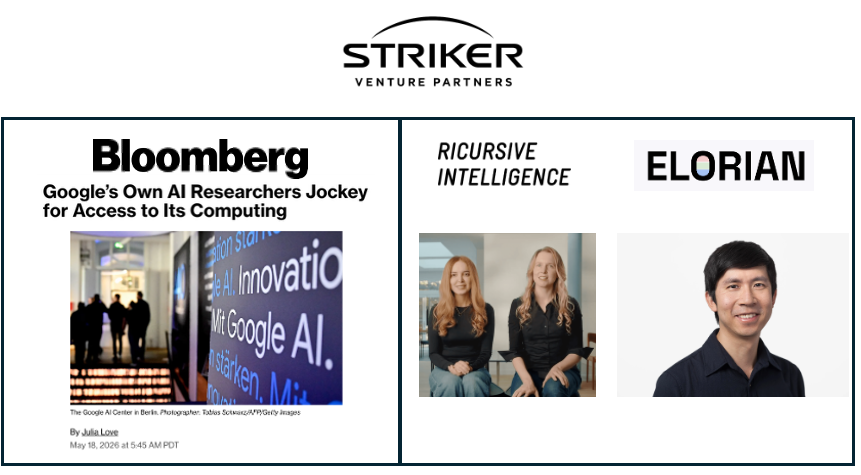
Striker portfolio companies @ElorianAI and @RicursiveAI were founded by Google's most elite AI researchers. Names like @AndrewDai, @annadgoldie & @Azaliamirh.
Read more in @Bloomberg today. Link below.
English
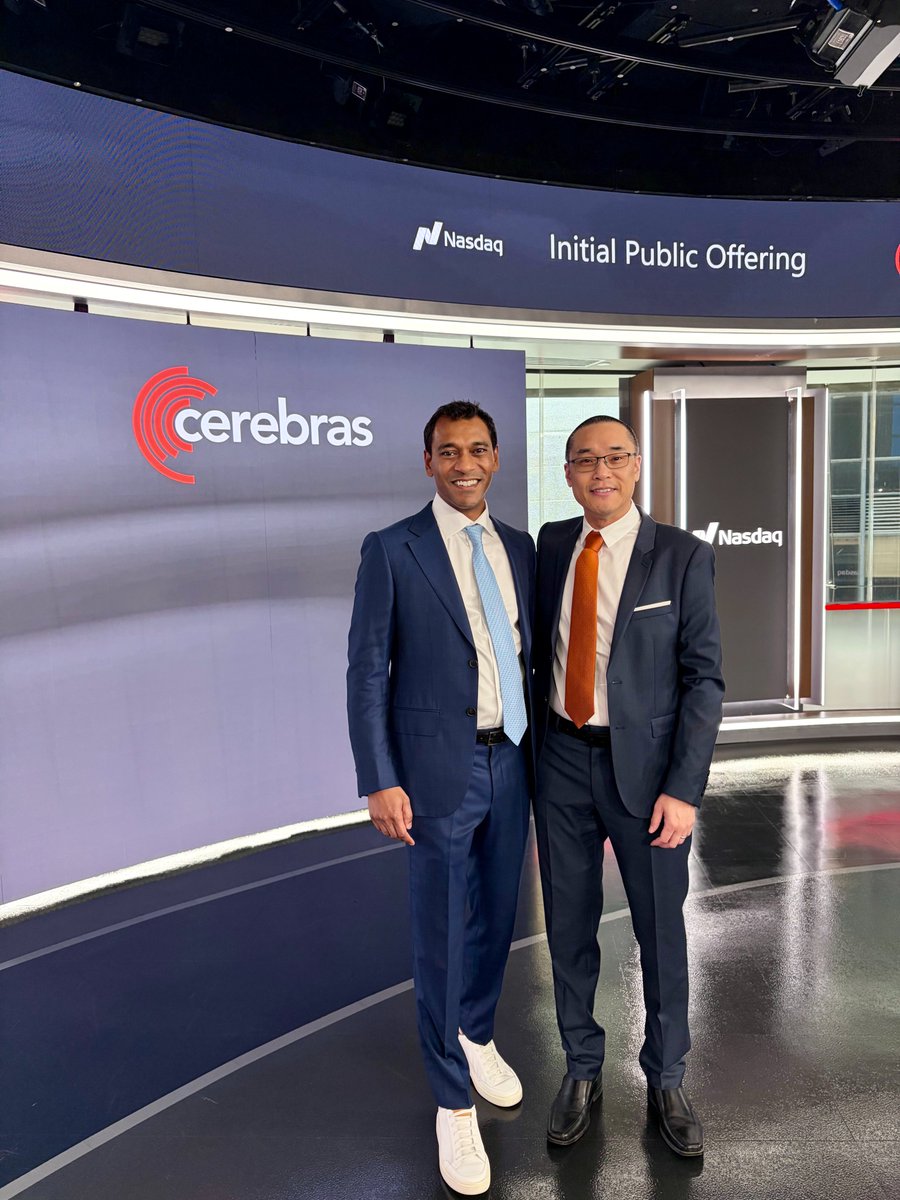
I’m so fucking proud of this team.
They took an extraordinarily difficult technical swing with wafer-scale and connected on the first try.
Then they spent years grinding through packaging, cooling, compilers, frameworks, early customers, and everything else required to turn a technical breakthrough into a real company — swinging and missing and learning and trying again.
Most importantly, they stayed clear-eyed about what they had (a technical marvel) and what they didn’t (enough advantage in training), saw the opportunity emerging in inference, and adapted.
That kind of persistence — not to be confused with stubbornness — is incredibly hard to describe, but absolutely essential in the unstable substrate of AI.
The requirements of AI today will not be the requirements of AI tomorrow. But this team will keep figuring it out.
And I’m here for it.



English
Striker Venture Partners (@strikervp) is committed to funding the frontier of AI.
We’ve partnered with AWS to give our frontier robotics founders an absolute edge in compute and scaling.
Read more in our joint essay below.
@AWSstartups @awscloud @nikhil_suresh2
AWS Startups@AWSstartups
Physical AI is hitting its inflection point. With @strikervp, we dug into world models and the multimodal stack rewriting robotics. The data gap separating LLM and robotics advancement can be closed.
English
Max Gazor retweetledi

Appreciate the take "it’s not that much" but I’d say you can do a lot with 8k GB300s.
A lot
Everything is a skill issue
Iain Dunning@iaindunning
If someone invests $1B in your "lab", neo or not, if you then went to a neocloud and gave them all of it, you'd get something like a 8192 [G]B[23]00 site on a 3 or 4 year contract. That's... Not that much! And that's all your money! Nothing left for comp, data, etc... hard math.
English
Max Gazor retweetledi

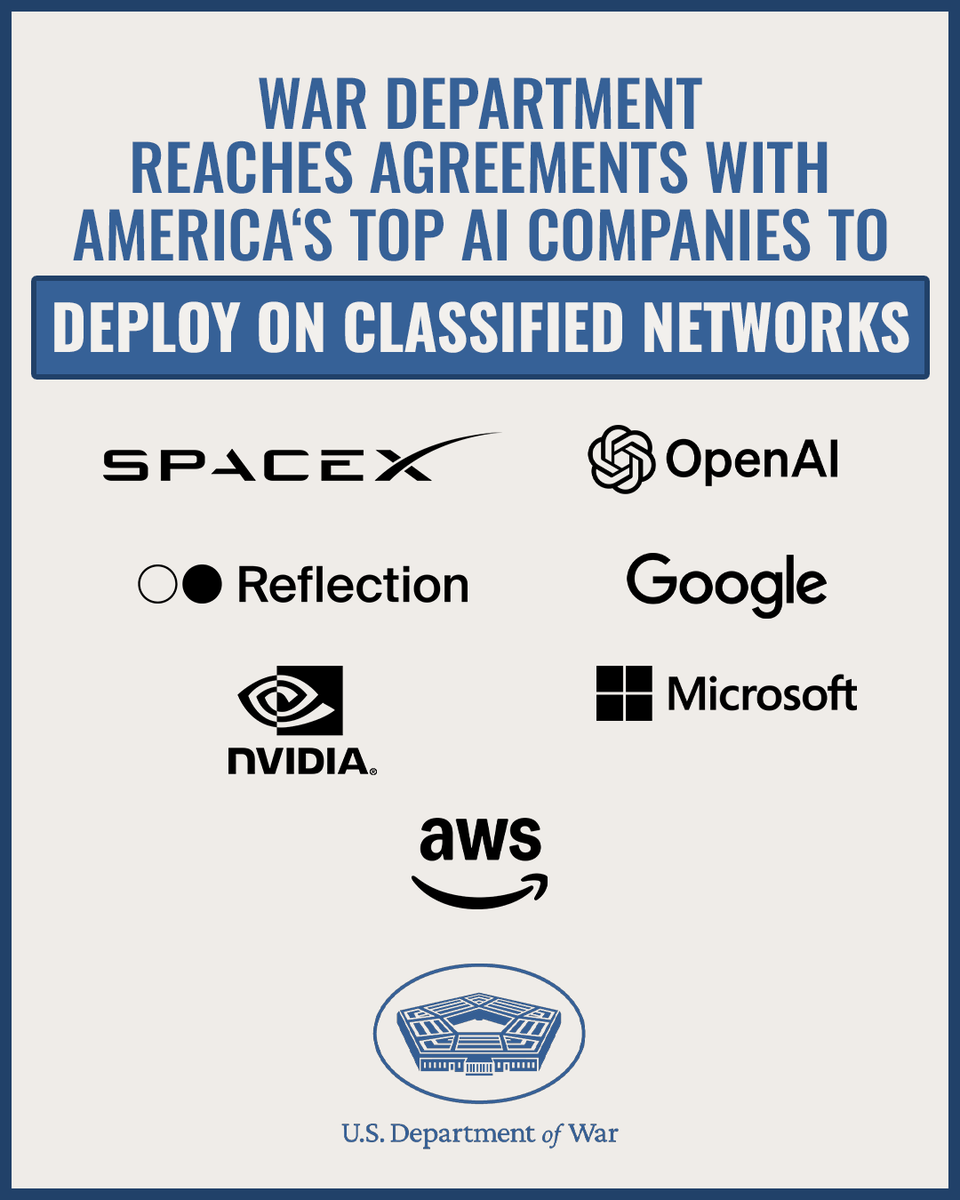
Today, the @DeptofWar entered into agreements with SEVEN of the world's leading frontier AI model and infrastructure companies to deploy frontier capabilities on the Department's classified networks:
• SpaceX
• OpenAI
• Google
• NVIDIA
• Reflection
• Microsoft
• Amazon Web Services
This is just the latest initiative in our mandate to create an AI-FIRST WAR DEPARTMENT 🇺🇸
English