
Max Jiang
71 posts
Max Jiang
@maxjiang93
Staff Research Scientist / TLM @ Waymo | Generative Models, 3D Vision, Self-driving Cars | Prev. PhD@Berkeley, Google, Cruise | Opinions are my own
Mountain View, CA Katılım Kasım 2013
226 Takip Edilen364 Takipçiler
A new generation in AV simulation is here!
We are announcing AlpaDreams, a real time interactive generative world model for AV simualtion! Just a year ago it took minutes to generate a few seconds of video, today it is real time and interactive!
research.nvidia.com/labs/sil/proje…
English
Max Jiang retweetledi

📢Our team @GoogleDeepMind is hiring a Research Scientist in MTV, NYC, or SF!
Join us to push the frontiers of visual perception & spatial reasoning for multimodal foundation models like Gemini, Nano Banana, and more!
Send your CV to gdm-3d-scene-understanding-job@google.com

English
Max Jiang retweetledi

Great use of Genie 3 from @waymo to create high-fidelity, interactive simulations of rare events that are nearly impossible to capture in the real world.
Google DeepMind@GoogleDeepMind
Genie 3 🤝 @Waymo The Waymo World Model generates photorealistic, interactive environments to train autonomous vehicles. This helps the cars navigate rare, unpredictable events before encountering them in reality. 🧵
English
Max Jiang retweetledi

Super cool use case of Genie 3 simulations!
Waymo@Waymo
We’re excited to introduce the Waymo World Model—a frontier generative mode for large-scale, hyper-realistic autonomous driving simulation built on @GoogleDeepMind’s Genie 3. By simulating the “impossible”, we proactively prepare the Waymo Driver for some of the most rare and complex scenarios—from tornadoes to planes landing on freeways—long before it encounters them in the real world. waymo.com/blog/2026/02/t…
English
Incredibly excited to share our most recent work: the Waymo World Model. We leverage the broad world knowledge in Google DeepMind's Genie 3 and bring it into our most advanced autonomous driving simulator to date, with emergent transfer of world knowledge even into the 3D domain.
Waymo@Waymo
We’re excited to introduce the Waymo World Model—a frontier generative mode for large-scale, hyper-realistic autonomous driving simulation built on @GoogleDeepMind’s Genie 3. By simulating the “impossible”, we proactively prepare the Waymo Driver for some of the most rare and complex scenarios—from tornadoes to planes landing on freeways—long before it encounters them in the real world. waymo.com/blog/2026/02/t…
English
Max Jiang retweetledi

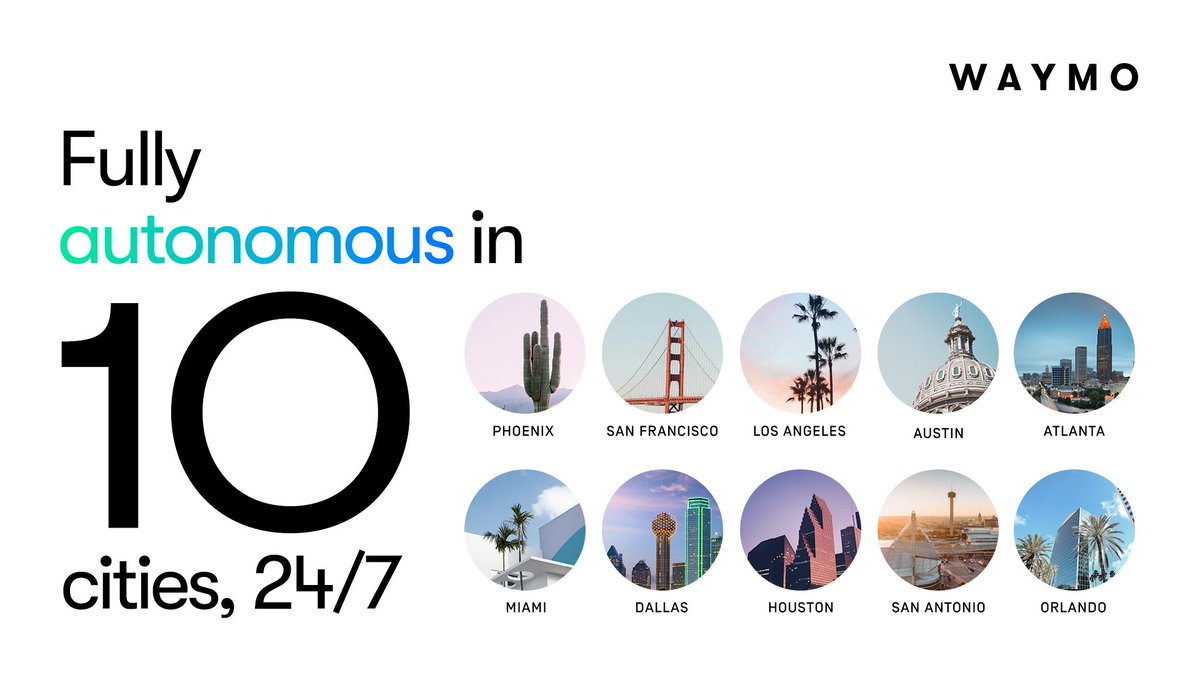
Exponential scaling ongoing – @Waymo has officially doubled our fully autonomous cities in a matter of weeks, reaching 10 cities with the newest additions of San Antonio and Orlando. This is a testament to the maturity and generalizability of the Waymo Driver, our deliberate, safety-first approach to scaling, and an important step as we prepare to serve more riders across more cities soon.
English
An early glimpse into the exciting future of fully generative AV world models ;)
Jiahao Wang@jiahaowg
🚗 Excited to present our paper "Drive&Gen: Co-Evaluating End-to-End Driving and Video Generation Models" at #IROS2025! 📅 Time: 10:55–11:00, Wed, 10.22.2025 📍 Room: 103C, Paper WeAT27.6 arxiv: arxiv.org/abs/2510.06209 #IROS2025 #WorldModels #AutonomousDriving #GenerativeAI
English
Max Jiang retweetledi

🚗 Excited to present our paper "Drive&Gen: Co-Evaluating End-to-End Driving and Video Generation Models" at #IROS2025!
📅 Time: 10:55–11:00, Wed, 10.22.2025
📍 Room: 103C, Paper WeAT27.6
arxiv: arxiv.org/abs/2510.06209
#IROS2025 #WorldModels #AutonomousDriving #GenerativeAI
English
📣Super excited to share a new opportunity to work with me and my team to build the most advanced generative world model for simulating autonomous vehicles 🤖🚕🌎 enabling Waymo to scale faster, safer, and serve more people.
careers.withwaymo.com/jobs/research-…
English
Max Jiang retweetledi

Can a single autonomous driving simulation world model jointly insert, delete, and control the behavior of all agents and traffic lights in a bird's-eye-view scene?
For the first time, we show this is possible in SceneDiffuser++, our CVPR '25 paper, w/ 60+ second simulations.🧵
GIF
English
Max Jiang retweetledi

Genie 3 feels like a watershed moment for world models 🌐: we can now generate multi-minute, real-time interactive simulations of any imaginable world. This could be the key missing piece for embodied AGI… and it can also create beautiful beaches with my dog, playable real time
English
English
It’s official!🎉I’m thrilled to announce that I will be joining @MIT as an assistant professor in a shared appointment between @MITBiology, @MITEECS and @MIT_SCC this fall.
My lab will couple ML and high throughput experimentation to harness the remarkable functional diversity of microbial genomes. If you are excited about the intersection of AI and microbiology, please get in touch!
It’s been an incredible journey building @tatta_bio with @ancornman1 to advance AI infrastructure for biology, and I will continue to further our mission as chief scientist. I am so grateful for all the support I received from my mentors, colleagues and collaborators over the years: @pgirguis, @sokrypton, @simroux_virus, @AlexJProbst, @annedekas

English
Max Jiang retweetledi

Exciting news: @Waymo is beginning public service on the Peninsula, starting with Palo Alto, Mountain View, and Los Altos! Initial service area below.

Waymo@Waymo
We’ve made millions of miles of memories over the past 15+ years, but today is special. We’re returning to where the journey began, gradually opening our doors to our first public riders in Mountain View, Los Altos, Palo Alto, and parts of Sunnyvale.
English
Max Jiang retweetledi
Exciting new @Waymo milestone: Waymo One is now serving 200k+ paid trips each week across LA, Phoenix and SF - that’s 20x growth in less than two years! Up next: Austin, Atlanta and Miami.
English
Max Jiang retweetledi

Just sat down to read the DeepSeek-R1 paper. We're entering an era where compute isn't primarily for training. It's for creating better data. I expect to see the money & compute spent on data processing (generation / annotation / curation) grow to match and exceed the money & compute spent on pre-training.
People have talked about pre-training plateauing because we're "running out of data" on the internet to scrape. While that may be the case, capability improvements are going to continue full steam ahead. The improvements in intelligence are going to come not from putting in more data (scraped from the internet) but rather from putting in more compute (to generate higher-quality data). Intuitively, this feels similar to me to how people learn. You don't learn just by ingesting lots of tokens. In many cases, you learn by thinking more (I am referring to training time, but thinking more also applies at inference time).
There are many creative ways to put in more compute to get better data, and this problem will be an important research area for a number of years.
- In this paper, they train two models. Why two models? The first one (a reasoning model trained via RL) is used to generate data to train the second. This works by using the first model to generate reasoning traces and then selectively keeping only the high quality outputs (quality is judged by simply checking the results). This approach of "checking the results" works well for domains like math and coding where you can easily check the results.
- In drug development, it is super common to put compute into generating better data in two phases. In the first phase, a generative model (e.g., for protein sequences) generates a massive number of candidate drugs. In the second phase, scoring or filtering is done with a slew of predictive models which may predict structure, toxicity, solubility, binding affinity, etc. After all this work is done, you may end up with 100 data points.
- In physical domains (e.g., climate applications), expensive but accurate physics simulators exist (these simulations are run on super computers for long periods of time to simulate the physics of the atmosphere or some other system). All of that data can be used to train models, which is showing a ton of promise.
The question of "how to put more compute into generating better data" is central to progress in AI right now.
English
Joint work with @YijingEric @ancornman1 Chris Davis @XiukunH @hongjjeon Sakshum Kulshrestha @jlambert_ Shuangyu Li Xuanyu Zhou @CarlosFuertes Chang Yuan @tanmingxing Yin Zhou @drago_anguelov
Filipino
[NeurIPS 2024] We are excited to share SceneDiffuser - SceneDiffuser is a diffusion based world model for traffic simulation.
Paper: openreview.net/pdf?id=a4qT29L…
Come talk to us at NeurIPS! Waymo Booth or Friday Poster Session. 11am, East Exhibit Hall A-C #1200.
English