Bryce McBride

1.5K posts

Bryce McBride banner
Bryce McBride

Bryce McBride

@mcbride_bryce

Writer and publisher of two economics books - Workbook for the New IB Economics (https://t.co/RnoJI0Jf1u) and Economics for Canadians (https://t.co/dSW9uTRcfl)

Ontario, Canada Katılım Nisan 2013
315 Takip Edilen172 Takipçiler
Bryce McBride
Bryce McBride@mcbride_bryce·
@MPelletierCIO This isn't so much a problem with Canada as it is a global strength for the US. America draws top talent from around the world. They are the imperial centre, after all. What Rome was in the 1st century CE, or Baghdad was in the 10th century CE, the US is today.
English
0
0
0
98
Martin Pelletier
Martin Pelletier@MPelletierCIO·
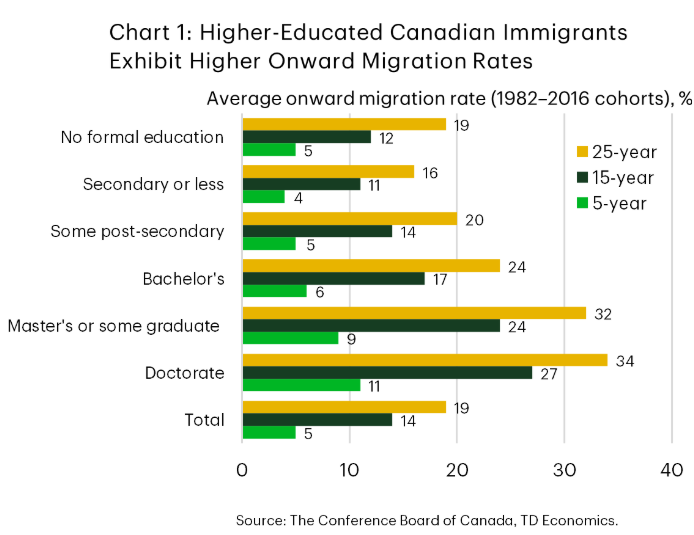
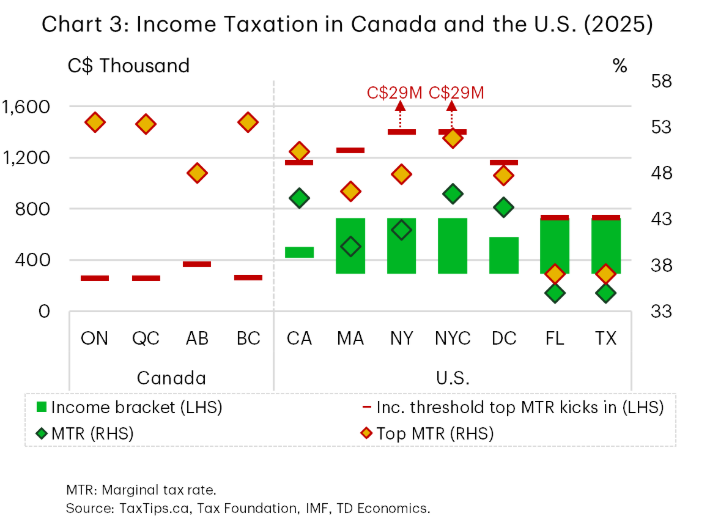
TD report on CANADA's BRAIN DRAIN is really interesting. Canada is quietly losing its top talent to the United States in what economists call a silent brain drain. While Canada does a strong job educating highly skilled workers in STEM, engineering, and entrepreneurship, it struggles to keep them due to higher taxes that kick in at much lower income levels, limited opportunities to scale companies, weaker commercialization of ideas, and much better pay and growth potential south of the border. -> Talent leaves mainly through temporary US work visas rather than permanent moves -> Outflows are heavily concentrated among the highest skilled, especially in tech and advanced degrees -> Onward migration is worst among immigrants and top university graduates -> Canada has a missing middle of medium sized firms, relying instead on many tiny businesses and a few large ones -> Personal tax rates often exceed 50 percent in major provinces and apply at much lower thresholds than in the US -> Complex corporate tax rules push entrepreneurs toward tax planning instead of growth All of this weakens productivity, innovation, and domestic returns on education, making Canada a feeder system for the US economy REPORT: economics.td.com/ca-silent-brai…
Martin Pelletier tweet mediaMartin Pelletier tweet mediaMartin Pelletier tweet media
English
123
529
1.8K
120.9K
Bryce McBride
Bryce McBride@mcbride_bryce·
@elonmusk @JeffBezos If your firm was in a competitive market, sure. Your profits then would reflect a portion of the value you created. However, as a platform oligopolist, not so much, as you are in a position to practice price discrimination and thereby take all the consumer and producer surplus.
English
0
0
0
5
Bryce McBride
Bryce McBride@mcbride_bryce·
@scottjduffy @senatorbabet Classical economists differentiated between earned and unearned income. Neoliberal economics has worked hard to make them seem the same. We need to bring back Classical thinking.
English
0
0
0
11
Scott Duffy
Scott Duffy@scottjduffy·
@senatorbabet So if you buy Gold, and the price of Gold goes up... Did you risk any money? Did you build any business? Is there work? We need to separate out price speculation ("the price of this asset will go up in the future") from investing in businesses and doing work, for tax purposes.
English
116
1
61
12.8K
Senator Babet
Senator Babet@senatorbabet·
Capital gains tax shouldn’t exist. I risk my money. I build the business. I make the investment. I do the work. I take the risk. So why the hell should the government take a cut of my success? They risk nothing. They create nothing. They just take. Parasites. F’en parasites.
English
3K
9.7K
69.4K
1.5M
Bryce McBride
Bryce McBride@mcbride_bryce·
@Nanan0567 @GaullistTory No, the middle class chooses French immersion in order to get their kids away from the poor, POC, and recent immigrants. The French is almost entirely incidental. FI should be done away with, and core French strengthened enormously, so everyone, after 10 years, is fluent.
English
1
0
0
88
N
N@Nanan0567·
@GaullistTory Lol, and I genuinely think it comes down to class. The privileged know the significance of getting their kids to be bilingual, while the working class aren’t invested in the same way
English
1
1
4
1.3K
Mitch Proctor 🇨🇦
Mitch Proctor 🇨🇦@GaullistTory·
French immersion is to Canadian liberals what private school is to British conservatives.
English
22
28
663
42.7K
Bryce McBride
Bryce McBride@mcbride_bryce·
@luxemiaa 3... The airline really tried to get us (and others near us) to move, but we were irritated by this guy's sense of entitlement. Eventually, after our departure was delayed by maybe 30 minutes, the onboard staff offered to seat us in FIRST CLASS! It was lovely.
English
1
0
22
2K
Bryce McBride
Bryce McBride@mcbride_bryce·
@luxemiaa 2...middle. Then, the flight attendant comes with a Saudi fellow who has the window seat. He claims he can not be separated from his wife, so the flight attendant asked us if one of us could 6 this guy and his wife might sit together. Our response? Why should we be apart?
English
1
0
10
2K
Mia♡
Mia♡@luxemiaa·
I was settled into my window seat on a flight when a flight attendant came over and asked if I would switch to a middle seat. Apparently the man sitting next to me said his religion did not allow him to sit beside a woman he wasn’t married to. I listened politely. Then I looked at the middle seat they were offering me. Absolutely not. I had specifically chosen and paid for my window seat. I was not giving it up so a stranger could avoid sitting next to half the population. I told the flight attendant, “Then he should consider traveling with his wife.” That was my full response. I wasn’t rude. I wasn’t loud. I simply declined to inconvenience myself to solve a problem that was not mine. The flight attendant nodded and moved on. The man........
English
277
735
16.8K
3.3M
Bryce McBride
Bryce McBride@mcbride_bryce·
As I tell my children and my students, life is not a race, and our path is seldom a straight one.
Ihtesham Ali@ihtesham2005

A Hungarian psychologist raised three daughters to prove that any child could become a chess grandmaster through early specialization. He succeeded. Two of them became grandmasters. One became the greatest female chess player who ever lived. Then a sports scientist looked at the data and found something nobody wanted to hear. His name is David Epstein. The book is called "Range." The Polgar experiment is one of the most famous case studies in the history of deliberate practice. Laszlo Polgar wrote a book before his daughters were even born arguing that geniuses are made, not born. He homeschooled all three girls in chess from age four. By their teens, Susan, Sofia, and Judit were dominating tournaments against grown men. Judit became the youngest grandmaster in history at the time, breaking Bobby Fischer's record. The story became the gospel of early specialization. Pick a domain young, drill it hard, and you can manufacture excellence. Epstein opens his book by telling that story honestly and then quietly demolishing the conclusion most people drew from it. Chess works that way. Most things do not. Here is the distinction that took him four years of research to articulate, and that almost nobody who quotes the 10,000 hour rule has ever read. There are two kinds of environments in which humans develop expertise. Psychologists call them kind and wicked. A kind environment has clear rules, immediate feedback, and patterns that repeat reliably. Chess is the cleanest example. Every game ends with a winner and a loser. Every move is recorded. The board never changes shape. The pieces never invent new ways to move. A child who plays ten thousand games will see most of the patterns that exist in the game, and pattern recognition is exactly what chess mastery is built on. A wicked environment is the opposite. Feedback is delayed or misleading. Rules shift. The patterns that worked yesterday may be exactly the wrong patterns to apply tomorrow. Most of the real world looks like this. Medicine is wicked. Investing is wicked. Building a company is wicked. Scientific research is wicked. Almost every job that involves a complex changing system with humans in it is wicked. The Polgar sisters trained in the kindest environment any human can train in. Their success was real and the method was correct. The mistake was generalizing the method to fields where the underlying structure of the environment is completely different. Epstein's research is what made the implication impossible to ignore. He looked at the careers of elite athletes outside of chess and golf and found that the pattern was almost the inverse of what people assumed. The athletes who reached the very top of their sports were overwhelmingly people who had played multiple sports as children, specialized late, and often switched disciplines well into their teens. Roger Federer played squash, badminton, basketball, handball, tennis, table tennis, and soccer before tennis became his focus. The kids who specialized in tennis at age six and trained year-round for a decade mostly burned out, got injured, or topped out at lower levels of the sport. The same pattern showed up everywhere he looked outside of kind environments. Inventors with the most patents had worked in multiple unrelated fields before their breakthrough work. Comic book creators with the longest careers had drawn for the most different genres before settling. Scientists who won Nobel Prizes were dramatically more likely than their peers to be serious amateur musicians, painters, sculptors, or writers. The skill that mattered in wicked environments was not depth in one pattern. It was the ability to recognize when a pattern from one domain applied unexpectedly in another. That kind of thinking cannot be built by drilling a single subject. It can only be built by accumulating mental models from many subjects and learning to move between them. The deeper finding is the one that should change how you think about your own career. Specialists in wicked environments often get worse with experience, not better. Epstein cites studies of doctors, financial analysts, intelligence officers, and forecasters showing that years of experience in a narrow domain frequently produce more confident judgments without producing more accurate ones. The expert builds elaborate mental models that feel comprehensive and turn out to be increasingly disconnected from the actual structure of the problem. They stop noticing what does not fit their framework. They mistake fluency for understanding. Generalists do better in wicked domains for a reason that sounds almost mystical until you understand the mechanism. They have less invested in any single mental model, so they abandon broken models faster. They are used to being a beginner, so they are not threatened by the discomfort of not knowing. They have seen enough different domains that they can usually find an analogy from one field that unlocks a problem in another. The technical name for this is analogical thinking, and the research on it is one of the most underrated bodies of work in cognitive science. The single most useful sentence in the entire book is the one Epstein puts almost as a throwaway. Match quality matters more than head start. A person who tries six different fields in their twenties and finds the one that genuinely fits them will outperform a person who picked one field at fourteen and stuck to it on willpower alone. The lost years were not lost. They were the search process that produced the match. Every field they walked away from taught them something they later imported into the field they finally chose. The reason this is so hard to accept is cultural, not empirical. We tell children to pick a path early. We reward the prodigy who knew at six. We treat the late bloomer as someone who failed to launch on time, when the data suggests they were running an entirely different and often more effective optimization process underneath. The Polgar sisters were not wrong. The conclusion the world drew from them was. If your environment is genuinely kind, specialize early and drill hard. If it is wicked, and almost every interesting human problem is, then the people who win are the ones who refused to specialize until they had seen enough to know what was actually worth specializing in. You are not behind. You were running the right experiment all along.

English
0
0
2
35
Bryce McBride
Bryce McBride@mcbride_bryce·
@PeakFinInv I have thought that equity and other asset markets have been overvalued since 2010. I sat out equities for 8 years waiting for a correction. Finally, I had to accept that the fix is in. We no longer have a market.
English
0
0
1
89
Peak Financial Investing
Peak Financial Investing@PeakFinInv·
Listen to this video twice, and then let it sink in: Paul Tudor Jones explains that, when you're at 232% of stock market cap to GDP (which we are), and you just get a normal PE mean reversion of 30-35% (which typically happens every 10 years), that it would be the equivalent of removing 89% of GDP from the market. The implications of such a move would be devastating. Full report: peakprosperity.pulse.ly/ex3gicuejf
English
10
38
181
13K
Bryce McBride retweetledi
Yanis Varoufakis
Yanis Varoufakis@yanisvaroufakis·
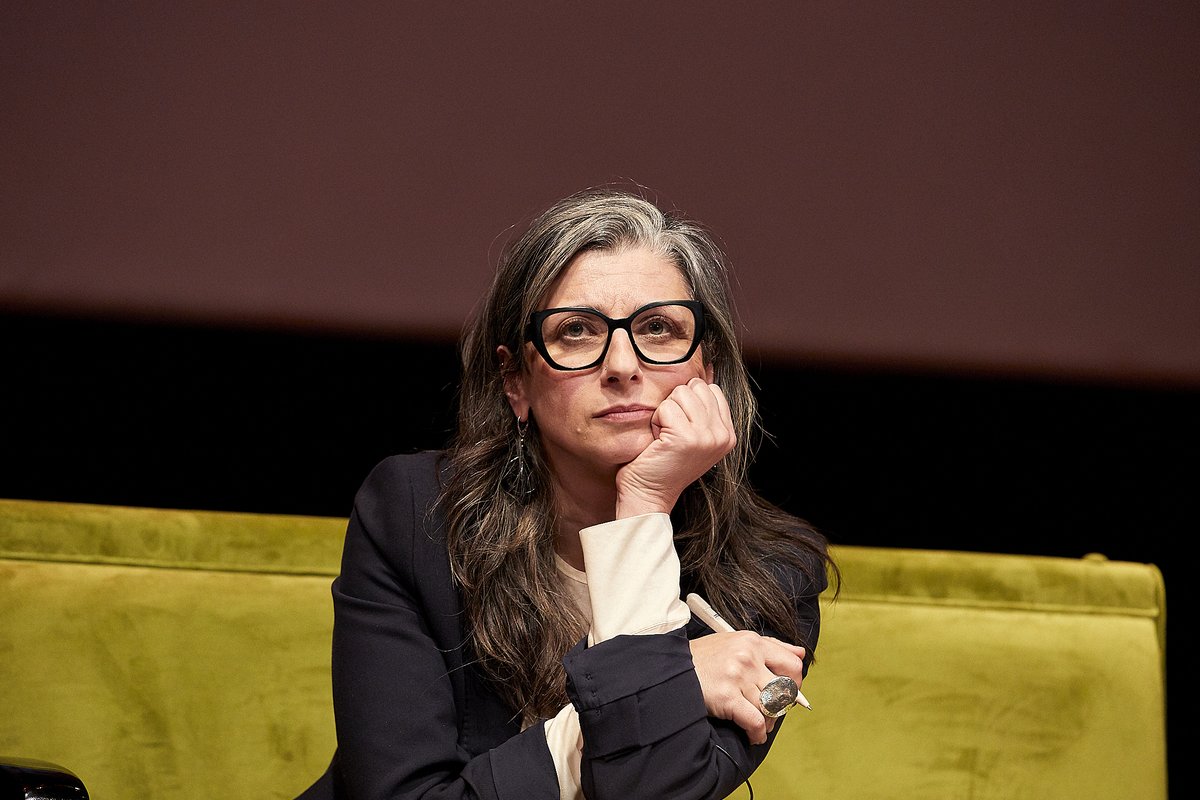
IN PRAISE OF FRANCESCA ALBANESE There is a question that visits me in the small hours, when sleep will not come and the mind turns over old stones. The question is this: “What would I have done in the 1930s, on the morning after Kristallnacht?" Not what I say I would have done. Not what I hope I would have done. But what would I actually have done—when the trains began to run, when the neighbours grew quiet, when the cost of decency became the loss of everything? Most of us, I think, would have done little. Not from malice. From fear. From the soft, creeping conviction that someone else will speak, that the situation is complex, that we must be 'reasonable'. Lest we forget, the ordinary is the extraordinary's alibi. And how we have clung to that alibi! How we still cling to it! And then, every once in a terrible while, someone appears who does not cling. Someone who steps forward when others step back. Someone who speaks the name of the thing when everyone else is busy naming something else. Francesca Albanese is that someone. She stands before the world—alone, unarmed, armed only with law and language and a rare courage—and she says what the centrists will not say, what the foreign ministries will not say, what the editorial boards will not say. She says: "This is a genocide. And we are watching it happen." Do not tell me that is hyperbole. Do not tell me the term is contested. She has not used it lightly. She has used it as a physician arrives scientifically at a diagnosis—not to wound, but to warn. Not to inflame, but to name. And for that, they have come for her. Oh, how they have come for her. Smears. Investigations. Vicious editorials. Frozen bank accounts. Dispossession of the only apartment she had ever owned. The machinery of the respectable turned to crush her. Because the respectable cannot abide what she represents: a mirror held up to their complicity. Let us, once again, travel back to the 1930s. Back to the few who stood up when the trains began to run laden with Jewish people. There was Aristides de Sousa Mendes, a Portuguese consul in Bordeaux. He defied his own government. He signed thousands of visas, by hand, for hours, until his fingers bled. He saved more lives than Schindler. And he died penniless, disgraced, erased. There was a German officer in Warsaw named Wilm Hosenfeld. He hid a Jewish pianist in the rubble. He did not save thousands. He saved one. But that one—Władysław Szpilman—carried the memory. And memory is "the only haven from which we cannot be expelled." There was Raoul Wallenberg. There were the villagers of Le Chambon. There were the anonymous, the quiet, the furious few who said: “Not on my watch.” Francesca Albanese is their heir. Not because she carries a gun. Not because she hides refugees in her basement. But because she does something equally dangerous in a world that has perfected the art of not seeing. She sees. And she speaks. She does not speak as a diplomat. Thank Goodness she doesn't! Diplomats have given us the language of "there are arguments on both sides" and "restraint" and "proportionality." Diplomatic language is the perfumed grave of moral clarity. No, she speaks as a jurist. As a human being. As a woman who has looked into the abyss and refused to call it a "complex geopolitical landscape". Edna O'Brien once described a character who "had the recklessness of those who have already lost everything worth losing." Francesca Albanese has not lost everything. She has her dignity, her office, her voice, her family. But she has calculated the cost of speaking truth to power. And she has decided that that cost is infinitely less than the cost of silence. What is that cost? Let us name it. She has been called antisemitic—she, who stands on the ground of international law forged in the ashes of Auschwitz and the fires of Nuremberg. She has been called a conspiracy theorist—she, who cites every source, every footnote, every UN resolution. She has been called naive—she, who understands better than most the machinery of realpolitik. These accusations are not arguments. They are the spittle of the threatened. Because Francesca Albanese threatens something very precious to the powerful: the right to commit atrocity without being named. Friends, the 1930s did not arrive with jackboots and pogroms on day one. They arrived in small increments. With "reasonable" restrictions. With "proportional" measures. With the silence of the respectable. We tell ourselves that we would have been different. That we would have been Sousa Mendes. That we would have been Wallenberg. But most of us, I fear, would have been the neighbours who later said, "I didn't know." Francesca Albanese knows. And she refuses to pretend otherwise. So let us praise her. Not with statues or awards she does not seek. But with something harder: with our own refusal to look away. With our own voices, raised in places that are safe for us but dangerous for her. With our own bodies, if it comes to that. A brave woman, who was injured while demonstrating outside a US nuclear military base in 1982, the infamous Greenham Common, had told me that "the heart is a hunter for what it cannot have." But I say the heart is a hunter for what it will not lose. And what we will not lose is the memory of those who stood up when standing up cost everything. Francesca Albanese is standing up now. In our time. In our name. Under our indifferent sky. Let us stand with her. Not tomorrow. Not when it is safe. Now. [Extract from a speech in Athens on Sunday 3rd May 2026]
Yanis Varoufakis tweet media
English
544
5.9K
14.1K
312.4K
Bryce McBride
Bryce McBride@mcbride_bryce·
@MaxBlumenthal @kthalps Clinton, Bush 2, and Obama all have father figure issues that made them unfit to lead. They all wanted to please the daddy they never had or never made happy. So, they were easily manipulated to serve father figures in finance, the MIC, etc.
English
0
0
0
178
Max Blumenthal
Max Blumenthal@MaxBlumenthal·
Asked if he thinks Israel committed genocide in Gaza, Obama accuses the questioner of not following the rules, then says “there are disasters and catastrophes everywhere” Obama is a historically inconsequential former president who believes in nothing but his own celebrity
Mosab Abu Toha@MosabAbuToha

@KStimmeGenozid Is Gaza a genocide?

English
1K
8.9K
28.9K
639.8K
Bryce McBride
Bryce McBride@mcbride_bryce·
@davidsirota The Dig from Jacobin has great episodes. My fave is one with Jo Guldi on her book, The Long Land War. Also, CBC Radio's Ideas show.
English
0
0
1
67
David Sirota
David Sirota@davidsirota·
I’m desperate for good podcast recommendations. Right now, my feed is basically 100 different shows all talking to the same 20 elites, celebs & podcasters about the same shit, which is a depressing reminder of the whole medium now being homogenized like everything else in media.
English
358
31
633
107K
Andrew Coyne 🇺🇦🇮🇱🇬🇪🇲🇩
So after all this: - The Iranian regime remains in place - The enriched uranium remains in place - Iran remains in control of the Strait of Hormuz, though it agrees to let ships through, for now - The US agrees to talks based on Iran’s terms, including an end to all sanctions and Iran gets to charge $2 million a ship for passage through the Strait, in perpetuity. - Meanwhile NATO is in ruins, the US and Israel are at odds, the Gulf States know they cannot depend on the US to protect them, etc etc etc “Another such victory and we are undone!”
English
475
759
3.3K
250.8K
Bryce McBride
Bryce McBride@mcbride_bryce·
@harleyf The food is better as well, bc the government supports smaller producers. So, small towns in rural areas have a bit more money circulating in their local economies. Houses are well-kept. Communities thrive. And the food is better. Lactose-free curds at fromagerie Bergeron!!
English
0
0
0
81
Harley Finkelstein
Harley Finkelstein@harleyf·
Québec: #1 in North America for life expectancy Feels a lot like a blue zone. Joie de vivre. Strong community. Slower meals. Deep connections.
Harley Finkelstein tweet media
English
163
148
1.2K
98K
Thrilla the Gorilla
Thrilla the Gorilla@ThrillaRilla369·
Do all 50-year-olds wake up at 5 a.m.?
English
2K
45
2.2K
164.5K
Furkan Gözükara
Furkan Gözükara@FurkanGozukara·
Absolute bombshell. Economics Professor Yanis Varoufakis officially declares the attack on Iran an unlawful, criminal war started by Washington and Israel. He states that rooting for an American victory means completely abandoning international law and human rights.
English
40
665
2.7K
87.3K
Matt Stoller
Matt Stoller@matthewstoller·
The reason Democrats have no position on the war is because no one has a coherent view on what to do. It’s not on them. The U.S. is basically the bank account and army for global oligarchs. This positioning is not good for Americans and it’s not good for the world. But it’s also impossible to imagine an alternative. The foreign policy establishment sees their work as a hobby. The U.S. is so endlessly rich and heroic that it’s all a game. They don’t think that the realm of foreign affairs should be good for ordinary people; that’s a rhetorical afterthought. To them the deindustrialization and erosion of the middle class at the heart of the destabilization of the world is sad but necessary, if they bother to notice it at all. The left foreign policy world is not actually that different. They are libertarian and hostile to Americans, and they don’t care about economics. Foreign policy to them is a hobby of the rich, it’s just the U.S. is the central villain instead of central hero. They do not understand or care about deindustrialization as a result of Chinese overcapacity, which is a central and fundamental foreign policy challenge. To them that’s handwaving away as ‘economics’ and boring. Let’s just do ‘care’ work, they imagine, as if a nation that makes nothing and imports food can afford to have its young people do nothing but wipe the asses of the old. What does a non-oligarch driven America actually do? What does it look like? Well for starters we pull back dramatically from the rest of the world. No troops in Europe, maybe offer some defense weapons to East Asian nations. No presence in the Middle East. Cut Israel loose entirely. Total revamp of our bloated and incompetent military and its corrupt establishment. Fire most admirals and generals and put in a new generation capable of actually thinking. This change will require us to be a LOT more protectionist. We put up huge trade barriers so that we can rebuild our industries. We also impose capital controls and confiscate or tax assets held by foreigners. No foreign ownership of land. We are not your bank account, Mr. Saudi Prince or Chinese money launderer. Finally, we crush capitalism. Rebuild our farms and factories. No more driving our corporations for shareholders. Lots of public utility regulation or nationalization of assets. No more private equity. No more crypto or corporate gambling. If you want to make money, you do something useful. Otherwise it’s poverty or handcuffs. America needs to be run for its people, not for the Epstein Class or for weirdos who can’t go over the Iranian overthrow of the shah or for lefty hobbyists funded by Koch industries to deindustrialize what’s left of what we have.
English
63
123
621
84.2K
Bryce McBride
Bryce McBride@mcbride_bryce·
@80s_channel Buy Microsoft at its IPO in 1986 and hold. I had about 5k saved up from summer jobs by then. That 5k would be worth 28 million dollars today.
English
0
0
0
7