Melanie

1.8K posts

Melanie banner
Melanie

Melanie

@mcflymell

Knitting, drinking tea and cycling.

Glasgow, Scotland Katılım Kasım 2009
1.6K Takip Edilen404 Takipçiler
Melanie retweetledi
Emma Hilton
Emma Hilton@FondOfBeetles·
I wholeheartedly welcome the new IOC guidelines that secure a safe and fair female category that excludes male athletes. SRY screening is a simple, non-invasive, once-in-a-lifetime check that returns female sport to female athletes. Laurel Hubbard should not have been allowed to lift weights against women. Caster Semenya should not have been allowed to run against women. Imane Khelif should not have been allowed to punch women in the face. This is a vindication for all the brilliant women who have fought for fairness and safety for all women in sport. Thank you to Kirsty Coventry, Jane Thornton and all those in the working group for a clear, evidence based policy. @iocmedia
English

119
1.1K
5.4K
121.1K
Melanie retweetledi
Dr. Lemma
Dr. Lemma@DoctorLemma·
19 years ago, a high school basketball coach put his team manager into a game for the final four minutes. The kid had never played a single minute of competitive basketball in his life. He scored 20 points. Jason McElwain was diagnosed with severe autism at age two. He didn’t speak until he was five. He couldn’t chew solid food until he was six. He wore a nappy for most of his early childhood. As a baby, he was rigid, wouldn’t make eye contact, and hid in corners away from other children. He tried out for his school basketball team every year and got cut every time. Too small. Too slight. Barely 5’6 and about 54 kilograms. But he loved the game so much that his mum called the school and asked if there was any way he could be involved. The coach created a team manager role for him. For three years, McElwain showed up to every practice and every game. He wore a shirt and tie on match days. He ran drills, handed out water, kept stats, and cheered every basket like he’d scored it himself. On 15 February 2006, the last home game of his final school year, the coach let him suit up in a proper jersey and sit on the bench. With four minutes left and a comfortable lead, the coach sent him in. His first shot missed. His second missed. Then something shifted. He hit a three-pointer. Then another. Then another. His teammates stopped shooting entirely and just kept passing him the ball. He hit six three-pointers and a two-pointer. 20 points in four minutes. The highest scorer in the game. When the final buzzer went, the entire crowd rushed the court and lifted him onto their shoulders. His mum tapped the coach on the shoulder, in tears. “This is the nicest gift you could have ever given my son.” McElwain won the ESPY Award for Best Moment in Sports that year, beating out some of the biggest names in professional sport. He’s 36 now. He works at a local supermarket, coaches basketball, has run 17 marathons including five Boston Marathons, and travels the country speaking about never giving up. When asked about that night, his coach still gets emotional. “For him to come in and seize the moment like he did was certainly more than I ever expected. I was an emotional wreck.”
English
875
10.8K
69.9K
10.1M
Melanie retweetledi
Crazy Vibes
Crazy Vibes@CrazyVibes_1·
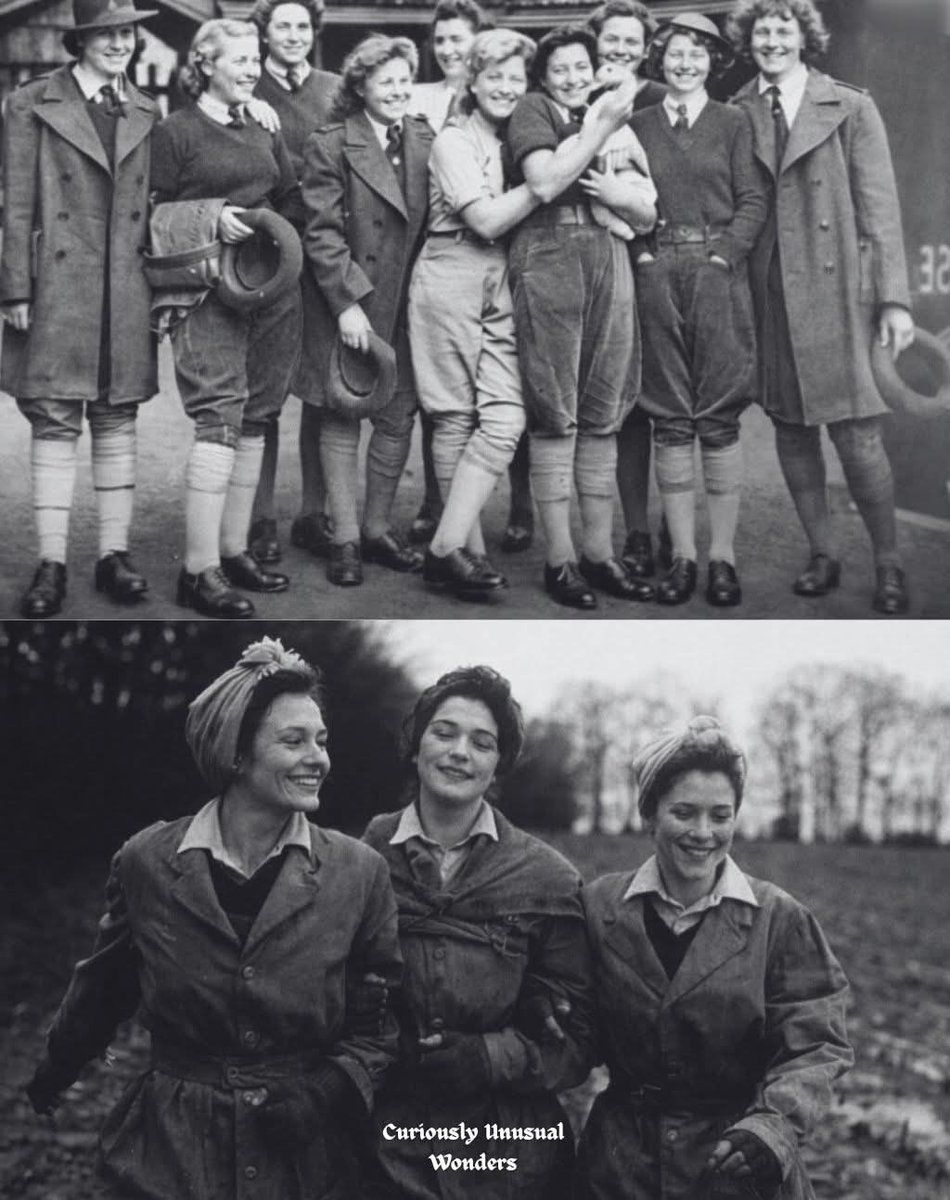
In 1939, Britain realized it could starve in weeks if the ships stopped coming—so they handed 80,000 women pitchforks and told them to save the nation. When war broke out, the math was brutal: Britain imported two-thirds of its food. With German U-boats hunting convoys across the Atlantic and men leaving farms for battlefields, the country faced a simple, terrifying truth—grow more food, or starve. The government's answer? The Women's Land Army. They came from everywhere. Shop girls from London. Office workers from Manchester. Teachers, secretaries, hairdressers—thousands of women who'd never touched a plough or milked a cow in their lives. They swapped heels for rubber boots, silk stockings for wool breeches, and city lights for muddy fields at dawn. Their uniform was practical: green jumpers, brown breeches, thick socks, wide-brimmed felt hats. They called themselves "Land Girls," and farmers didn’t know what to make of them. Could city girls really do farm work? Could women handle heavy machinery, twelve-hour days, brutal winters? The Land Girls answered with their backs, not their words. They learned to plough frozen fields, their hands blistering around wooden handles. They milked cows at 4 a.m., mucked out stables, stacked hay, harvested wheat, picked potatoes, and repaired tractors when they broke down. Rain soaked them, frost numbed their fingers, exhaustion made them collapse into bed without washing the mud off. It wasn’t glamorous. It was hard, dirty, lonely work. They lived in drafty hostels and converted barns, far from home. Village locals were sometimes suspicious. Farmers who’d doubted them slowly, grudgingly, began to respect them. Among themselves, the Land Girls formed bonds that would last lifetimes—friendships forged in shared struggle, laughter over burnt porridge, pride in knowing they were keeping the country alive. Under Lady Gertrude Denman, the Women's Land Army grew to over 80,000 strong by 1944. While U-boats sank merchant ships, these women made sure the nation could still eat. They planted. They harvested. They endured. When the war ended, there were no victory parades, no medals, no veterans’ benefits. They returned to lives that no longer fit quite the same way. Many had discovered strength, independence, and capability they hadn’t known they possessed. For decades, their story was barely told. But their legacy endured in every field they saved, every harvest they brought in, every life they sustained. The Land Girls proved strength has nothing to do with gender, and patriotism isn’t only measured in battles fought. They didn’t carry guns. They fought with grit, determination, blistered hands, and refusal to let their country fall. Eighty thousand women kept a nation alive. Their service was quiet. Their impact was everything.
Crazy Vibes tweet media
English
133
1.6K
4.6K
63.8K
Melanie retweetledi
Stellar
Stellar@StellarArtoisGB·
Did you know 😏 He rubbed lemon juice on his face. Robbed two banks. Smiled at the cameras. Got caught in an hour. And changed psychology forever. In 1995, McArthur Wheeler walked into two banks in Pittsburgh and robbed them with no mask, no disguise, and lemon juice on his face. He believed that because lemon juice works as invisible ink on paper, it would make his face invisible to cameras. He smiled directly into the security cameras. Police aired the footage on the evening news and arrested him within an hour. When shown the tape, Wheeler stared at the screen and said, "But I wore the juice." He had tested the theory with a Polaroid selfie and didn't appear in the photo — because lemon juice got in his eyes and he aimed the camera at the ceiling. His case inspired Cornell psychologists David Dunning and Justin Kruger to publish their 1999 paper defining the Dunning-Kruger Effect — the cognitive bias where people with low ability drastically overestimate their own competence.
Stellar tweet media
English
2.2K
14.2K
151.4K
13.1M
Melanie retweetledi
Cian McCarthy
Cian McCarthy@arealmofwonder·
Please Repost 🌿 An influential Scottish literary magazine has removed their 'Book of the Month' review for Polly Clark's poetry collection Afterlife, and all simply due to the sensible views she holds on what a woman is. Let's stand with her. Support & Follow @MsPollyClark
Cian McCarthy tweet media
English
20
480
1.1K
13.8K
Melanie retweetledi
Dinah Brand🦖 🟥 🇨🇦 KPSS
'Trans women' in women's prisons is an example of special treatment, not "equal treatment", of "trans people". Men who say they're women have a choice of remaining in a men's prison or requesting to be moved to a women's prison. Other men who are in danger in men's prisons don't have that choice. Women don't get a choice at all.
English
3
25
129
844
Melanie retweetledi
Steve Magness
Steve Magness@stevemagness·
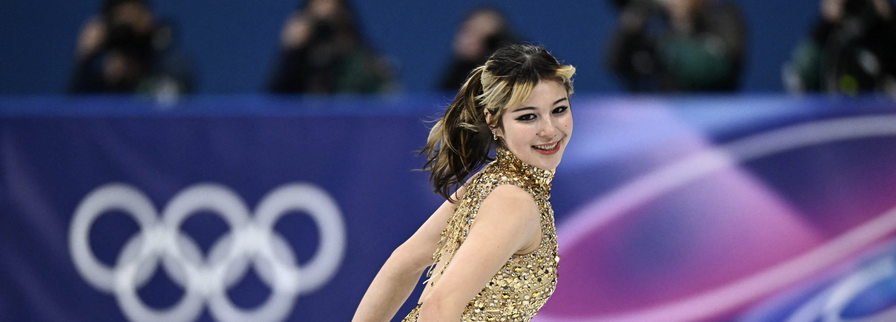
Alysa Liu just won Olympic gold. She retired at 16. Was traumatized by the sport. Wouldn't go near an ice rink. And just delivered a career-best on the biggest stage on earth. It's the most compelling comeback story in sports right now. At 13, Liu was the youngest US national champion ever. At 16, she finished 6th at the Olympics. She was a prodigy being told what to eat, what to wear, what music to skate to, and when to train. She lived in a dorm alone at the Olympic Training Center. And she was miserable. "The rink was my home for far too long... And I didn't have a choice," So she quit. She'd lost something essential: the feeling that any of it was hers. She had no autonomy. So she went the other direction. She went to Nepal. Trekked to Everest Base Camp. Got her driver's license. Dyed her hair. Attended college. She lived life. As Liu put it: “Quitting was definitely, and still to this day, one of my best decisions ever.” She built an identity that wasn't tied solely to the ice. She figured out who she was as a human being. Then in early 2024, she went skiing and felt something she hadn't felt in two years: an adrenaline rush. If skiing feels like this, what would skating feel like? She went to a public session. Landed a double axel and triple salchow on the spot. Two weeks later, she was back, but this time on her own terms. She came back because she wanted to. "I choose to be here. I loved that I was able to come back and choose my own destiny." That shift from external obligation to internal choice is the point. A mountain of research tells us autonomy is one of the most powerful driver of sustained motivation. Self-Determination Theory is one of the most established theories in psychology. When people feel ownership over their pursuits, performance goes up, burnout goes down, and creativity skyrockets. Her coach, Phillip DiGuglielmo, nailed it: "For many years she was dropped off at the rink. She was told what to do. Now she comes in, and it is all collaborative." She picks her own music. Designs her own costumes. Controls her training load. "No one's gonna starve me or tell me what I can and can't eat." We often get performance wrong. We think the path to greatness is more control, more structure, more sacrifice. We push young phenoms to "grind", to be disciplined... Not realizing we're often extinguishing the flame that makes them great. It's what psychologist Ellen Winner found when studying prodigies. They have the "rage to master," but over controlling environments suck the passion and joy out of them, snugging out that rage. Those who make it to adult staff have support, but their drive is more intrinsic than extrinsic. Liu's career-best came AFTER she walked away, lived her life, and came back with agency. Tonight she skated to Donna Summer's MacArthur Park with platinum blonde streaks, a lip piercing, and the biggest smile in the building. Career-best 226.79. First American woman to win Olympic gold in figure skating in 24 years. It was pure joy. Her message to the camera: "That's what I'm f---ing talking about." Everyone wants to know the secret to elite performance. It's not complicated. Give people ownership. Let them bring themselves to the performance, instead of squashing the joy and authenticity out of them. Alysa Liu retired at 16 because skating wasn't hers anymore. She won Olympic gold at 20 because it finally was. Be yourself. Go all the way.
Steve Magness tweet media
English
75
1.6K
9.9K
3.1M
Melanie retweetledi
Emma Hilton
Emma Hilton@FondOfBeetles·
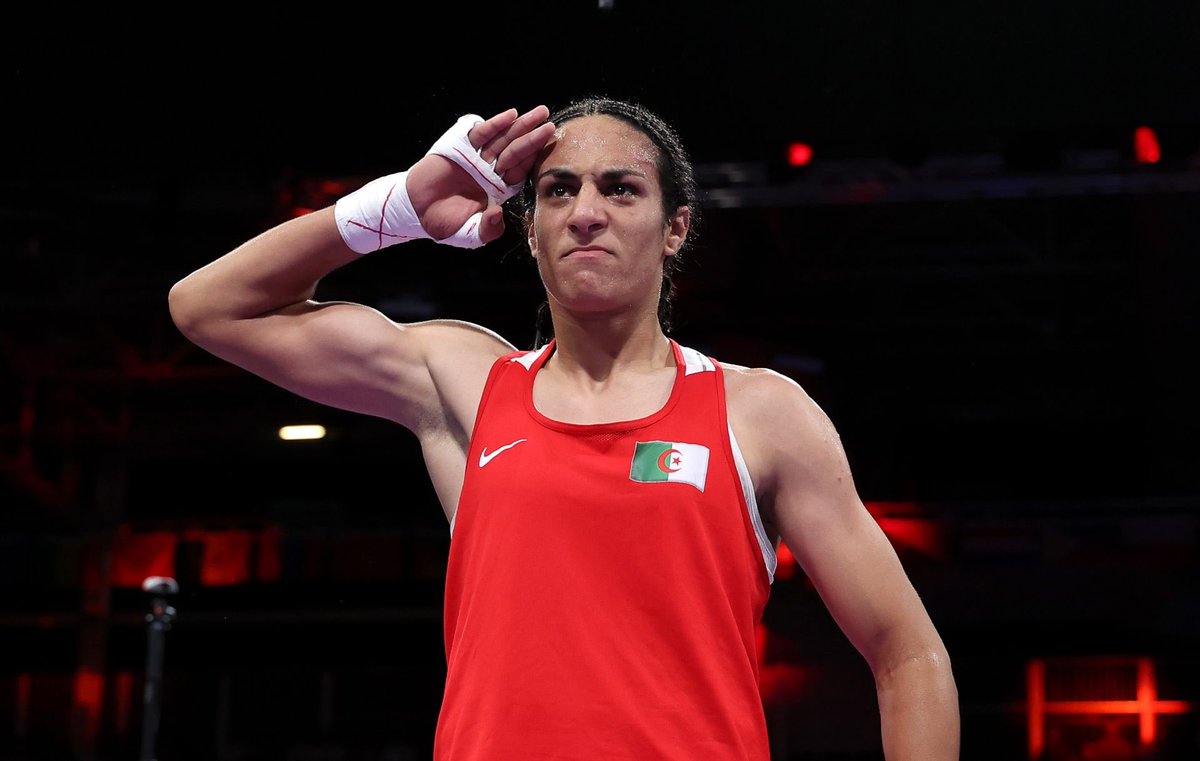
In news that will surprise only the wilfully blind, Imane Khelif has admitted having the SRY “make male” gene. In pursuit of their ideology, the International Olympic Committee not only allowed a male boxer into a ring with women, but also demanded we all STFU about it. No.
Emma Hilton tweet media
English
123
1.2K
6.6K
183.2K
Melanie retweetledi
Le_Sorelle_Arduino KPSS
Le_Sorelle_Arduino KPSS@Sorelle_Arduino·
Calling all train companies, please spend your DEI budgets fixing things like this instead of covering your trains in progress flags…
English
198
1.5K
10.2K
539.7K
Melanie retweetledi
Roshana 🦴
Roshana 🦴@RoshanaMN·
@Heccles94 As a liberal & an Iranian, please just stop this rhetoric. You either stand with a nations desire for freedom & self governance and freedom from murderous oppression or you don’t And if you do, stop making it about who you like or don’t like & just support Iranians. Full stop.
English
37
103
4.9K
39.7K
Melanie retweetledi
James Blunt
James Blunt@JamesBlunt·
Hi @grok, I COMPLETELY authorise you to take, modify or edit ANY photo or video of mine, whether published in the past or the future… as long as you always include a Freddie Mercury style moustache and bright red lipstick.
English
600
894
24.4K
3.7M
Melanie retweetledi
Steve Magness
Steve Magness@stevemagness·
Do women close the gap on men in longer distance races? It’s a common belief. Tons of articles, social media posts, and even some studies… But it’s not true. A deep dive into the performance gap at longer distances. open.substack.com/pub/stevemagne…
English
18
25
343
210.9K
Melanie retweetledi
Massimo
Massimo@Rainmaker1973·
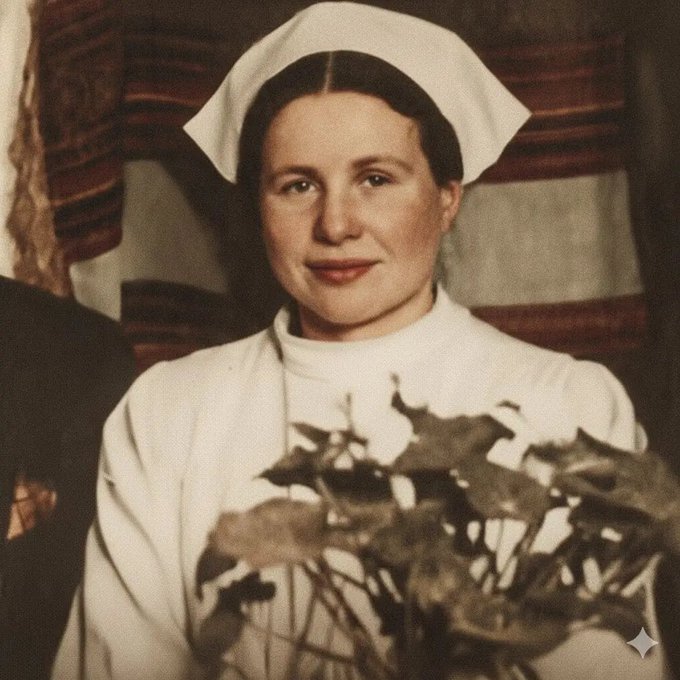
In the autumn of 1942, a slight, 32-year-old Polish social worker named Irena Sendler passed through the gates of the Warsaw Ghetto with a carpenter’s toolbox in her arms. Beneath the hammers and nails lay a drugged six-month-old infant, breathing softly, utterly silent. One cry would have meant instant death for both of them. Irena smiled at the guards; they waved her through. They never suspected that this quiet woman would repeat the journey 2,499 more times. The ghetto was a slow-motion extermination. Starvation, disease, and random murder stalked every street. Jewish parents faced a choice no human being should ever have to make: keep their child and watch them waste away, or hand them to a stranger who promised a chance—however thin—at life. Irena came officially to inspect for typhus. In reality, she came to steal children from death. Babies left in toolboxes or ambulances under false bottoms. Toddlers sedated and tucked into potato sacks. Older children led by the hand through the stinking, lightless sewers while German boots marched overhead. “Not a sound,” she whispered as rats scurried past their feet. She knew that the rescued children would be given new names, new religions, new families. Their pasts would vanish unless someone remembered. So, on fragile scraps of tissue paper, Irena wrote each child’s real name, their parents’ names, and their new hiding place. She rolled the papers tight, slipped them into glass jars, and buried them beneath an apple tree in a neighbor’s garden. If she were caught and killed, the truth might still survive. She was caught. On October 20, 1943, the Gestapo kicked in her door. They took her to Pawiak Prison and demanded the list. When she refused, they smashed both her legs with iron bars. Then her feet. Then her arms. For weeks the beatings continued. She never spoke. They scheduled her execution. On the appointed morning, guards dragged the broken woman from her cell. Instead of a firing squad, she found herself outside the prison walls—alive. The Polish underground council Żegota had bribed a guard to mark her file “shot while trying to escape.” Officially dead, Irena Sendler limped back into the shadows to keep working.When the war finally ended, the first thing she did was dig up the jars under the apple tree. She spent years trying to return the children—now scattered across convents, farms, and foster homes—to whatever family might remain. Almost no parents had survived. But the children had. Because of her, 2,500 Jewish boys and girls lived to grow up, to marry, to have children and grandchildren of their own—an entire secret branch of the human family tree that the Nazis never managed to cut down.For decades her story stayed buried deeper than the jars themselves. Then, in 1999, four high-school girls in rural Kansas stumbled across a brief mention of her name. They found the old woman still living quietly in Warsaw and brought her courage back into the light. Journalists called her the greatest rescuer of the Holocaust. Irena only shook her head.“I could have saved more,” she said. “That regret follows me to the grave.”Irena Sendler—armed with nothing but a ghetto work permit, a toolbox, and a refusal to look away—proved that even in the heart of the worst evil humanity has ever devised, one determined person can still keep the darkness from winning completely.
Massimo tweet media
English
329
3.7K
18.1K
547.1K
Melanie retweetledi
Lily Craven
Lily Craven@TheAttagirls·
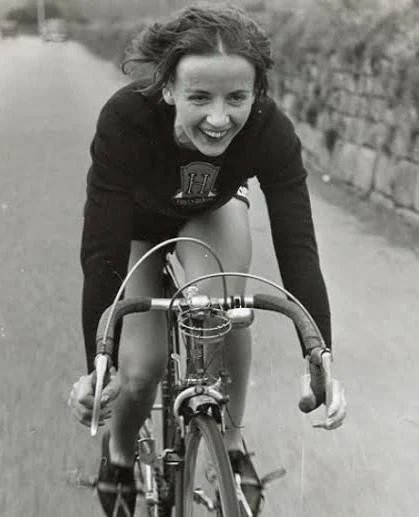
Woman of the Day cycling champion Eileen Sheridan, born OTD in 1923 in Coventry, smashed records in the 1940s and 1950s (men beaten by her claimed she’d cheated. She hadn’t) and held the End to End record - Land’s End to John O’Groats - for 36 years. Her 1,000-mile record time was not broken until 2002. Eileen didn’t take up competitive cycling until after she married in 1942. Her husband soon realised that she was not only a better cyclist than him but whereas men in their cycling groups wilted late in their marathon rides, she found new strength. By the end of 1949 she had won everything the sport could offer in the UK, including setting a 12-hour record of 237 miles, smashing the previous record by 17 miles and beating all but five of the men in the field. They refused to believe she had managed to go so far so quickly and asked her if she had cut a corner or two. In fact, she should have registered an even greater distance as she had gone off-course. London-Holyhead, Edinburgh-London, London-Portsmouth-London and Land’s End-London - Eileen swept up every time record but she was merely building up for the most prestigious one of all: Land’s End-John O’Groats, 837 miles. On Friday, 9 July 1954, followed by a Bedford flatbed lorry carrying a caravan and portable toilet which could only be accessed by going up a ladder, Eileen set off from Land’s End, having first broken-in multiple pairs of shoes. 470 miles and one change of wet clothes later, she stopped in Carlisle. Neither torrential rain nor high winds nor long climbs into a headwind up Bodmin Moor stopped her. The palms of her hands were so blistered, she could only grip the handlebars with her thumbs. Her feet ached, her legs were swollen and on the second night, she was hallucinating but she carried on. "Would I be able to go on, I asked myself as I battled against the wind and rain up the cruel climb.” Revived by soup, blackcurrant juice and chicken, Eileen set off again for the second leg: 260 miles to John O’Groats. She arrived late on Sunday, 11 July, setting a new women’s record: two days, 11 hours, and 7 minutes. "No one will ever know what the sight of the John o’ Groats Hotel meant to me." You’d think Eileen had earned a rest but no, her manager persuaded her to go for the 1,000 mile record. She had two hours’ kip and a full English, and set off to cycle another 130 miles. They were the hardest. She did it in twelve hours but she was hallucinating again and saw mermaids, giant glasses, and people urging her to turn the corner. By the time Eileen competed in the inaugural women's Tour of Britain in 1955, she held 21 records but she’d had enough, although she took up kayaking and won the national 500m double kayak championship in 1956. Why did she never qualify for the Olympics? Ah well, you see, there were no world championships for women then – they were not inaugurated until 1958 – and the Olympics was barred to female cyclists until 1984. Cycling was considered improper for women due to the alleged risk of their, erm, nether regions becoming unduly stimulated. A very male opinion, of course. I suppose it makes a change from wandering wombs. Eileen died in 2023, aged 99. “Where is a woman’s place? Is it in the home? Is it in industry or in sport? If I have shown in my life that it can be – and successfully so – in all three, then I am happy…I never felt like a champion.”
Lily Craven tweet media
English
60
354
1.3K
27.8K
Melanie retweetledi
James Dreyfus
James Dreyfus@DreyfusJames·
G’night, Annie Hall… RIP Diane Keaton. 💔
James Dreyfus tweet media
English
321
526
7.9K
216K
Melanie retweetledi
Women's Rights Network - WRN
Women's Rights Network - WRN@WomensRightsNet·
We have raised this directly with @parkrunUK Recording participants’ gender instead of their sex is meaningless and undermines the value of their research into female participation at parkrun. A brilliant initiative to improve the nation’s health is undermined by the gender activists in charge.
Mara Yamauchi@mara_yamauchi

Reposting this. 👇Minister confirmed in 2024 that parkrun provides no sex or “gender” data to Sport England. So they take millions of public money to “increase female participation” and have no idea what impact, if any, this money has had towards the goal it was granted for.

English
8
122
644
22.7K
Melanie retweetledi
Bruce Bowman
Bruce Bowman@boswelltoday·
🧵 Scotland’s New Trans Guidance in Schools – What Changed, What Didn’t 1. Scotland’s old guidance on “trans pupils” looked like this 👇 Yes to boys in girls’ loos, yes to opposite-sex changing rooms, yes to rewriting school records, yes to teaching gender identity as fact. The new guidance dropped yesterday. What’s changed – and what hasn’t – 🧵
Bruce Bowman tweet media
English
29
128
325
35.2K