Sabitlenmiş Tweet

Ramil Amirov
108 posts

@mcp0x
perp research @chaoslabs defi hip hop 📚 fully personal pov on crypto and stuff
To address some follow up directly: My guess is that Bitmex picked I =1bp and H=8 hours since the ‘fair’ I when they listed their XBTUSDT perp was around 10.95%, I=1bp was the lowest they could think of, and H = 8 hours made it 10.95%. These choices now continue to plague the industry 😅 If you enjoyed this, I’ll be highlighting some other design choices we’ve made for our tradfi-native perps.

When I was 22, my first CEO had one rule: Every time someone said “this is impossible,” they paid $5. Small thing. Rewired me for life. You start seeing how often people kill ideas before they try. How most limits live in the head, not in reality. “Impossible” usually just means “I don’t know how” or “I’m afraid.” I think about this every single day now. Because we’re already inside the singularity. Most people don’t feel it yet - the surface still looks normal. Underneath, everything is being rewritten. For the first time in history, one founder can ship what used to take a team of 50. Small teams are eating giants. And we’re still at the very beginning. The real bottleneck isn’t intelligence anymore. It’s speed of adaptation. Most founders already know what to do. They just can’t operate at AI-native speed. No focus. No rituals. Still running on pre-AI muscle. Still calling things impossible that already aren’t. The Monastery That’s why we built the digital Monastery. An environment for founders who want to fully adapt to this new reality. Extreme focus. High intensity. Small groups. Almost unhealthy commitment. People who compress years into months. People who operate with leverage that didn’t exist before. Not for everyone. By design. This is the best time and the last time to build. Best - because AI amplifies ambitious people and the world hasn’t caught up. Last - because intelligence is becoming a commodity. Soon everyone has the same tools. A short window before the world reorganizes. A window where small AI-native teams can create asymmetries that won’t exist again. The future belongs to those who move first. Do the impossible. While it still looks impossible.
Longs on @binance and @HyperliquidX quietly overpaid $480 million in funding last year on $BTC and $ETH markets alone Almost every major perp exchange copy-pasted BitMEX’s 2017 emergency setting… and "forgot" to touch it for nine straight years Binance carved out an exception for their own token. Here is why🧵

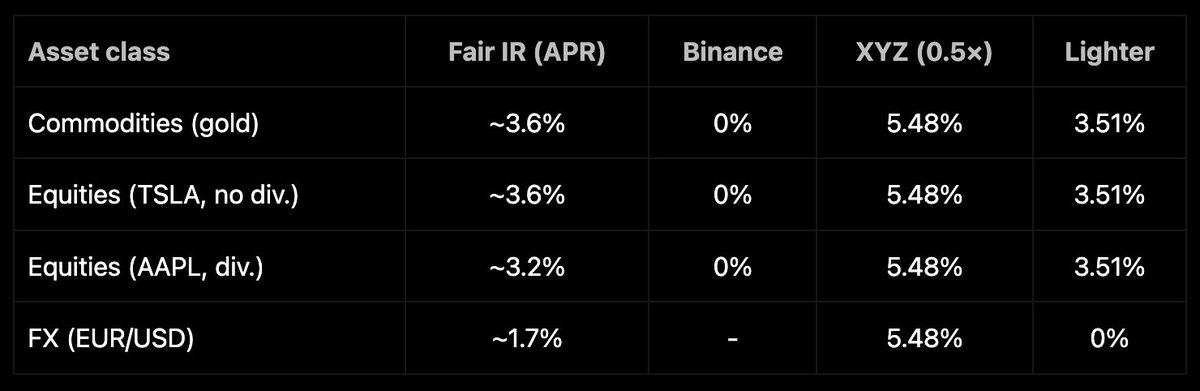


The last explainer on the funding formula you'll ever need to read. Part of the privilege of designing for the tradfi-native space is getting to examine crypto assumptions and seeing whether they still make sense for tradfi perps. A ‘standard’ perps formula, eg: F = clamp (average_premium, 5ps, default_interest=1bp)/ 8, paid every hour. is probably the least understood thing in crypto, which is bizarre given the volumes that now flow through perps. The aim is to create a formula that allows: >the market to realize its ‘fair’ funding rate in a stable way; >the perp mark price to track the underlier closely. If you don’t know what the ‘fair’ funding is, there are good explainers online, but broadly the perps should pay out (riskfree_rate - dividend_yield)% annualized [for equities], or around 0-3.5% for most US stocks. If flow is very one-sided, the perp price should deviate from the fair, allowing participants to earn risk-free money as it does so, and incentivizing more capital deployment which should move it back in line. Let’s parameterize the formula, and decide how to pick the params: F = clamp(average_premium, C, I) / D, paid every H hours If we pick H=8 and D=1 like Bitmex, say, then an average premium of just 1bp would lead to a whopping 10.95% annualized rate! Given 1bp is around a tick, we can see that this is really unstable. We can counteract this by: >having a ‘clamp’, C. This way short-term deviations around the fair will not contribute. >picking a big value of D. However, if it’s too big, then the perp price will not match the index price for the market to realize its ‘fair’ funding. At @QFEX, recognizing that tradfi funding should be lower than crypto, we chose as attached. Note we kept interest I=0. Picking a value for I has little effect on the market, other than forcing the perp to trade away from the index if the fair market interest rate does not equal I. Since the rate changes over time, the exchange has no business deciding the rate. This is replicated across tradfi exchanges - eg, CME doesn’t hardcode the S&P500 dividend yield into the ES mark formula.