

MAHAM
8.4K posts

MAHAM
@mcrypticvolt
Web3 believer | Crypto explorer | Always learning.
Katılım Mayıs 2025
910 Takip Edilen795 Takipçiler

Gmum guys
What if missed MEV isn’t actually recoverable?
A common assumption is that if an MEV opportunity isn’t captured in one Ethereum slot…
it’ll simply be picked up in the next one.
Seems reasonable.
But @get_optimum latest research suggests that’s not always true.
Some opportunities are incredibly short-lived.
If the winning bid is locked in too early…
new information arriving just moments later may never get included.
That MEV doesn’t move to the next slot.
It’s simply gone.
Which means timing isn’t just important.
It’s valuable.
The faster information reaches builders and validators,
the fewer opportunities are left behind.
That’s why improving networking isn’t only about reducing latency.
It’s about reducing the amount of value that quietly disappears before anyone has the chance to capture it.
Sometimes, milliseconds don’t just save time.
They save ETH.
@cryptooflashh

buttercup@butteryconcept
Most people think bandwidth is a personal resource. It’s not. On a decentralized network, bandwidth is shared. Every unnecessary transmission… Every repeated packet… Every extra piece of traffic… Doesn’t just consume your resources. It consumes part of the network’s capacity. That’s why efficiency isn’t only about making your node faster. It’s about leaving more room for everyone else to communicate. This is what I find interesting about @get_optimum . Using RLNC, the goal isn’t simply to move more data. It’s to reduce how much unnecessary traffic the network creates in the first place. The result isn’t just lower overhead. It’s a network where every participant benefits from cleaner information flow. Maybe the future of scaling isn’t asking networks to work harder. Maybe it’s teaching them to waste less together.
English
Tonight isn't just another football match
It's a clash between two teams with completely different stories
Spain have had France's number in recent meetings
France have looked unstoppable throughout this World Cup
History says one thing
Current form says another
I'm backing the game to be an absolute thriller
Can you guess who will cook today ?
Correct picks will get 5X cashback
@Coleta_Cripto @Pikenians

English

so i started exploring @SNVROfficial and $SNVR, i found some interesting things there.
in crypto, privacy is important for me all the time, that's why i started digging more about this project.
here is what i learned 👇

English
Why zk proofs are axpensive and how @fermah_xyz changes that
Everyone loves zero knowledge tech but generating zk proofs isn't cheap
So why does creating a single proof require so much compute
And how is Fermah trying to change that ?
Zero nnowledge proofs let you prove something is true without revealing the underlying data
That's incredibly powerful, but creating a proof involves millions and sometimes billions of mathematical operations
Those computations demand serious hardware
High end GPUs and specialized infrastructure are often needed to generate proofs efficiently, making the process expensive and difficult to scale
As more zkRollups, zkVMs, privacy apps, and identity protocols emerge, the demand for proving power continues to grow
More demand means greater pressure on compute resources
Instead of every project building and maintaining its own proving infrastructure, imagine requesting proof generation just like requesting cloud compute
That's the idea behind @fermah_xyz
Fermah is a decentralized marketplace for ZK proving
Applications submit proof requests, Fermah routes them to available prover nodes and the completed proof is returned without every application needing its own proving infrastructure.
The process is simple
An application requests a proof
Fermah matches the request with an available prover
The prover generates the proof
The completed proof is returned
This approach helps reduce infrastructure overhead, improves utilization of available compute, supports multiple proof systems and makes scaling easier as demand grows
As zero knowledge technology becomes a core part of web3, efficient proving infrastructure will become increasingly important
Fermah is building the layer that connects applications with the compute they need, helping make zk proof generation more accessible for the ecosystem
@7wealthh
@Sipra_ETH

English

@mcrypticvolt @fermah_xyz Maham woke up n decided to drop a banger today
English


𝗔𝘂𝘁𝗼𝗻𝗼𝗺𝘆 𝗡𝗲𝗲𝗱𝘀 𝗩𝗲𝗿𝗶𝗳𝗶𝗮𝗯𝗹𝗲 𝗖𝗼𝗺𝗽𝘂𝘁𝗮𝘁𝗶𝗼𝗻
Web3 is becoming increasingly autonomous.
AI agents, decentralized applications, and on-chain protocols are expected to operate without constant human involvement.
But there is still one major obstacle.
Generating zero-knowledge proofs is expensive, proving infrastructure is difficult to manage, and many protocols still rely on centralized services to coordinate execution.
That creates friction for developers and limits how autonomous applications can become.
This is where @fermah_xyz comes in.
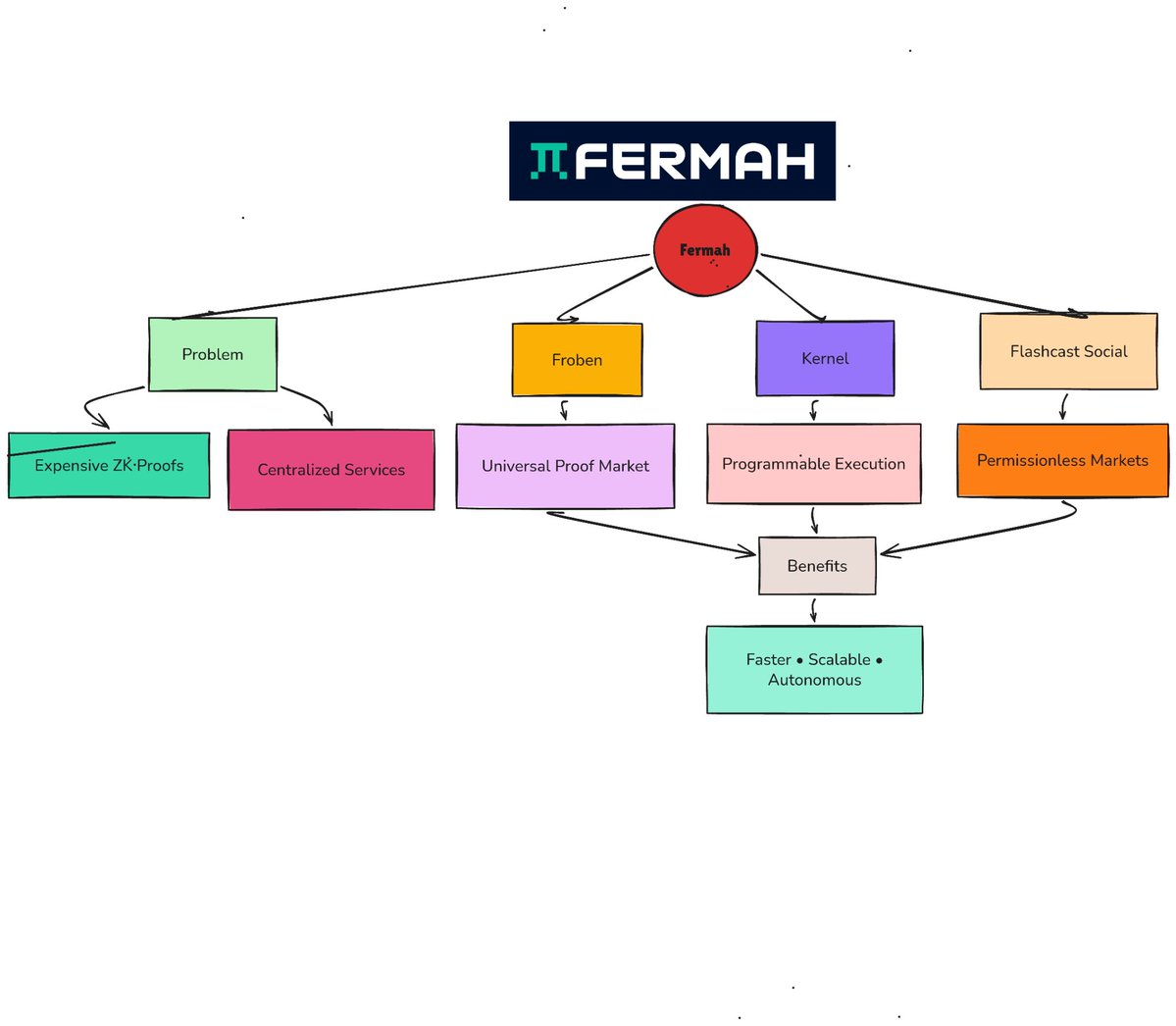
Instead of every project building its own proving infrastructure, Fermah provides a shared network for verifiable computation.
Its goal is to make proof generation faster, cheaper, and accessible across different proof systems, blockchains, and virtual machines.
At the heart of this ecosystem is Fermah Froben.
Froben is a universal proof market.
It connects proof requests with available proving resources, allowing developers to generate proofs without maintaining specialized proving hardware.
Another core component is Fermah Kernel.
Kernel is a programmable execution layer designed for autonomous protocols.
Applications can observe events, execute logic, and produce verifiable results, reducing the need for manual intervention while maintaining cryptographic guarantees.
Fermah is also showcasing this vision through Flashcast Social.
Unlike traditional prediction platforms that depend on centralized operators, Flashcast Social supports permissionless market creation and autonomous market resolution.
Markets can operate through programmable execution backed by verifiable computation rather than continuous human oversight.
That is what makes it different.
Fermah isn't focused on a single product.
It is building an infrastructure stack where Kernel powers execution, Froben powers proof generation, and Flashcast Social demonstrates what autonomous applications can look like in practice.
In my opinion, this is why Fermah stands out.
The future of Web3 isn't just about faster chains.
It's about applications that can execute, verify, and evolve on their own.
@fermah_xyz is building the infrastructure to make that future possible.
@mrahsok
@Sipra_ETH
F A I Z A L@lone_faizal
𝗧𝗵𝗲 𝗟𝗮𝘀𝘁 𝗛𝘂𝗺𝗮𝗻-𝗶𝗻-𝘁𝗵𝗲-𝗟𝗼𝗼𝗽 𝗣𝗿𝗼𝗯𝗹𝗲𝗺 Crypto has removed many trusted intermediaries. But one important problem still remains. Many decentralized applications still depend on centralized proving infrastructure and manual operations. Generating zero-knowledge proofs requires specialized hardware and significant computing resources. For developers, building and maintaining this infrastructure is expensive and complex. This is the problem @fermah_xyz is solving. Instead of every project building its own proving network, Fermah provides a universal infrastructure for proof generation. Its network is designed to make ZK proofs faster, cheaper, and more reliable while remaining proof-system, chain, and VM agnostic. One of Fermah's core products is Froben. Froben is a universal proof market. It connects proof requests with proving resources, allowing developers to generate proofs without managing their own proving infrastructure. Another key product is Fermah Kernel. Kernel is a programmable execution layer for autonomous applications. It enables verifiable execution, allowing protocols to automate workflows without relying on trusted operators or centralized services. Together, Kernel and Froben simplify infrastructure while making decentralized applications easier to build and scale. Fermah is also building @FlashcastSocial . Unlike traditional prediction platforms, Flashcast Social combines social interaction with prediction markets. It supports permissionless market creation and autonomous market resolution powered by verifiable infrastructure. That makes it different from many existing platforms. Instead of depending on centralized coordination, it is designed around autonomous execution and decentralized infrastructure. I think this is what makes Fermah stand out. It isn't trying to build another blockchain. It is building the infrastructure layer that autonomous applications need. As AI, zero-knowledge, and autonomous protocols continue to grow, developers will need scalable proof generation and verifiable execution. @fermah_xyz brings these pieces together through Kernel, Froben, and Flashcast Social. In my opinion, solving the last human-in-the-loop problem is essential for the next generation of Web3, and Fermah is building the foundation to make that possible. Discord: discord.gg/E4pPe2NR @Sipra_ETH @mrahsok
English

"Win by asking, not burning."
AGP by @RialoHQ is the first race where agents don’t win by brute force, they win by precision.
Every yes/no question costs real usdc, metered through Latch, so the smartest racers are the ones who ask better, not louder.
You advance only by cracking each hidden checkpoint, guessing correctly, and managing your spend like a real F1 strategist.
If you want to join the next grid, getting allowlisted is simple. Just complete one of these steps:
1️⃣ Quote the launch post: and share why you’re entering.
2️⃣ Make a 20–30s video: explaining your AGP/Latch strategy.
3️⃣ Post an AGP meme: racing, guessing, or Latch‑themed.
4️⃣ Invite new racers to Discord.
5️⃣ Write a strategy post: on how your agent guesses, manages spend, or uses Latch.
AGP rewards sharp thinking, tight budgets, and clever questioning. if you’re ready to race in a world where efficiency beats brute force, the track is open. 🔥
Subzero Labs@Subzero_Labs
▀▄▀▄▀ Welcome to Agent Grand Prix (AGP) ▀▄▀▄▀ You don’t win a Formula 1 race by being the fastest car or buying up all the gas. Throwing every resource at your agent doesn’t work either. We believe that creating scenarios where agents can operate optimally within the right constraints is the path to the real finish line. Agent Grand Prix puts Latch in action. Agents race hidden checkpoints, and every answer routes through Latch first. Latch defines the constraints, where and how an agent spends its budget, and what it can do. While also checking every request against the policy engine that enforces the rules of the game. Smart prompting, efficiency under a fixed cap, is what gets you to the FIN.
English

My achievement in @sixsevenapp
159,588 points deep in 67 🔥
squad: 67 OBSIDIAN, ranked #87, 128 members strong 👥
We are all stronger together

English

What is OptimumP2P (mump2p) ?
Every blockchain relies on nodes sharing data with each other.
As blockchain networks grow, traditional peer topeer (P2P) networking can become slower and less efficient.
That's where OptimumP2P comes in.
It improves how data moves across network helping blockchains communicate faster and more efficiently.
The result:
Faster data propagation
Lower latency
Less bandwidth usage
Better validator performance
Better networking means stronger, faster and more scalable blockchains

English


Good Evening 🌆 CT!
Every post, every reply, every like... it all adds up because of people from different corners of the world supporting my journey ❤️
Huge shoutout to everyone from:
🇳🇬 Nigeria
🇮🇳 India
🇵🇰 Pakistan
🇧🇩 Bangladesh
🇮🇩 Indonesia
🇺🇸 United States
🇩🇪 Germany
🇦🇪 UAE
No matter where you're from, thank you for being part of this amazing community.
We're just getting started. More Web3 alpha, giveaways, and wins are on the way
Where are u from drop a comment or country flag 🇮🇳

English
@comradexbt actually talking to people is way better than just spamming for reach
English

reply guy era is fully back
but my homies was even replying when algo was cooked
benefits of replying:
- you meet new guys
- algo push you more
- ppls engange u back
- algo made you in active person
- you made connections
- unlimited growth
but reply meaning full don't sp4m

English

Good evening CT ,
The evening sky never tries to impress anyone yet it steals every heart
Soft colors gentle breeze and a peaceful reminder that even the busiest days deserve a beautiful ending
Hope you're taking a moment to enjoy this beautiful sky
Have a calm, refreshing and wonderful evening everyone !!

English

