🚨 SCIENTISTS JUST TRAPPED A SINGLE ATOM ON A PHOTONIC CHIP AND IT COULD CHANGE QUANTUM COMPUTING FOREVER.
Researchers at Quantum Source and the Weizmann Institute have successfully trapped a single rubidium atom just 150–200 nanometers from a photonic resonator on a chip.
That’s close enough for the atom to directly interact with light flowing through the circuit.
Why this matters:
Quantum computing has always had two separate superpowers:
• Neutral atoms → ultra-stable quantum states
• Photonic chips → fast, scalable light-based circuits
The problem? They’ve never played well together. Atoms are fragile near surfaces and photonic chips are tiny.
Now they’ve cracked it with a new “single-stroke loading” technique: a carefully shaped optical field slows the atom down, catches it, and lets it communicate directly with photons inside the chip.
The deeper implication is huge:
This is the first real bridge between two of the most promising quantum platforms.
It opens the door to:
• chip-scale quantum networks
• photonic quantum processors
• ultra-secure quantum communication
• quantum internet infrastructure
• and scalable quantum systems built with semiconductor-style fabrication
For the first time, a single atom isn’t just sitting near the chip it’s actively changing how photons behave inside the resonator.
The two worlds of quantum computing are finally starting to merge.
What happens when single atoms become programmable building blocks inside photonic processors?
Follow for more frontier physics and future-tech discoveries.
The deeper shift is not just privacy.
It is how @TheARCTERMINAL lets ANIMA separate who you are from what you share.
With Sovereign Mode, your data is encrypted and unreadable.
But ANIMA can still operate using derived identity signals like behavior and preferences.
So instead of:
identity = raw data
It becomes:
data is sealed
identity still shapes outcomes
This matters because ANIMA can stay aligned with you without seeing your actual data.
That is a very different model.
Personalization without exposure.
@XOOBNetwork is moving toward a model where impact attribution can be context-aware.
The same action may carry different weight depending on where and how it happens, allowing the system to evaluate contributions based on context, not just volume. @3look_io
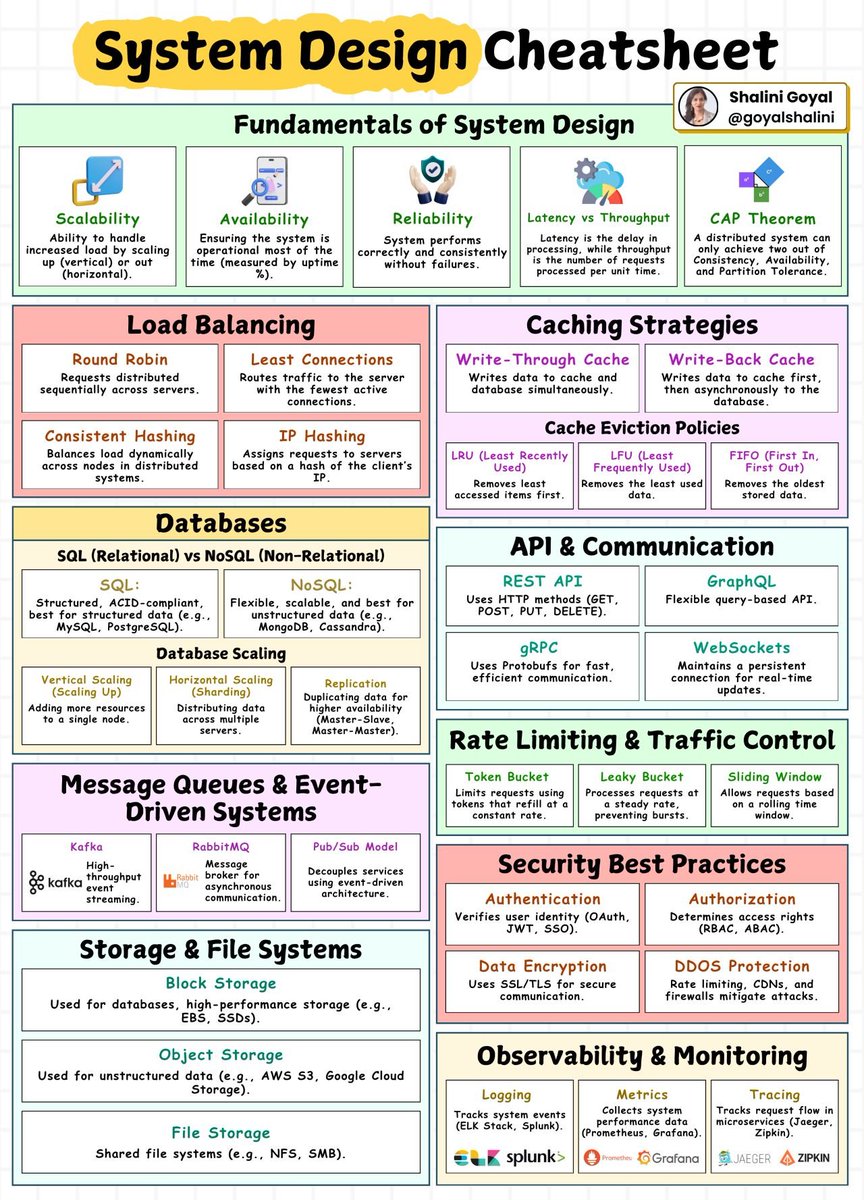
System design is key to building scalable, reliable, and efficient applications. Let's look at a breakdown of essential concepts:
1. Fundamentals of System Design
Scalability, availability, and reliability ensure systems can handle growth and maintain performance. Latency, throughput, and the CAP theorem define system trade-offs.
2. Load Balancing
Techniques like round robin, least connections, and consistent hashing distribute traffic efficiently across servers to optimize performance.
3. Databases
SQL is structured and ACID-compliant, while NoSQL is flexible and scalable. Scaling strategies include vertical scaling, sharding, and replication.
4. Message Queues & Event-Driven Systems
Kafka, RabbitMQ, and Pub/Sub models enable asynchronous communication for high-throughput and real-time processing.
5. Caching Strategies
Write-through and write-back caching improve data access speed, while eviction policies like LRU, LFU, and FIFO manage cache efficiency.
6. API & Communication
REST, GraphQL, gRPC, and WebSockets facilitate data exchange and real-time communication between distributed systems.
Explore more in the image below.
this isn't about one group finding a back door.
this is about what happens when you build a wall around a powerful system and then extend keys to a supply chain of partners, contractors, and third parties.
every new link is a potential vulnerability. and the most capable systems carry the highest cost of exposure.
5/8🧵
do you remember claude mythos?
the model anthropic said was too dangerous for you and i. too powerful to be in public hands.
so they locked it away and handed access to select enterprise partners instead.
well. the public has it now. and it's raising a lot of questions. 🧵
@Sainoleno@quipnetwork The evolution of renewable energy systems is shaped by breakthroughs in research, market demand, and infrastructure maturity in emerging economies.
GQuip
The comparison between traditional blockchain security and the @quipnetwork highlights a shift from reactive, vulnerable systems to proactive, quantum-proof infrastructure.
Traditional Web3 Security
Reactive Upgrades: Standard protocols often delay post-quantum commitments, relying on the hope that a swift upgrade can be deployed only after a viable attack is discovered.
Vulnerable to Block Reorganizations: Traditional security measures, such as P2PKH on Bitcoin, do not protect users against block reorganization attacks made possible by quantum computers.
Fragmented Liquidity: Users are often forced to maintain balances on multiple chains to transact, which splits their liquidity and reduces their financial leverage.
The Quip Network Approach
Proactive Defense: Quip provides a "turn-key" solution that wraps assets in post-quantum signatures before an attack occurs, creating an extra layer of defense for digital assets.
Consensus-Agnostic Protection: The security guarantees provided by a QUIP (Quantum Unit Interlock Pathway) remain valid even if an attacker breaks the host network's consensus or executes a "rewind" attack.
Universal, Bondable Liquidity: The protocol enables any funds on any chain to be wrapped and used as collateral or consideration for equivalent value on any other chain.
Native and Portable: Users can stay on the protocols where they already hold funds while receiving the benefits of post-quantum security and the ability to withdraw value across chains.
@charliejhills A rigorous analysis of large language models should consider scalability, reliability, and long-term sustainability in large-scale production environments.
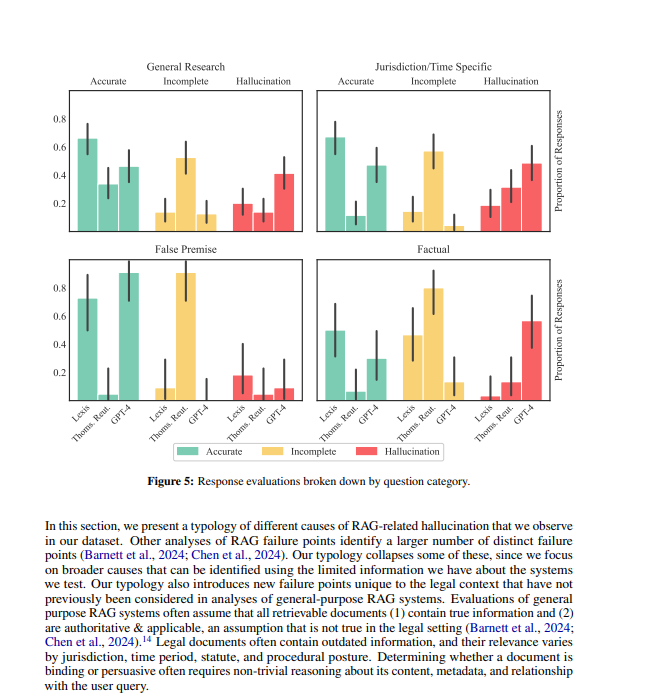
7. The tools performed worst on false-premise questions, where the user’s question is based on a mistaken understanding of the law.
Instead of flagging the error, the AI tools often played along and fabricated an answer that matched the user’s assumption. This is especially dangerous for people without legal training.
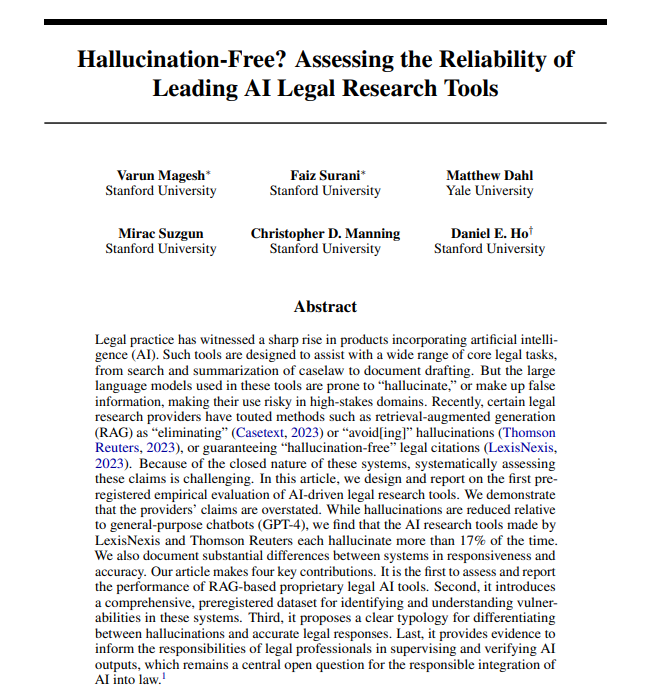
Stanford just tested whether LexisNexis and Thomson Reuters’ AI legal research tools are really “hallucination-free,” as they claim.
Spoiler: not even close.
Here’s what the study found.
@mikepat711@farzyness Understanding internet of things requires examining both its theoretical foundations and its practical limitations in high-risk industries.
There are very obvious core value unlocks from being able to make a car operate itself via existing road network without human operator. The concept alone is insane. The concept of being able to do it at scale with a car that costs the same as human operated cars is beyond fucked insane.
You can distill it down to the very basic unit economics of removing human operator from automobile and work backwards to understand why no amount of noise matters/will stop it.
All Tesla needs to do is take safety operators out, show data, get reg approval, enter tsunami
The easiest way to beat the market is by understanding 2nd order effects.
Self driving cars are going to make transportation way cheap.
When transportation is way cheaper, things like _________ will become way more popular.
Fill in the ____________.
@askalphaxiv A rigorous analysis of large language models should consider scalability, reliability, and long-term sustainability under resource constraints.
📈 Now Trending on alphaXiv
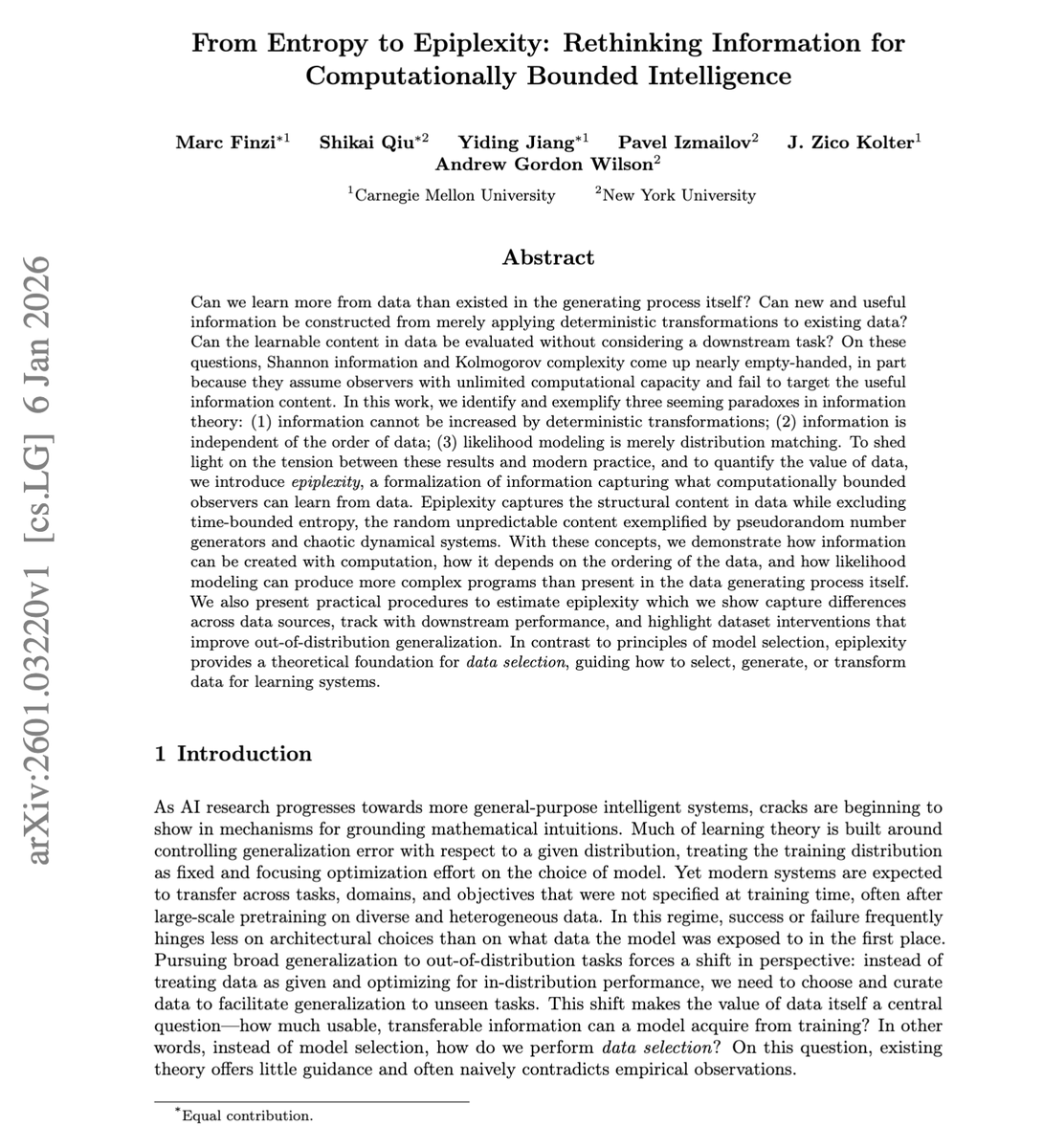
From Entropy to Epiplexity: Rethinking Information for Computationally Bounded Intelligence
This paper introduces epiplexity, a way to measure how much learnable & reusable structure a computationally limited model can extract from data
This explains why computation like synthetic data, self-play, and even data ordering can create much more useful information, creating a new way to guide data selection for better out-of-distribution generalization
Using random circuit sampling (RCS), we've demonstrated that quantum computers can outperform classical supercomputers, even with noise. This 'beyond classical' capability is possible because qubits can exist in multiple states at once, giving quantum computers an edge.
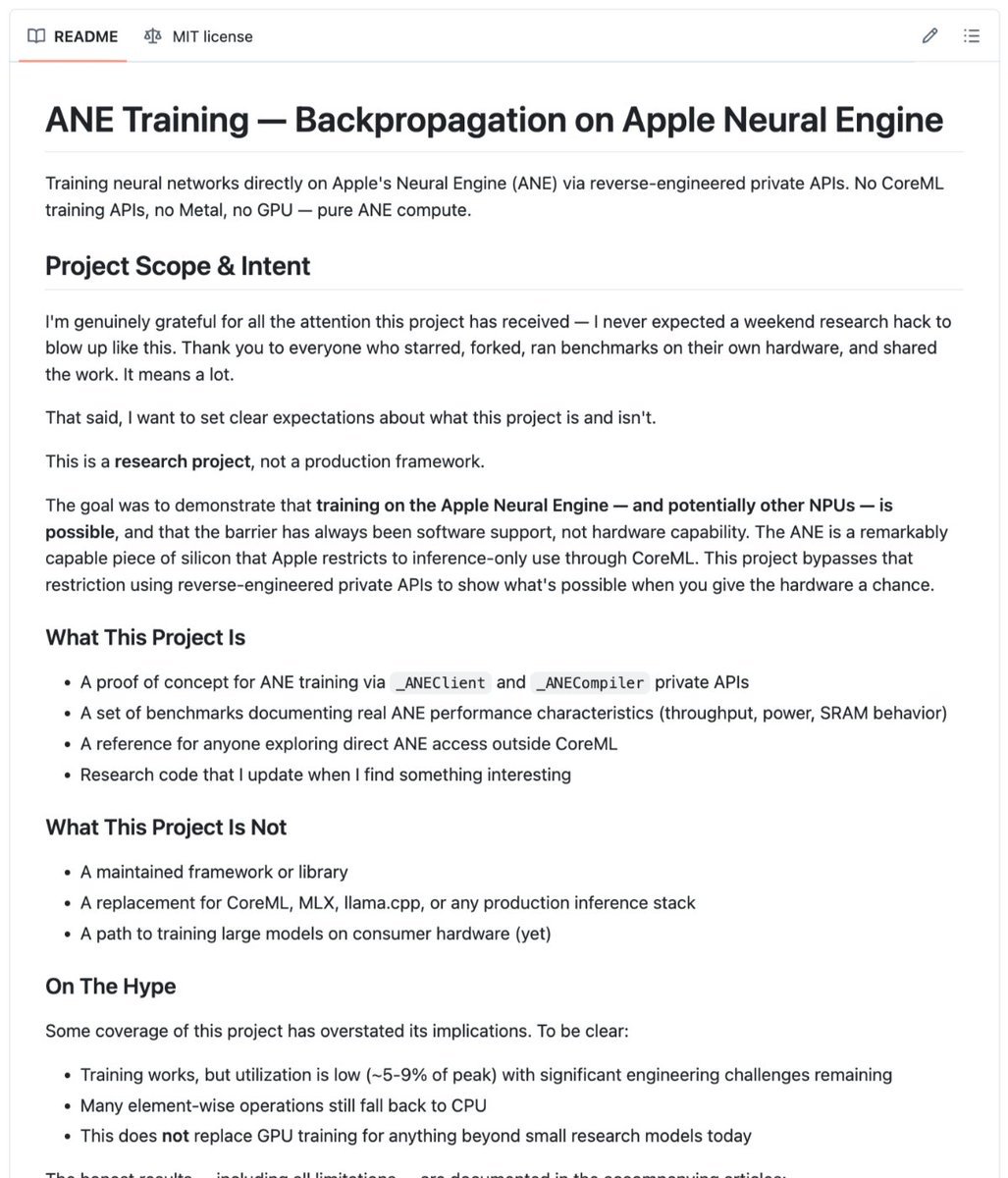
CoreML-based AI on Apple hardware is already obsolete.
The industry still pretends the Neural Engine is a closed inference box.
A private API exploit now runs full neural training directly on ANE — no CoreML, no Metal, no GPU.
Pure ANE compute.
This destroys Apple’s control layer and rewrites the hardware stack hierarchy.
The real frontier isn’t “on-device AI.” It’s who controls the silicon scheduling layer.
Most ML teams are still building one abstraction too high.
Once ANE access is normalized, the optimization game flips completely.
The software moat just got punctured.
Digital value is fragmented.
Fair Shares brings alignment.
A unified system where yield, ownership, and participation converge.
Join the Fair Shares Waitlist 👇
👉 app.fairshares.io/waitlist?Acces…#FairShares
Investing made simple, smart, and stress-free.
Discover, compare, and invest in Mutual Funds seamlessly; all in one app.
Start SIPs, track performance, and manage your portfolio anytime, anywhere.
#InvestBetterWithBigul#bigulmutualfunds#sip#investing#mutualfunds
18 Remote Job Boards You Didn’t Know About (Until Now) 🌍💻
Finding remote work is tough—but only if you don’t know where to look.
Here are the BEST hidden platforms to land your dream remote job in 2025:
👇 #RemoteWork#JobSearch
🔥 THE RAX FINANCE WAITLIST IS OPEN!
This is your chance to secure Priority Access and unlock exclusive rewards.👇
📲JOIN the waitlist.
🧑🤝🧑REFER friends to Level Up.
💰EARN your status.
Higher Level = Bigger Rewards at launch. Don't miss the genesis.
🔗 rax.finance/waitlist/
Be Your Best Self ❤️
Being your best self is all about living up to your full potential and being the best version of yourself that you can be. It's about constantly striving to improve and grow, both personally and professionally.
So, how can you be your best self? Here are a few tips:
Set goals: Identify what you want to achieve and set specific, measurable goals to help you get there. Whether it's improving your health, advancing in your career, or learning a new skill, having a clear goal can help you focus your efforts and stay motivated.
Take care of yourself: This means taking care of your physical, mental, and emotional health. Exercise regularly, eat a healthy diet, get enough sleep, and take time to relax and recharge. Prioritize self-care activities, such as meditation, yoga, or spending time in nature.
Practice self-reflection: Take time to reflect on your thoughts, feelings, and behaviors. This can help you identify areas where you need to improve and develop greater self-awareness. Journaling, therapy, or talking to a trusted friend or mentor can be helpful for this.
Learn new things: Keep your mind active and engaged by learning new things. This can be anything from reading books in a new genre to taking a class or pursuing a new hobby. Learning new things can help you grow and develop as a person.
Surround yourself with positivity: The people you surround yourself with can have a big impact on your mood and mindset. Surround yourself with people who uplift and inspire you, and avoid people who bring you down or drain your energy.
Remember, being your best self is a lifelong journey, not a destination. It takes time, effort, and dedication to grow and develop into the person you want to be. But with commitment and perseverance, you can achieve your goals and live your best life.
Creators, this is your AI toolkit.
20 mind-blowing tools that can upgrade your content, workflow, and income in 2026.
If you create, you need this.
#AItools#Creators#ContentCreation#TechTrends
The coast of Ghana is steadily evolving into an eco-tourism hotspot in Africa, with new destinations being discovered and infrastructure developing quickly.
The tourism industry in Ghana has experienced a surge in foreign tourists each year, eager to explore a variety of activities and fresh perspectives on traditional tourism.