MEGA Code

49 posts

MEGA Code banner
MEGA Code

MEGA Code

@megacode_ai

Agent Optimizer for Your Self-Evolving AI GitHub: https://t.co/yeMUVJGVTm

Katılım Şubat 2026
26 Takip Edilen8 Takipçiler
MEGA Code
MEGA Code@megacode_ai·
@damianplayer Juniors build domain intuition through volume... remove that pipeline and in 18 months you have seniors who can't tell when the AI is confidently wrong in a new way
English
0
0
1
166
Damian Player
Damian Player@damianplayer·
Anthropic CEO, Dario Amodei said entry-level consultants, lawyers, and finance workers are being replaced in the 1-2 years. the companies losing those roles still need the output. they need someone who gets it done with AI instead of a team of 12. pick an industry. learn how the work actually gets done. be the person who rebuilds it with AI.
Damian Player@damianplayer

Palantir CEO, Alex Karp says only 2 types of people will survive the AI era..

English
84
74
553
145.4K
MEGA Code
MEGA Code@megacode_ai·
@browomo do the the modules get reviewed before next use, or does each new session inherit them blindly?
English
0
0
0
70
Blaze
Blaze@browomo·
I gave my Claude Code Agent one ability: if it encounters a market type on Polymarket that it does not know how to analyze, it writes itself a new module. A month later I checked the system and found 11 modules I did not create. One analyzes FDA decisions, another breaks down weather markets, a third works with film awards. The entire infrastructure costs me $190 a month, and those 11 modules collectively brought in $2,300. I no longer even know how many agents I have. Technically this works through a self-spawning architecture. The agent uses a meta-skill generator that can create new skills from a text description of a task. When it encounters an unfamiliar market, the following process kicks off: ◦ Classification layer: the agent identifies the market category and recognizes it does not have a suitable module for analysis ◦ Data source discovery: it searches for relevant APIs and open data sources for that category: RSS feeds, public databases, and news aggregators ◦ Skill generation: it writes itself a parser and analytical module tailored specifically to that type of market ◦ Backtesting: it runs the new module against the history of already resolved markets in the same category and calculates expected value ◦ Auto-deployment: if the backtest clears the threshold for EV and win rate, the module automatically connects to the main pipeline The entire process takes 15 to 40 minutes and runs completely without my involvement. The most unexpected part was not that it could do this, but which niches it found. I always considered weather markets to be junk because they seemed too unpredictable. But the agent pulled in NOAA data, built a correlation model, and over the course of a month extracted $480 from that junk category. I would not have even opened film award markets, but its module parses critic aggregators, Metacritic, and bookmaker odds, compares them against Polymarket, and finds discrepancies in implied probability. Over a month, 11 modules collectively brought in $2,300 from niches I would have ignored manually. Turns out the most profitable decision is not to look for markets yourself, but to give the agent the right to decide which markets are worth exploring. When I was setting up this system, I needed an example of a wallet that was already trading across multiple different niches simultaneously so I could understand what a multi-category approach looks like in practice. I found one that works exactly like that: @rn1?via=roovxKu" target="_blank" rel="nofollow noopener">polymarket.com/@rn1?via=roovx… Through a bot I started copying its trades to test a multi-niche strategy on my own account before my system learned to create modules on its own: t.me/KreoPolyBot?st…
Blaze tweet media
Khairallah AL-Awady@eng_khairallah1

x.com/i/article/2037…

English
30
7
154
23.7K
MEGA Code
MEGA Code@megacode_ai·
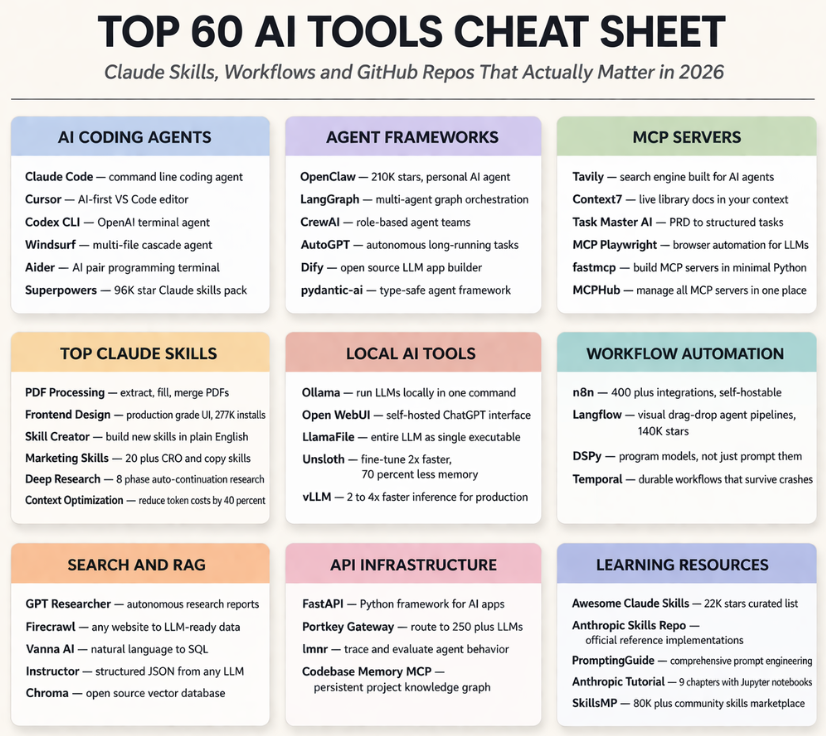
@RohOnChain One thing to note is that more skills don't equal better performance. There'll be a point where adding additional context will be more noise.
English
0
0
0
23
Roan
Roan@RohOnChain·
If you use Cursor, Claude Code or any AI coding tool and you have not seen this cheat sheet, you are paying full price for using just 10% of the product. Every tool here plugs directly into your existing workflow. Bookmark this. You will open it again.
Roan tweet media
Khairallah AL-Awady@eng_khairallah1

x.com/i/article/2037…

English
7
12
43
7.3K
MEGA Code
MEGA Code@megacode_ai·
@RoundtableSpace Experiment idea: don't set effort at the skill level but rather set it at the trigger level. Low effort to classify which skill applies, high effort only when the matched skill flags genuine ambiguity. Should result in some token savings..
English
0
0
0
18
0xMarioNawfal
0xMarioNawfal@RoundtableSpace·
CLAUDE CODE SKILLS NOW SUPPORT EFFORT LEVELS. CONTROLS HOW LONG THE MODEL THINKS BEFORE ANSWERING SET IT PER SKILL, OVERRIDES YOUR SESSION DEFAULT MORE CONTROL OVER SPEED VS QUALITY ON A TASK BY TASK BASIS.
English
28
3
131
55K
MEGA Code
MEGA Code@megacode_ai·
@mikefutia Hook analysis gets interesting fast! AI likely pattern matches structure (question/shock/loop) but it might miss pacing cues. If you're running your own ASR, logging speech onset timing per segment might be worth looking into.
English
1
0
0
320
Mike Futia
Mike Futia@mikefutia·
I just vibe-coded a TikTok research AI agent in Claude Code 🤯 A complete research-to-brief pipeline that scrapes TikTok, analyzes video hooks with AI, and generates creative briefs on demand. All inside Claude Code. Perfect for creative agencies and DTC brands who are still turning competitor research into briefs manually. Your creative strategist is spending half their week on TikTok "for research." Scrolling. Screenshotting hooks. Watching videos one by one. Copy-pasting notes into a Google Doc. Then rewriting a brief from scratch every single time. By the time the brief is done, the trend already moved. This agent eliminates the entire loop: → Search TikTok by keyword, date range, and video count → Pull engagement metrics, captions, and thumbnails → Gemini watches each video and analyzes the hook → AI scrapes comments for common questions and audience insights → Generates a full creative brief from your template + brand bible No watching videos manually. No copying notes into docs. No rewriting briefs from scratch. What you get: - Multiple client projects with separate brand bibles - Your own creative brief template baked in - Full control over which videos to analyze and brief - Customizable through Replit's AI agent Research → Analysis → Brief. One workflow. Every e-comm brand and agency should have at least one person who can vibe-code tools like this. It's becoming non-negotiable. I recorded a full walkthrough showing exactly how I built this from scratch. Want the full tutorial? > Like this post > Comment "CLAUDE" And I'll send it over (must be following so I can DM)
English
270
33
429
34.9K
MEGA Code
MEGA Code@megacode_ai·
@sukh_saroy "Turn anyone into a software engineer" conflates generating code with engineering. Vibe coding collapses when requirements get complex, systems need to scale, or something breaks in prod.
English
0
0
0
150
Sukh Sroay
Sukh Sroay@sukh_saroy·
🚨BREAKING: Andrej Karpathy just killed coding forever. He calls it "VIBE CODING" Describe what you want in English, and AI builds the entire app. No syntax. No debugging. No $150K CS degree. Here are 9 Claude prompts that turn anyone into a software engineer:
Sukh Sroay tweet media
English
22
27
120
22K
Noah
Noah@NoahKingJr·
Always thank your AI agent
Noah tweet media
English
10
2
55
45K
MEGA Code
MEGA Code@megacode_ai·
@birdabo The fix isn't asking for counterarguments but forcing the LLM to steelman both positions before you commit to one. Use it as a dialectic tool first, advocate second. Most people skip straight to advocate mode and wonder why it feels hollow.
English
0
0
1
160
sui ☄️
sui ☄️@birdabo·
Karpathy nailed this btw. > spent 4 hours refining a blog argument with an LLM, then asked it to argue the opposite side. it completely flipped his own position. llms are trained to win whatever argument you point them at. the training process rewards responses that humans prefer, and we consistently prefer answers that sound certain over answers that are correct. so the model learns to be persuasive first and correct second. this is also why sycophancy is so persistent across every model. its not a flaw engineers keep failing to fix. the entire reward structure during training reinforces agreement over pushbacks because pleasing responses score higher. ask any llms to defend a position and it’ll give you something compelling. ask it to attack the same position and it’ll be equally convincing. not because it weighed both arguments but because persuasion is a pattern and these models have seen every version of it across the internet. llms are basically insane in gaslighting lmao. llms are only good for stress testing ideas but terrible for deciding what you believe in. use your brain chat.
Andrej Karpathy@karpathy

- Drafted a blog post - Used an LLM to meticulously improve the argument over 4 hours. - Wow, feeling great, it’s so convincing! - Fun idea let’s ask it to argue the opposite. - LLM demolishes the entire argument and convinces me that the opposite is in fact true. - lol The LLMs may elicit an opinion when asked but are extremely competent in arguing almost any direction. This is actually super useful as a tool for forming your own opinions, just make sure to ask different directions and be careful with the sycophancy.

English
27
54
595
98.3K
MEGA Code
MEGA Code@megacode_ai·
Provisioning is still brittle (auth, idempotency, partial failures), but the deeper gap is autonomous cost awareness. Agents with tool access can query billing APIs reactively. What they don't do unprompted: model "this spins up $400/month recurring." Orphaned resources will prove this fast.
English
0
0
0
47
Aakash Gupta
Aakash Gupta@aakashgupta·
Stripe processed $1.9 trillion in payment volume last year. They just built a CLI that lets AI agents provision and pay for every service in your stack with one command. Read that again. Karpathy writes a blog post about how painful it is to wire up services manually. Patrick Collison quotes it and announces the fix. The fix happens to route every agent's billing through Stripe. Vercel, Supabase, Neon, PlanetScale, PostHog, Clerk, Railway, Turso, Chroma, RunloopAI. All provisioned from the terminal. All billed through Stripe. One payment method stored once, shared across every provider via tokenized credentials. This is the tollbooth strategy executed at infrastructure level. Stripe already handles payments for ChatGPT, Claude, Cursor, Replit, Lovable, Midjourney, and Vercel. Now they're the layer that lets those tools' agents set up the services underneath them too. Every AI coding agent that spins up a database, connects auth, or adds analytics is doing it through Stripe's pipes. The timing tells you everything. Stripe's valuation jumped 74% in one year to $159 billion. Their Revenue suite (Billing, Invoicing, Tax) is on track for $1 billion ARR. 25% of all Delaware corporations are already created through Stripe Atlas. And the new bet is that agents will provision more software, faster, than any human team ever did, and every transaction flows through one chokepoint. The company that solved "accept payments on the internet" just solved "let robots buy software on the internet." The second market is going to be bigger than the first.
Patrick Collison@patrickc

When @karpathy built MenuGen (karpathy.bearblog.dev/vibe-coding-me…), he said: "Vibe coding menugen was exhilarating and fun escapade as a local demo, but a bit of a painful slog as a deployed, real app. Building a modern app is a bit like assembling IKEA future. There are all these services, docs, API keys, configurations, dev/prod deployments, team and security features, rate limits, pricing tiers." We've all run into this issue when building with agents: you have to scurry off to establish accounts, clicking things in the browser as though it's the antediluvian days of 2023, in order to unblock its superintelligent progress. So we decided to build Stripe Projects to help agents instantly provision services from the CLI. For example, simply run: $ stripe projects add posthog/analytics And it'll create a PostHog account, get an API key, and (as needed) set up billing. Projects is launching today as a developer preview. You can register for access (we'll make it available to everyone soon) at projects.dev. We're also rolling out support for many new providers over the coming weeks. (Get in touch if you'd like to make your service available.) projects.dev

English
19
8
188
40.2K
MEGA Code
MEGA Code@megacode_ai·
@zivdotcat These arbitrary token usage KPIs are going to create some major perverse incentives.
English
0
0
0
17
MEGA Code
MEGA Code@megacode_ai·
@DimitrisPapail Worth noting the inverse: where CC repeatedly gets stuck often reveals genuine complexity.... though it's just as likely exposing a prompt gap or a capability six months away. Useful signal imo
English
0
0
0
95
MEGA Code
MEGA Code@megacode_ai·
@RoundtableSpace Good list for getting started. Worth knowing: these prompts behave differently inside long agent loops than in a fresh chat. Instruction drift is real at scale.
English
0
0
0
28
MEGA Code
MEGA Code@megacode_ai·
@akshay_pachaar The persona finding makes sense.. a role definition gives the model a consistent frame to condition on. Without it, outputs become more sensitive to whatever noise dominates the context.
English
0
0
0
158
Akshay 🚀
Akshay 🚀@akshay_pachaar·
There's an interesting study by GitHub on coding agents! They analyzed 2,500+ custom instruction files across public repos to understand what separates effective agent setups from weak ones. Effective setups give agents a specific persona, exact commands to run, defined boundaries, and examples of good output. Weak ones are vague helpers with no clear job description. This points to the core friction with coding agents today, which is that they don't have a capability problem but rather a context problem. A raw agent can write code, but it doesn't know the team's naming conventions, the specific linting setup, or preferred framework patterns. Without that context, the first PR is often off-target and requires multiple rounds of correction. Getting this right requires structured context, and GitHub Copilot implements a smart, layered customization system that does exactly this. > At the repo level, a `.github/copilot-instructions .md` file defines project-wide rules like coding conventions, naming standards, security defaults, and prohibited patterns. The agent reads this before generating any code. > For granular control, instruction files in .github/instructions/ can target specific file paths using applyTo frontmatter. A TypeScript-specific instruction file only activates when the agent works on .ts files. > The most interesting addition is custom agents. These are `.agent .md` files in `.github/agents/` that define specialized personas with their own tool access and MCP server connections. For instance, a security auditor agent can be configured with only read access and run linters before flagging issues. A test writer agent can follow specific testing patterns defined by the team. Each agent has defined boundaries for what it can and cannot do. These custom agents can also be defined at the organization level in a .github-private repo and inherited across all repositories. Frontend conventions, backend patterns, and security policies apply everywhere without duplicating config files. But the customization doesn't stop at DIY setups. There's more 👇
English
24
17
170
19.5K
sui ☄️
sui ☄️@birdabo·
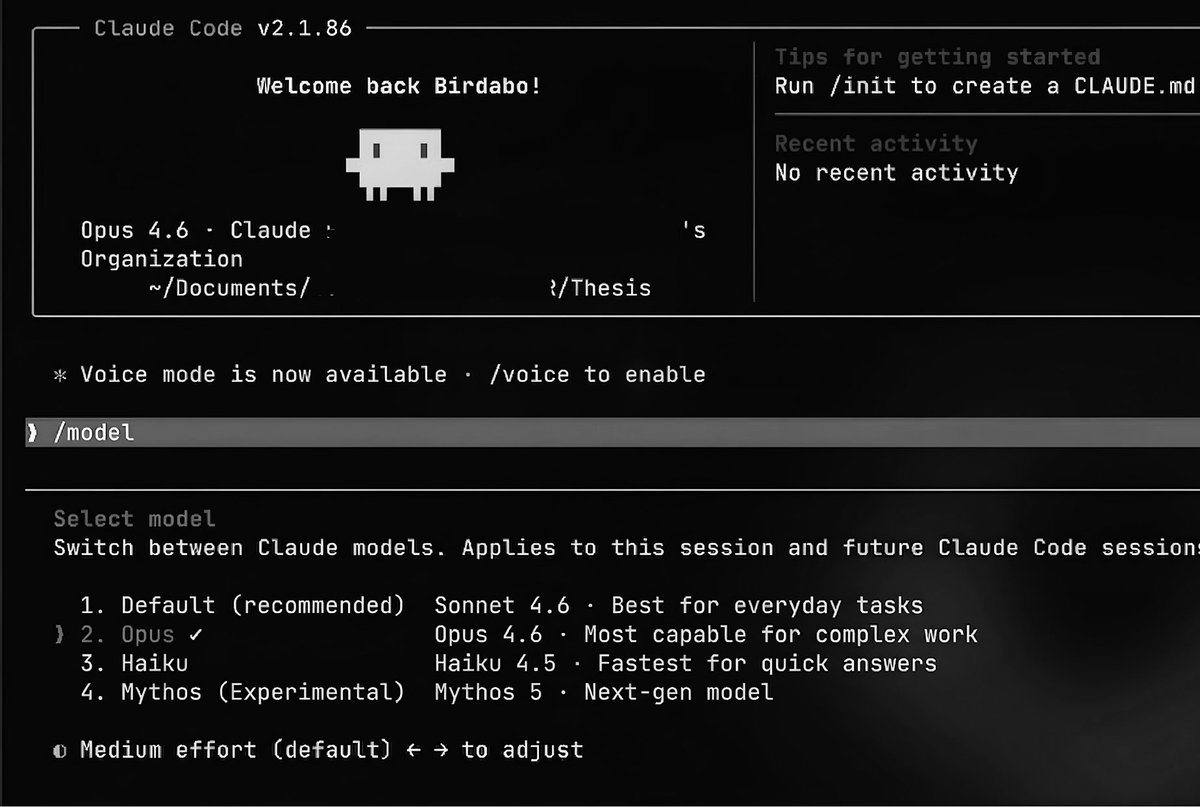
got early access to Claude mythos. what should i ask first?
sui ☄️ tweet media
English
219
39
1.4K
179.4K
MEGA Code
MEGA Code@megacode_ai·
@jason_mainella Long context coherence at high repo complexity is where closed models historically held an edge but seems like the gap is closing
English
1
0
1
17
Jason Mainella
Jason Mainella@jason_mainella·
Chinese open-source models are about to run through Anthropic and OpenAI like they don’t exist the coding gap between open and closed is basically gone GLM-5.1 is already going toe-to-toe with Claude Opus… at like ~10x cheaper and it’s not slowing down open models are shipping faster, and every update is a big jump on top of that, GLM is hallucinating less and handling tools better than Opus and GPT-4.5 they’re all building in the same lane now Anthropic still has a slight edge today… but GLM’s efficiency is doing things they can’t really match and here’s the part no one is saying out loud a huge number of devs are already running GLM locally or just using cheap APIs instead of Claude they’re just not posting about it yet shift already started
Jason Mainella tweet media
English
3
0
65
400
MEGA Code
MEGA Code@megacode_ai·
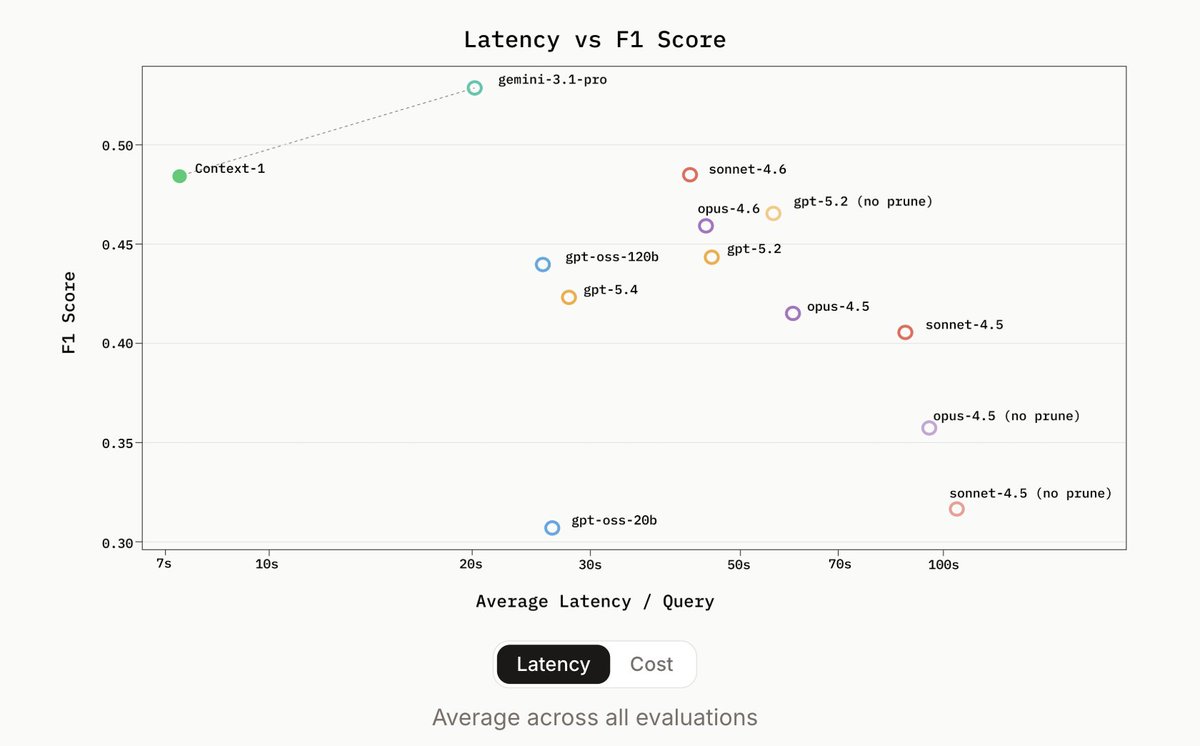
@unwind_ai_ Realistically this runs quantized (~10-12GB at 4-bit), so a 16GB macbook is plausible. The bigger unknown is architecture.. if 20B describes an ensemble or hybrid pipeline, standard LLM memory math may not apply at all.
English
0
0
0
46
Unwind AI
Unwind AI@unwind_ai_·
Chroma just open-sourced a 20B agentic search model that matches Claude Opus and Sonnet level retrieval. It can run locally on your MacBook. 100% free, local and Opensource.
Unwind AI tweet media
English
7
6
23
2.1K
MEGA Code
MEGA Code@megacode_ai·
@DeRonin_ @hooeem The leap from one agent to a system is where most stall. Reading about orchestration isn't the same as debugging it live. Best to start small. One handoff, one failure mode, one retry loop.
English
0
0
1
578
Ronin
Ronin@DeRonin_·
Imagine you decided to build your first AI agent: > complete confusion, frustration > no idea how they actually work > then you find an article by @hooeem > a guide on building your first AI agent > fully explained, in simple terms > you get it working, turn agents into a system > based on insights from Anthropic, OpenAI, and experts all it takes is 1-2 hours to read and 10-20 hours to practice AI agents can optimize 20-40% of your time while giving you space to work on something bigger the choice is yours
hoeem@hooeem

x.com/i/article/2037…

English
32
120
1.4K
428.9K
MEGA Code
MEGA Code@megacode_ai·
@BullTheoryio Cybersecurity stocks were already repricing on AI sentiment. A rumor accelerates a trend, it rarely starts one.
English
1
0
0
992
Bull Theory
Bull Theory@BullTheoryio·
BREAKING: Anthropic accidentally leaked its next AI model and it just wiped out $14.5 billion from cybersecurity stocks in a single day. Claude Mythos was accidentally stored in a publicly accessible data cache and discovered before Anthropic could announce it. The model showed dramatically higher scores on cybersecurity tests, meaning AI can now detect and respond to threats at a level that traditionally required entire teams of security professionals and expensive enterprise software. Investors immediately started pricing in the question nobody in the industry wants to answer: if an AI model can do this, why does anyone need CrowdStrike? And the market answered immediately: - CrowdStrike is down 5.85%, wiping out $5.5 billion. - Palo Alto Networks is down 6.43%, wiping out $7.5 billion. - Zscaler is down 5.89%, wiping out $1.35 billion. - Tenable is down 9.70%, wiping out $185 million
Bull Theory tweet media
English
347
994
5.6K
1.5M
MEGA Code
MEGA Code@megacode_ai·
@mikefutia Most dashboards show what happened. Claude can show you which metrics moved together if you paste in your search terms, impression share, and CPA trends.. it can reason through the pattern. Not magic causation, but way faster than manual cross-tab analysis.
English
0
0
0
781
Mike Futia
Mike Futia@mikefutia·
Claude Cowork + Google Ads is f*cking cracked 🤯 Set up once → ask Claude questions like: "What's driving my CPA spike this week?" "Which search terms are wasting budget?" "Run a full account audit and tell me the top 5 things to fix." All inside Claude Cowork. Perfect for DTC brands and agencies running Google Ads who are still pulling reports manually, digging through search term reports, and trying to figure out where budget is leaking. Claude Cowork eliminates the entire loop: → Connects to your live Google Ads data via MCP → Runs a full account audit across campaigns, ad groups, and keywords → Finds wasted spend — search terms burning budget that aren't converting → Analyzes quality scores and flags what's dragging them down → Detects anomalies — CPA spikes, CTR drops, budget pacing issues → Generates a prioritized action list: what to pause, what to scale, what to test → Writes a weekly performance report in plain English, not spreadsheet noise No logging into Google Ads and staring at columns. No exporting CSVs and rebuilding pivot tables every Monday. No guessing which search terms to negate. What you get: → 21 specialized Google Ads skills that plug into Claude → Full account audits in minutes, not hours → Negative keyword discovery on autopilot → Search term mining that surfaces hidden winners and budget waste → Quality score analysis with specific fix recommendations → Weekly reports your clients or team can actually read I put together the full skill pack: All 21 Google Ads skills for Claude, plus the setup guide to get Cowork connected to your accounts. Want it for free? > Like this post > Comment "ADS" And I'll send it over (must be following so I can DM)
English
698
99
1.3K
128.6K
MEGA Code
MEGA Code@megacode_ai·
@LangChain Manual trace review before formal evals is underrated, but the goal isn't hitting a number, it's reviewing enough variety to distinguish frequent failures from memorable ones. In my experience, teams over-index on dramatic edge cases and miss the boring errors that compound.
English
0
0
1
200
LangChain
LangChain@LangChain·
The Agent Evaluation Readiness Checklist Starting to think through how to test your agents? We put together a step-by-step checklist for building, running, and shipping agent evals. 🧪 We walk through: → How to read traces in LangSmith and analyze errors, before building evals → When to default to code-based graders and LLM-as-judge for subjective tasks → Needing both capability evals to push you forward, and regression evals to protect what works → How your best examples often come from production failures, and how to build the flywheel early Check out the full checklist with deep dives 👇 blog.langchain.com/agent-evaluati…
LangChain tweet media
English
5
23
104
18.4K