

Håkan Karlsson (lock)🍌 u/572
5.2K posts
Håkan Karlsson (lock)🍌 u/572
@meganeutral
Bitcoiner since early 2011. Then Bitcoin cash. Now ⭐️Bitcoinˢᵛ. 0014 $meganeutral 1meganeutral https://t.co/XjortPokpM
Katılım Aralık 2010
240 Takip Edilen268 Takipçiler


Anyone paying $78,000 to buy Bitcoin is not getting in cheap. Based on the historic price range in which Bitcoin has traded since inception, $78,000 is a very high price to pay. Just because some people paid more, that does not mean paying less than they did is a bargain.
English
@Twentynothing00 @kurtwuckertjr I believe Craig was very careful when destroying all his evidence when he did not want to be exposed and blackmailed as satoshi.
English

@kurtwuckertjr The irony is that they probably have as much evidence as Craig did.
English

I have no fewer than six people in the last two weeks that have told me they are Satoshi Nakamoto, and that they’re considering moving the coins.
English
Håkan Karlsson (lock)🍌 u/572 retweetledi

You were told Ethereum would deliver fully decentralized applications. Others have made similar claims. The difference here is that Bitcoin already has the capacity to do it, and BSV has addressed the practical constraints—scaling, cost, and the ability to run these systems at real-world levels.
Over the next 12 months, that stops being theoretical. You’ll start to see these systems actually operating—peer-to-peer applications between individuals that scale properly, without operators, without central points of control. Systems that function as they were originally envisioned.
At that point, it becomes self-evident.
And none of this requires permission.
English
@APompliano Sure you do. Just don't want it to be so.
English

No one knows who Satoshi Nakamoto is.
That is a good thing.
English
Håkan Karlsson (lock)🍌 u/572 retweetledi

Håkan Karlsson (lock)🍌 u/572 retweetledi
Håkan Karlsson (lock)🍌 u/572 retweetledi

Håkan Karlsson (lock)🍌 u/572 retweetledi

BSV → Cash. No drama!
Regulated. Banked. Working since day one ⚙️
While others promise off-ramps, we built one 🔨
180+ countries. Real liquidity 🌐
Orangegateway.com

English
Håkan Karlsson (lock)🍌 u/572 retweetledi

As off today there are only 1M Bitcoin (BSV) remaining within its network waiting to be mined.
However, it will take 114yrs to extract this last 1M coins.
Only 300k BSV Bitcoin available for sale across the markets world wide representing $4.5M. Massive supply squeeze due soon.

English
Håkan Karlsson (lock)🍌 u/572 retweetledi
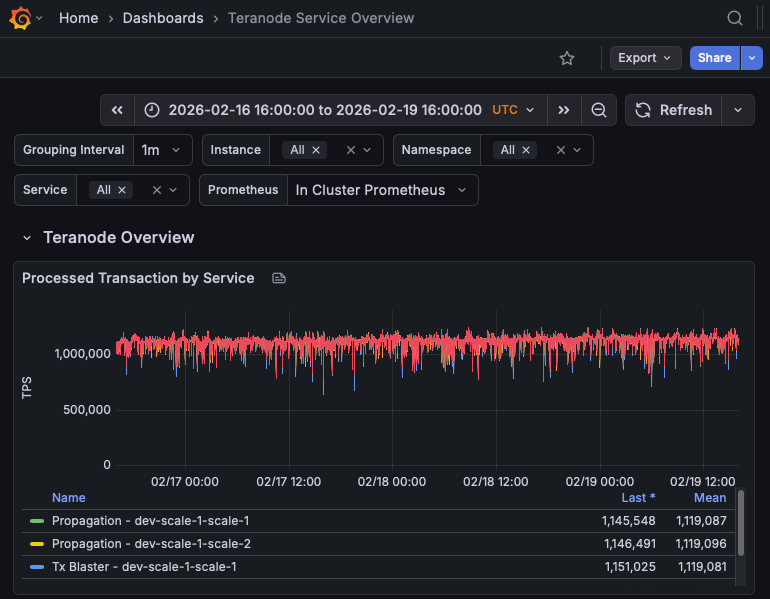
$629,469.95 USD.
The costs per 24 hours of a billion tps 2 node test for teranode.
Let us hope the existing test is sufficiently robust.
English
Håkan Karlsson (lock)🍌 u/572 retweetledi
With the network processing a total of 1 billion transactions per second, the total revenue generated across the ecosystem at a fee of 1,000th of a cent per transaction is 10,000 dollars every second. This results in a total daily network revenue of 864 million dollars. When this total is divided among a cluster of 10 nodes, each node receives a daily revenue share of 86.4 million dollars. This income scale completely transforms the economic profile of the infrastructure, turning the massive hardware requirements into a highly profitable enterprise.
The cost to operate each of these nodes remains at approximately 13.1 million dollars per day to account for the 21.6 petabytes of daily data ingestion and the 200-day rolling storage of 4.32 exabytes. By subtracting this operational overhead from the 86.4 million dollars in daily revenue, each node generates a net daily profit of 73.3 million dollars. This means that even with the most expensive high-performance AWS configurations and massive bandwidth demands, each node maintains an exceptionally strong profit margin while serving as a backbone for the global data economy.
On an annual basis, the numbers reach a scale that defines a new class of industrial utility. Each individual node in the 10-node cluster earns 31.5 billion dollars in gross revenue per year. After accounting for the 4.77 billion dollars in yearly AWS infrastructure costs, each node brings in a net annual profit of 26.73 billion dollars. Collectively, the 10-node cluster generates a total net profit of 267.3 billion dollars a year, proving that the infrastructure required to sustain 1 billion transactions per second is not just viable, but one of the most lucrative assets ever conceived.
In time... there are no other options.
English

@thebtcdad Yes BSV. Even if I have some BTC still left to convert before the flippening.
English

Out of my followers, I wonder how many of you are REAL Bitcoin supporters.
If you do NOT hodl another coin, please say hi.
English

Håkan Karlsson (lock)🍌 u/572 retweetledi
Gold and silver make lows not seen since…..
8 days ago.
(Still hurts alot)
English
Håkan Karlsson (lock)🍌 u/572 retweetledi
Linear Scaling, Not Ritual: What Teranode Actually Changes
open.substack.com/pub/singulargr…

English
Håkan Karlsson (lock)🍌 u/572 retweetledi

They can’t convince me that there are no under the table deals going on at the COMEX…
#Silver
Tooch@andrewjsantucci
@chrismartenson i like the part where 31,828 contracts changed hands during the halt... comex rats
English
Håkan Karlsson (lock)🍌 u/572 retweetledi

Håkan Karlsson (lock)🍌 u/572 retweetledi
In the next 12 months, this will be dwarfed as real action hits BSV.
Chainspect@chainspect_app
⚡ Who's actually the fastest in Web3? We looked at the highest TPS ever recorded in a single block on mainnet and ranked the chains by peak performance Some of the numbers are way higher than most people expect 😱 📊 chainspect.app/dashboard?gain…
English

The slogan “most PoW” only has meaning inside a single, unchanging protocol, because proof-of-work measures computational work against a fixed definition of what constitutes a valid block and a valid transaction. If that definition shifts, then what PoW is securing shifts with it. The metric does not stand above the rules; it operates within them.
This is why the honest chain is the one that does not change. The protocol is the contract. It defines validity. It defines consensus. It defines the object to which PoW is applied. If you alter the protocol, you have altered the contract, and you are no longer identifying the same chain through accumulated work—you are redefining the system and then appealing to work performed under the new definition as if nothing changed.
When people invoke “most PoW” as though it were a universal solvent, they ignore that PoW only aggregates meaningfully when the rule set is stable. Total proof-of-work in a single protocol is the mechanism. The moment you start flipping opcodes, altering limits, redefining transaction validity, or otherwise modifying consensus rules, you are no longer talking about continuity—you are talking about governance. And governance dressed up as inevitability does not restore objectivity.
Cherry-picking the phrase “most PoW” while defending protocol mutability destroys the coherence of the argument. If the protocol can be changed to suit preference, then PoW is merely securing the latest version of that preference. The honest chain, by definition, is the one that maintains the original, stable rules so that accumulated proof-of-work remains attached to a constant standard rather than a moving target.
Joseph Ward@littlejoeward
@CsTominaga @Politicatore satoshi.nakamotoinstitute.org/quotes/proof-o… Very bottom quote
English