Rafael Rodríguez

18.6K posts

Rafael Rodríguez

Rafael Rodríguez

@mentorero

En la búsqueda.....

Katılım Kasım 2008
1.3K Takip Edilen234 Takipçiler
Rafael Rodríguez
Rafael Rodríguez@mentorero·
@JuanLuis_JG @fcapellaga Ojo, que no digo que no se lo merezcan (merezcamos)....grupo repleto de "wokismo" e "izquierda caviar". Por eso mismo su reacción es de lo más peligrosa (sus hijos, por ejemplo, ya andan coqueteando con Vox)
Español
0
0
0
6
Rafael Rodríguez
Rafael Rodríguez@mentorero·
@JuanLuis_JG @fcapellaga Yo pondría el foco en las clases medias-altas pseudoglobalizasas de las grandes urbes (white collars) . Es decir, la "España q madruga" para comerse el atasco es la gran perdedora....tiene pequeños lenitivos como el teletrabajo y esas cosas pero vamos perdiendo día tras día
Español
1
0
0
11
Juan Luis Jiménez
Juan Luis Jiménez@JuanLuis_JG·
La clase media en España apenas ha aumentado sus ingresos netos reales desde 2007, independientemente de la composición del hogar, lo que señala el estancamiento en ingresos de las familias de este país.
Juan Luis Jiménez tweet media
Español
12
123
204
18.5K
Rafael Rodríguez
Rafael Rodríguez@mentorero·
@FernandoGLV1212 @martinvars Me impresiona la última pregunta....El consumo y la inversión debe ir sonde el individuo q genera valor lo estime pertinente. Intervenir con impuestos para que eso no sea así (proteccionismo) , es totalmente rechazable desde un punto de vista liberal que es el mío.
Español
0
0
1
9
Fernando Garrido-Lestache Vidal
Fernando Garrido-Lestache Vidal@FernandoGLV1212·
@mentorero @martinvars Incentivos me refería a bajadas de impuestos. Hay distintas herramientas. Si tuviésemos un único inmigrante enviando remesas perfecto. ¿Qué haces con millones de inmigrantes? ¿No quiere aumentar su consumo e inversión en España?
Español
1
0
0
4
Martin Varsavsky
Martin Varsavsky@martinvars·
España ha normalizado lo absurdo. Interior reconoce un alza del 392% en la inmigración ilegal por Ceuta y Melilla en el primer trimestre. El Banco de España registró más de 11.300 millones en remesas en 2024. Importamos pobreza, exportamos capital y lo llamamos progreso.
Español
41
765
2K
20.4K
Rafael Rodríguez
Rafael Rodríguez@mentorero·
@FernandoGLV1212 @martinvars Poner un impuesto no es incentivos para nada, todo lo contrario. Son barreras para que el individuo (en este caso el emigrante) pueda hacer lo que quiera como individuo con el valor que ha generado.... Estas cosas me aburren tanto
Español
1
0
1
8
Fernando Garrido-Lestache Vidal
Fernando Garrido-Lestache Vidal@FernandoGLV1212·
@mentorero @martinvars A ver es mejor incentivos en positivo muy de acuerdo. Es injusto eso pero hay una cuestión de cantidad, cuando es muy grande, tienes que meter algún incentivo para que compren e inviertan aquí.
Español
1
0
0
7
Rafael Rodríguez
Rafael Rodríguez@mentorero·
@Jongonzlz Lo preocupante de este tweet son muchos de los comentarios. Te has convertido en referente @Jongonzlz y tienes toda una tropa de zombies por aquí
Español
0
0
1
106
Jon González
Jon González@Jongonzlz·
Tuit de los duros pero creo que muy interesante. ✍️ Dinamarca 🇩🇰 me gusta mucho porque es un ejemplo precioso de por qué la presión fiscal, siendo un indicador súper útil, no nos lo cuenta todo: Presión fiscal 2023 (Eurostat): Dinamarca: 43,9% España: 36,8% Dinamarca tiene una presión fiscal aproximadamente 7 puntos superior a España. De forma sencilla: 3 puntos se explican por la mayor contribución del IVA, y los otros 4 puntos se explican por la mayor contribución de los impuestos al trabajo (IRPF+cotizaciones sociales+payroll taxes). Sin embargo, la cuña fiscal del trabajador medio danés, que tiene un salario ¡un 80% superior al del español medio! es ¡4 puntos INFERIOR a la del trabajador español! Vuelve a leerlo: El trabajador medio gana un 80% más pero paga 4 puntos porcentuales menos de impuestos por su trabajo. Tax Wedge 2023 (OECD): Dinamarca: 36,4% España: 40,2% ¿Qué leches pasa aquí? ¿Cómo puede ser que Dinamarca, con mayor "presión fiscal laboral" tenga menor imposición al trabajo por trabajador? Pues principalmente por dos motivos: 1) Dinamarca recauda más por el trabajo, porque hay más gente trabajando. Hay casi 12pp más de tasa de empleo, y la masa salarial absorbe más parte del PIB que en España, a pesar de que cada trabajador tenga menor imposición. 2) La imposición laboral en Dinamarca se compone principalmente de IRPF, mucho más alto que en España (pero recuerdo, no lo suficiente como para que los impuestos al trabajo por trabajador sean superiores que en España). En ausencia de cotizaciones sociales, el IRPF es el encargado de "soportar" el estado de bienestar. Pero... ¿Quién paga IRPF? IRPF paga todo el mundo: pagan los desempleados, los pensionistas, pagan los rentistas... ¿Quién paga cotizaciones sociales? Solamente los trabajadores activos. En España, los ciudadanos "activos", soportan la mayor parte de la carga impositiva del Estado y además son pocos relativamente. En Dinamarca, que además tiene más cantidad de activos, el reparto de la carga fiscal del Estado está más repartido hacia otras rentas.
Doctor Mitencio Perez@mitacoPerez

@Jongonzlz cabe recordar que la presion fiscal en Dinamarca es del 45% del PIB, en España es del 37%. Be careful with what you wish for...

Español
49
914
2.2K
228.9K
Fernando Garrido-Lestache Vidal
Fernando Garrido-Lestache Vidal@FernandoGLV1212·
@martinvars Eso requiere un plan especial. En el mundo actual la demanda interna manda, se debe gastar y reinvertir aquí, todos los que estén aquí. Puede ser injusto pero tendría sentido poner impuestos a las remesas, o reducir impuestos si se gasta e invierte aquí.
Español
1
0
0
193
Sancho Garcés III EL GRANDE
Sancho Garcés III EL GRANDE@JuanDelMundo2·
@Jongonzlz No te enrolles, Dinamarca es un paraíso fiscal al lado de España 🤷 Aún pagando un 50% de impuestos, ganan más que los españoles antes de que les cobren impuestos. No hay más 🤷
Sancho Garcés III EL GRANDE tweet mediaSancho Garcés III EL GRANDE tweet media
Español
1
0
7
1.4K
Santiago Calvo
Santiago Calvo@SantiCalvo_Eco·
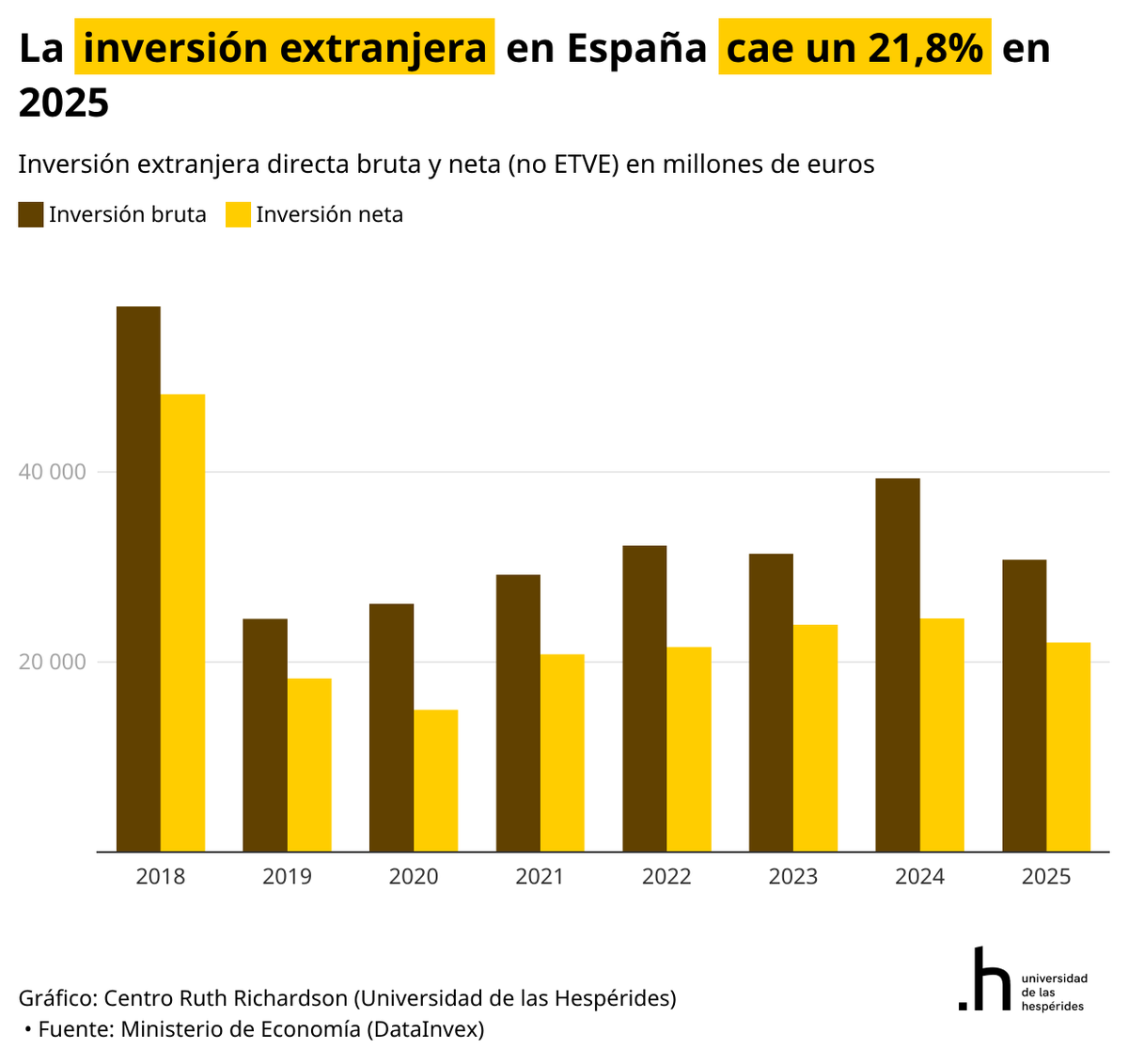
La caída de la inversión extranjera un 21,8% en España: el peor año desde la pandemia pese al imán de los fondos europeos. En 2024, récord de 39.351 M€ y anuncio de Sánchez en el Congreso. En 2025, silencio: 30.764 M€, el peor dato desde 2021. La UNCTAD estima que la IED mundial creció un 14%. Si el aumento era "confianza internacional en España", el descenso es exactamente lo contrario. Por @carlossegovia_. elmundo.es/economia/macro…
Santiago Calvo tweet media
Español
4
11
27
1K
Rafael Rodríguez retweetledi
Charly Wargnier
Charly Wargnier@DataChaz·
“Intelligence is the ability to avoid doing work, yet getting the work done.” Linus Torvalds Creator of Linux
Charly Wargnier tweet media
English
59
481
3.7K
117.7K
Rafael Rodríguez retweetledi
Alejandro Fargosi
Alejandro Fargosi@fargosi·
¿Han dicho algo @FOPEA, Adepa y la Academia del Periodismo, sobre el increíble escándalo de medios y periodistas cobrando de Rusia para desestabilizar a un gobierno democrático?
Español
131
534
1.7K
22.1K
Rafael Rodríguez
Rafael Rodríguez@mentorero·
@pitiklinov Es peligroso el sesgo, no? Incentiva el sesgo hacia "creerse más que lo que eres". No me gusta, realmente somos así?
Español
1
0
0
34
Pablo Malo
Pablo Malo@pitiklinov·
"Un mayor estatus social subjetivo – es decir, cómo las personas perciben su posición en la escalera social – se asocia con tasas de mortalidad más bajas."
Rolf Degen@DegenRolf

Higher subjective social status – how people estimate their standing on the social ladder – was linked to lower death rates. This study explores a simple but powerful idea: it’s not just how much money you have that keeps you healthy, but where you think you stand compared to everyone else. While researchers usually look at "Objective Socioeconomic Status" (like your actual salary or your degree), this paper looks at Subjective Social Status—your own gut feeling about your rank in society regarding respect, power, and security. In a national American cohort followed from early adulthood into midlife, higher subjective status predicted lower mortality even after accounting for education, income, occupation, and baseline health. Each one-step increase on the [10-rung] ladder was associated with an 11% lower hazard in fully adjusted models. In categorical analyses, those in the upper part of the ladder had 40% lower risk than those at the midpoint, indicating concentration of benefit at high Subjective Social Status once covariates were included. This study proves that your sense of social rank is a physical health factor, not just a feeling. It shows that even when two people have the exact same income, the one who feels more respected and secure lives longer. This is important because it identifies "status-related stress" as a silent killer that standard medical checks often miss.

Español
6
20
86
4.9K
Rafael Rodríguez
Rafael Rodríguez@mentorero·
@PeterBoettke @AdrianRavier Curioso, pensaba que se había apropiado de su discurso la economía ecológica de solución estatista. Me gusta ver a Boetke hablando de Boulding.
Español
0
0
0
21
Rafael Rodríguez retweetledi
Dios
Dios@diostuitero·
Me han puesto un ladrón a cada lado. Parece esto el Consejo de Ministros.
Español
228
3.4K
18.3K
210.7K
Sebastián Puig ⚓
Sebastián Puig ⚓@Lentejitas·
Hoy pasear por el barrio de Salamanca ha sido un placer absoluto. Día primaveral radiante y tranquilo. Y les dejo una recomendación para comer (estaba dudando en hacerlo para que no me lo saturen) puertolagasca.com
Español
2
0
15
2.2K
Luis Garicano 🇪🇺🇺🇦
Two things: 1. If you care about AI and you don't follow Karpathy, you are making a major mistake. He is a huge provider of public goods. 2. This idea is genius, specially for all academics. I have not implemented it. But it is my next project.
Andrej Karpathy@karpathy

LLM Knowledge Bases Something I'm finding very useful recently: using LLMs to build personal knowledge bases for various topics of research interest. In this way, a large fraction of my recent token throughput is going less into manipulating code, and more into manipulating knowledge (stored as markdown and images). The latest LLMs are quite good at it. So: Data ingest: I index source documents (articles, papers, repos, datasets, images, etc.) into a raw/ directory, then I use an LLM to incrementally "compile" a wiki, which is just a collection of .md files in a directory structure. The wiki includes summaries of all the data in raw/, backlinks, and then it categorizes data into concepts, writes articles for them, and links them all. To convert web articles into .md files I like to use the Obsidian Web Clipper extension, and then I also use a hotkey to download all the related images to local so that my LLM can easily reference them. IDE: I use Obsidian as the IDE "frontend" where I can view the raw data, the the compiled wiki, and the derived visualizations. Important to note that the LLM writes and maintains all of the data of the wiki, I rarely touch it directly. I've played with a few Obsidian plugins to render and view data in other ways (e.g. Marp for slides). Q&A: Where things get interesting is that once your wiki is big enough (e.g. mine on some recent research is ~100 articles and ~400K words), you can ask your LLM agent all kinds of complex questions against the wiki, and it will go off, research the answers, etc. I thought I had to reach for fancy RAG, but the LLM has been pretty good about auto-maintaining index files and brief summaries of all the documents and it reads all the important related data fairly easily at this ~small scale. Output: Instead of getting answers in text/terminal, I like to have it render markdown files for me, or slide shows (Marp format), or matplotlib images, all of which I then view again in Obsidian. You can imagine many other visual output formats depending on the query. Often, I end up "filing" the outputs back into the wiki to enhance it for further queries. So my own explorations and queries always "add up" in the knowledge base. Linting: I've run some LLM "health checks" over the wiki to e.g. find inconsistent data, impute missing data (with web searchers), find interesting connections for new article candidates, etc., to incrementally clean up the wiki and enhance its overall data integrity. The LLMs are quite good at suggesting further questions to ask and look into. Extra tools: I find myself developing additional tools to process the data, e.g. I vibe coded a small and naive search engine over the wiki, which I both use directly (in a web ui), but more often I want to hand it off to an LLM via CLI as a tool for larger queries. Further explorations: As the repo grows, the natural desire is to also think about synthetic data generation + finetuning to have your LLM "know" the data in its weights instead of just context windows. TLDR: raw data from a given number of sources is collected, then compiled by an LLM into a .md wiki, then operated on by various CLIs by the LLM to do Q&A and to incrementally enhance the wiki, and all of it viewable in Obsidian. You rarely ever write or edit the wiki manually, it's the domain of the LLM. I think there is room here for an incredible new product instead of a hacky collection of scripts.

English
53
156
4.9K
2.7M
Rafael Rodríguez
Rafael Rodríguez@mentorero·
@fabiancbarrio Victimismo en vena. Me aburro. Con lo q pago no merezco ésto....Tú verás, creo q voy cancelar mi suscripción
Español
1
0
3
130
🇨🇾 Fabián C. Barrio
🇨🇾 Fabián C. Barrio@fabiancbarrio·
Lamento informar de que esta semana no habrá #LMDO - No estoy en Pafos - Hay pocas noticias - Tengo la garganta regulera y hace frío para salir de noche a presentarlo. Gracias por su comprensión y perdonen que los disculpe.
Español
59
21
457
7.5K
Rafael Rodríguez
Rafael Rodríguez@mentorero·
@LegalMalvado El plan de todas las izquierdas es acabar con el ahorro para q tengas que depender del Estado.....de ahí sale todo
Español
0
0
0
33