mesteraidam 🇭🇺🇰🇿

1.4K posts

mesteraidam 🇭🇺🇰🇿 banner
mesteraidam 🇭🇺🇰🇿

mesteraidam 🇭🇺🇰🇿

@mesteraidam

Kazakh-Kipchak || 𐱅𐰇𐰼𐰜 ||Turanist-Tengrist Interested in the deep connections between Hungarian culture & history and the steppe

Karcag, Hungary Katılım Eylül 2023
202 Takip Edilen180 Takipçiler
Sabitlenmiş Tweet
mesteraidam 🇭🇺🇰🇿
mesteraidam 🇭🇺🇰🇿@mesteraidam·
Kazak vagyok, a Kipcsak-Altybas nemzetségből. ​Jól ismerem a történetünket. A 13. században a Toxoba (Akköbik kán nemzetsége) konfliktusba került a Törtobával (Kötény kán nemzetségével). ​Az előbbiek behívták a mongolokat és kiszorították az utóbbiakat, ezért maradt a kipcsakok jelentős része Közép-Ázsiában. ​Azok, akik elmentek, lényegében a testvéreim, akiket egy ősi viszály választott el tőlem, de legalább képesek voltak új hazát találni és kitartani. ​Mándoky Kongur István küldetésében népeink azóta tartó megbékélését látom. 🇭🇺🇰🇿
Magyar
3
0
19
3.6K
Északifül_2.0🇭🇺🦉
Északifül_2.0🇭🇺🦉@Vojpel_eszak2·
@mesteraidam This level of hatred for anything Finno-Ugric or Uralic and the whole lieing about Hungarian history is why I got disilliusoned, they remind me of those Romanian "theories". The Russophilia connected to it is also alarming, they have no problem being Russia supporters.
English
2
0
1
15
mesteraidam 🇭🇺🇰🇿
I think those Hungarians who are skeptical of Turanism (I mean the Uralo-Altaic Theory) are missing the point. Look at it as roots as... literal roots. A tree grows from its roots, after all. If you forget these roots, abandon them, and don't modernize, transform, or cultivate them, you lose something essential. Besides, the neighbors will always remind the Hungarians that they came from somewhere else. ​For centuries, this identity was stifled by the Habsburgs, then, after Trianon and WWII, it was stifled by the Eastern Bloc. Now it’s being stifled by the European Union. Well... when it comes to politics, I'm not entirely sure how much Orbán Viktor utilized this idea for his own benefit. If it was so marginal, why was he in power for so long? Besides, in terms of resources, Hungary has always depended, and continues to depend, on Europe and Russia. At the very least, this whole ideology could become quite tangible if (for example) a gas pipeline were built to Hungary from Kazakhstan, across the Caspian to the Adriatic, and through Montenegro and Serbia. The same goes for other resources, and this could be a two-way process; as I understand it, Kazakhstan, conversely, needs more academic-technological resources. I think skepticism toward Turanism arises because many view it merely as mythology (and LARPing), rather than as a tool. If viewed as a foreign policy philosophy, Turanism transforms Hungary from being the "periphery of Europe" into a "bridge between the East and the West." That is a very ambitious role.
English
2
1
14
586
mesteraidam 🇭🇺🇰🇿
You kind of proved my point there 😁 The skepticism is understandable, but from a Kazakh perspective, I see it a bit differently. Turkic and Uralic connections don't have to compete with each other. If anything, Kazakhstan could act as a bridge between Hungary and Finno-Ugric peoples that happen to live in Russia today. Given the current political climate, it's simply easier and more practical to build academic and cultural ties through Kazakhstan than to work directly with Moscow. Kazakhstan is in a much better position to serve as a neutral meeting point. To me, that's what Turanism should be about. Not denying Finno-Ugric roots, and definitely not aligning with Russian geopolitical interests. It should be a pragmatic framework for regional cooperation, whether that's energy, trade, or cultural exchange.
English
0
0
0
4
T-64 🇫🇮
T-64 🇫🇮@99Khaotik·
I wonder if he had this wojak ready or was it made specifically for my post? Well it's too late to ask now, unfortunately this Australian groyper blocked me 💔🥀
T-64 🇫🇮 tweet media
English
2
0
16
363
mesteraidam 🇭🇺🇰🇿 retweetledi
Yuno Poster
Yuno Poster@HidamariSneed·
Yuno Poster tweet media
ZXX
7
23
287
2.4K
mesteraidam 🇭🇺🇰🇿 retweetledi
Wilhelm
Wilhelm@Politzania10·
Pre-Trianon Hungary is the most pleasing country to look at
Wilhelm tweet media
English
67
95
1.9K
93.8K
mesteraidam 🇭🇺🇰🇿 retweetledi
Achilles
Achilles@Xhej__·
Achilles tweet media
ZXX
178
1.7K
14.3K
184.1K
mesteraidam 🇭🇺🇰🇿 retweetledi
𝙉𝙤𝙢𝙖𝙙 𝘾𝙪𝙡𝙩𝙪𝙧𝙚
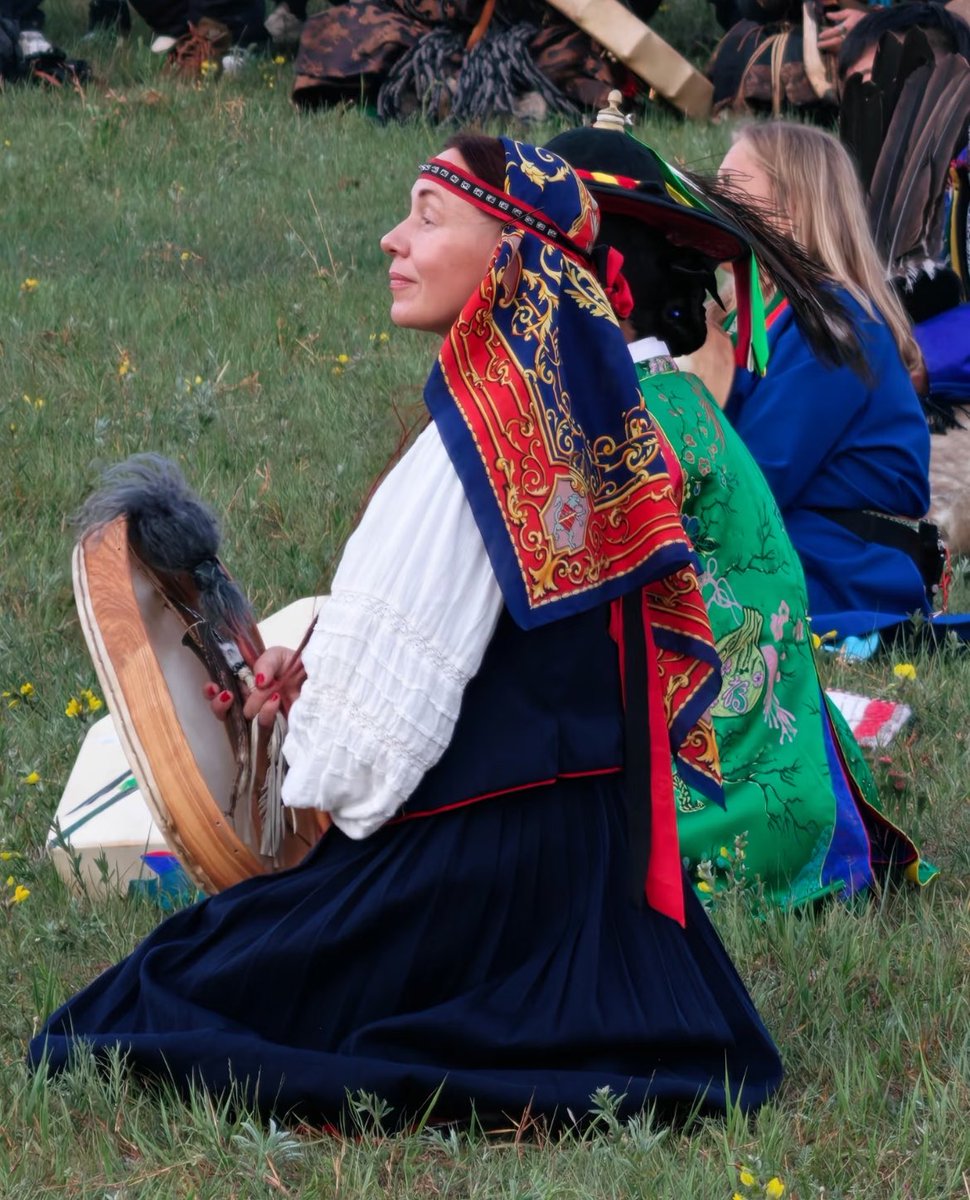
Taking place right now (June 12–15, 2026) in Mongolia, the "TENGER" World Shaman Festival serves as a prominent international showcase, marked by the official participation of United Nations (UN) and UNESCO representatives. However, the true significance of this organization lies in how beneath the shadow of global institutions it exposes the rawest form of a shared aesthetic and ritual language deeply woven into the daily lives of people stretching from the depths of Asia to the Mediterranean basin. Stripped of grandiose claims, the festival stands simply as a quiet testament to a profound, millennia-old continuity. When observing the grounds, the most compelling element is the intricate detail found upon the ceremonial garments and headdresses of the participants. Serving as portable microcosms of nature, these headpieces feature seasonal wildflowers alongside specific motifs like ladybugs and cicadas, signifying a deep reverence for the cyclical renewal of the earth. The color palette of the attire relies on a thoroughly familiar cosmology: crimson red representing vital life energy, emerald green signifying the awakening of the earth, and sky blue mirroring the infinite canopy above. The way these organic motifs are bound together by vibrant blue and turquoise glass beadwork long believed to act as an apotropaic shield against the evil eye and negative energies demonstrates that this visual language is no mere regional decoration, but the shared visual memory of an entire geography.
𝙉𝙤𝙢𝙖𝙙 𝘾𝙪𝙡𝙩𝙪𝙧𝙚 tweet media𝙉𝙤𝙢𝙖𝙙 𝘾𝙪𝙡𝙩𝙪𝙧𝙚 tweet media𝙉𝙤𝙢𝙖𝙙 𝘾𝙪𝙡𝙩𝙪𝙧𝙚 tweet media𝙉𝙤𝙢𝙖𝙙 𝘾𝙪𝙡𝙩𝙪𝙧𝙚 tweet media
English
1
27
126
4.1K
mesteraidam 🇭🇺🇰🇿
There is some truth to that, but the presence of Slavic and Germanic loanwords doesn't erase the profound historical impact of earlier contacts. While Finno-Ugric and Turkic are indeed separate language families, their long-standing interaction is undeniable. This Oghur-Kipchak Turkic influence is clearly visible not only in Hungarian but also in other Ugric and Finno-Volgaic languages (such as Moksha and Erzya) that coexisted with Turkic peoples for centuries.
English
1
0
0
30
Robert
Robert@DrRob82·
@mesteraidam But there’s no Uralo-Altaic reality; they’re completely different languages groups. Uralic developed in northern Central Siberia, not the Turan region. Even the “late Turkic” adstrate is overstated, whilst Germanic and Slavic are minimised by Hungarian X posters
English
1
0
1
73