MiBakh

1.1K posts

MiBakh banner
MiBakh

MiBakh

@mibakh

USA Katılım Ocak 2010
782 Takip Edilen48 Takipçiler
MiBakh retweetledi
Jon Yongfook
Jon Yongfook@yongfook·
Schrödinger's SaaS A newly launched and meticulously built B2B SaaS product at $0 MRR. The SaaS exists in a superposition, simultaneously alive and dead.
English
55
8
173
12.5K
MiBakh retweetledi
Pierre-Louis Soulié
Pierre-Louis Soulié@plsoulie·
Wondering how we give life to our robots? Just released a blog on how we bring our robotics ideas from initial sketch to functional product in a matter of days! Fable Engineering #4 — From Sketch to Product in Days, not Weeks open.substack.com/pub/fableengin… In a world where software interfaces are being vibe-coded, fast hardware execution is key to compress iteration loops. #Robotics #Startup #AI
Pierre-Louis Soulié tweet media
English
5
3
47
2.1K
MiBakh retweetledi
Tom Dörr
Tom Dörr@tom_doerr·
"Document (PDF) extraction and parse API using state of the art modern OCRs + Ollama supported models. Anonymize documents. Remove PII. Convert any document or picture to structured JSON or Markdown"
Tom Dörr tweet media
English
20
198
1.9K
136.9K
MiBakh retweetledi
Shubham Saboo
Shubham Saboo@Saboo_Shubham_·
Claude Sonnet 3.5 artifacts is now available to use with GPT-4o, Gemini and Llama-3. ChatLLM playground provides access to GPT-4o, Claude, Llama-3, and Gemini in just $10 a month. Plus, build custom AI agents with RAG to chat with your internal data with zero Python Code.
English
15
67
425
53.5K
MiBakh retweetledi
Aaron Levie
Aaron Levie@levie·
One of the biggest open questions with AI is its impact on software business models over time. What seems to be under-appreciated about AI is how it can enable significant TAM expansion for a large number of categories over time when software can deliver outcomes, and not just enable existing work. Right now the dominant business model in SaaS is a per seat model, which inevitably means that the total number of seats you can sell is limited to the number of employees in the organization that are relevant for your particular software. Legal software is roughly capped by the size of the legal team, audit software is capped by the size of the audit team, and so on. The implication of this is that the customer generally *already* has to have not only a need for your solution, but also the existing headcount in the organization to become users of your software. Incidentally, this is often why so many SaaS products tend to go after horizontal productivity categories, because this maximizes the number of potential users you have access to in an organization. AI flips this on its head, especially with the power of AI Agents, and you get a new form of “outcome-as-a-service”. When AI is actually doing the work within the software itself, you're no longer constrained by the number of employees inside the organization to use the actual software. The software is quite literally bringing along the work with it and delivering a particular business outcome. It's clear the full potential of this playing out is not fully understood, as this represents a massive transformation of software as an industry.  When you are no longer constrained by the size of a team or department to use your software, markets are no longer arbitrarily capped in size. In this new era, software that powers a legal workflow actually brings the equivalent of legal knowledge work along with it, and software for audits brings the equivalent of audit work with it. All of a sudden small businesses, under-resourced teams in large enterprises, and all new geographies begin to open to up as markets. AI will enable otherwise niche categories of software to become much larger, and already large categories of software to become even bigger. This transformation is similar to what we've seen in other markets where a new innovation has unlocked the size of a market well beyond its original demand. For instance, most investors and economists would have thought the size of Uber or Lyft's market was the size of the existing Taxi market, when in fact the market size was orders of magnitude larger once the shape of the product changed to make the offering easier to consume. We’ve seen this effect time and time again in areas like SaaS, cloud computing, a variety of mobile categories, and more. We’re only in the earliest of stages of figuring out what this all means for the future of the software business model. Clearly all new variables of monetization will need to emerge when you start to pay software vendors for outcomes as opposed to just the software itself. But inevitably, when you remove the existing dominant constraint of enterprise software, TAM expansion will follow.
English
80
94
777
241.7K
MiBakh retweetledi
VeryBritishProblems
VeryBritishProblems@SoVeryBritish·
Delighted to bring half of you together in recognition and the other half in pure confusion.
English
9
1
328
81.1K
MiBakh retweetledi
The Graph
The Graph@graphprotocol·
👀 Have you explored Agentc yet? Agentc is a ChatGPT-like tool built on The Graph’s Uniswap data! For the next 2 weeks, interact with AI & The Graph using natural language... & compete for bounties! Let’s see what you can do 📊 🔗agentc.xyz
English
9
33
225
12K
MiBakh retweetledi
Lukas Ziegler
Lukas Ziegler@lukas_m_ziegler·
🚨 BREAKING: Open-source robotics program - Le Robot. @huggingface x @pollenrobotics! 🤝 This is further proof that the 'humanoid race' is not slowing down and more big players are joining. Check out the first project from Hugging Face's open-source robotics program, "Le Robot," in collaboration with Pollen Robotics! 🎉 ℹ️ Bit of facts about the french humanoid robot: → Reachy2 is a humanoid robot designed by Pollen Robotics, trained by Hugging Face to do various household chores and interact safely with humans and dogs. → The robot was initially teleoperated by a human wearing a virtual reality headset, who controlled it through various tasks. → A machine learning algorithm then studied 50 videos of the teleoperation sessions, learning how to do the tasks on its own and guiding Reachy2 to do them. → The dataset and model used for the demo are open-sourced on Hugging Face, and available for anyone to use. ❓ Question: How will open-source robotics AI change the game for robotics development? Credits: @RemiCadene ~~~ ♻️ RT to help 1 robot find a new workplace.
English
13
38
178
24.5K
MiBakh retweetledi
Lucas Crespo 📧
Lucas Crespo 📧@lucas__crespo·
What if ChatGPT was a standalone desk device?
Lucas Crespo 📧 tweet media
English
104
34
873
91.7K
MiBakh retweetledi
Andrej Karpathy
Andrej Karpathy@karpathy·
📽️ New 4 hour (lol) video lecture on YouTube: "Let’s reproduce GPT-2 (124M)" youtu.be/l8pRSuU81PU The video ended up so long because it is... comprehensive: we start with empty file and end up with a GPT-2 (124M) model: - first we build the GPT-2 network - then we optimize it to train very fast - then we set up the training run optimization and hyperparameters by referencing GPT-2 and GPT-3 papers - then we bring up model evaluation, and - then cross our fingers and go to sleep. In the morning we look through the results and enjoy amusing model generations. Our "overnight" run even gets very close to the GPT-3 (124M) model. This video builds on the Zero To Hero series and at times references previous videos. You could also see this video as building my nanoGPT repo, which by the end is about 90% similar. Github. The associated GitHub repo contains the full commit history so you can step through all of the code changes in the video, step by step. github.com/karpathy/build… Chapters. On a high level Section 1 is building up the network, a lot of this might be review. Section 2 is making the training fast. Section 3 is setting up the run. Section 4 is the results. In more detail: 00:00:00 intro: Let’s reproduce GPT-2 (124M) 00:03:39 exploring the GPT-2 (124M) OpenAI checkpoint 00:13:47 SECTION 1: implementing the GPT-2 nn.Module 00:28:08 loading the huggingface/GPT-2 parameters 00:31:00 implementing the forward pass to get logits 00:33:31 sampling init, prefix tokens, tokenization 00:37:02 sampling loop 00:41:47 sample, auto-detect the device 00:45:50 let’s train: data batches (B,T) → logits (B,T,C) 00:52:53 cross entropy loss 00:56:42 optimization loop: overfit a single batch 01:02:00 data loader lite 01:06:14 parameter sharing wte and lm_head 01:13:47 model initialization: std 0.02, residual init 01:22:18 SECTION 2: Let’s make it fast. GPUs, mixed precision, 1000ms 01:28:14 Tensor Cores, timing the code, TF32 precision, 333ms 01:39:38 float16, gradient scalers, bfloat16, 300ms 01:48:15 torch.compile, Python overhead, kernel fusion, 130ms 02:00:18 flash attention, 96ms 02:06:54 nice/ugly numbers. vocab size 50257 → 50304, 93ms 02:14:55 SECTION 3: hyperpamaters, AdamW, gradient clipping 02:21:06 learning rate scheduler: warmup + cosine decay 02:26:21 batch size schedule, weight decay, FusedAdamW, 90ms 02:34:09 gradient accumulation 02:46:52 distributed data parallel (DDP) 03:10:21 datasets used in GPT-2, GPT-3, FineWeb (EDU) 03:23:10 validation data split, validation loss, sampling revive 03:28:23 evaluation: HellaSwag, starting the run 03:43:05 SECTION 4: results in the morning! GPT-2, GPT-3 repro 03:56:21 shoutout to llm.c, equivalent but faster code in raw C/CUDA 03:59:39 summary, phew, build-nanogpt github repo
YouTube video
YouTube
Andrej Karpathy tweet media
English
414
2.2K
15.4K
1.5M
MiBakh retweetledi
Shubham Saboo
Shubham Saboo@Saboo_Shubham_·
Build a LLM app with memory using Llama-3 running locally on your computer (100% free and without internet):
English
20
117
1.2K
330.8K
MiBakh retweetledi
Virat Singh
Virat Singh@virattt·
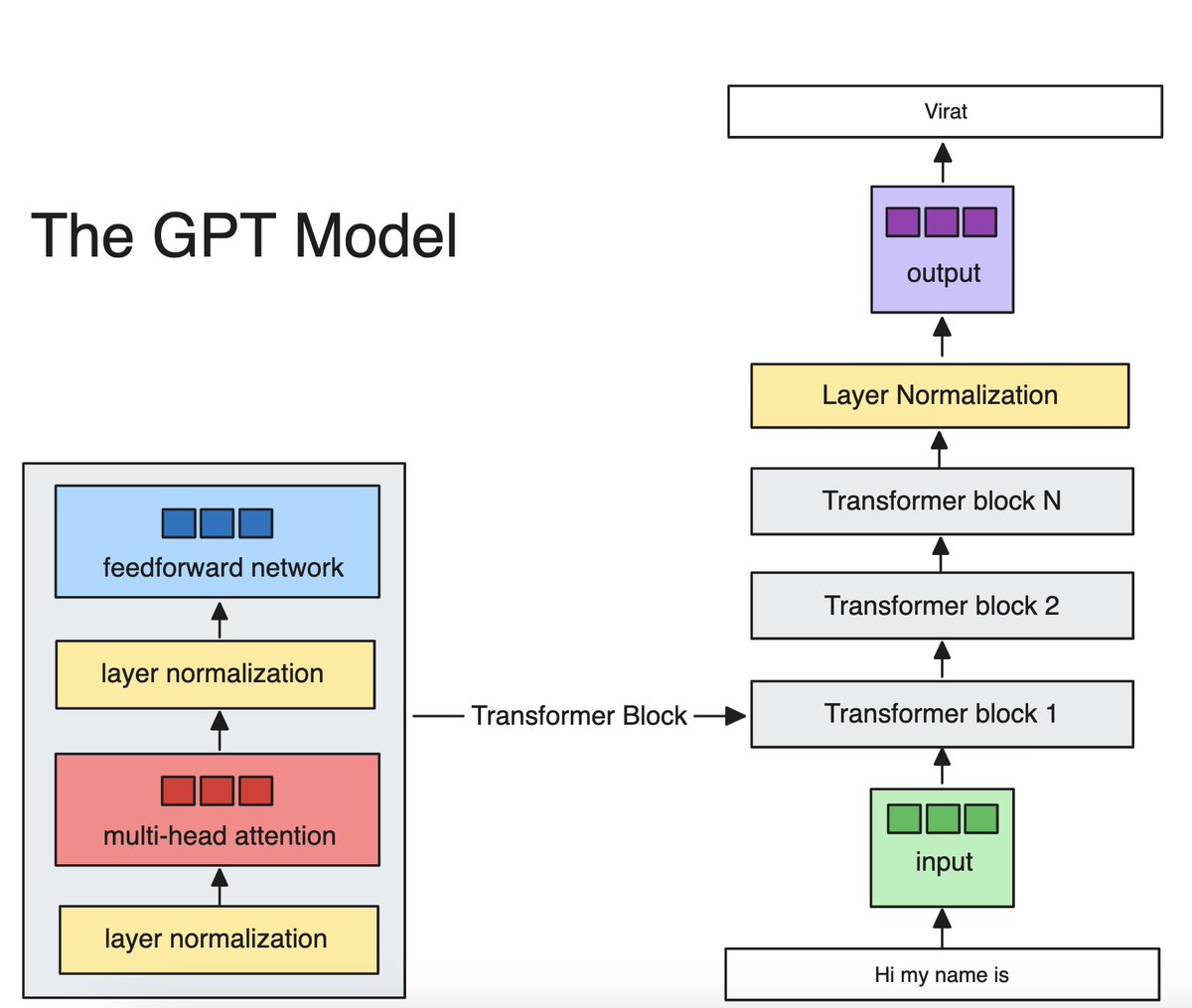
I finally understand how GPT generates text. Really helps to code it from scratch in Python. There are 5 components: • token embeddings • positional embeddings • transformer blocks • layer normalization • output head It sounds complex, but grokking GPT is simple. Token embeddings turn input text into meaningful vectors that capture semantic meaning. Positional embeddings encode positions of input tokens. This tells GPT "where" each token is in the input text. Transformer blocks are the processing powerhouse. This is where attention and training happens. Layer normalization smooths out the data, which enhances training stability. Output head translates the learned features into a next token prediction. And that's it! I recommend running the code below and then implementing it step-by-step on your own. Happy learning.
Virat Singh tweet media
English
8
118
706
73.9K
MiBakh retweetledi
Chief AI Officer
Chief AI Officer@chiefaioffice·
$1B+ raised last week by AI startups 9 startups building insane products you should know about:
English
28
164
1.4K
868.3K
MiBakh retweetledi
Ashpreet Bedi
Ashpreet Bedi@ashpreetbedi·
Lets build the `LLM OS` inspired by the great @karpathy Can LLMs be the CPU of a new operating system and solve problems using: 💻 software 1.0 tools 🌎 internet browsing 📕 knowledge retrieval 🤖 communication with other LLMs Code: git.new/llm-os
English
17
131
965
81.6K
MiBakh retweetledi
Chris Do
Chris Do@theChrisDo·
You can make an unlimited amount of money. Do the following: Solve a big problem that the client sees as necessary and urgent. Design your entire conversation and content around addressing this. Here are 12 steps to follow. Step 1: Who is your client? Describe them. Most get stuck here because they can’t commit to a single dream client avatar. Less is more. Step 2: What do they want? Step 3: Why do they want it? Step 4: What’s the obstacle standing in their way? Step 5: In an ideal world, what is their dream outcome? Step 6: What are they afraid of? What negative outcomes are they trying to avoid? Step 7: What have they tried in the past that hasn’t worked? What gives them pause to try again? Step 8: How would they measure success? Step 9: What impact would this have on their life and business? Step 10: What % of value created feels fair to spend? Step 11: Are there any reasons preventing them from moving forward with someone like you? Step 12: What do they want to do next?
Chris Do tweet media
English
14
29
311
24.5K
MiBakh retweetledi
Greg Brockman
Greg Brockman@gdb·
Introducing GPT-4o, our new model which can reason across text, audio, and video in real time. It's extremely versatile, fun to play with, and is a step towards a much more natural form of human-computer interaction (and even human-computer-computer interaction):
English
838
4.8K
21.9K
4.4M
MiBakh retweetledi
javi
javi@Javi·
GPT-4o is MIND BLOWING. First time having genuinely natural voice conversations with a computer. I can’t wait for you all to experience it.
English
18
24
437
36.2K