Sabitlenmiş Tweet
Michael Lebowitz, CFA
36.9K posts

Michael Lebowitz, CFA
@michaellebowitz
https://t.co/EACe3xwbXw - https://t.co/u9XO4ltpTE - https://t.co/Yn86Xe0FLA
Washington DC area Katılım Temmuz 2011
1.1K Takip Edilen33.6K Takipçiler

Is the AI investment boom genuinely broadening this country’s economic footing or weakening the labor force, the foundation of the economy? Check out Part One-
realinvestmentadvice.com/resources/blog…
English


Is the AI investment boom genuinely broadening this country’s economic footing or weakening the labor force, the foundation of the economy? Check out Part One-
realinvestmentadvice.com/resources/blog…
English


Is the AI investment boom genuinely broadening this country’s economic footing or weakening the labor force, the foundation of the economy? Check out Part One-
realinvestmentadvice.com/resources/blog…
English

Pipelines Are Defusing Iran’s Negotiating Leverage open.substack.com/pub/simpleviso…
English


Market Mechanics Or Fundamentals: What's Behind This Rally? open.substack.com/pub/simpleviso…

English

Let's look beyond fundamentals and narratives to better understand how herding, momentum, and option delta and gamma can systematically drive prices higher and eventually lower. realinvestmentadvice.com/resources/blog…
English


Michael Lebowitz, CFA retweetledi

5-16-26 Kevin Warsh Inherits a Fed Trapped by Inflation
with @michaellebowitz
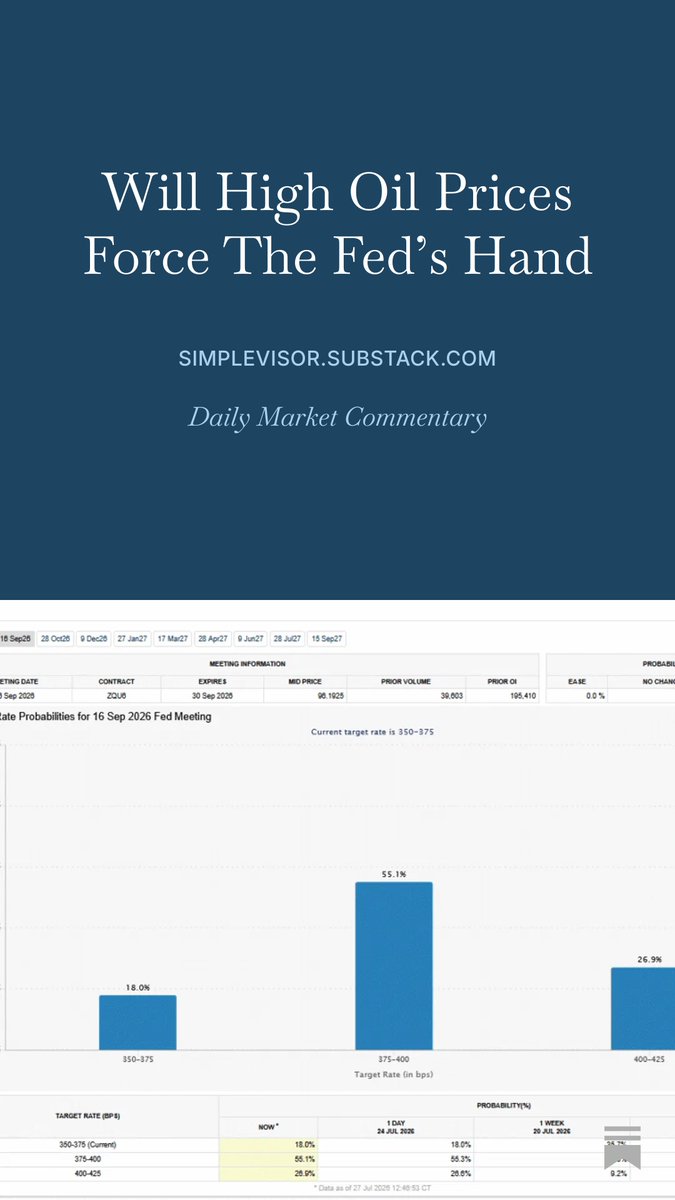
The market may be misreading the Fed’s ability to cut rates in the near future, especially after Kevin Warsh officially takes over as Fed Chairman in June.
The current inflation backdrop, driven heavily by the Iran-related oil shock, leaves the Fed with very little flexibility despite ongoing market hopes for easier monetary policy.
Expectations for rate cuts that were previously priced into this year now have mostly been pushed into next year. Even though equity markets remain optimistic that the Fed will eventually become more accommodative, the Fed simply cannot justify cutting rates right now.
A major point is the relationship between the Fed funds rate and the 2-year Treasury yield. The 2-year Treasury is trading slightly above the Fed funds rate, signaling that markets are already pricing in restrictive conditions and persistent inflation risks. In that environment, aggressive easing would risk undermining inflation credibility.
There is also the internal policy shift happening at the Fed itself. The departure of Stephen Moran, who had advocated consistently for aggressive 50bp rate cuts, materially changes the tone of the committee. His removal eliminates one of the strongest voices pushing for immediate easing.
At the same time, expect Warsh to be more cautious and pragmatic. He shouldn’t be considered strongly dovish, but there is “no way” he cuts aggressively in the current environment. Instead, Warsh may act similarly to Powell: maintain current rates, avoid overreacting, and acknowledge that much of the inflation problem is outside the Fed’s direct control.
That creates a Fed that is not necessarily hawkish, but “less dovish.” The removal of dissenting voices advocating immediate cuts means the committee consensus is now more firmly centered around holding rates steady for longer.
The deeper macroeconomic concern now centers on oil prices and their delayed impact on consumer demand, as high oil prices act as a hidden tax on consumers.
Because consumer spending accounts for roughly 70% of the U.S. economy, sustained increases in gasoline and energy costs gradually erode purchasing power throughout the broader economy. We may eventually see “consumption destruction.”
Even though markets are currently rallying and rising asset prices are boosting the wealth effect, the economic damage is still occurring quietly in real time beneath the surface.
The Fed’s real problem may emerge after the Iran conflict eventually stabilizes. Once oil supply normalizes and crude prices fall, headline inflation pressures could quickly ease. On the surface, this would appear positive for the Fed, as inflation would begin to cool naturally.
However, the economic damage from months of elevated energy costs may only begin to appear at that exact moment. As a result, economic growth could slow materially just as inflation finally starts to fall.
In that scenario, the Fed could suddenly shift from being unable to cut rates to potentially needing aggressive rate cuts later to counteract weakening growth and falling inflation.
If you like this video, please ❤️like and 🔁retweet
English


Let's look beyond fundamentals and narratives to better understand how herding, momentum, and option delta and gamma can systematically drive prices higher and eventually lower. realinvestmentadvice.com/resources/blog…
English
Michael Lebowitz, CFA retweetledi

Here you go. A wild and wooly discussion of markets and the economy with @spomboy and @michaellebowitz brought to you by @zerohedgeDebate organize by @cosgrove_iv. It starts in two minutes....
zerohedge.com/markets/are-ma…
English
Michael Lebowitz, CFA retweetledi

Things not seen at market bottoms..


Michael Lebowitz, CFA@michaellebowitz
Options were traditionally used for risk management purposes. Yet their proliferation and widespread use by traders and gamblers have created a market structure that increasingly results in significant volatility and enormous price changes for entirely non-fundamental reasons. Thus, the risk management tool has become a market risk in and of itself. realinvestmentadvice.com/resources/blog…
English
Michael Lebowitz, CFA retweetledi

Yesterday, we at @GnSEconomics updated our forecasts for OECD's leading indicators, where a shock awaited us.
Even the standard forecasts indicated an imminent downturn in the global business cycle.
1/3

English