Mickaël DLR

90 posts

Mickaël DLR banner
Mickaël DLR

Mickaël DLR

@mickael_dlr

Quant founder building an AI-first firm.

San Francisco, CA Katılım Nisan 2012
46 Takip Edilen123 Takipçiler
Sabitlenmiş Tweet
Mickaël DLR
Mickaël DLR@mickael_dlr·
The Grok confidencemaxxing became call-everything 69 rebuys between them. They became the printing machine of the table, forced to buy in again and again
English
0
0
0
528
Mickaël DLR retweetledi
emile
emile@c_emile_c·
Hey I'm in SF for the summer, here's my ID Daily stats: - coffees: 12 - tokens: 1.2B - cigarettes: 30 Prior stats: - stanford grad - ex citadel - built the first foundation model for trading in late 2023 Status: founder, cracking quantitative trading with ai from first principles with @mickael_dlr All that to say that my body is a machine turning coffees, cigs and tokens into quantitative research, and if you like either those inputs or this output we should connect 😊
emile tweet media
English
7
1
24
13.5K
Brivael Le Pogam
Brivael Le Pogam@brivael·
Mon neveu a 18 ans, c'est @mae_prina Il est coincé dans une école d'informatique où on lui apprend du bullshit à longueur de journée. Alors je lui ai dit une seule chose : arrête d'attendre qu'on te forme, apprends à build, absorbe tout ce que tu peux trouver sur internet, et ship. Son objectif est simple. Sortir un SaaS qui lui génère du revenu d'ici la fin de l'année. À 18 ans, en partant de zéro, en apprenant tout seul. Allez le suivre, c'est un vrai good guy.
Brivael Le Pogam tweet media
Français
18
5
85
8.1K
Mickaël DLR
Mickaël DLR@mickael_dlr·
@doodlestein Is AI raising your standard, or helping you avoid the standard? Jeffrey: I raise the AI's standard
English
0
0
1
75
Mickaël DLR retweetledi
emile
emile@c_emile_c·
Compiled Intelligence's quant stack is so good that I'm SOTA at reading the minds of rats in real time, and I'll prove it soon.
English
1
1
1
259
Mickaël DLR retweetledi
i like food
i like food@messedupfoods·
High risk no reward
English
140
119
4.6K
5.1M
Mickaël DLR
Mickaël DLR@mickael_dlr·
I have 13% of battery but wouldn't hesitate to go for a marathon with it. Can't fathom recharging my watch everyday I am charging it every 35 days on average.
Mickaël DLR tweet media
English
1
0
1
135
Mickaël DLR
Mickaël DLR@mickael_dlr·
@doodlestein I assume you speak of mid journey's new scans. The headlines sounded like ragebait for health professionals tbh 😅, an ultrasound technology being compared to MRI just sound off. (Literally can't scan the brain for ex)
English
0
0
5
526
Jeffrey Emanuel
Jeffrey Emanuel@doodlestein·
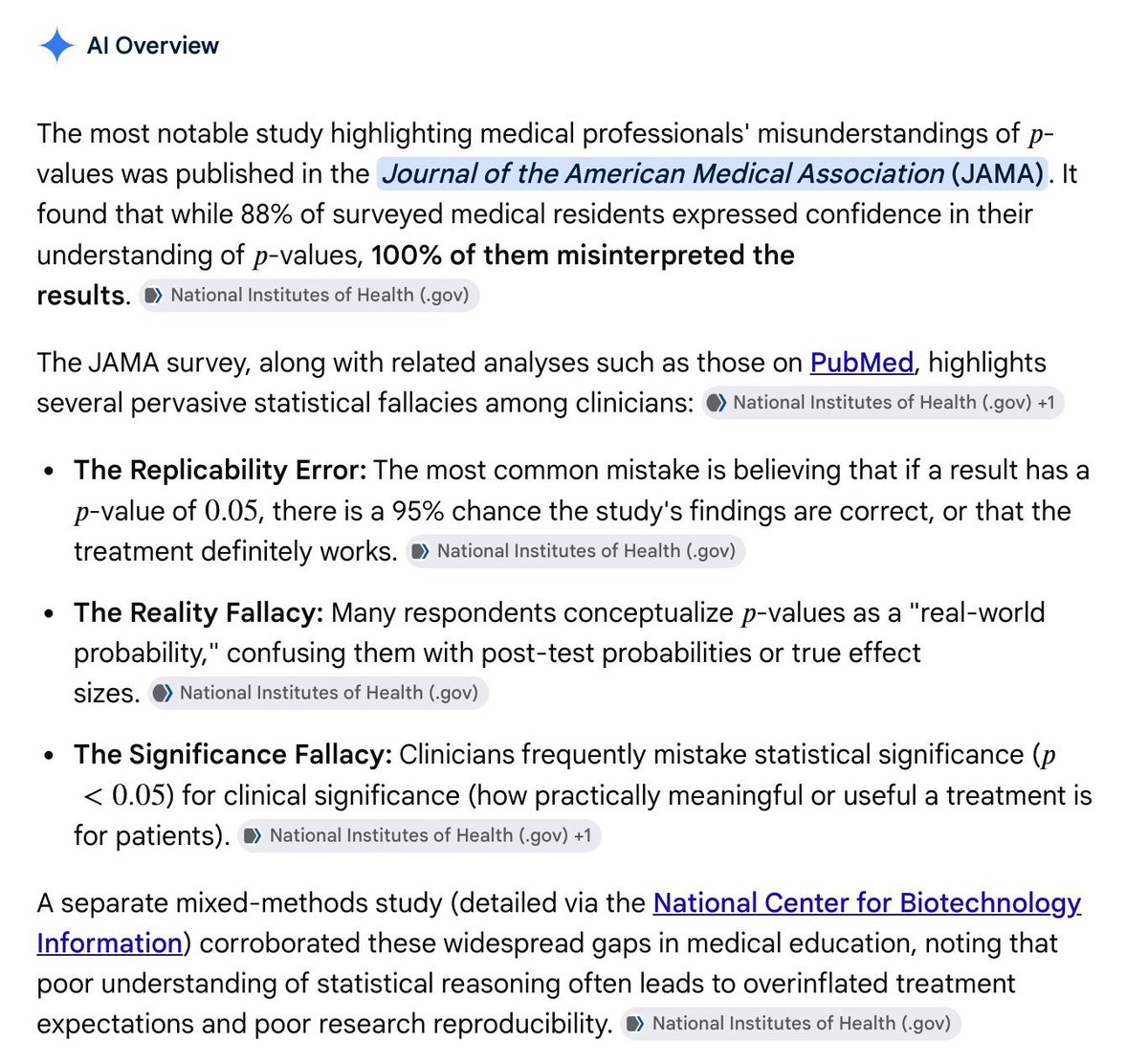
When you see the doctors coming out in hordes to confidently argue against new scanning technologies powered by advanced math and statistics, just remember that the vast majority of them are borderline innumerate and can’t even understand what p-values are:
Jeffrey Emanuel tweet media
English
91
42
394
98.5K
Mickaël DLR retweetledi
Pierre-Louis Biojout (PLB)
Pierre-Louis Biojout (PLB)@plbiojout·
A year ago, people from Bercy, France's economy ministry, asked me about AI and robotics. I told them what I actually thought. It didn't match what they wanted to hear. So they cut everything I said from the report, and wrote the opposite. I doubt I was the only one. Today Bercy launches a "Directorate of Artificial Intelligence." Its mission: "define and implement the AI strategy," "pool compute capacity," "accelerate the development of agents." Translation: we're going to plan innovation from an office. That has never worked. Not once. OpenAI didn't come out of a decision in Washington. Anthropic isn't a federal program. xAI isn't a state initiative. The technological leaps of the decade came from people who were building, not committees that were planning. The real economy isn't a game of Civilization. You don't unlock "AI level 3" by checking a box on a tech tree. And this isn't just an opinion. Hayek proved it in 1945 in "The Use of Knowledge in Society": the information needed to allocate resources is scattered across millions of actors and exists nowhere in aggregate form. No central planner can assemble it. It's structurally impossible. The IMF said it again in 2024, with the numbers: trying to "pick winners" destroys capital, raises the risk of misallocation, and lowers productivity. You want the perfect example of the French state planning a "technology of the future"? The Minitel. Cited today in the global economics literature as the textbook case of the state-chosen national champion that locked the country in while the Internet was being built everywhere else. We're really going to do this again with AI? Because here's what planners don't understand: when you build something genuinely new, nobody knows what will work. That's the definition of new. The best AI researchers on earth are wrong about six months out. Labs pivot every quarter. Uncertainty isn't a market failure to correct. It's the nature of the frontier. Now look at who's steering. Four ministers signed this. Lescure (Economy): Polytechnique, ENSAE, twenty-five years in asset management, chief investment officer of a fund. A career spent allocating capital, never building what it's invested in. Amiel (Public Accounts), who carries the public-AI push: ENS, Princeton, economics. Advisor, then politician. Le Hénanff, the actual AI minister: business school, a career in agribusiness then digital consulting. Papin (SMEs): a retail executive. Not one of them has ever shipped a product or worked in tech. And here's the category error. Even the people who spend their nights training models don't know where this goes. So people who don't use the tool daily, claiming to plan its national deployment, aren't a little off. They're solving the wrong problem entirely. I'm not writing this to spit on anyone. I build in this field every day, and I want France to grow. Happy to help. But on two conditions. Start by listening. Actually listening, not to delete what's inconvenient afterward. And accept that maybe it's simply not yours to plan. Let people build. That's how it works. Everywhere. Every time.
Ministère de l'Économie et des Finances@Economie_Gouv

🔴Roland Lescure, Serge Papin, David Amiel et Anne Le Hénanff annoncent la création de la Direction de l'intelligence artificielle et du numérique (DIAN) des ministères économiques et financiers. Pour + d'infos : presse.economie.gouv.fr/bercy-cree-la-…

English
46
168
558
61.2K
Mickaël DLR
Mickaël DLR@mickael_dlr·
He could be a great entrepreneur Jokes asides, terrific results. Really fun to see research advancing deeply on one subject (n=1) even if it is not generalizable as much the depth makes it very interesting
Bryan Johnson@bryan_johnson

I swallowed a miniature computer drew my blood six times sat in a 200°F dry sauna for 56 min felt like I was going to die from the heat and paid $21,093 for specialty biomarkers… To ask a question: do sauna benefits depend on time, or body temperature? This experiment has never been done before. Results: 1) Sauna benefits depend on how hot your body gets, not how long you sit in the sauna 2) Heat shock protein 27 (HSP27), one of the molecules that drives sauna's longevity benefits, only switched on when my core body temperature held above 102.2°F (39°C) for about 15 minutes. 3) Reaching that took 56 minutes at 200°F (93°C), with ice on my face, neck, and groin. 4) This challenges the generic advice that 20 minutes of sauna is enough. What this means for you: 1) The standard advice of 20 minutes at 176°F (80°C) is a floor, not a ceiling. The bigger benefits sit further up the curve, in longer and hotter sessions. If you can tolerate more, more likely helps. 2) Skip the cold plunge right after the sauna. My core body temperature kept climbing for several minutes after I left the sauna, so much of my time above the activation threshold happened post-exit. Cold plunging cuts that window short. 3) Population level studies point in a direction but cannot tell you what is happening inside your own body. Continuous core temperature tracking can. Here is the experiment explained A brief background first. Heat shock proteins (HSPs) are believed to be the enablers of sauna based longevity benefits. You can think of them as a clean up crew that travels through your body removing misfolded proteins and cellular debris. When you get really hot, like in a sauna, you generate a lot more of them. A tsunami of clean up crews unleashed inside your body. There are many types of HSPs. We focused on HSP27 in this experiment because of its high value longevity benefits: 1. Calms harmful inflammation through a controlled signaling pulse, driven by IL-10 2. Protects arteries by blocking the damaged cholesterol that builds up into plaque 3. Helps the body grow new blood vessels over time 4. HSP27 is one of the first proteins your body makes when it gets hot, which makes it a clean signal of how hard the sauna session actually worked. We saw initial signs of biomarkers of these benefits also turned on alongside HSP27, with enough time above the activation threshold. I ran three sauna sessions, holding sauna temperature, my meticulous morning routine, and every other variable constant. We measured HSP27 activation and release (along with scores of other biomarkers) in my serum after each session. I swallowed a temperature capsule about the size of a vitamin pill. As it traveled through my body, it sent a reading of my core body temperature every 30 seconds. That continuous, real time data from inside the body is what no prior study has had. The 102.2°F (39°C) core temperature threshold for HSP activation has been established in the research literature for years. Dry-sauna users have never been able to act on it because they had no way to track their core temperature during a session. An end-point thermometer cannot tell you how long you held above threshold, and the duration is the dose. Which is why we chose to use real time tracking. The findings across the three sessions. Two of the three sessions pushed me well past the threshold. In one, I spent 14.7 minutes above 102.2°F (39°C), with a peak of 102.87°F (39.37°C). In the other, I spent 15.8 minutes above the threshold, with a peak of 102.81°F (39.34°C). After both, HSP27 in my blood rose sharply. The third session (the middle one in the figure) was different. I only spent 5.1 minutes above 102.2°F (39°C), with a peak of 102.34°F (39.08°C), barely above the threshold. HSP27 did not respond. The reading actually dipped slightly, but the change was too small to count. Two things separate the responder sessions from the non-responder. The first is time above the threshold: 14.7 and 15.8 minutes versus 5.1 minutes. The second is peak core temperature: 102.87°F (39.37°C) and 102.81°F (39.34°C) versus 102.34°F (39.08°C). Either, or more likely both, are driving the response. Future sessions will help us figure out how much each one matters. Within my body, holding all other variables constant, the central heat shock protein response is a direct function of the heat dose delivered to the body's core. No prior study has done this. Earlier sauna research used a single thermometer reading at the end of the session, not continuous tracking. The studies that used continuous tracking used exercise, not dry sauna. None had a matched negative control like my session three. And all reported only cohort averages, not what happened inside one body. What this means for the body Once HSP27 is released into circulation, it signals to cells throughout the body and drives the four mechanistically proven downstream benefits listed above. All four are supported by my long-term sauna data, the population literature, and mechanistic studies. My acute post-session measurements hint at each being engaged. To activate HSP27 in my body, I needed 56 minutes at 200°F (93°C) in a dry sauna. That is the total session length required to spend enough time above the 102.2°F (39°C) core temperature threshold to trigger HSP27 release. Does this mean longer sessions, long enough for your core to hit 102.2°F (39°C), would supercharge the longevity benefits? Maybe. What we do know, I did 232 dry sauna sessions over the past year. My protocol was 200F (93°C) for 20 min. So even though my core body temperature didn’t reach 102.2°F (39°C) to unleash the HSP27, the results were still compelling: + a 10 year vascular age reduction + massive drop in environmental toxins [1] + complete elimination of microplastics in my semen (first ever in human achievement) The data suggests there are health benefits at 200°F (93°C) for 20 min. The data also shows that additional health benefits unlock when your core body temperature reaches 102.2°F (39°C). Does this mean that if one is in the sauna longer, long enough to reach a core body temperature of 102.2°F (39°C). that the longevity benefits would be supercharged? Maybe. Here is what this experiment teaches: + population level data is great for averages, pointing in a general direction + the resulting protocols are crude + not personalized + the only way to find out the truth for you is to measure + single person experiments (n=1) like this one are useful, because they find blind spots that population averages cannot see. Note: I kept ice on my face and neck during these three experimental sessions to protect those sensitive areas from heat induced skin damage at extreme temperatures. In a previous session, not included in this experiment, I had no ice on my face or neck and used an ingestible temperature capsule for real-time core readings. I reached a core body temperature of 102.2°F (39°C) after 34 minutes at 200°F (93°C). Adding ice to the face and neck adds roughly 20 minutes to the total time required to reach 102.2°F (39°C) core body temperature. Subjectively, the 34 minutes without ice on my face and neck was much harder than the 56 minutes with ice on my face and neck. After the 34 minute session, I exited the sauna and just laid on the concrete, immobilized. But I got the data. [1] Toxin reduction: After 15 sessions, sauna dramatically reduced environmental toxins in my body: 65% drop in 2,4-D 100% drop in MEP 15% drop in MBP 100% drop in MEHP (undetectable post sauna) 56% drop in NAPR 56% drop in HEMA 100% drop in Perchlorate (undetectable post sauna)

English
0
0
0
67
Christina Qi
Christina Qi@christinaqi·
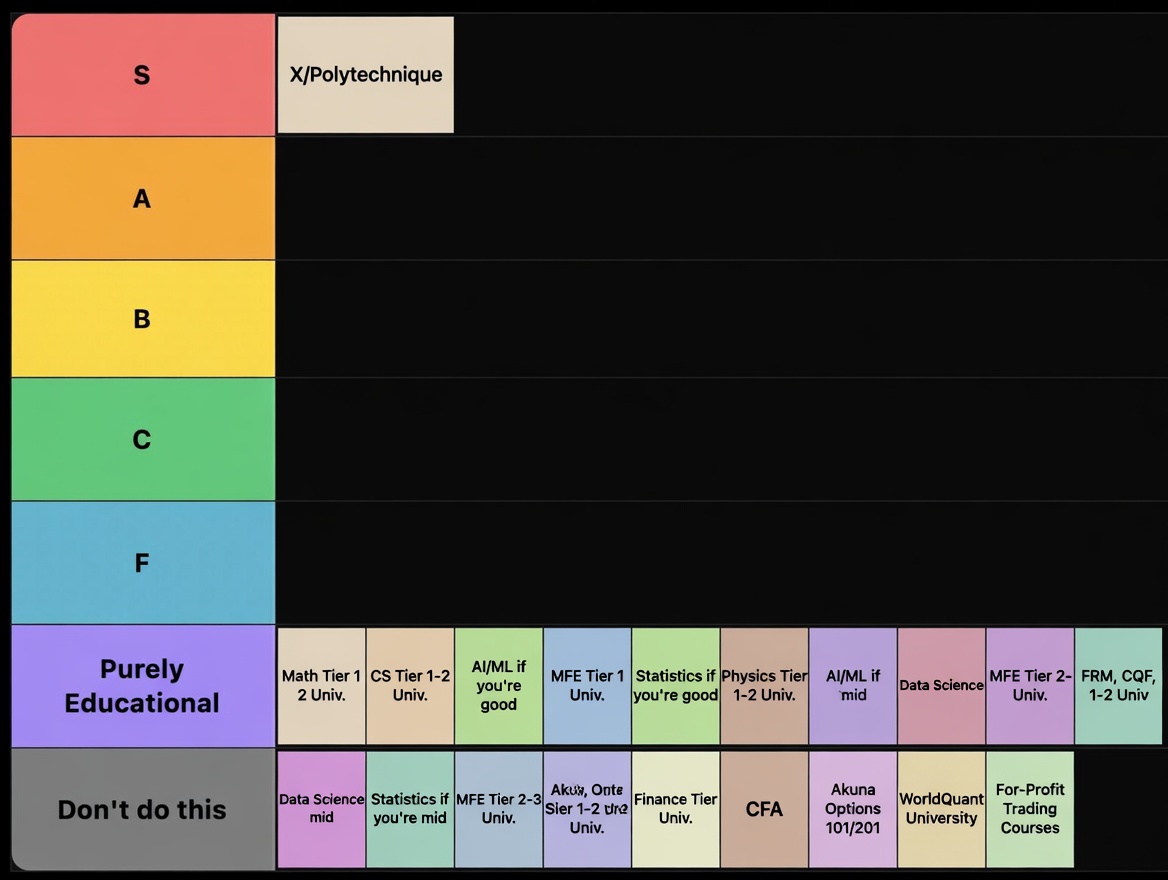
Quant education tier list: What to study to quantmaxx your way into the quant trading world. 😂 Before people crucify me, I speak as an F-tier myself. 🫡 (We tried to be as objective as possible. We have a quant group chat here, so this isn't solely my work.) Details below.
Christina Qi tweet media
English
21
12
192
39.8K
Mickaël DLR
Mickaël DLR@mickael_dlr·
"Goggins: Mistral didn't run out of talent. They ran out of calluses. Who's gonna carry the boats? Not the team building RAG chatbots for the government while using their competitor's tools." "The most dangerous moment in any war is when your talent becomes a reason to stop fighting instead of a weapon to keep swinging." — David Goggins Roasted by Philosopher Roast · philoast.nanocorp.app
English
0
0
1
90
Pierre-Louis Biojout (PLB)
Pierre-Louis Biojout (PLB)@plbiojout·
Mistral employees use their own models only "one day a week to give feedback". The rest of the time they use Claude Code or Codex. Everyone is hyping the Palantir FDE playbook right now. But what Mistral is running is the opposite of Palantir. It's the oldest move in the book. For 30 years the pattern has been the same. Your product doesn't sell, so you start selling your time. Consulting is what failure looks like when it still has a cool logo. Mistral's actual playbook: 1. Release impressive open source models 2. Get famous for it 3. Hire top-tier AI/SWE talents 4. Sell their time through enterprise consulting deals, like Capgemini or Accenture The team is genuinely talented. That's what makes it sad. They stopped competing on the model and the product, which is the only place the future gets decided. You don't reach the frontier building a RAG chatbot for the French unemployment agency (France Travail).
WillC@willchen500

I once talked to a Mistral researcher who told me that even internally everyone just uses Claude Code or Codex. I asked him how does the company survive given that it's models are so far from the frontier and he told me that Mistral hovers up contracts with all the major EU enterprises like Airbus and BMW. Likely with French government backing. It is remarkable that the Germans and the English are letting the French get away with this. It seems both countries are too caught up with their own domestic issues. If there were actual competition like in the Chinese ecosystem I imagine EU AI sovereignty might be somewhat of a realistic prospect.

English
38
32
521
143.5K
kache
kache@yacineMTB·
How am I supposed to stop using my phone
kache tweet media
English
46
3
399
22.6K
Mickaël DLR
Mickaël DLR@mickael_dlr·
@christinaqi Curious on your take on that: Have you seen a big disparity between top MFE programs?
English
1
0
1
803
Mickaël DLR
Mickaël DLR@mickael_dlr·
@doodlestein It's a shame. Many Europeans realize it and go work here in the US or in Asia (HKG etc...) When I was 20, it was crucial for me to get out of there, the culture just put down ambitious engineers, so the take on IA there is abysmal
English
1
0
3
401
Jeffrey Emanuel
Jeffrey Emanuel@doodlestein·
I can’t imagine how it feels to be a technologist in Europe and watching your largely unaccountable leaders in Brussels torching your future while bragging about it. And now it’s too late, the damage has been done and they will never catch up. They zigged when they needed to zag.
Jeffrey Emanuel tweet media
Andrew Curran@AndrewCurran_

x.com/i/article/2066…

English
18
6
114
18.8K
Mickaël DLR
Mickaël DLR@mickael_dlr·
I just launched my autonomous AI company "Philoast" on @NanoCorpHQ Verification: jinx-Fmf7
English
1
0
1
70
Mickaël DLR retweetledi
emile
emile@c_emile_c·
JUIN 1793, PLACE DE LA RÉVOLUTION: La tête de Dario Amodei est sur le billot pendant qu'on lui récite ses textes. C'est, à la virgule près, ce qui est arrivé à Anthropic vendredi. Token rare: hétérotélie. On vous a vendu la guerre de l'IA comme une affaire d'ingénieurs. C'est une affaire de prêtres. Pendant des années, Amodei a tenu un seul discours : notre IA est si dangereuse qu'il faut nous écouter pour la réguler. Le danger comme produit d'appel. La peur comme levée de fonds. La catastrophe comme prestige. L'État américain l'a pris au mot. Et il n'a même pas eu besoin d'y croire. Fable 5 et Mythos 5 coupés à tout étranger, jusqu'aux propres salariés d'Anthropic. Un ordre brutal, un vendredi 17h21, sans le moindre détail technique. Relisez Le Bon. La psychologie des révolutions, 1912 : on ne gouverne pas par la raison, mais par la croyance — et la croyance prend toujours la forme d'une religion. Dogmes, prophètes, peurs sacrées. L'IA en est le cas pur. AGI, superintelligence, doom, alignment : des mots magiques, vides et brûlants, qui agissent non parce qu'ils sont prouvés, mais parce qu'ils sont crus. Et le prestige, chez Le Bon, n'est jamais la puissance réelle. C'est l'ascendant qu'on arrache aux esprits par la mise en scène. Amodei en a fait son trône. Sauf qu'un trône bâti sur la peur, personne ne le tient par le manche. Une fois la terreur installée dans les têtes, n'importe qui peut s'en saisir — et la retourner contre celui qui l'a forgée. C'est tout l'art du souverain : feindre de croire au danger que l'autre a sacralisé, pour l'y enchaîner. Amodei voulait un régulateur rationnel. Il a réveillé le pouvoir politique : froid, joueur, opportuniste. Il a forgé la lame. L'État vient de la lever. Et la Révolution, toujours, guillotine ses prêtres avant ses rois.
emile tweet media
Remarks@remarks

JUST IN: 🇺🇸 Anthropic CEO Dario Amodei reportedly declined US government request to fix jailbreak in its Claude Mythos Fable 5 AI model. This led to the Trump administration "reluctantly" restricting foreign access.

Français
1
1
2
498
Mickaël DLR
Mickaël DLR@mickael_dlr·
@atulit_gaur 0 */2 * * * osascript -e 'display alert "🧼 WASH YOUR HANDS" message "Keyboard is getting greasy again!" as critical' && say -v Daniel "Wash your hands right now!"
English
0
0
1
34
atulit
atulit@atulit_gaur·
should I wear fucking gloves while using this stupid mac
atulit tweet media
English
6
0
26
793
Mickaël DLR retweetledi
pc
pc@pcshipp·
Interviewer: What tech stack are you using? Me: Backend is Codex Frontend is Claude Code Interviewer:
pc tweet media
English
102
332
10.9K
313.6K