MICK 🇦🇺

3.2K posts

MICK 🇦🇺 banner
MICK 🇦🇺

MICK 🇦🇺

@mickross_

https://t.co/FvfEZu5H19 Team

Katılım Şubat 2018
599 Takip Edilen1.7K Takipçiler
Sabitlenmiş Tweet
MICK 🇦🇺
MICK 🇦🇺@mickross_·
What makes @AzukiOfficial art so special in a sea of anime. My deep dive into one of the most represented PFP collections in web3. Lets start with 9736 as an example, being close to floor it provides a good base to draw from.

MICK 🇦🇺 tweet media
English
27
64
329
0
Chayenne Zhao
Chayenne Zhao@GenAI_is_real·
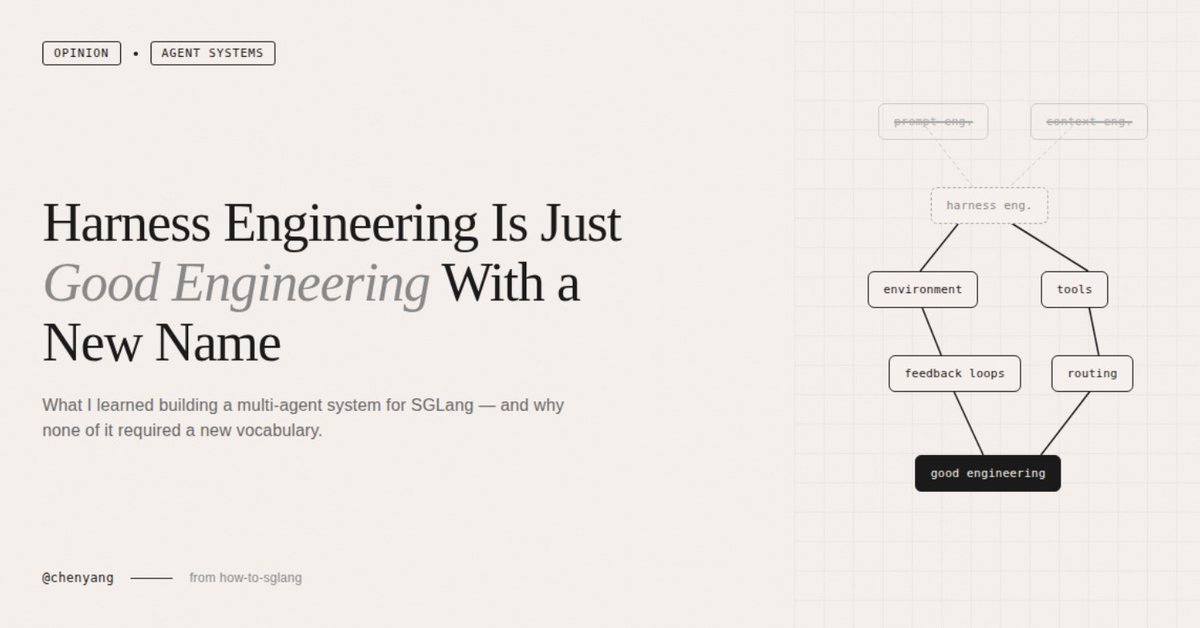
Today I read a lengthy piece on Harness Engineering — tens of thousands of words, almost certainly AI-written. My first reaction wasn't "wow, what a powerful concept." It was "do these people have any ideas beyond coining new terms for old ones?" I've always been annoyed by this pattern in the AI world — the constant reinvention of existing concepts. From prompt engineering to context engineering, now to harness engineering. Every few months someone coins a new term, writes a 10,000-word essay, sprinkles in a few big-company case studies, and the whole community starts buzzing. But if you actually look at the content, it's the same thing every time: Design the environment your model runs in — what information it receives, what tools it can use, how errors get intercepted, how memory is managed across sessions. This has existed since the day ChatGPT launched. It doesn't become a new discipline just because someone — for whatever reason — decided to give it a new name. That said, complaints aside, the research and case studies cited in the article do have value — especially since they overlap heavily with what I've been building with how-to-sglang. So let me use this as an opportunity to talk about the mistakes I've actually made. Some background first. The most common requests in the SGLang community are How-to Questions — how to deploy DeepSeek-V3 on 8 GPUs, what to do when the gateway can't reach the worker address, whether the gap between GLM-5 INT4 and official FP8 is significant. These questions span an extremely wide technical surface, and as the community grows faster and faster, we increasingly can't keep up with replies. So I started building a multi-agent system to answer them automatically. The first idea was, of course, the most naive one — build a single omniscient Agent, stuff all of SGLang's docs, code, and cookbooks into it, and let it answer everything. That didn't work. You don't need harness engineering theory to explain why — the context window isn't RAM. The more you stuff into it, the more the model's attention scatters and the worse the answers get. An Agent trying to simultaneously understand quantization, PD disaggregation, diffusion serving, and hardware compatibility ends up understanding none of them deeply. The design we eventually landed on is a multi-layered sub-domain expert architecture. SGLang's documentation already has natural functional boundaries — advanced features, platforms, supported models — with cookbooks organized by model. We turned each sub-domain into an independent expert agent, with an Expert Debating Manager responsible for receiving questions, decomposing them into sub-questions, consulting the Expert Routing Table to activate the right agents, solving in parallel, then synthesizing answers. Looking back, this design maps almost perfectly onto the patterns the harness engineering community advocates. But when I was building it, I had no idea these patterns had names. And I didn't need to. 1. Progressive disclosure — we didn't dump all documentation into any single agent. Each domain expert loads only its own domain knowledge, and the Manager decides who to activate based on the question type. My gut feeling is that this design yielded far more improvement than swapping in a stronger model ever did. You don't need to know this is called "progressive disclosure" to make this decision. You just need to have tried the "stuff everything in" approach once and watched it fail. 2. Repository as source of truth — the entire workflow lives in the how-to-sglang repo. All expert agents draw their knowledge from markdown files inside the repo, with no dependency on external documents or verbal agreements. Early on, we had the urge to write one massive sglang-maintain.md covering everything. We quickly learned that doesn't work. OpenAI's Codex team made the same mistake — they tried a single oversized AGENTS.md and watched it rot in predictable ways. You don't need to have read their blog to step on this landmine yourself. It's the classic software engineering problem of "monolithic docs always go stale," except in an agent context the consequences are worse — stale documentation doesn't just go unread, it actively misleads the agent. 3. Structured routing — the Expert Routing Table explicitly maps question types to agents. A question about GLM-5 INT4 activates both the Cookbook Domain Expert and the Quantization Domain Expert simultaneously. The Manager doesn't guess; it follows a structured index. The harness engineering crowd calls this "mechanized constraints." I call it normal engineering. I'm not saying the ideas behind harness engineering are bad. The cited research is solid, the ACI concept from SWE-agent is genuinely worth knowing, and Anthropic's dual-agent architecture (initializer agent + coding agent) is valuable reference material for anyone doing long-horizon tasks. What I find tiresome is the constant coining of new terms — packaging established engineering common sense as a new discipline, then manufacturing anxiety around "you're behind if you don't know this word." Prompt engineering, context engineering, harness engineering — they're different facets of the same thing. Next month someone will probably coin scaffold engineering or orchestration engineering, write another lengthy essay citing the same SWE-agent paper, and the community will start another cycle of amplification. What I actually learned from how-to-sglang can be stated without any new vocabulary: Information fed to agents should be minimal and precise, not maximal. Complex systems should be split into specialized sub-modules, not built as omniscient agents. All knowledge must live in the repo — verbal agreements don't exist. Routing and constraints must be structural, not left to the agent's judgment. Feedback loops should be as tight as possible — we currently use a logging system to record the full reasoning chain of every query, and we've started using Codex for LLM-as-a-judge verification, but we're still far from ideal. None of this is new. In traditional software engineering, these are called separation of concerns, single responsibility principle, docs-as-code, and shift-left constraints. We're just applying them to LLM work environments now, and some people feel that warrants a new name. I don't know how many more new terms this field will produce. But I do know that, at least today, we've never achieved a qualitative leap on how-to-sglang by swapping in a stronger model. What actually drove breakthroughs was always improvements at the environment level — more precise knowledge partitioning, better routing logic, tighter feedback loops. Whether you call it harness engineering, context engineering, or nothing at all, it's just good engineering practice. Nothing more, nothing less. There is one question I genuinely haven't figured out: if model capabilities keep scaling exponentially, will there come a day when models are strong enough to build their own environments? I had this exact confusion when observing OpenClaw — it went from 400K lines to a million in a single month, driven entirely by AI itself. Who built that project's environment? A human, or the AI? And if it was the AI, how many of the design principles we're discussing today will be completely irrelevant in two years? I don't know. But at least today, across every instance of real practice I can observe, this is still human work — and the most valuable kind.
Chayenne Zhao tweet media
English
42
141
1.2K
155.4K
MICK 🇦🇺
MICK 🇦🇺@mickross_·
How do I short the internet
English
0
0
0
18
MICK 🇦🇺
MICK 🇦🇺@mickross_·
hallucination is the most underrated rng feature of ai, it's not a bug to be prompted out of your product its a feature to be utilized for live systems.
English
0
0
0
20
MICK 🇦🇺
MICK 🇦🇺@mickross_·
It's been 5 years since the culture peak and tbh founders have learnt nothing. They still think community is built around basic engagement. It's built around friendship, organic dialogue, cultural discourse...you don't launch that, you grind it.
English
0
0
0
29
MICK 🇦🇺 retweetledi
MEME.COM
MEME.COM@meme·
We have something awesome for you! A chance to create an officially licensed piece of Doge history 🍷 Introducing the @ownthedoge X @meme tshirt contest Best creation wins, post yours below 👇
MEME.COM tweet media
English
196
1.3K
982
27.8K
MICK 🇦🇺 retweetledi
MEME.COM
MEME.COM@meme·
Everyone knows @knowyourmeme is the premier source of meme intel. But who can predict their picks? New market just dropped 🍷
MEME.COM tweet media
English
55
1.6K
890
14.3K
MICK 🇦🇺 retweetledi
MEME.COM
MEME.COM@meme·
Predict memes. Trade trends. Our meme-based predictions are live. You stake Memescore on outcomes. If you’re right, you win more Memescore. If you’re wrong, skill issue. Sign up now to get 2x starter bonus!
MEME.COM tweet media
English
129
2.8K
2K
49.6K
Voyager
Voyager@voyager_cx·
Voyager Token Symbol: V Chains: Ethereum | ØG Supply: 1B V is the utility token powering the Voyager ecosystem. Used to reduce fees, unlock premium access, and support staking, lending, and rewards. Holders benefit from discounted trading and lending costs, yield tied to platform activity, and access to advanced tools designed for active traders and institutions. Demand for V is driven by real usage. Trading fees and RWA activity support token buybacks and burns, while staking and lock ups reduce circulating supply. As platform activity increases, token utility scales alongside it. The token is live on ØG mainnet via Chainlink CCIP. V is locked on Ethereum and minted one-for-one as wrapped V on ØG. Transfers leverage CCIP’s Risk Management Network and Token Pool Rate Limits, with contract controls governed by Safe multisig. This architecture preserves Ethereum’s security and liquidity while enabling ØG’s instant finality and ultra-low transaction fees. V appeara natively in wallets on ØG, transfers run at ØG speeds, and the user experience remains seamless across chains. The final phase of the V Token Presale is currently underway. To participate, head over to our website and sign up now: voyager.cx
Voyager tweet media
English
491
170
527
5K
MICK 🇦🇺 retweetledi
MEME.COM
MEME.COM@meme·
What is dead may never die. Introducing MEME CODED. Post or tag @meme + $TICKER(s) on any great meme. If we reply, the meme gets coded on MEME.COM, forever. Immortalize memes & earn memescore 🍷
English
81
637
493
22.6K
MICK 🇦🇺
MICK 🇦🇺@mickross_·
ready for day 1 🫡
English
0
0
0
29
MICK 🇦🇺
MICK 🇦🇺@mickross_·
@shivst3r Was a pleasure sir, the true value of social characters is just starting to bubble to the surface and it's going to be a lot of fun being part of that tide.
English
0
0
1
11
Shiv
Shiv@shivst3r·
> Had the pleasure of catching up with @mickross_ late last year, excited to see how they’re bringing memes back in full force. They’re clearly locked in. Believe in something.
English
1
0
15
634