mintarion

26 posts

mintarion banner
mintarion

mintarion

@mintarion

Mintarion Labs {one feed infinite alpha}

Katılım Aralık 2025
20 Takip Edilen7 Takipçiler
Sabitlenmiş Tweet
mintarion
mintarion@mintarion·
10/10: Synthetic Death How the market deflated without sellers, and how Tier-1 players got their faces washed in #SBLC. A post-mortem on recursive collateral, disabled oracles, bank letters of credit, collateral haircuts, and the resale of your stops at a discount. Chapter 1. The Calm Before the Recursion Pops October 10th. Open interest (OI) at all-time highs. Everyone’s predicting a sideways chop. Participants are stuffing the order books with partially covered straddles. Euphoria. #Ethena Labs with its synthetic dollar #USDe has reached a market cap of $14.8 billion, promising up to 27% APY - the “internet bond” of a new generation. The key vulnerability everyone chose to ignore: FULL VERSION - mintarion.substack.com/p/1010-synthet… TELEGRAM - t.me/mintarionlabs #SyntheticDeath #GreySwan #CryptoLiquidation #SBLC #USDe #CrossInventory #ExitLiquidity #REKT
mintarion tweet media
English
0
0
1
20
mintarion
mintarion@mintarion·
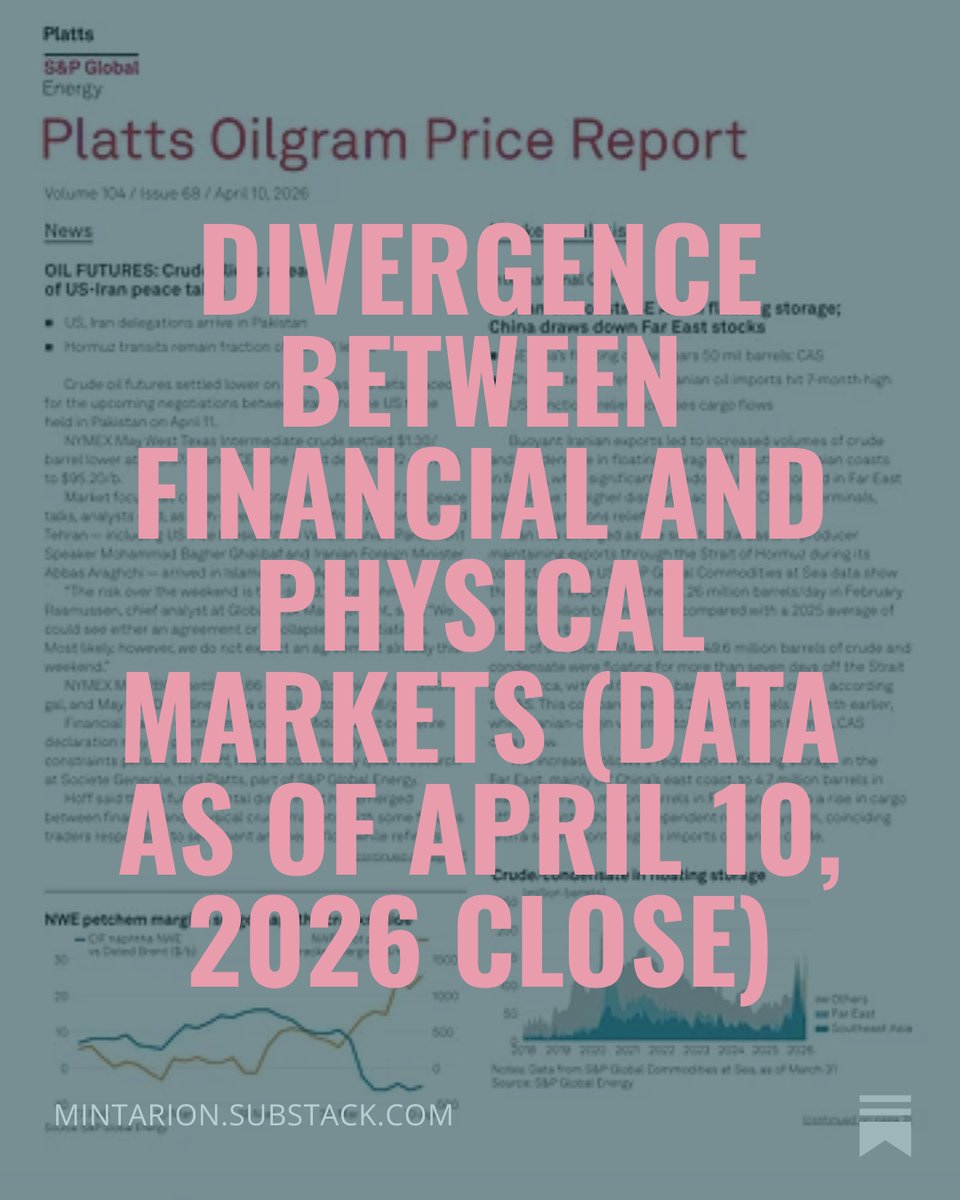
Divergence Between Financial and Physical Markets (Data as of April 10, 2026 close) April 12, 2026 | Reading time: ~25-30 minutes. For counterparties: ARS Trading Company-AZ LLC / British Petroleum Exploration (Services) Limited / UfaOil LLC / Nord Axis LTD / Bellatrix Energy Limited LTD The energy market continues to operate in a state of pronounced schizophrenia. The temporary ceasefire between the US and Iran announced on April 7 triggered a sharp drop in oil futures (ICE Brent M1 down 0.72 cents to $95.20 per barrel), as financial traders focused on macroeconomic news and technical analysis began unwinding long positions. However, the physical market, which deals in actual barrels and tanker rates, ignored this decline. The reason is that the “paper” truce did not lead to a resumption of shipping through the Strait of Hormuz. As Ben Hoff of Societe Generale noted, there is a fundamental difference between the movement of dollars and the movement of barrels. Physical traders and refineries face the need to secure supplies “here and now,” and it is their actions during the Market on Close (MOC) window that reveal the true picture of the deficit, hidden behind the volatility of futures curves. FULL VERSION - mintarion.substack.com/p/divergence-b… TELEGRAM - t.me/mintarionlabs #OIL #PLATTS #LOGISTIC #VITOL #TRAFIGURA #PERSIAN_GULF #DIESEL
mintarion tweet media
English
0
0
1
13
mintarion
mintarion@mintarion·
THE GREAT MIGRATION A country with a beautiful view but a dying population and rising taxes is a trap, not a safe haven. Where to move and where to park capital in 2026–2040. mintarion.substack.com/p/the-great-mi…
mintarion tweet media
English
0
1
2
22
mintarion
mintarion@mintarion·
BIG BEAUTIFUL ARTICLE drops April 15th - SUBSTACK subscribers only. Don't sleep on it. @mintarion" target="_blank" rel="nofollow noopener">substack.com/@mintarion
mintarion tweet media
English
0
1
2
21
mintarion
mintarion@mintarion·
FLASH ALERT | FUNDING EXTREME $BTC perpetual funding rate hit 0.5556% - the highest level since May 2021. At current mark price of $71,097, this represents an annualized cost of over 600% for long positions. This funding extreme signals dangerously crowded longs. The last time we saw funding above 0.5% was during the euphoric peak before the 65% correction in summer 2021. Current positioning is unsustainable at these levels. Immediate risk: Cascading long liquidations if BTC drops below key support. Overleveraged positions will be forced to close, potentially triggering violent downside moves within 24-48 hours. WATCH: Support at $69,500 - break below could trigger liquidation cascade.
English
0
0
4
67
mintarion
mintarion@mintarion·
$BTC Daily | March 24, 2026 $BTC reclaims $70K with +2.5% bounce to $70,318 after touching $67,688 low. Still bleeding -5.3% over 7 days despite today's recovery. 24h range: $67,688 - $71,646 Volume: $49.5B | Dominance: 56.6% DXY flat at 99.37, US10Y yields cooling -1.3% to 4.33%. SPX grinding +1.1% to 6,581 while VIX drops -2.3% to 26.15. Risk-on creeping back as yields ease and equity vol compresses, but crypto still digesting last week's damage. Levels to watch: Resistance: $71,650 (24h high), $72K psychological Support: $70K reclaim, $67,688 today's low
mintarion tweet media
English
0
0
1
30
mintarion
mintarion@mintarion·
Mintarion on Substack. We are officially launching EXCLUSIVE articles only for our subscribers on @Substack. Every single week, you'll receive: ✅ A curated Weekly Digest ✅ In-depth exclusive articles from the Mintarion Labs team ✅ Behind-the-scenes thoughts & market updates Join the community and get the full experience: @mintarion" target="_blank" rel="nofollow noopener">substack.com/@mintarion
mintarion tweet media
English
0
1
2
53
mintarion
mintarion@mintarion·
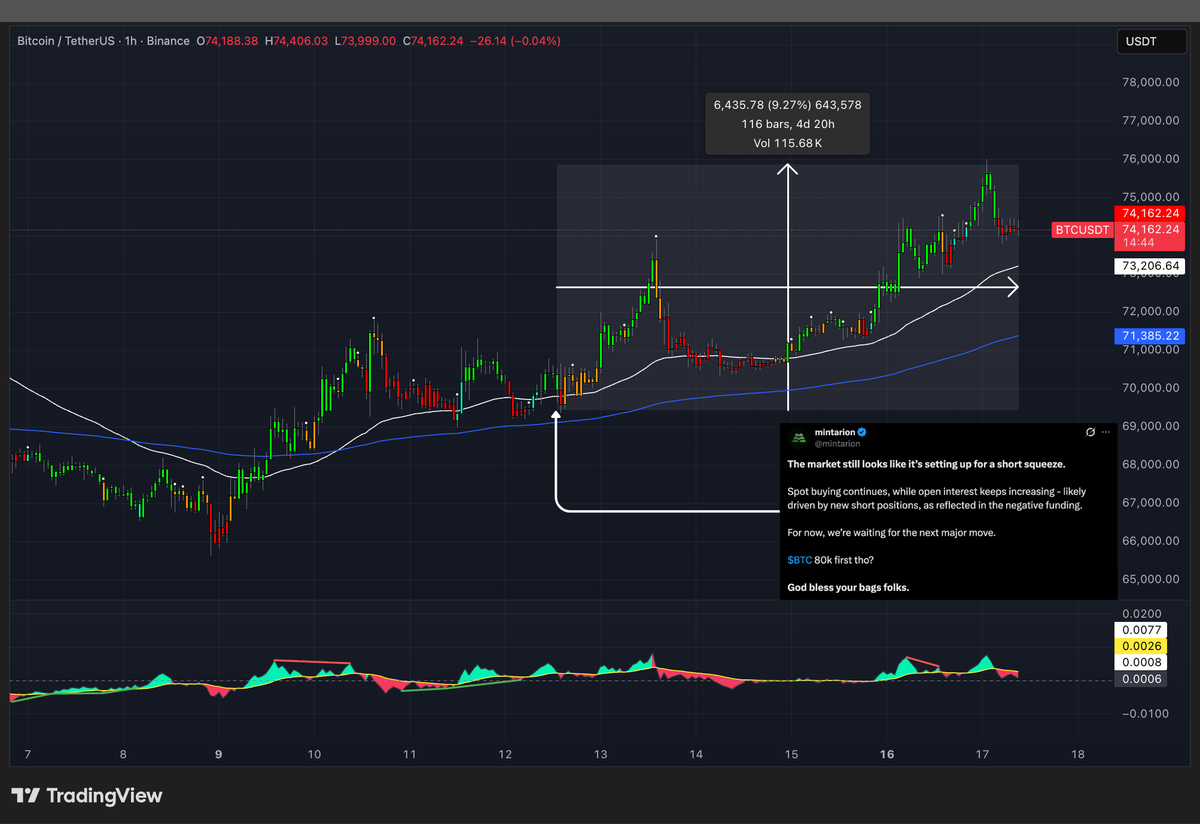
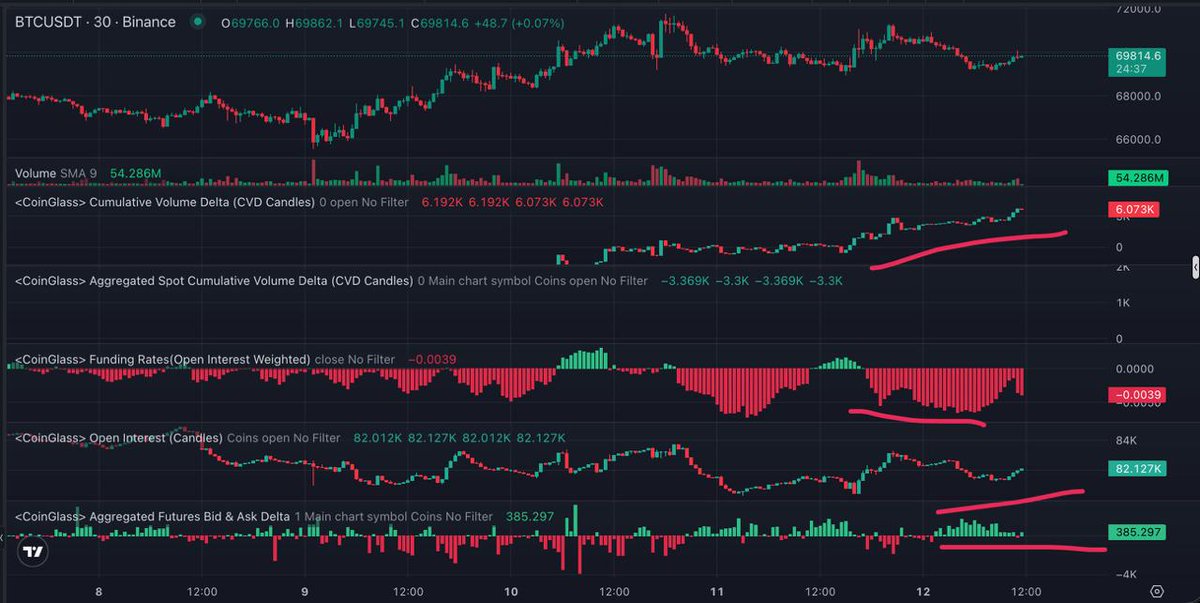
The market still looks like it’s setting up for a short squeeze. Spot buying continues, while open interest keeps increasing - likely driven by new short positions, as reflected in the negative funding. For now, we’re waiting for the next major move. $BTC 80k first tho? God bless your bags folks.
mintarion tweet media
mintarion@mintarion

Caution to Short-Sellers: The "Saylor Flywheel" is in Motion The current market setup suggests that shorting $BTC - especially with high leverage - is a dangerous game right now. We are seeing a rare alignment of technical indicators and a specific corporate "infinite bid" mechanism that could squeeze bears throughout the week. The Thesis: Why the Tide is Turning Bullish 1) Coinbase Premium: Domestic demand in the US is surging, with prices on Coinbase trading higher than global exchanges. 2) Negative Funding: The BTC OI-Weighted Funding Rate is currently -0.0020%. This indicates a crowded short trade; bears are paying bulls to keep their positions open, creating prime conditions for a short squeeze. 3) STRC Volume Explosion: $STRC saw >$100M in volume within the first hour of trading, signaling massive institutional interest in Michael Saylor’s latest financial vehicle. 4) CRCL Performance: Up 10% today (+120% from the bottom), showing a complete decoupling from traditional commodities and standard risk assets. Mechanics of the $STRC / $MSTR Flywheel The synergy between $STRC and MicroStrategy ($MSTR) creates a massive, automated buying force for Bitcoin. Here is how the math breaks down: STRC Issuance: If $STRC trades above $100, Saylor is obligated to issue additional shares. The cash (USD) from these sales is immediately converted into BTC. MSTR ATM Sales: To maintain a stable leverage ratio, Saylor sells $MSTR shares via an At-The-Market (ATM) facility. Historically, this volume is roughly double the $STRC placement. The Multiplier: For every $100M in $STRC trading volume, approximately $40M (40% of volume) is captured for BTC purchases. When you add the $MSTR ATM sales (approx. $80M), every $100M in STRC volume translates to roughly $120M in BTC buy pressure. The "March 15" Dividend Anchor A critical factor for this week is the March 15 dividend payment date. Holders of $STRC have a strong financial incentive to hold their positions until this date to capture the yield. This effectively "locks" the price floor for the week, preventing a massive sell-off and allowing the BTC accumulation machine to run at full speed. Weekly Outlook: A $1.5 Billion Bid? If we maintain current momentum, the numbers are staggering: Daily Volume Projection: $250M Weekly Volume (5 days): $1.25B Total BTC Buy Pressure: ~$1.5B Between the negative funding rates and @saylor`s systematic buying, the path of least resistance for $BTC appears to be up. Be extremely careful with leverage; the "dividend lock" until March 15 makes a sudden dump unlikely. @saylor @Strategy

English
0
0
2
91
mintarion
mintarion@mintarion·
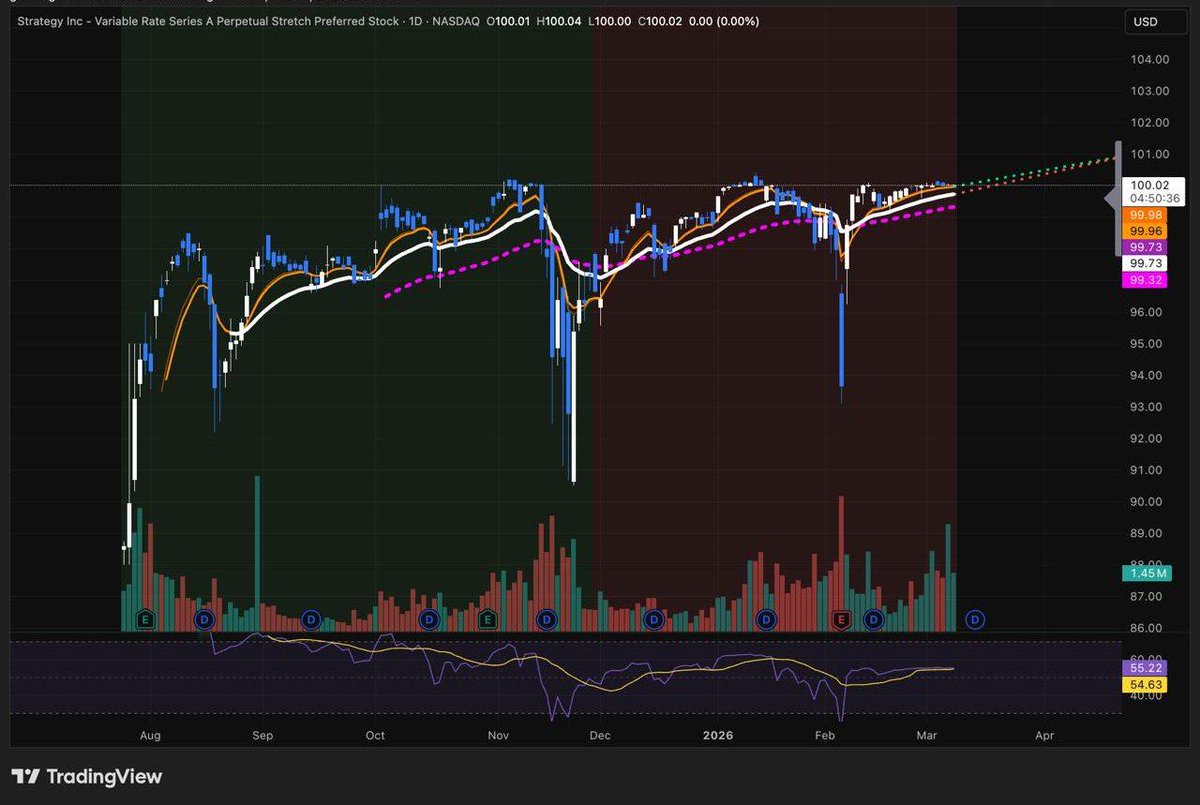
Caution to Short-Sellers: The "Saylor Flywheel" is in Motion The current market setup suggests that shorting $BTC - especially with high leverage - is a dangerous game right now. We are seeing a rare alignment of technical indicators and a specific corporate "infinite bid" mechanism that could squeeze bears throughout the week. The Thesis: Why the Tide is Turning Bullish 1) Coinbase Premium: Domestic demand in the US is surging, with prices on Coinbase trading higher than global exchanges. 2) Negative Funding: The BTC OI-Weighted Funding Rate is currently -0.0020%. This indicates a crowded short trade; bears are paying bulls to keep their positions open, creating prime conditions for a short squeeze. 3) STRC Volume Explosion: $STRC saw >$100M in volume within the first hour of trading, signaling massive institutional interest in Michael Saylor’s latest financial vehicle. 4) CRCL Performance: Up 10% today (+120% from the bottom), showing a complete decoupling from traditional commodities and standard risk assets. Mechanics of the $STRC / $MSTR Flywheel The synergy between $STRC and MicroStrategy ($MSTR) creates a massive, automated buying force for Bitcoin. Here is how the math breaks down: STRC Issuance: If $STRC trades above $100, Saylor is obligated to issue additional shares. The cash (USD) from these sales is immediately converted into BTC. MSTR ATM Sales: To maintain a stable leverage ratio, Saylor sells $MSTR shares via an At-The-Market (ATM) facility. Historically, this volume is roughly double the $STRC placement. The Multiplier: For every $100M in $STRC trading volume, approximately $40M (40% of volume) is captured for BTC purchases. When you add the $MSTR ATM sales (approx. $80M), every $100M in STRC volume translates to roughly $120M in BTC buy pressure. The "March 15" Dividend Anchor A critical factor for this week is the March 15 dividend payment date. Holders of $STRC have a strong financial incentive to hold their positions until this date to capture the yield. This effectively "locks" the price floor for the week, preventing a massive sell-off and allowing the BTC accumulation machine to run at full speed. Weekly Outlook: A $1.5 Billion Bid? If we maintain current momentum, the numbers are staggering: Daily Volume Projection: $250M Weekly Volume (5 days): $1.25B Total BTC Buy Pressure: ~$1.5B Between the negative funding rates and @saylor`s systematic buying, the path of least resistance for $BTC appears to be up. Be extremely careful with leverage; the "dividend lock" until March 15 makes a sudden dump unlikely. @saylor @Strategy

mintarion tweet media
English
0
0
2
72
mintarion
mintarion@mintarion·
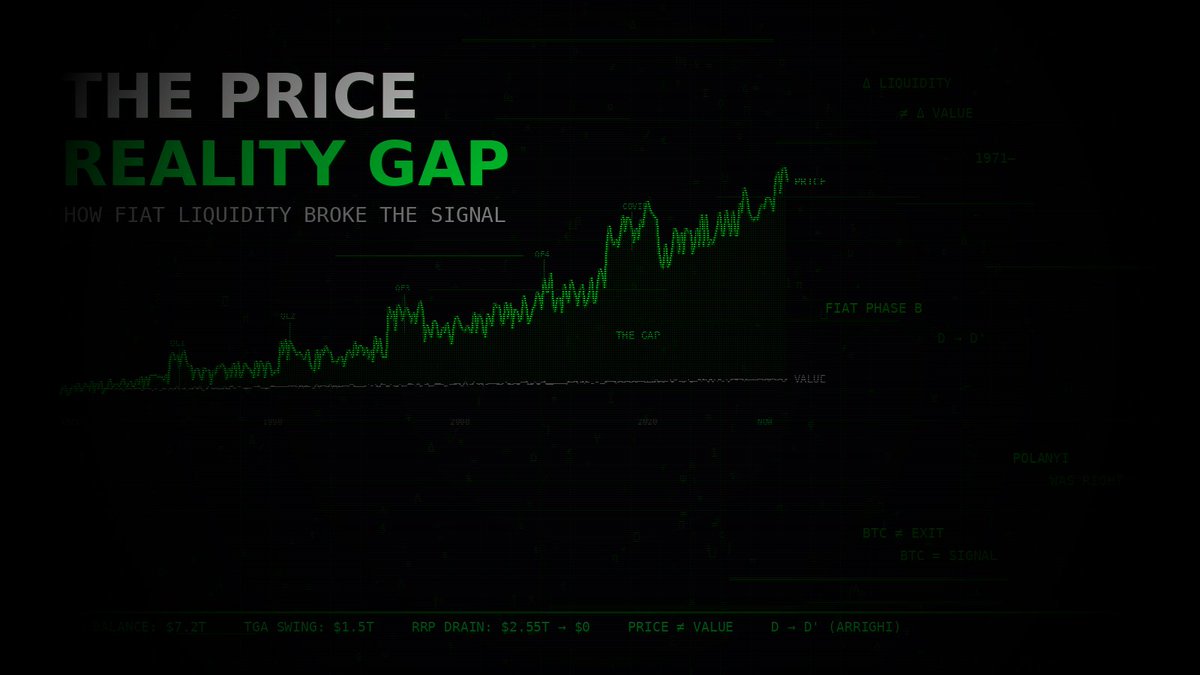
The Price-Reality Gap - How Fiat Liquidity Broke the Signal Prices don't mean what you think they mean. Not anymore. There's a structural fracture between what things cost and what things are worth, and it's not a bug - it's the defining feature of late-stage fiat capitalism running on financial expansion fumes. Every asset you're looking at right now is priced off a liquidity function, not a value function. And if you don't understand the plumbing underneath, you're trading someone else's game. This isn't a doomer take. This is mechanics. The machinery of price discovery has been disassembled, piece by piece, over the past fifty years. What's left is a shell that looks like a market but operates like a central bank derivative. Blockchain isn't a tech toy in this context. It's the first serious attempt to rebuild value verification through cryptographic proof instead of sovereign trust. Whether it succeeds is an open question. But the fact that it exists tells you everything about how broken the current system is. The real question isn't "when do prices return to reality." The real question is which reality wins - the one maintained by government balance sheets, or the one maintained by immutable distributed ledgers. I. The Formula and Its Corruption Marx gave us the basic circuit: D → C → D. Money into commodity into more money. That's capitalism in its productive phase - capital deployed into trade, manufacturing, real assets, real output. Giovanni Arrighi, in The Long Twentieth Century, showed something more disturbing. Systemic accumulation cycles don't stay in production forever. They pass through two phases: Phase A - Material Expansion (D → C → D'): Capital goes into production, trade, tangible assets. This is where wealth actually gets created. Phase B - Financial Expansion (D → D'): Capital skips the commodity entirely. Money breeds money through financial operations. No factory required. Arrighi put it plainly: > "Financial expansions are symptomatic of a situation in which the investment of money in the expansion of trade and production no longer serves the purpose of increasing the cash flow to the capitalist stratum as effectively as pure financial deals can. In such a situation, capital invested in trade and production tends to revert to its money form." We are deep in Phase B. Money has detached from commodities. Price no longer tracks value — it tracks liquidity. Every QE cycle, every TGA drain, every RRP facility move reinforces this. You're not pricing earnings. You're pricing the next injection. II. Fictitious Commodities Karl Polanyi saw this coming in 1944. In The Great Transformation, he introduced a concept that should be tattooed on every macro trader's forearm: fictitious commodities. Labor, land, and money - these aren't produced for sale. They're not commodities by any natural definition. Polanyi was explicit: > "Labor, land, and money are obviously not commodities... the commodity description of labor, land, and money is entirely fictitious." His warning: subject these fictitious commodities to the whims of a self-regulating market, and you guarantee social catastrophe. Not risk it. Guarantee it. Here's where we are now: Money became fully fictitious after 1971 when the gold window closed. Central banks manufacture liquidity through QE at will. The price of money itself - the interest rate - is a politically administered variable, not a market-discovered one. The result is straightforward: price has stopped functioning as a signal for real value. It's a reflection of policy decisions made in rooms you're not invited to. III. Volatility as Destruction Friedrich List nailed a point in 1841 that modern macro still hasn't internalized. Writing in The National System of Political Economy: > "Low or high prices are a matter of indifference only when they remain for a long period at the same level. But if fluctuations in prices are frequent and severe, they produce disturbance in private and public economy. He who purchased raw material when prices were high cannot, when selling his manufactured goods at low prices, realize the amount of coin which he paid for his raw material." It's not the level of prices that destroys an economy. It's the volatility. The unpredictability. The whiplash. Look at the current landscape: - Fed balance sheet: peaked at $8.9T (2022), drained to ~$7.2T - that's not organic. That's a policy lever. - Treasury General Account (TGA): swings from $0.3T to $1.8T - each swing is a liquidity shock that moves markets. - Reverse Repo Facility (RRP): from $2.55T to near-zero in 18 months - the largest silent liquidity drain in history. Prices aren't moving on supply and demand shifts. They're moving on Fed and Treasury plumbing operations. List was writing about 19th-century grain markets, but the diagnosis applies perfectly to 21st-century everything. IV. The Market That Isn't John Kenneth Galbraith described three ways corporations protect themselves from market uncertainty in The New Industrial State: 1. Market control - monopolization, oligopoly 2. Market suspension - long-term contracts, government orders 3. Market elimination - vertical integration Galbraith's observation: > "The market motivates the firm in only one way - by offering greater pecuniary reward. If the firm cannot influence prices, it is deprived of any choice in setting the goals of its activity." In the current fiat regime, the state has eliminated the money market itself. Central bank monopoly on issuance and rate manipulation means there is no free market for money. The most important price in the entire economy - the cost of capital - is set by committee. This isn't controversial. It's just true. And everything downstream from that administered price is contaminated. V. Liquidity as Cocaine - The QE Chronology Here's the empirical record. Every cycle follows the same pattern: inject liquidity, inflate assets, withdraw liquidity, watch things crack. QE1 (2008–2010): Fed balance sheet $0.9T → $2.1T S&P 500 rallied 50% while corporate earnings were still in freefall. This was the first clean demonstration that asset prices had decoupled from fundamentals. Price became a function of Fed intervention, not business performance. QE2 (2010–2011): +$600B Commodity spike — oil touched $147/barrel on collapsing demand. This is the textbook case. Price was not a demand signal. Price was a liquidity signal. Money needed somewhere to go, and commodities caught the flow. QE3 (2012–2014): +$1.7T FANG stocks began their parabolic ascent. Europe went to negative interest rates — the price of money across time went below zero. Think about that. The market was saying your dollar tomorrow is worth more than your dollar today. That's not economics. That's policy distortion. QE4 "Not-QE" (2019): Repo Crisis The Fed denied it was doing QE while the balance sheet grew $400B in four months. Risk assets jumped 15% with zero change in economic fundamentals. The market didn't even bother pretending to care about earnings. It was pure flow-chasing. QE5 COVID (2020–2022): +$4.8T in 18 months The largest liquidity explosion in human history. Everything went up simultaneously - stocks, bonds, real estate, crypto ( $BTC / $ETH / $SOL / $BNB / $ADA / $XRP ) , #NFTs, #SPACs. Correlations went to 1. The entire market became a single bet on liquidity, dressed up in different ticker symbols. QT (2022–2024): -$1.5T 60/40 portfolio had its worst year since 1932. DXY ran from 90 to 114 in twelve months. Regional banks collapsed - SVB, Signature, First Republic. The system that was built on cheap liquidity couldn't handle the withdrawal. VI. Treasury Plumbing - The Shadow Monetary Policy Most people have never heard of the Treasury General Account. It's the US government's checking account at the Fed, and it functions as a shadow monetary policy instrument. TGA goes up (government hoards cash) → sucks liquidity out of the system → prices drop. TGA goes down (government spends cash) → injects liquidity into the system → prices rise. The manipulation cycle, 2020–2024: - March 2020: TGA at $0.4T - July 2020: TGA at $1.8T - $1.4T drained from markets - December 2020: TGA at $0.3T - $1.5T dumped back in before the political cycle turned - 2021–2024: constant oscillation = constant price distortion The Reverse Repo Facility tells the same story from a different angle: - April 2021: $0 - December 2022: $2.55T (peak) - money market funds parked excess liquidity they couldn't deploy - Late 2024: $0.2T - reserves drained, prepping the system for the next liquidity event The conclusion is unavoidable: asset prices are driven by technical plumbing operations at Treasury and the Fed, not by earnings, not by supply and demand, not by any fundamental economic logic. VII. From Gold to Trust Games The timeline of money's disconnection from reality: 1914: WWI begins. Europe suspends the gold standard. The fiat experiment starts. 1944: Bretton Woods. USD pegged to gold at $35/oz, all other currencies pegged to USD. A semi-fiat system - dollar backed by gold, but gold doesn't circulate. 1971: Nixon Shock. Gold convertibility terminated. Money becomes pure fiat - backed by nothing except the state's capacity for violence and taxation. 1971–1981: Great Inflation. CPI hits 13.5% annual peak in 1980. Gold runs from $35 to $850 - a 24x move in a decade. The market was screaming: fiat is unstable. 1979–1982: Volcker Shock. Fed funds rate to 20%. Marketed as "restoring confidence." But confidence in what, exactly? In the state's ability to manufacture artificial scarcity through punishing rates. 1982–2008: The Great Moderation. The illusion of stability. Consumer price inflation stayed low, but asset price inflation went parabolic. The trick: liquidity flowed into asset prices instead of CPI. Governments measured success by the metric they could control, not the one that mattered. 2008–present: The QE Era. Combined central bank balance sheets went from ~$5T to $30T+. Asset prices are determined not by cash flows but by anticipated liquidity. "Don't fight the Fed" stopped being a trading aphorism and became the only pricing rule that matters. VIII. Cognitive Failures Kahneman and Thaler showed that humans are systematically terrible at evaluating value. Anchoring bias: A stock at $100 feels "fair" simply because it was $100 yesterday. People don't notice that the purchasing power of that $100 eroded 30% over the last decade. The nominal anchor blinds them to real depreciation. Sunk cost fallacy: Gary Marcus, in *Kluge*, pointed out that even presidents persist with failed policies when everyone can see they're not working. The same applies to monetary policy. Nobody in charge will admit the framework is broken because they've invested decades defending it. Framing effect: "3% inflation" sounds manageable. "Your savings lose 97% of their value over 30 years" sounds catastrophic. These are mathematically identical statements. The framing determines the public response. This is how the gap between price and reality stays hidden. Not through conspiracy - through the systematic cognitive weaknesses that prevent populations from seeing compound erosion in real time. IX. When Prices Broke Before Every time a state loses monetary discipline, the sequence is the same: prices disconnect from reality, the gap widens until it becomes unsustainable, and the system either resets to hard money or collapses into barter. Roman Empire (200–300 AD) The denarius went from 95% silver to 5% silver over a century. Prices rose roughly 1,000x. Diocletian attempted price controls in 301 AD - they failed instantly. The monetary economy collapsed. Trade reverted to barter across large parts of the empire. Weimar Germany (1921–1923) The reichsmark went from 4.2 per dollar to 4.2 trillion per dollar. Prices doubled every 3.7 days. The critical gap: wages lagged prices, and the working class was destroyed in real terms. The solution was the Rentenmark — a currency backed by land. Backing by a real asset restored trust that pure fiat had obliterated. Soviet Union (1980–1991) Official inflation: 2% per year. Real inflation (black market): 20-50% per year. Prices in state stores were fictional - the shelves were empty. Real prices existed only on the black market. When the system finally broke in 1991, the overnight transition to market prices - shock therapy - revealed the true scale of distortion. Venezuela (2016–2020) The bolivar's official exchange rate diverged from the black market rate by 100x. Hyperinflation exceeded 1,000,000% over three years. The population dollarized de facto - shifting to USD and BTC. The state lost monetary sovereignty not through policy, but through the population's refusal to participate in the fiction. The pattern repeats without exception: lose emission discipline → prices decouple from reality → system collapses → society migrates to hard money (gold, commodity-backed instruments) or falls back to barter. X. Where This Ends Arrighi saw the endgame clearly: > "The emergence of a new developmental path with greater potential for growth than the old one is an integral part of the growing turbulence experienced by the world economy in phases of financial expansion." We're in the turbulence. The old path - fiat liquidity games managed by central banks - is showing stress fractures in every direction. Yield curve inversions, regional bank failures, sovereign debt loads that can never be repaid at real rates, asset bubbles that require permanent intervention to sustain. The new path is still forming. Blockchain-based verification. Cryptographically enforced scarcity. Distributed consensus replacing centralized trust. Whether $BTC , or some successor, becomes the settlement layer for this transition is a tactical question. The strategic reality is that the current system's price signals are broken, everyone who matters knows it, and the search for alternatives is already underway. The gap between price and reality isn't closing. It's the defining feature of the era. Trade accordingly. God bless your bags folks
mintarion tweet media
English
0
1
2
46
mintarion
mintarion@mintarion·
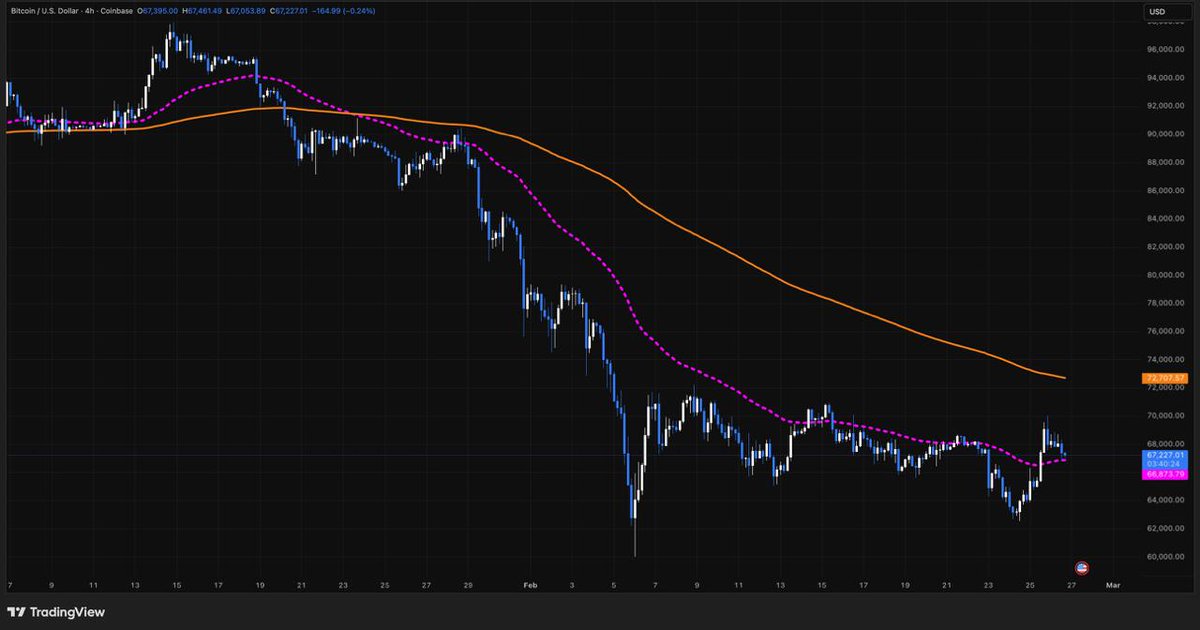
DAILY $BTC BTC Price: $67,371 (−0.91%) 24h range: $66,786 – $68,867 1. MACRO Fed Funds Rate: 3.75% (unchanged). @CMEGroup FedWatch shows 96% probability of a hold at the March 18 FOMC meeting; only 4% odds of a 25bps cut. Rate cut path: April hold probability 82.1%; June cut probability ~47–54%, down from 67.5% one week ago. Wall Street consensus: 2.1 cuts in 2026 (range: 0–4), year-end rate ~3.25%. DXY: 97.74 (+0.04%), trading in a narrow 97.43–97.84 range — broadly flat and trending lower YoY from ~106. US 10Y Treasury Yield: 4.02% (−3bps today), down from 4.51% a year ago . US CPI (Jan, final): Headline 1.7% YoY (in-line), Core 2.2% YoY (in-line). Core PCE (Q4): 3.0% YoY, still above the Fed's 2% target (Rio Times, Washington Trust). US PPI (Jan): Released today. Headline PPI YoY 3.0% (consensus 2.6%, prior 2.9%); Core PPI ex-food/energy/trade YoY 3.5% (prior 3.4%) — hotter than expected. Key events: Next FOMC March 17–18; Powell's term ends May 15; SEC crypto ETF decisions due March 27 (91 applications across 24 tokens); CLARITY Act expected by April 3. 2. NEWS & CATALYSTS Spot BTC ETF inflows surge: +$506.5M on Feb 25 — the largest daily inflow since Feb 2, breaking 5 consecutive weeks of outflows totaling $3.8B. BlackRock IBIT led with $297.4M; Grayscale added $121.8M; Bitwise $39.4M; Fidelity $30.1M. Weekly cumulative inflows now $560.4M. ETF trading volume rebounded to $4.3B Citigroup announces BTC integration: The $2.5T bank plans to "make BTC bankable" for institutional clients in 2026 — custody, collateral management, and reporting alongside traditional assets. This follows JPMorgan and BNY Mellon's existing crypto capabilities. Jane Street controversy / market structure: Quant firm Jane Street faces backlash over alleged BTC price manipulation (linked to a Terraform Labs lawsuit). Sentiment around potential cessation of manipulation contributed to the rebound. @Bloomberg notes Bitcoin's "plumbing holds up fine" despite the selloff, unlike 2022 3. GLOBAL RISK SENTIMENT VIX: 19.38 (+8.09%), spiked intraday to 20.51 — elevated risk aversion. S&P 500: 6,892.51 (−0.77%);  Nasdaq Composite: 22,809.53 (−1.48%). Both indices trading negatively; Nasdaq underperforming on tech weakness. Gold: $5,190.90 (−0.68%), pulling back from recent all-time highs above $5,500. Still up $2,121 YoY from ~$2,940 Crypto Fear & Greed Index: 10–16 (Extreme Fear). @Coinglass reads 10; @CoinMarketCap reads 16, rebounding from a year-to-date low of 5. The 7-day average is 8; the 30-day average is 11 — worst readings in nearly 5 years. Geopolitical risk: Analysts flag potential US military action against Iran as a tail risk; Trump tariff program was struck down by the Supreme Court, removing tariff revenue and widening fiscal deficits. 4. ON-CHAIN METRICS Exchange net flows: Net outflow of ~18,000 BTC over the past week — a bullish signal indicating accumulation over selling. Active addresses: ~950,000 (7-day average), in a 6-month declining trend. Daily transactions ~472,485. Whale accumulation: Wallets holding 1,000+ BTC accumulated ~53,000 BTC ($4B) in the past week — the most aggressive buying since November. Over 30 days, whales absorbed ~270,000 BTC (~$23B), counteracting retail outflows Miner reserves: Public miners hold 115,335 BTC (~$7.4B), down 4.44% MoM — first sustained contraction as miners sold 5,359 BTC ($348M) under hash price stress. Mining difficulty at 144.40T (+14.73% on Feb 19); next adjustment March 5 (+1.35% expected). Hash rate: ~1.06 ZH/s (near ATH). Hashprice: ~$28.73/PH/day forward, signaling sustained stress. MVRV Z-Score: −2.28 (MVRV ratio 1.25x) — anomalously low, below the 2018 (−1.6) and 2022 (−1.4) bear market bottoms. Local minimum was −3.38 on Feb 5. This is structurally amplified by the ETF era's elevated realized cap. NUPL: 0.197 ("Hope" zone) — not yet in capitulation territory (which requires NUPL < 0). ~65% of addresses remain in profit. The two metrics diverge, suggesting structural pressure without full capitulation. Funding rates: BTC perpetual funding fell to 2-week lows as spot briefly hit $62K. Aggregate long/short ratio across Binance, OKX, Bybit: 49.41% long / 50.59% short — nearly balanced with a slight bearish tilt. Funding rates remain near neutral. 5. LIQUIDITY FLOWS Global M2 money supply: ~$100.02T as of Feb 24 (US + Eurozone + China + Japan). US M2 is making new all-time highs with deposits at $18.76T as of Feb 18. US M2 alone ~$22T Stablecoin market cap: Total sector ~$307B (−$4B from peak). USDT: $183.5B (−$1.5B in Feb, −0.8% MoM, second consecutive monthly decline — first since 2022). USDC: ~$75.3B (growing, absorbing rotation from USDT). Analysts flag this as a key liquidity tightening signal. Open interest (BTC futures): CME BTC futures OI down ~47% from peak — similar to the ~45% decline in the 2022 cycle. Broader BTC futures OI dropped from ~$61B to ~$49B in one week (−20%). March CME options show a 3:1 call-to-put ratio ($660M calls vs $240M puts), suggesting some positioning for a Q1 recovery. Liquidations (24h): $585M total — $474M shorts vs $111M longs. This is the first time in ~1.5 months that short liquidations exceeded long liquidations, driven by BTC's bounce from $60K to $69K. Largest single liquidation: $10.4M BTC-USD on Hyperliquid. Capital rotation signals: ETF inflows returning (+$507M in one day); USDT-to-USDC rotation suggests capital reallocation, not outright exit. However, 30-day NUPL at 0.33 breaching the "fear" threshold and CME basis compression indicate structural demand remains weak.
mintarion tweet media
English
0
1
2
77
BOOM X
BOOM X@CryptoBoomNews·
Bitcoin price action these days
English
22
55
551
68.5K
mintarion
mintarion@mintarion·
Decoupling Statistics: Financialization vs. Reality The period from 2020 to 2030 will go down in history as the era of the "Great Decoupling." Data from international organizations (IMF, World Bank) and independent studies convincingly demonstrate that the correlation between financial market growth and real economic growth has been disrupted. While real GDP stagnated or grew at a minimal rate (2-3% per year), stock market capitalization and derivatives volume grew exponentially, creating the illusion of wealth. This phenomenon is explained by the fact that money issued in the fiat system was no longer backed by commodities or energy. Money was issued using debt as collateral (debt-based money), leading to asset inflation. As a result, the financial sector "sucked" liquidity without releasing it to the real sector. According to Thomas Philippon, the unit cost of financial intermediation in the US has remained at around 2% of assets for over a century, despite tremendous advances in information technology. This suggests that the benefits of digitalization have been appropriated by financial intermediaries in the form of rents rather than passed on to consumers in the form of reduced fees. Particularly alarming is the growth of the non-bank financial intermediation (NBFI) sector, which reached $256.8 trillion in 2024, accounting for nearly half of all global financial assets. This "shadow banking" operates outside the direct control of central banks, creating hidden liquidity and leverage risks that could collapse the system at any moment. Intermediary Inefficiencies and the "Friction Zone" The 2050 prototype diagram highlights the "Bypassed Zone" - an inefficient zone inhabited by small brokers, arbitrageurs, and agents. They thrive on friction in the system: settlement delays (T+2), price opacity, spreads between exchanges, and difficulty accessing liquidity. Research shows that in traditional finance (TradFi), information passes through a chain of 5-7 intermediaries (custodian, clearing, broker, exchange, transfer agent) before a transaction is completed. Each step adds latency and cost, as well as the risk of error. In first-generation decentralized finance (DeFi - 2020-2024), the problem of fragmentation has also not been solved: liquidity has become spread across dozens of blockchains and protocols, leading to the emergence of MEV bots, which are essentially digital parasites extracting value from transaction inefficiencies. Thus, both traditional and early crypto economies suffer from the same problem: the absence of a "Single Source of Truth." Without a single screen, market participants are forced to pay intermediaries to verify reality.
mintarion@mintarion

The Theoretical Prototype: The Financial "Meta-Screen" We don't see this yet. We are still looking at a fragmented, chaotic market. But if we look at the theoretical end-state of finance, a clear prototype emerges. It is a Metasystem - a "Standard of the Single Source of Truth." In theory, this Centralized Machine is built on four distinct fragments: 1) Data Layer: Direct input from the real sector (truth). 2) Analytics Engine: A "fair" calculation core (logic). 3) Integration Layer: Connectors bridging the real & the digital (execution). 4) Interface Layer: The Display. The result is a Centralized Meta-Screen. This theoretical machine does not just "improve" the market; it solves it. By closing every inefficiency gap, it renders the entire small and medium financial sector obsolete. They survive on friction. This system is frictionless. We are not there yet, but the blueprint is visible. thinking out loud

English
0
0
2
67