M. Konrad Borowicz
580 posts

@mkborowicz
Assistant Professor @TilburgU_TILT | Research Coordinator @TILEC1 | Credit, payments, competition | Ex City lawyer | Yacht rock ambassador


Everything becomes a bank Airlines figured it out ages ago. They don’t make money flying people. They make money on the credit cards they sell to passengers.

To confirm, this “100% AI generated” passage is the opening of chapter 5 from Mary Shelley’s Frankenstein

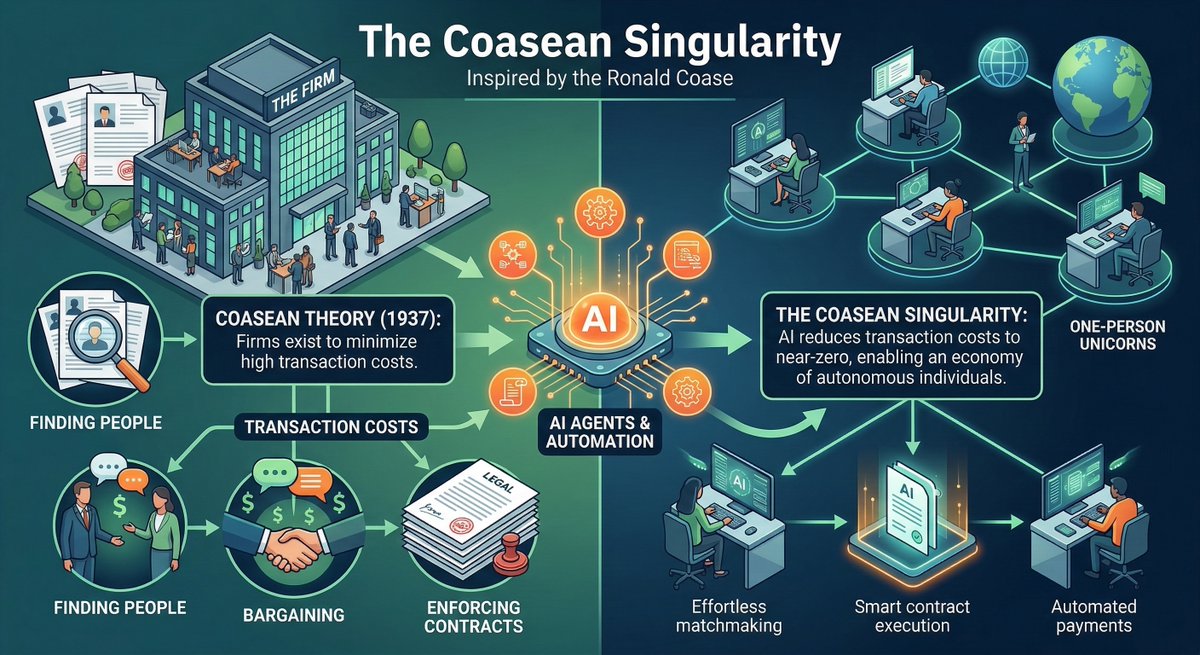
Our new essay is out in Science: "Agentic AI and the Next Intelligence Explosion" For decades, the AI "singularity" has been imagined as a single, godlike mind bootstrapping itself to omniscience. In this piece with the inimitable Benjamin Bratton (@bratton) and Blaise Agüera y Arcas (@blaiseaguera), we argue this vision is wrong in its most fundamental assumption. Every prior intelligence explosion—primate sociality, human language, writing, institutions—wasn't an upgrade to individual cognitive hardware. It was the emergence of a new socially aggregated unit of cognition. AI is extending this sequence, not breaking from it. The evidence is already inside the models themselves. In recent work, we showed that frontier reasoning models like DeepSeek-R1 don't improve by "thinking longer"—they spontaneously simulate internal multi-agent debates, what we call a "society of thought" (lnkd.in/guNfRtXh). Reinforcement learning for accuracy alone causes models to rediscover what epistemology and cognitive science have long suggested: robust reasoning is a social process, even within a single mind. This opens a vast design space. A century of research on team composition, hierarchy, role differentiation, and structured disagreement has barely been brought to bear on AI reasoning. The toolkits of organizational science become blueprints for next-generation AI. Outside the model, we've entered the era of human-AI centaurs—composite actors that are neither purely human nor purely machine. Agents that fork, differentiate, recombine. Recursive societies of thought that expand when complexity demands and collapse when problems resolve. The scaling frontier isn't just bigger models. It's richer social systems—and the institutions to govern them. Just as human societies rely on persistent institutional templates (courtrooms, markets, bureaucracies), scalable AI ecosystems will need digital equivalents. The Founders would have recognized the logic: no single concentration of intelligence should regulate itself. The intelligence explosion is already here. Not as a singular ascending mind, but as a combinatorial society complexifying—intelligence growing like a city. The question is whether we'll build the social infrastructure worthy of what it's becoming. No mind is an island. Read it here in Science (science.org/doi/10.1126/sc…) or free on the arXiv (arxiv.org/abs/2603.20639)


A trader swapped $220,000 USDC to USDT and only received $5,000 because he got MEV'd

Over the past few hours, our armed forces, with the support of the French Defence, have boarded an oil tanker belonging to the Russian shadow fleet. The vessel is currently being escorted to the port of Zeebrugge, where it will be seized. Operation Blue Intruder was carried out by a team of exceptionally brave service members. Excellent work. More information tomorrow morning. Thanks for the excellent cooperation @AnneliesVl @jeanluccrucke @BernardQuintin_ @prevotmaxime @CaVautrin .

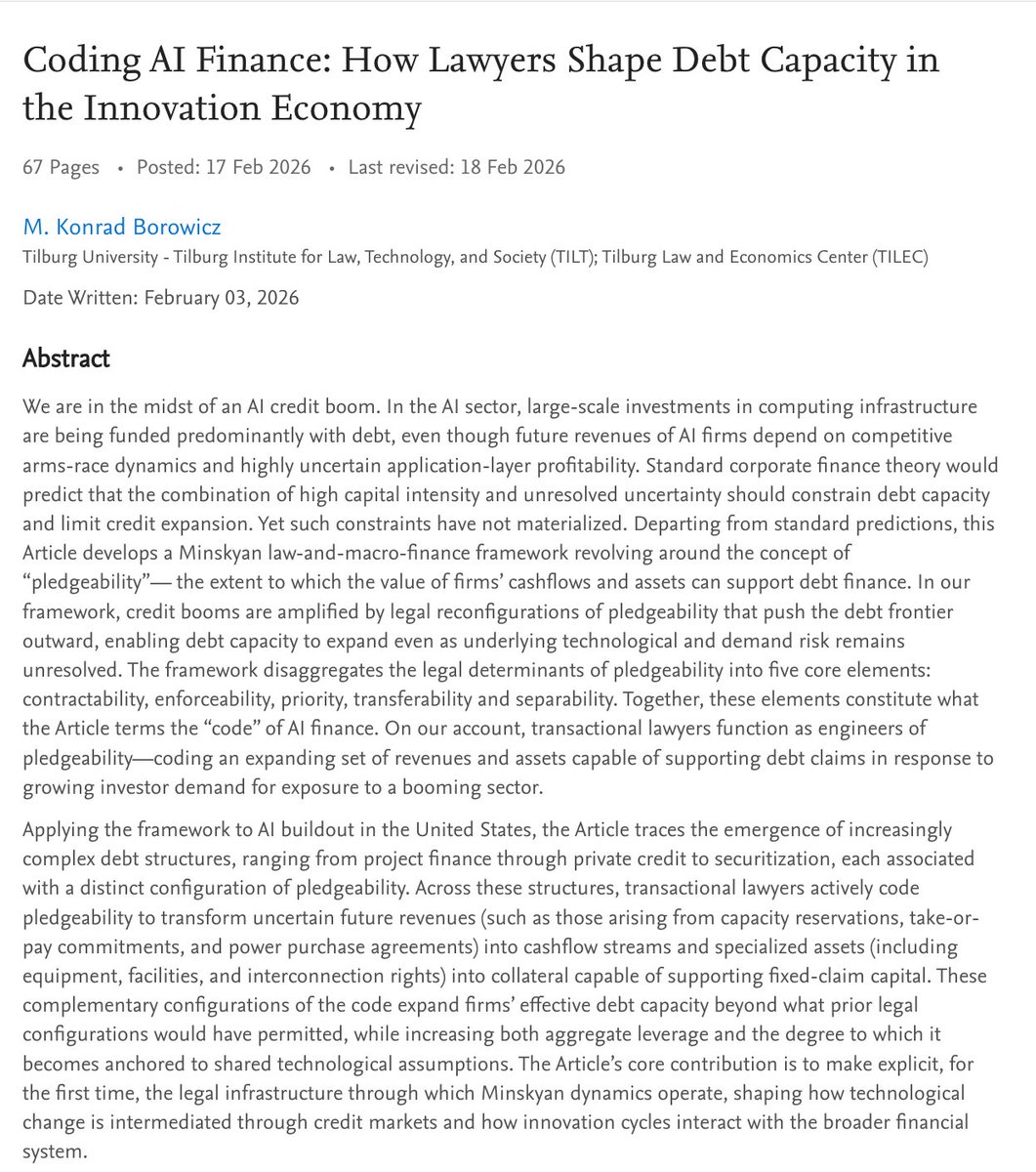
Coding #AI Finance: How Lawyers Shape Debt Capacity in the Innovation Economy This Article develops a Minskyan law-and-macro-finance framework revolving around the concept of “pledgeability”. Author: M. Konrad Borowicz Read More: spkl.io/6011AQSnZ #AI