Sabitlenmiş Tweet

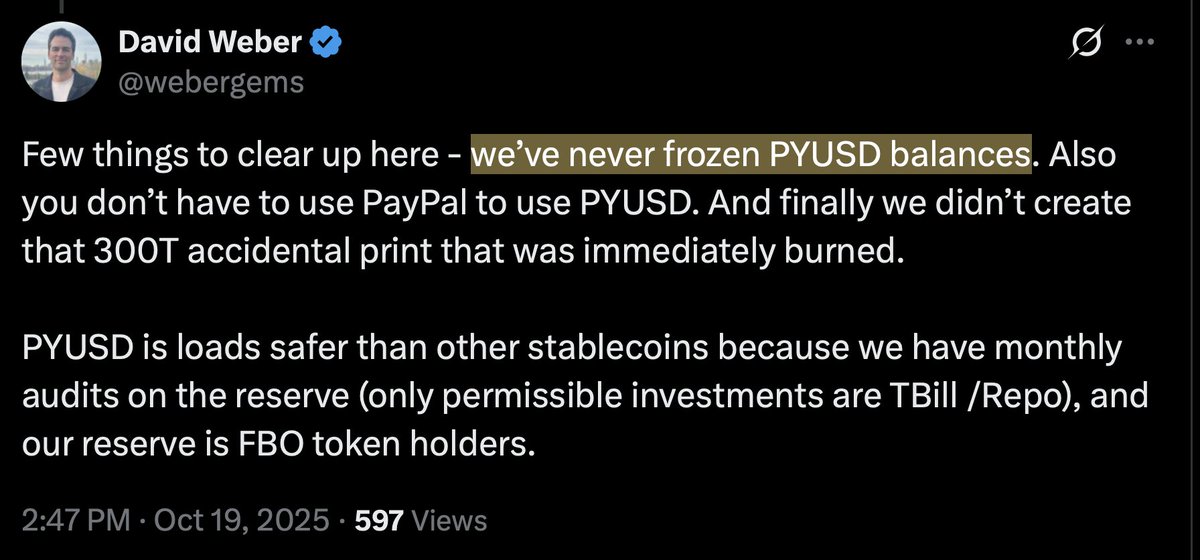
PayPal claims they have "never frozen PYUSD balances", but they froze our Solana token account.
Never trust PYUSD. @webergems @PayPal

English
A
488 posts








I spent time on the ground in Jakarta over the last few days and came away more convinced that it will play a growing and significant role in the internet financial system In many ways it already is; Indonesia has extremely high crypto and stablecoin adoption. Hard to think otherwise after meeting so many leading entrepreneurs and innovators. @williamsutanto of @indodax has built Indonesia's largest crypto assets platform. @CalvinKizana and @sndyc of Tokocrypto operate one of Indonesia’s leading platforms, focused on delivering simple, secure, and seamless crypto trading and transactions. The @mobee_id team is focused on providing seamless access to digital asset trading and liquidity through an easy-to-use platform for both individuals and businesses. It was so great to spend time again with Vince Iswara, founder and CEO of @danawallet, which continues to improve the financial wellbeing of so many through innovation, and is the largest digital wallet platform in Indonesia. @pangxuekai and his team @ICExGroup have built an OJK-licensed bourse for digital assets, operating Indonesia’s integrated exchange alongside clearing and custody infrastructure. @archie_anugrah, @andyputra, @ririnadani and the whole team @PintuID have built a mobile-first digital asset platform that serves millions and has been innovating in the space from the early days. Natasha Ardiani and the team at Durianpay are laser focused on making payments seamless across the entire ecosystem. The Lippo Group and Nobu Bank are thinking deeply about the digital future at one of Asia’s largest diversified conglomerates and digital bank, clearly poised to continue the firm’s legacy as an industry pioneer in Indonesia and beyond. jeth_soetoyo of CFX and I first met in 2018 before Circle had even launched USDC! It’s impressive what he did with Pintu and is now doing with @cfx_id, a licensed bourse that is on a mission to accelerate the adoption of digital assets. I got to meet with him and leaders from ICC, KKI and IKS. @D3Labsdotio is a secure and compliant asset tokenization infrastructure for asset issuance, management, and transactions. taking an innovative approach to tokenization and real world assets. It was great to meet Chung Ying Lai and Tigran Adiwirya. They have a deep commitment to the local crypto community! Very strong energy across the board, excited about what we can do together and the potential for growth in this highly dynamic market.



Since it’s morning/noon in Asia, seeing the Drift post, I just wanted to say that by ever talking to me or my team at a conference, texting any of us, by working for P0, or touching our code, even by just visiting our website — you are implicitly stating that Kim Jong Un is evil, North Korea is bad, and you are not loyal to the DPRK. Every single person that works at P0, uses P0, and touches P0 code thinks that Kim Jong Un is evil. If you come ask for a job, integration, or code questions, I will ensure u think Kim Jong Un is evil.



There are often posts mentioning that I donated a very large amount of funds to @FLI_org years ago and connecting me to various policy actions that they take. I thought I would make clear the record both on the nature of my connection to them, and on similarities and differences between my approach to the AI risk topic and theirs. First, what happened: * In 2021, I received a large amount of SHIB and other dog coins, seemingly because the creators wanted to use "Vitalik owns half our supply" as a marketing tactic and be "the next Dogecoin" * The tokens quickly rose in value, and at the peak the "book value" of those tokens was over a billion dollars * I felt that surely this was a bubble, it would pop quickly and the price would drop massively, and so I scrambled to retrieve the funds from my cold wallet (this included things like calling my stepmother in Canada and asking her to go into my closet and read out a 78-digit number, and then adding it to a different 78-digit number transcribed from a paper in my backpack). I sold what I could for ETH and donated to relatively more "normal" things (eg. $50m to GiveWell). But then I was still left with lots of SHIB * I sent half to @CryptoRelief_ (half of _those_ funds ended up supporting Balvi, and the other half is being spent by @sandeep and team on improving medical infrastructure in India). I sent the other half to FLI * At the time, they presented me with a comprehensive roadmap that focused on improving all major existential risks (bio, nuclear, AI...) as well as general pro-peace and pro-epistemics (ie. helping us know the truth in adversarial contexts) initiatives * I thought that surely they would cash out at most $10-25M, because there's no way the SHIB market is deep enough to cash out more * Instead, they managed to cash out ... something like $500M (same with cryptorelief) * Since then, FLI had an internal pivot by which they started focusing on cultural and political action as a primary method, quite different from the original approach. * Their justification is that the situation has changed greatly since 2021, AGI is coming very soon, and their pivot is needed to affect the world fast enough, and to counteract the lobbying warchests of large AI companies. * My worry is that large-scale coordinated political action with big money pools is a thing that can easily lead to unintended outcomes, cause backlashes, and solve problems in a way that is both authoritarian and fragile, even if it was not originally intended that way. * For example, their primary approach to biosafety has been "how do we put guards into bio-synthesis devices and AI models so that they refuse to create bad stuff?". I view this as a very fragile solution: there are many ways to jailbreak, fine-tune or otherwise get around such restrictions. Ultimately, putting all your eggs into this strategy can lead to very dark places like "let's ban open-source AI" and then "let's support one good-guy AI company to establish global dominance and don't let anyone else get to the same level". Approaches like this VERY EASILY backfire: they make the rest of the world your enemy. * More generally, historical experience tells us that when regulations are made on dangerous tech, "national security" orgs (today, realistically incl Palantir) inevitably get exempted, and in fact those very same orgs are a major source of risk (see: pandemic lab leaks typically coming from government programs). This is something I worry about. * My approach on these topics has been centered around d/acc: build the tech (eg. air filtering, early detection, continuous passive PCR-quality air testing, prophylactics etc for pandemics, greatly improving software and hardware verifiability for cybersecurity...) to help us survive a much higher-capability world safely, and open-source the tech so that the entire world can freely incorporate it. * This is the sort of thing that the ~$40m I recently allocated is for. A big part of that pot is for secure hardware, which is good both for Ethereum users who do not want to lose their coins, and for humanity if we want ubiquitous computer chips to not be hackable (incl by AI) and spy on us. If I had the FLI warchest and tweet-chest, I would use it to do more of those things. * I have shared my difference in perspective with them on several occasions. * At the same time, I've also been heartened by many of @FLI_org 's recent moves. I think the "pro-human AI declaration" ( humanstatement.org ) is a very good philosophical path forward. It unites conservatives, progressives and libertarians, America, Europe and China, people worried about unemployment, surveillance, psychosis and paperclip doom, atheists and the Pope. They have also been researching ways to avoid concentration of power resulting from AI. These things are all good. I wish them best of luck on these positive initiatives, and hope that they operate with the caution and wisdom that their task deserves.


Earlier today, a malicious actor gained unauthorized access to Drift Protocol through a novel attack involving durable nonces, resulting in a rapid takeover of Drift’s Security Council administrative powers. This was a highly sophisticated operation that appears to have involved multi-week preparation and staged execution, including the use of durable nonce accounts to pre-sign transactions that delayed execution.