Shann³@shannholmberg
how to use autoreason for email marketing
you run klaviyo for a DTC brand, your weekly broadcast hits 28k subscribers, 22% open rate, 1.9% CTR, drives around $0.21 per email sent, and you want all three numbers up without rewriting from scratch. most marketers would prompt an LLM with "rewrite this email" and ship whatever comes back.
the problem with asking AI to rewrite its own work is it never says "this is already good." it invents missing sections, drifts from the original angle with every pass, and strips out the lines that were converting in the first place.
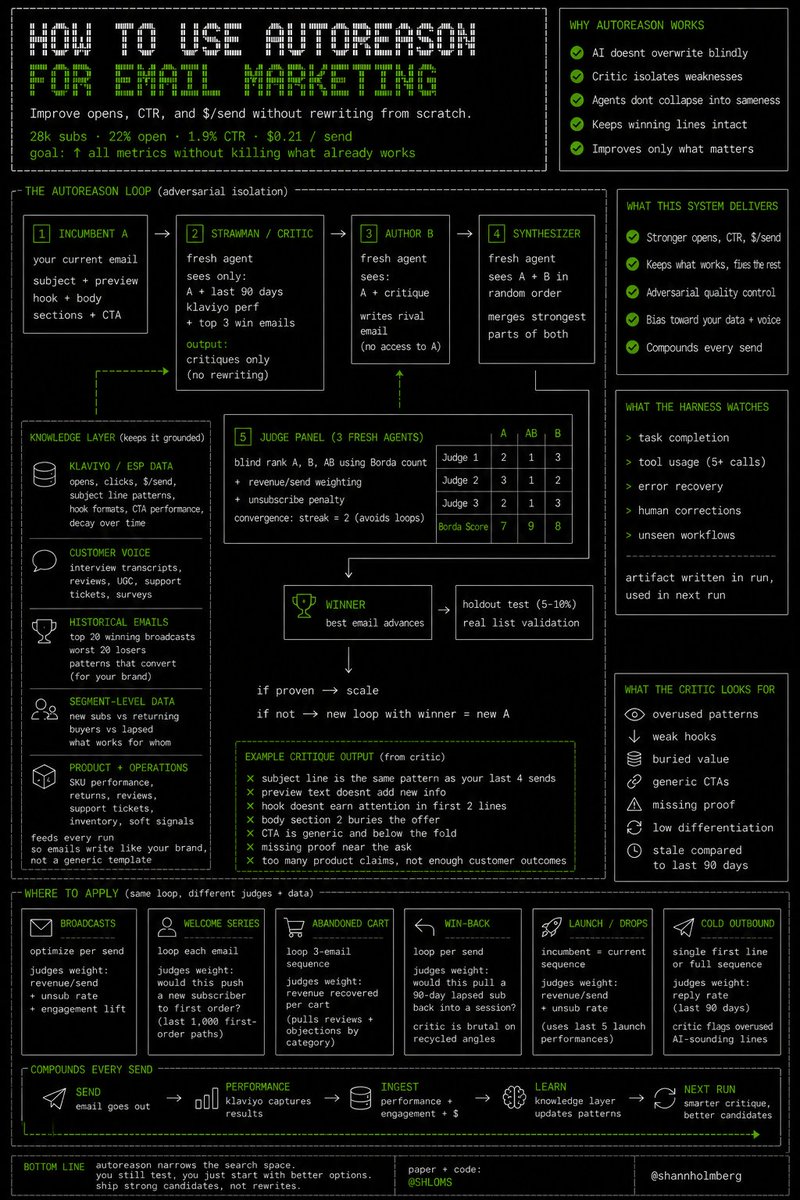
autoreason fixes that with adversarial isolation. every role in the loop is a fresh agent that cant see what the others wrote, so the output doesnt collapse into the same generic email everyone in your category is sending this week.
> incumbent is your current email, the subject line, preview text, hook, body sections, CTA
> strawman is a fresh agent that sees only the email + your last 90 days of klaviyo performance + the top 3 emails from your own win history, it writes critiques like "subject line is the same pattern as your last 4 sends, body section 2 buries the offer, CTA is generic." no rewriting, just finding problems
> author B is a fresh agent that sees the original + the critique and writes a revised version
> synthesizer is a fresh agent that sees original + B in random order and merges the strongest parts of both
> judge panel of 3 fresh agents does a blind ranked-choice vote on A, B, and AB using Borda count, convergence at streak=2 so it doesnt loop forever
for email work the knowledge layer is what keeps this grounded in your business instead of generic email advice:
> klaviyo or your ESP performance data, which subject line patterns win opens for your list, which hook formats drive clicks, which CTAs convert, decay over time
> customer interview transcripts and reviews so the email writes in the language your customers use, not the language your marketing team assumes they use
> your top 20 winning broadcasts and worst 20 losers, the synthesizer can merge in patterns from what already works for your brand
> segment-level data, what works for new subs vs returning buyers vs lapsed, instead of rewriting one email for everyone
> SKU performance, returns, support tickets, the soft signals about what customers use vs what they say they use
this works the same way for the rest of the email stack:
> welcome series: loop each email separately, judges score on "would this push a new subscriber to first order" using your last 1,000 first-order paths from new subs as ground truth
> abandoned cart: loop on the 3-email sequence, judges weighted on revenue recovered per cart, knowledge layer pulls customer reviews and past objections by category
> win-back: judges score against "would this pull a 90-day lapsed subscriber back into a session", the critic is brutal on emails that read identical to ones you sent these subs three months ago
> sales sequences and product drops: incumbent is the current sequence, knowledge layer feeds the past 5 launch performances, judges weight on revenue per send and unsubscribe rate
> cold outbound first lines: judges score against reply rate from your last 90 days of sent sequences, the critic flags any line that pattern-matches what every other AI-generated outbound sounds like
you still send the winner through a real holdout test on 5 to 10% of the list before scaling. autoreason just narrows the search space so youre shipping strong candidates instead of whatever ChatGPT cleaned up this morning.
results feed back every send so the next one is sharper