btant, esq.

2.1K posts

btant, esq. banner
btant, esq.

btant, esq.

@mr_tanter

Lawyer ⚖️ #girldad #Clippers #DaBears Retired D2 🏀 Former Deputy District Attorney (Los Angeles County, San Bernardino County)

Long Beach, CA Katılım Haziran 2020
97 Takip Edilen202 Takipçiler
btant, esq. retweetledi

Ronald Ussery Jr, Esq.
Ronald Ussery Jr, Esq.@ronaldusseryjr·
@JakeSherman Worth watching how the amendments handle the antitrust safe harbor piece, plus how the bill treats athlete employment status. Those have been the two parts most likely to draw athlete and state AG challenges if it clears the floor.
English
0
1
0
68
btant, esq. retweetledi
Jake Sherman
Jake Sherman@JakeSherman·
We scooped yesterday that the SCORE Act would be on the floor next week. House Rules is now seeking amendments for the package. Big NIL/college athletics bill that the House flopped on last year. rules.house.gov/media/announce…
English
3
9
18
14.6K
btant, esq.
btant, esq.@mr_tanter·
Another jury trial in the books.
English
0
0
0
56
btant, esq. retweetledi
Ronald Ussery Jr, Esq.
Ronald Ussery Jr, Esq.@ronaldusseryjr·
@jon_wertheim @AndrewBrandt @ITA_Tennis Title IX is the pressure point here. When schools redirect dollars toward football and basketball rosters at the expense of non revenue sports, the proportionality math gets harder to defend.
English
0
1
1
65
btant, esq. retweetledi
Michael McCann
Michael McCann@McCannSportsLaw·
The NCAA House settlement is suddenly unsettled as the two sides file dueling briefs over how to interpret what the settlement language says and, just as importantly, doesn’t say. The marketplace for NIL deals is at stake. My @Sportico legal column: sportico.com/law/analysis/2….
English
4
8
21
26.9K
btant, esq. retweetledi
Evan Sidery
Evan Sidery@esidery·
The Pacers’ full price paid for Ivica Zubac at the trade deadline: Bennedict Mathurin Isaiah Jackson No. 5 overall pick 2029 unprotected 1st Future 2nd A massive price to pay in the end.
Evan Sidery tweet media
English
315
490
8.4K
1.3M
btant, esq. retweetledi
LA Clippers
LA Clippers@LAClippers·
WE GOT THE 5TH OVERALL PICK WE GOT THE 5TH OVERALL PICK WE GOT THE 5TH OVERALL PICK WE GOT THE 5TH OVERALL PICK WE GOT THE 5TH OVERALL PICK
LA Clippers tweet media
English
420
1.3K
13.7K
1.1M
btant, esq. retweetledi
Eric Blevins
Eric Blevins@EricJBlevins·
Too bad final exams just ended, because the College Sports Reform Committee proposal (reported by @RossDellenger) could torment law students with the number of fascinating legal issues raised. In short, the proposal’s objective to “tak[e] action without risk of litigation” is probably wishful thinking, because the proposed antitrust exemption doesn’t protect against many other issues. Outlining a few below, starting with (perhaps?) the most novel the proposal raises: 1. A Takings Case? The proposal includes a new Permanent Governing Body that would “evaluat[e] the effectiveness” of the NCAA/CFP/CSC not only for governance but also over the economics of college sports. This sounds like a possibility that the NCAA/CFP or other stakeholders could lose control of valuable media or other economic rights. The Constitution’s Fifth Amendment prevents the government from “taking” private property unless it can demonstrate a public good and, if it can, it must at least pay just compensation. A classic example is when the state takes title to private land in the path of a new highway. This constitutional protection extends to intangible property rights besides land. Could a new Task Force effectively taking over the business of college sports- and the billions at stake- give rise to a “takings” lawsuit from whatever stakeholder loses control? 2. More Constitutional Issues @samcehrlich has published an article suggesting that creating the Task Force itself might be unconstitutional, since that body would receive significant legislative power. Sam and his colleagues @nealcternes and @sabo21 have also written (recently published by @MattBrownEP) on another issue: whether the NCAA could be deemed a “state actor. Placing the Task Force inside the NCAA subject to Congressional oversight could make the NCAA more like a “state actor” such that it owes constitutional duties like due process. Per Sam/Neal/Joe, this has significant ramifications in how the NCAA can discipline schools, athletes, coaches if every time it hands down punishment, the NCAA can be sued over whether the process comported with constitutional due process. The NCAA won an important 1988 case against Jerry Tarkanian to avoid that obligation, but could it be revisited? 3. The Employment Question The most glaring omission from the proposal is athlete employment. This has been a major sticking point in college sports reform. An antitrust exemption does nothing to prevent athletes from seeking employee status, either for minimum wage (FLSA) or to unionize (NLRA). In fact, the proposal probably strengthens the argument that some athletes in major revenue sports are employees. If athletes can unionize as employees, any Task Force rules regarding wages, hours, and terms of employment (read: a ton of stuff) won’t matter. Schools will have to negotiate those with athletes. 4. Contracts How will the Task Force and new governance handle pay-for-play? @heitner has written at length on NIL contract details in real life and whether some provisions suggest p4p arrangements, which @profgoose has analyzed in his ongoing analysis of college sports’ political/legal architecture. P4p has employment implications too. Also in the contract realm- recall that some athletes like Trinidad Chambliss won eligibility lawsuits by arguing that they are 3rd party beneficiaries of a contract created by the NCAA rules. In other words, the NCAA owes athletes a duty to apply its rules fairly (like Chambliss’ eligibility waiver rule). Could this remain a legal avenue for athletes to challenge Task Force rules they believe are unfairly applied? 5. Title IX Title IX, which requires that schools provide equal athletic opportunities and benefits to male & female athletes, still looms as potentially disrupting the entire proposal. One of the Task Force’s stated goals is to protect Olympic and women’s sports, but distribution of revenue to athletes is still an unsettled Title IX question.
Eric Blevins tweet mediaEric Blevins tweet mediaEric Blevins tweet mediaEric Blevins tweet media
English
3
8
21
15.8K
btant, esq.
btant, esq.@mr_tanter·
Athletes, if you ever miss an adrenaline rush and want to feel like you’re in a game. Jury trial. It’s nothing like being in front of a jury box advocating your position. Your skills will transfer!
English
0
1
2
216
btant, esq. retweetledi
Nigel Carter
Nigel Carter@NigelCarter_·
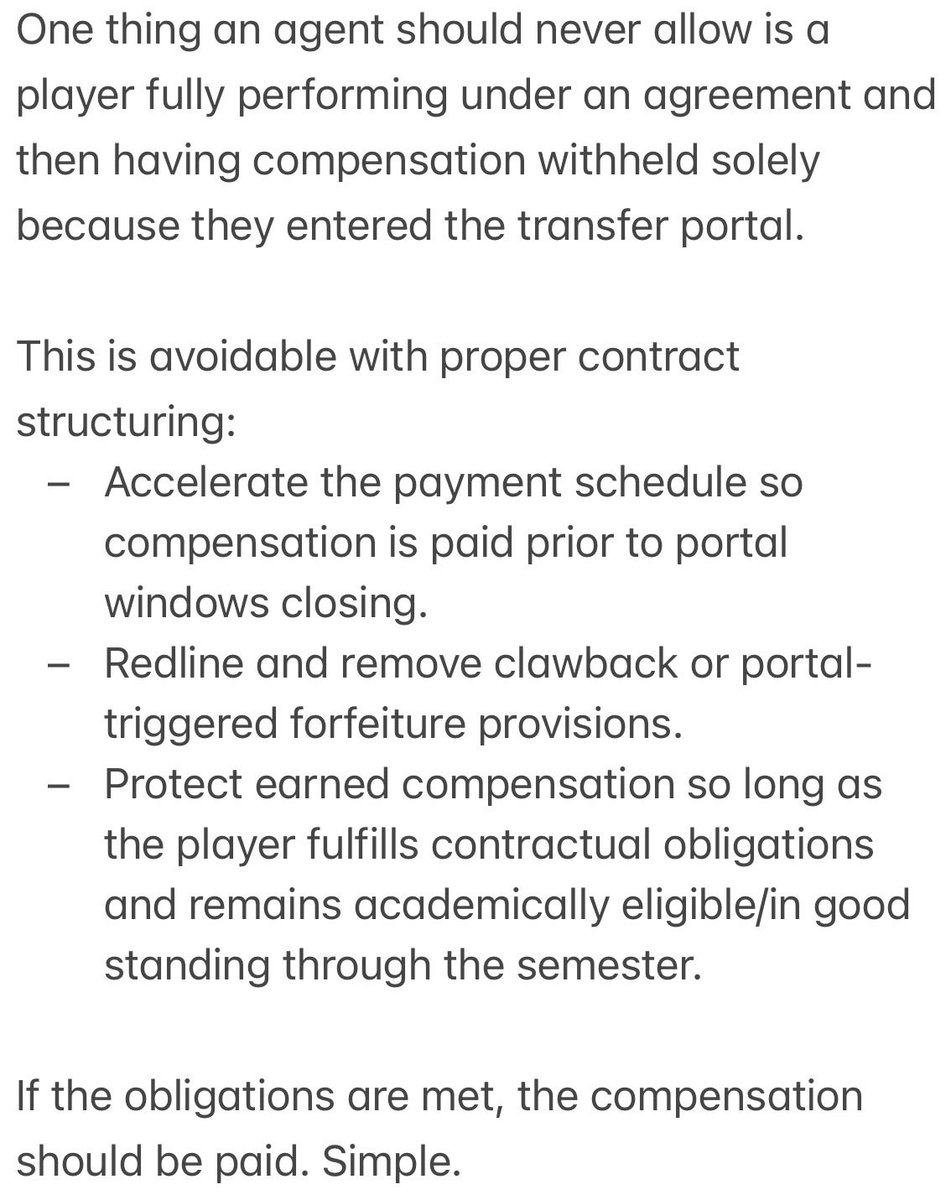
Agents shouldn’t greenlight and players shouldn’t sign agreements without fully understanding the payment structure, forfeiture language, and transfer portal implications. The details matter. Proper contract structure matters even more.
Nigel Carter tweet media
Darren Heitner@heitner

Some schools are withholding final #NIL payments by invoking transfer portal clauses even after the athlete has fulfilled every obligation in the contract. That's a problem. Perhaps the deeper problem is that these contracts are not really NIL agreements. linkedin.com/pulse/newslett…

English
1
7
37
15.3K
btant, esq. retweetledi
Lethal Shooter
Lethal Shooter@LethalShooter__·
One of the most underrated skills you can learn is the ability to ignore your mood and stick with the plan.✅
English
9
71
324
8.7K
btant, esq. retweetledi
Darren Heitner
Darren Heitner@heitner·
Over the past week, I have reviewed dozens of #NIL agreements across the country. The market continues to mature, but certain issues keep surfacing in negotiations. Here are some of the things I'm finding: Payment structures have grown far more sophisticated. I'm seeing more hybrid deals that combine guaranteed upfront payments with performance bonuses tied to specific deliverables and some deals that contain no guarantees whatsoever. Any non-guaranteed income could leave athletes chasing money they were orally promised. Termination clauses remain the most heavily negotiated provision. One-sided, "sole discretion," termination rights without notice or cure periods are concerning. Post-termination rights and IP ownership remain areas of emphasis. I specifically look for "perpetual" and "irrevocable" grant of rights or extended licenses in my review. Athletes should want rights (other than limited archival rights) to expire cleanly when the deal ends. These are real business contracts with real dollars and real consequences. Athletes and their advocates need to treat them that way. The deeper the NIL industry develops, the more important it is for athletes to retain experienced counsel to walk them through every material term before signing.
English
16
63
238
117.1K
btant, esq. retweetledi
Land of Enchantment Law
Land of Enchantment Law@HeresJohnnyLaw·
@mr_tanter I'll never understand the parents who don't understand that agents care less about their kids than the lawyers do. Oh well!
English
0
1
1
35
btant, esq. retweetledi
David Hickson
David Hickson@David_Hickson·
Parents, first order of business is to find a lawyer you trust. It’s better to have your lawyer learn to communicate like an agent than to have your “ NIL Agent” try to learn how to be a lawyer.
Darren Heitner@heitner

Over the past week, I have reviewed dozens of #NIL agreements across the country. The market continues to mature, but certain issues keep surfacing in negotiations. Here are some of the things I'm finding: Payment structures have grown far more sophisticated. I'm seeing more hybrid deals that combine guaranteed upfront payments with performance bonuses tied to specific deliverables and some deals that contain no guarantees whatsoever. Any non-guaranteed income could leave athletes chasing money they were orally promised. Termination clauses remain the most heavily negotiated provision. One-sided, "sole discretion," termination rights without notice or cure periods are concerning. Post-termination rights and IP ownership remain areas of emphasis. I specifically look for "perpetual" and "irrevocable" grant of rights or extended licenses in my review. Athletes should want rights (other than limited archival rights) to expire cleanly when the deal ends. These are real business contracts with real dollars and real consequences. Athletes and their advocates need to treat them that way. The deeper the NIL industry develops, the more important it is for athletes to retain experienced counsel to walk them through every material term before signing.

English
0
6
28
10K
btant, esq.
btant, esq.@mr_tanter·
🤷🏾. A lot parents, players, handlers don’t want to hear this. Agents have a duty to themselves at the end of the day. This means they will act in their best interest. The agent’s lawyer has a duty to the agent. A player’s lawyer has a duty to the player.
David Hickson@David_Hickson

Parents, first order of business is to find a lawyer you trust. It’s better to have your lawyer learn to communicate like an agent than to have your “ NIL Agent” try to learn how to be a lawyer.

English
1
2
1
375