mattt
32 posts
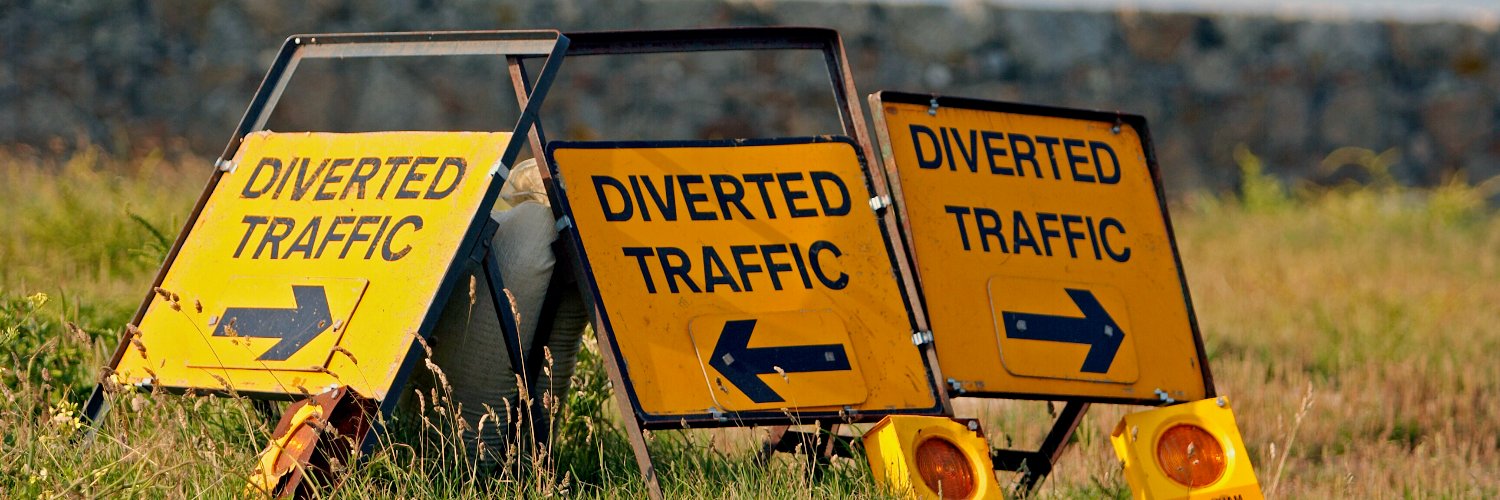



@mrtgsy Clearest form I could come up with for that meaning. What do you suggest instead?
English
New preprint. This time AI safety related. Kinda funny, given what was just announced in the US… Oh well. Comments very welcome: techrxiv.org/users/684323/a…

English
@ChrisCalviFree @CitizenUddin @Wankpanzer @YPLAC I did, which is why I asked. 243 & 247 clearly relevant here but can’t find the wording that allows loading for non-goods vehicles on double yellows without “blips”. (Although the tail end of this car is clearly alongside/blocking a lowered curb so somewhat moot anyway!)
English

@mrtgsy @CitizenUddin @Wankpanzer @YPLAC Look up the Highway Code. Double yellow lines without kerb blips prohibit waiting/parking but not loading. Loading must be genuine but is often used as an excuse to avoid a ticket. Parking officers can't instantly ticket in these circumstances; must "observe"(check for loading).
English

I would be interested to hear both @Wankpanzer and @YPLAC views on this one. How on earth, would any normal person, think this is acceptable? Because they are not "normal" they are rich. So fuck everyone else. I am the only one that matters. Shame that "keying" a car isn't legal.
English
@CitizenUddin @Wankpanzer @YPLAC Agree entirely. However, part of the problem is that the UK rules are quite specific: double yellow lines without kerb blips allow loading. Maybe the owner is a lawyer well versed in such intricacies. They only have to appear within a couple of minutes with a large box and voila!
English
@oldfarmhorace @PeterRoffey5 @RossLeBrun How does the policy make developments unprofitable? Are they required to sell houses at cost?
English

@PeterRoffey5 @RossLeBrun Making a tax avoidable is a great aim but I expect the developer has to meet the States view of what an accepted profit margin is?
English
GP11 is best forgotten rather than being fought for. Making the mistake once is almost forgivable, trying to make the same mistake again is what brought Ferbrache, Helyar and Mahoney down.
Charles McHugh@ChasMcHugh
@BBCGuernsey @JohnFernandez1 How can a non-performing policy that has contributed nothing for 8 years relieve the States of a burden Lindsay? To be clear 0% of any number is still a big fat zero. GP11 was a catastrophic policy failure from day 1. It was stalled private housebuilding and it’s got to go.
English


@jerseyrobins Same. I like it for home cinema stuff. Have been slowly moving over to HomePod… sound quality is on a par. Wholesale move though is scuppered by whatever spat Apple and BBC have had means no BBC sounds 🤦♂️ so now have messy mishmash of two systems.
English

I’ve concluded that Sonos sucks salty balls. Has anyone done a whole house migration away from Sonos and found something transformationally better?
English

No. I used AI to write the above as a way for expressing some of the nuance that wasn't in the articles. My personal views tend to be more radical than the way this is worded. I have an autistic daughter who is still non verbal that may never fit into this way of assessing. I have a Dad that left school at 14 with dyslexia that became more successful than most people I know with an education. As someone who felt like a fish trying to climb a tree throughout my education here because of the narrow tested definitions of intelligence within the education system. Right now you have people designing and benchmarking education that are part of the 30% that the current model (both private and state) works for. Most of the population are tolerating a model that feels OK at best to them and some people find it a very traumatic experience. For me the success of an education system is down to the thriving nature of the population that it produces. We have a chronic disease and mental health explosion in young people and adults. If the first wish of every parent is to create happy and healthy children then we are just not performing that well. So by all means complain about Maths scores and buildings but the elephant in the room is the overall health of the society that the education system produces. We can't get 40 people to agree what to do about education for 15 years and yet we never ask what kind of education system produces this kind of lack of skill to be able to navigate this complexity? The world is getting much more uncertain and complex and yet we still have leaders calling for certainty and trying to use reductionist approaches to benchmark performance.
Saint Peter Port, Bailiwick of Guernsey 🇬🇧 English

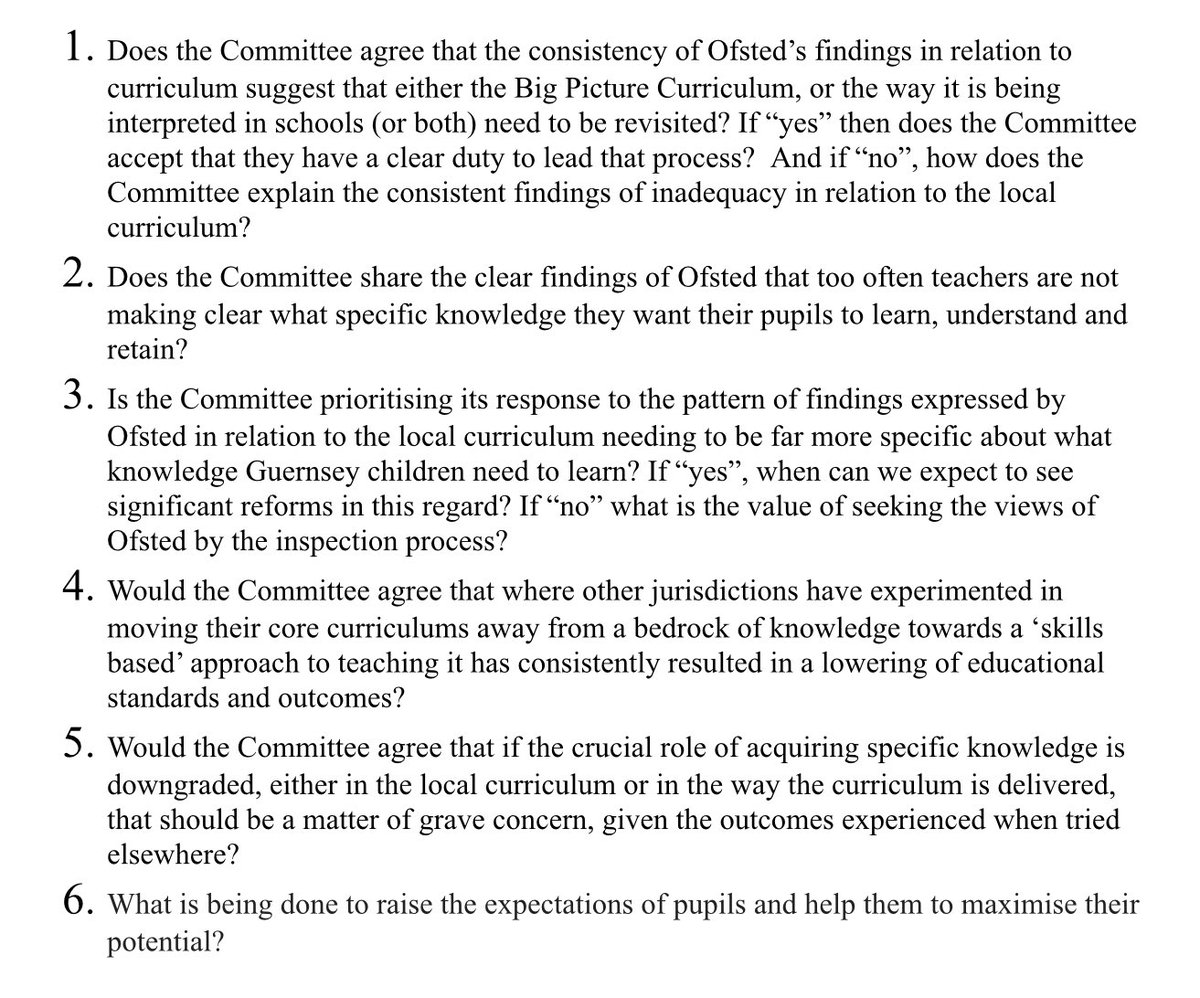
For anyone interested, these are the questions in full that I’ve posed to the Committee for Education, Sport & Culture around curriculum:
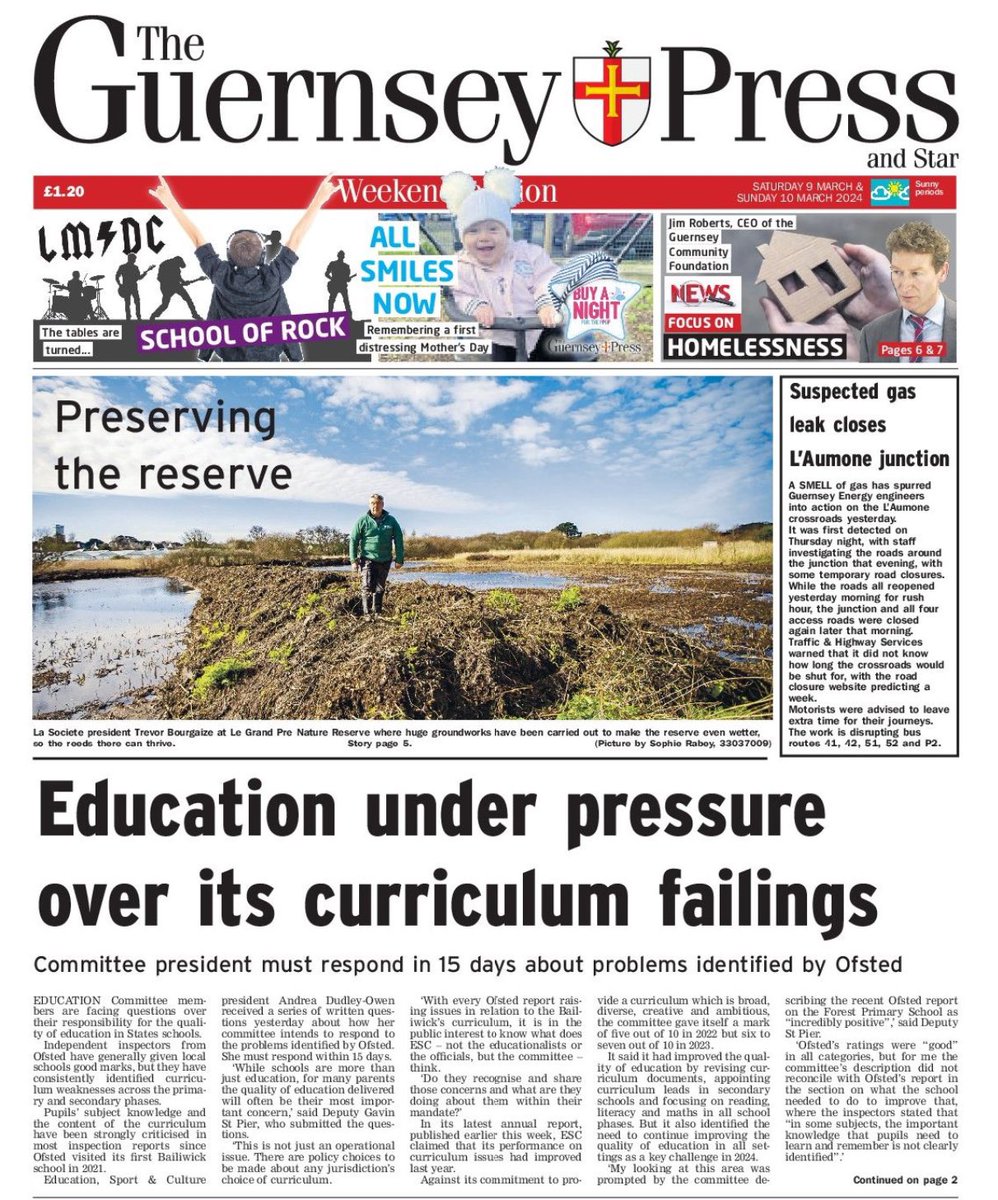
(PS you can see Ofsted’s comments with the recurring theme in the second extract from @GuernseyPress )

English
I tend to think of the way educational assessment is done is similar to the GDP problem.
Comparing the use of the Programme for International Student Assessment (PISA) for measuring educational outcomes to the use of Gross Domestic Product (GDP) for measuring societal success is insightful. Both metrics provide valuable information but also have significant limitations when used as sole indicators of success in their respective fields:
1. **Narrow Scope**: Just as GDP focuses mainly on economic activity and overlooks other aspects of societal well-being, PISA tests concentrate on assessing students' abilities in reading, mathematics, and science. Both measures miss broader dimensions of their respective domains. PISA does not encompass all facets of educational quality, such as emotional well-being, creativity, or civic engagement, similar to how GDP overlooks environmental health, income distribution, and quality of life.
2. **Standardisation vs. Diversity**: PISA tests are standardised to allow for international comparison, similar to how GDP provides a common measure for economic output. However, this standardisation can oversimplify or misrepresent the diverse educational contexts and priorities of different countries, just as GDP can misrepresent the true state of societal well-being by ignoring cultural, environmental, and social values that contribute to a society's success.
3. **Performance vs. Quality**: Relying on PISA scores to gauge educational success is akin to using GDP as the sole measure of a society's success. Both can indicate certain levels of performance — PISA in terms of student achievement, GDP in terms of economic output — but neither provides a complete picture of quality. High PISA scores might not reflect whether students are happy or well-rounded, just as a high GDP might not reflect whether citizens have access to quality healthcare or enjoy a clean environment.
4. **Improvement and Progress**: Both PISA and GDP can drive policy and priorities, sometimes at the expense of other important factors. Countries might reform educational systems with the narrow aim of improving PISA scores, just as they might chase GDP growth without considering sustainability or equity. This can lead to imbalanced policies that don't address broader needs or long-term well-being.
5. **International Comparison**: Both metrics enable international comparison, offering a way to benchmark progress against other countries. However, this can also lead to competition and oversimplification, as countries might strive to improve their rankings without considering whether the underlying improvements align with their unique educational goals or societal values.
In essence, while PISA and GDP can provide important insights, they are both limited in scope and can lead to an oversimplified view of educational and societal success. A more holistic approach in both domains would consider a wider range of indicators to capture the full spectrum of what it means to have a successful education system or a thriving society.
Saint Peter Port, Bailiwick of Guernsey 🇬🇧 English


@mrtgsy I mean not when overtaking a cyclist but I always thought it was permissible especially when Guernsey roads are so narrow and cars get bad cases of granite rash
English
Large action models are going to make LLMs look like small beer. The human potential we are about to unlock is beyond imagination.
rabbit inc.@rabbit_hmi
Introducing r1. Watch the keynote. Order now: rabbit.tech #CES2024
English

@MattJChampion @chiefofstuffs jira still makes the fan on the iMac Pro go off. it shouldn't do that.
English