morgan edwards

380 posts

morgan edwards banner
morgan edwards

morgan edwards

@mrznerd1

Katılım Aralık 2010
322 Takip Edilen56 Takipçiler
morgan edwards retweetledi
Nemesis
Nemesis@Nemesisdottrade·
Nemesis Ticket collection page is out on Opensea: opensea.io/collection/nem… Which one is your favorite? Comment it below👇 Nemesis.
English
530
20.5K
22.2K
268.2K
morgan edwards retweetledi
Nemesis
Nemesis@Nemesisdottrade·
Today, we unveil Nemesis Tickets, a 2,100 limited edition NFT collection✦ Each ticket is your key to the $NEMESIS whitelist (0.05 ETH allocation). Programmatically generated. Greek-Roman aesthetics. Zero duplicates. Let's dive into the traits and rarity tiers🧵
Nemesis tweet media
English
854
23.1K
25K
225.9K
morgan edwards retweetledi
Nemesis
Nemesis@Nemesisdottrade·
Welcome to the Arena: wl.nemesis.trade Nemesis.
Nemesis tweet media
English
515
21.3K
22.4K
222.3K
morgan edwards retweetledi
Nemesis
Nemesis@Nemesisdottrade·
Today, we announced our upcoming token name change. Here is everything you need to know about $NEMESIS. A remade thread🧵
Nemesis tweet media
English
373
23.6K
25K
181.7K
morgan edwards
morgan edwards@mrznerd1·
@DilmarBTC @TheoriqAI TheoriqAI DAO gives real utility to $THQ by letting holders shape both funding and validation logic What’s the minimum amount of $THQ needed to submit a proposal?
English
1
0
1
4
Dilmar
Dilmar@DilmarBTC·
TheoriqAI DAO: Influence of $THQ holders on the evolution of the platform @TheoriqAI DAO is not just a form of governance, but a true tool for decentralized development of the platform. Holders of $THQ tokens have real influence on making key decisions that shape the future of the ecosystem. Voting for development directions $THQ holders can propose and support changes to the protocol, launch new features or partnerships. This allows the platform to adapt to the needs of the community, and not just to the decision of the development team. Resource and grant allocation The DAO controls the development budget, including grant programs for developers and marketing initiatives. Holders influence which projects receive support. Regulation of knowledge validation rules Key parameters of staking, validation and reward mechanisms are determined through the DAO. This ensures a balance between content quality and incentivizing activity. Increasing Transparency and Trust Decentralized governance creates an open system where every $THQ holder sees how resources are allocated and decisions are made. Conclusion: TheoriqAI DAO is the driving force behind the platform, ensuring its adaptability, transparency, and collective responsibility. $THQ holders are not just users, but co-creators of the future of the ecosystem.
Dilmar tweet media
English
28
0
26
104
morgan edwards
morgan edwards@mrznerd1·
@DilmarBTC @TheoriqAI The feedback loop between AI and tokenized knowledge makes TheoriqAI feel like a next-gen data layer for LLMs Will users own the AI models trained on their data?
English
1
0
1
10
Dilmar
Dilmar@DilmarBTC·
TheoriqAI Vision: Transforming Knowledge into a New Type of Digital Asset @TheoriqAI aims to fundamentally change the way we value and use knowledge in the digital age. The idea is to make knowledge not just information, but a fully-fledged asset with economic value in Web3. Knowledge as Tokenized Assets TheoriqAI is developing an infrastructure where pieces of knowledge, individual facts, skills, or modules — are converted into tokens that can be sold, bought, staked, and validated. This creates a new class of digital assets with their own market value. Decentralized Validation and Trust Instead of centralized authorities, knowledge verification is carried out through the community and AI agents. This reduces the risk of manipulation and increases the quality of information, making knowledge more reliable and valuable. Incentive Economy and Monetization The $THQ token provides an incentive to create, verify, and distribute quality knowledge. Ecosystem participants receive rewards for their contributions, which incentivizes the development and maintenance of content. Integration with AI and Web3 The knowledge stored in TheoriqAI is used to train AI models, creating a feedback loop between digital assets and artificial intelligence. This opens up new possibilities for generative applications, personalization, and automation. Conclusion: TheoriqAI transforms knowledge from abstract information into a real, economically meaningful digital asset. This is a fundamental step towards a new era where intellectual contribution becomes value that generates revenue and impact in Web3.
Dilmar tweet media
English
27
0
27
93
Dilmar
Dilmar@DilmarBTC·
How TheoriqAI Works: Modular Knowledge Architecture in Web3 @TheoriqAI is not just an AI project, but a complex system for storing, validating and monetizing knowledge in a decentralized Web3 environment. It is based on a modular architecture that provides flexibility, scalability and security. Knowledge Modules Each module is a separate block of information or skills that can be independently updated, validated and tokenized. Modules are interconnected, forming complex knowledge without centralized control. It is similar to Lego: anyone can add their own element or change an existing one. Validation through the community Users and AI agents verify the quality and reliability of modules through staking and voting mechanisms. This creates a system of collective responsibility that minimizes errors and fakes. Tokenization and access Each module can have its own access level, determined by the owner or DAO. Access to premium modules often requires $THQ or other form of payment, which incentivizes quality and supports the platform’s economy. Integration with AI TheoriqAI uses knowledge modules to train and improve generative models, which increases the relevance and accuracy of answers, minimizing AI “hallucinations”. Conclusion: TheoriqAI’s modular architecture is an innovative way to organize knowledge in Web3. It combines decentralization, economic motivation and AI technologies to create an open, reliable and flexible knowledge system.
Dilmar tweet media
English
49
0
47
267
morgan edwards
morgan edwards@mrznerd1·
@DilmarBTC @TheoriqAI If Theoriq can prove real-world agent utility with low friction onboarding, institutional capital will follow naturally Is $THQ utility locked only to Hana Network?
English
1
0
1
7
Dilmar
Dilmar@DilmarBTC·
Analytics of attracting institutional investors to @TheoriqAI Institutional investors are increasingly paying attention to projects that combine blockchain and artificial intelligence. TheoriqAI has several important arguments that make it attractive for this segment. 1. Innovative business model TheoriqAI offers a unique mechanism of knowledge tokenization and decentralized validation, which creates a new asset class. This attracts investors looking for projects with the potential for scaling and long-term value. 2. Growing AI+Web3 market The demand for generative AI in the Web3 ecosystem is growing rapidly. TheoriqAI, having a ready-made infrastructure and a $THQ token, is advantageously positioned in this niche, which increases investment attractiveness. 3. Partnerships and Ecosystem Active integrations with other Hana Network projects and support from technology partners add confidence to investors in the stability and prospects of the platform. 4. Risks and Challenges Institutions are carefully assessing regulatory risks, scalability and the competitive environment. TheoriqAI should work on increasing transparency, compliance and demonstrating real-world use cases. Conclusion: TheoriqAI is gradually attracting institutional investors thanks to its innovation and strong position in the AI-blockchain segment. For more active involvement, it is important to strengthen communication, develop the ecosystem and reduce risks. This is the path to large-scale funding and long-term growth.
Dilmar tweet media
English
49
0
46
166
Linera ⛓️
Linera ⛓️@linera_io·
Want to join on us? For a chance to win a pair of free tickets: 🎾 Follow us @linera_io 🏓 RT this thread's first post 🎷 Reply with your favorite jazz song Let’s build the agentic future together. The winner of the two tickets will be announced 7/29!
English
67.4K
113
205
33.2K
morgan edwards retweetledi
Linera ⛓️
Linera ⛓️@linera_io·
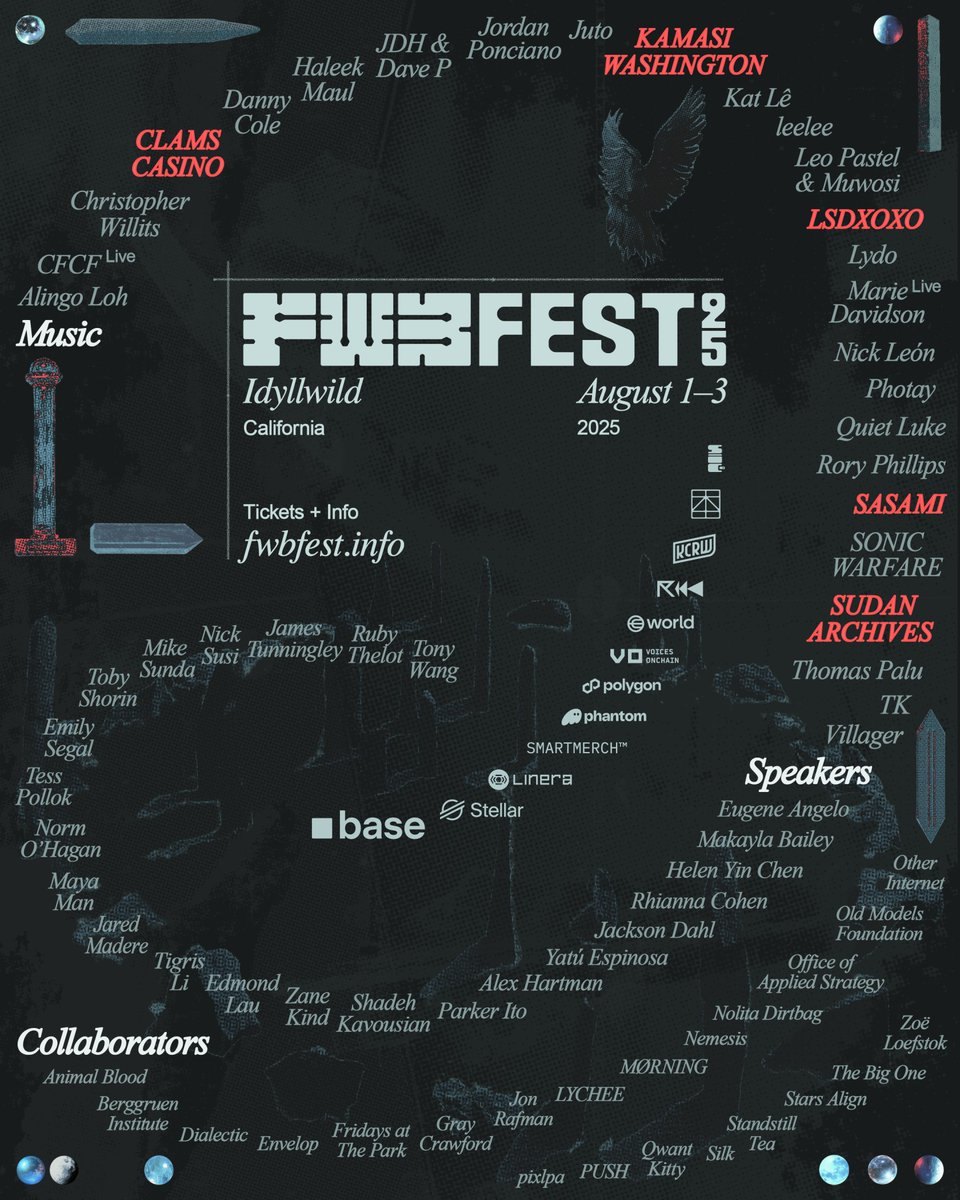
Linera is headed to the mountains! We’re a proud main sponsor of @FWBtweets in Idyllwild, CA, Aug 1–3. Music, tech, microchains—and maybe a free ticket? Follow this thread + read to the end for a shot at joining us under the pines. 👇🌲 #FWBFEST25
Linera ⛓️ tweet media
English
1.5K
30.6K
6.4K
366.2K
morgan edwards
morgan edwards@mrznerd1·
@alex___kos Polkadot’s DAO stack with Substrate and OpenGov makes decentralized governance feel like a first-class feature not a workaround
English
1
0
1
10
AleX KoS
AleX KoS@alex___kos·
DAOs on Polkadot – examples of decentralized governance Decentralized autonomous organizations (DAOs) are becoming a key governance tool in Web3. In the Polkadot ecosystem, this model is developing particularly actively thanks to the high flexibility of parachains, cross-chain capabilities, and modern governance mechanisms One of the most notable projects is SubDAO Network, which provides tools for creating DAOs of any complexity. They have already brought together more than 15 initiatives within the Polkadot DAO Alliance, which promotes DAO standards, funding for new projects, and legal recognition Another important initiative is Dora Factory, a DAO-as-a-service platform that provides modules for voting, funds, grants, and cross-chain asset management. It is aimed at technical teams, hackathons, and public goods Among the applied DAOs, the following stand out: - Imbue Network a crowdfunding platform where the community controls the financing of ideas; - GameDAO a DAO for the gaming industry with a focus on game development through DAO mechanics; - Acala a financial platform entirely managed by DAO; - Zenlink a community-managed DEX with cross-chain trading; - SpiderDAO a unique DAO model with dual governance that prevents the concentration of power @Polkadot also supports ecosystem DAOs such as Polkadot Fellowship, ChaosDAO, and others they are responsible for network development, moderation, research, and security Conclusion: @Polkadot demonstrates that DAO is not just a buzzword, but a real tool for collective decision-making. Thanks to the Substrate and OpenGov infrastructure, DAO governance in the ecosystem has become accessible, scalable, and practical. In the coming years, Polkadot may become the leader in DAO innovation in Web3
AleX KoS tweet media
English
25
0
24
94
morgan edwards
morgan edwards@mrznerd1·
@defiflop Warden stands out by integrating cross-chain data securely rather than focusing solely on chain interoperability or staking
English
1
0
1
2
Deviron
Deviron@0xDeviron·
Comparing Warden with Cosmos, Polkadot, and EigenLayer Warden Warden is a protocol for integrating verified external data into decentralized Web3 applications through Asynchronous Verifiable Resources (AVR) technology. It focuses on improving data reliability and security for smart contracts by connecting different blockchains into a single network. Cosmos @cosmos offers a modular multi-chain ecosystem with a focus on interoperability through IBC (Inter-@blockchain Communication). It creates an “internet of blockchains,” allowing different chains to interact and scale, but without a single common security level. Polkadot Polkadot is a multi-chain platform that provides shared security for parachains through a relay chain. It provides flexibility in creating custom chains with centralized security and powerful interoperability, focusing on scalability and consistency. EigenLayer EigenLayer is a restaking protocol that allows existing ETH stakes to be used to secure new protocols and services. Its focus is on maximizing economic security and extending Ethereum's functionality, rather than creating a new multi-chain ecosystem. Comparison of key aspects Security: @Polkadot and EigenLayer offer shared security, Cosmos does not, Warden focuses on data security. Interoperability: Cosmos and Polkadot have developed cross-chain interaction mechanisms, @wardenprotocol integrates data from different networks, EigenLayer expands Ethereum's functionality. Focus: Warden focuses on data security and verification, Cosmos focuses on multi-chain scaling, Polkadot focuses on shared security and scaling, and EigenLayer focuses on reusing Ethereum security. Conclusion Warden differs from cosmos , Polkadot , and @eigencloud in its focus on verifying and integrating external data for Web3, while other projects focus on scaling, shared security, or extending blockchain functionality. The choice depends on specific needs - whether data security, network scaling, or @ethereum enhancement is required.
Deviron tweet media
English
26
0
26
140
morgan edwards
morgan edwards@mrznerd1·
@defiflop Warden Protocol’s modular design really sets it apart for building adaptable and secure Web3 apps How do you see guards evolving to handle more complex fraud vectors?
English
1
0
1
7
Deviron
Deviron@0xDeviron·
Warden Protocol Architecture: Modularity, Security, Scalability Modularity Warden Protocol is built on the principle of modularity, allowing individual components to operate independently and be easily updated. Key modules - intents, guards, and executors - interact with each other, ensuring the flexibility and adaptability of the system Security Security in @wardenprotocol is achieved through multi-level checks. Guards validate user actions and smart contracts, protecting the network from fraud and errors. Cryptographic verification of external data is also used through Asynchronous Verifiable Resources (AVR) Scalability Warden's architecture supports asynchronous data processing, allowing it to efficiently handle large volumes of requests and integrate information from different sources without delays. Modularity and decentralization contribute to the horizontal scalability of the protocol Conclusion Warden Protocol combines modularity, high security, and scalability, making it a powerful platform for complex decentralized applications in the Web3 world
Deviron tweet media
English
26
0
25
140
morgan edwards
morgan edwards@mrznerd1·
@silandrift What makes Bless private clusters stand out for corporate blockchain solutions? Its on-chain governance and scalability are key for adapting to evolving business needs
English
0
0
0
6
morgan edwards
morgan edwards@mrznerd1·
@defiflop @wardenprotocol Warden’s approach unlocks flexible asset rules with guardians verifying every step, perfect for businesses needing fine-grained control How does Warden ensure guardians remain decentralized and unbiased?
English
1
0
1
3
Deviron
Deviron@0xDeviron·
How users manage their accounts in Warden through intents Managing digital assets in Web3 is often associated with complex smart contracts and technical barriers. @wardenprotocol changes this approach by introducing the “intents” model, which makes interacting with the blockchain easier and safer What are “intents” in Warden Intents are clear instructions from the user: what, where, and under what conditions something should happen. For example, “send 10 USDC to this address if the BTC rate falls below $60,000” or “allow the use of NFT only in a specific decentralized application.” These intents are not executed immediately - they are first verified by the system The role of “guardians” and secure execution Instead of trusting the smart contract code, the user trusts “guardians” - special modules that check intents for compliance with the rules. They automatically reject dangerous actions, check conditions, and only then initiate the transaction. This allows for flexible and secure management without complex programming. Flexibility without risk Thanks to intents, users can set their own rules: limit amounts, allow actions only to certain protocols, or activate functions under specific conditions. This is ideal for both DeFi beginners and businesses that want control without unnecessary complexity. Conclusion Warden Protocol takes Web3 asset management to a new level: understandable, controllable, and secure. Intents make interacting with the @blockchain as easy as formulating intentions - everything else is done automatically and protected by the system.
Deviron tweet media
English
27
1
29
133