Mauricio Salazar-Saenz

2.1K posts

Mauricio Salazar-Saenz

Mauricio Salazar-Saenz

@msalazsa

Director of @ofiscalpuj, Assistant Professor @JaverianaEcon Interested in fiscal policy, labor, household economics, time use, and gender gaps. Ph.D. @UNC.

Katılım Aralık 2019
1.1K Takip Edilen913 Takipçiler
Mauricio Salazar-Saenz retweetledi
Ricardo Emilio Barco 📈
Ricardo Emilio Barco 📈@ribarcodi·
@QueDiceLozano @petrogustavo @TataZambranos El desempleo baja, porque todos los días están saliendo del pais 1230 colombianos, a vivir en el extranjero. El 80% menores de 30 años. Eso lo confirma las cifras de remesas y la baja (enorme) en la natalidad en Colombia. No existe merito del gobierno en eso
Queens, NY 🇺🇸 Español
2
1
4
139
Mauricio Salazar-Saenz retweetledi
Sandra Borda 🪷🪷
Sandra Borda 🪷🪷@sandraborda·
Un duelo… el viaje de testosterona en el que andan este par es de tamañas proporciones. Esto se convirtió en una competencia de masculinidades tóxicas absolutamente insoportable. Si los hombres se pudieran oír alguna vez, no les alcanzaría la imaginación para darse cuenta lo inmensamente ridículos que suenan.
Español
2
77
363
27.2K
Mauricio Salazar-Saenz retweetledi
X-tian
X-tian@UnCaricaturista·
SEGUNDA VUELTA. Mi caricatura de hoy.
X-tian tweet media
Español
277
995
4.8K
568.7K
Mauricio Salazar-Saenz retweetledi
International Republican Institute
Our international election observation mission to Colombia’s 2026 presidential election has released its preliminary statement with findings & recommendations. Colombians voted in record numbers, demonstrating a strong commitment to democratic participation. Electoral authorities administered the process with professionalism, technical competence, & resilience. Despite criticism and allegations of fraud, observers found no evidence of systemic deficiencies that could compromise the integrity of the vote. We look forward to observing the June 21 runoff. 🇨🇴🗳️ #Elecciones2026 #ColombiaVotes Read the full statement (Spanish version coming soon): iri.org/resources/iri-…
International Republican Institute tweet media
English
33
101
173
19.8K
Mauricio Salazar-Saenz
Más radicalizados y rotos. Ojalá el sentido común y de construir patria mueva a cada Colombian@. Exijámosle a los políticos que gobiernen para tod@s y no sólo para sus barristas. Ya que nacimos, exijamos. Ellos son nuestr@s empleados. Los que elegimos y exigimos somos nosotr@s.
Español
0
0
5
79
Mauricio Salazar-Saenz retweetledi
Andre Silva
Andre Silva@andresilvatw·
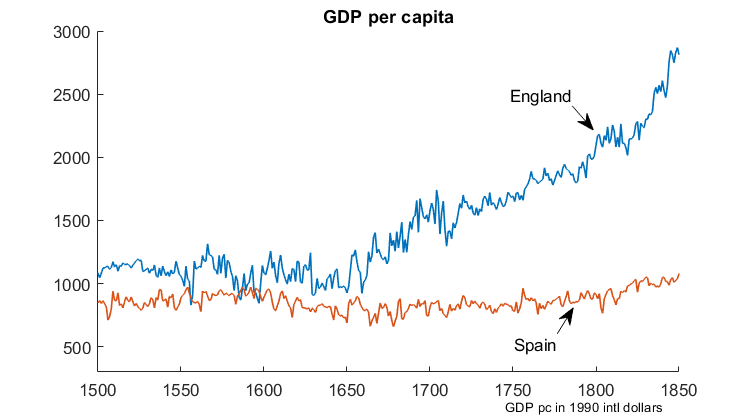
"The series also shows that Spain did not benefit from its empire. That is a problem for every theory tying colonies to modern growth." This is important and surprising: with all the gold and new territory, GDP per capita in Spain did not increase. The figure below shows the same message with a different dataset. GDP per capita in Spain is almost flat between 1500 and 1800. It is not gold that explains the wealth of nations
Andre Silva tweet media
Jesús Fernández-Villaverde@JesusFerna7026

How has the Spanish economy performed over the very long run? To answer, I use Leandro Prados de la Escosura’s (@LdelaEscosura) data on real GDP per capita from 1277 to 2024. I express Spain’s figure as a ratio to Britain’s, since Britain was the first economy to achieve modern economic growth, from around 1660, and has been the leader, or close to it, ever since. Spain, within its present borders, was prosperous in the Late Middle Ages, well ahead of Britain, then a peripheral corner of Europe. The Black Death and its aftermath hit Spain harder, and by 1360, the two economies had converged. That parity held until 1600, when Spain began a long decline, in absolute terms (on the eve of the French Revolution, it was barely above its 1600 level, after a deep slump in between) and in relative terms (Britain pulled steadily away). The standard explanations, the Habsburg wars, and the serial bankruptcies run into one problem. They can account for the poor performance between 1550 and 1650, but not for the stagnation between 1650 and 1789. 140 years of stagnation is far more than wars and debt under the Habsburgs can explain. The series also shows that Spain did not benefit from its empire. That is a problem for every theory tying colonies to modern growth. At most, one can argue that colonies were a necessary condition for takeoff (I do not believe even that, but leave it for another day). One cannot argue that they were sufficient. The period from 1789 to 1936 was no kinder. The economy grew a little, and Spain built a modern but unfinished liberal state. Yet it never closed the distance to Britain. It is hard not to read the period from 1789 to 1936 as a national failure and the Civil War as its final consequence. The recent efforts of some historians to paint those years in brighter colors strike me as unfounded. Spain did not fail at modernization as badly as China, but it did not succeed. A deeply corrupt dynasty, closed and incompetent elites in Madrid, Barcelona, and Bilbao, and an economic policy built on intervention and protection (by 1920, Spain was the most protectionist economy in the Western world, so much for the friends of protection) together made the country a basket case. A cruel civil war left Spain at its historical low, with just 31% of the British GDP per capita. The foreign visitors who arrived in the early 1950s found a poor, backward country. Policy in the first twenty years of the dictatorship was awful. Autarky was not so much imposed by the Allies as chosen. Spain’s rulers, using their quasi-fascist Weltanschauung, believed growth would come from state intervention, closed markets, and unorthodox fiscal and monetary policy. Then, in 1959, policy changed. Spain adopted a more orthodox fiscal and monetary policy and opened to foreign investment and trade. The results were spectacular. For forty years, Spain grew briskly and became the modern country it is today. By 2001, it had reached 77% of British GDP per head. But the internal contradictions of two things eventually became binding: the growth model launched in 1959, and the political regime created by the 1978 constitution. By 2024, Spain had slipped back to 74% of British GDP per head. This is worse than it looks. Britain itself has done poorly over the past twenty years, and losing ground to a weak performer is a bad sign. Spain stands at a crossroads, economic and political. The country’s foundations no longer work, but its political and business elites have failed to understand this fundamental reality. A good grasp of its economic history helps make sense of its present predicament.

English
70
260
1.3K
207.7K
Mauricio Salazar-Saenz retweetledi
Diego Montañez-Herrera
Diego Montañez-Herrera@DiegomontanezH·
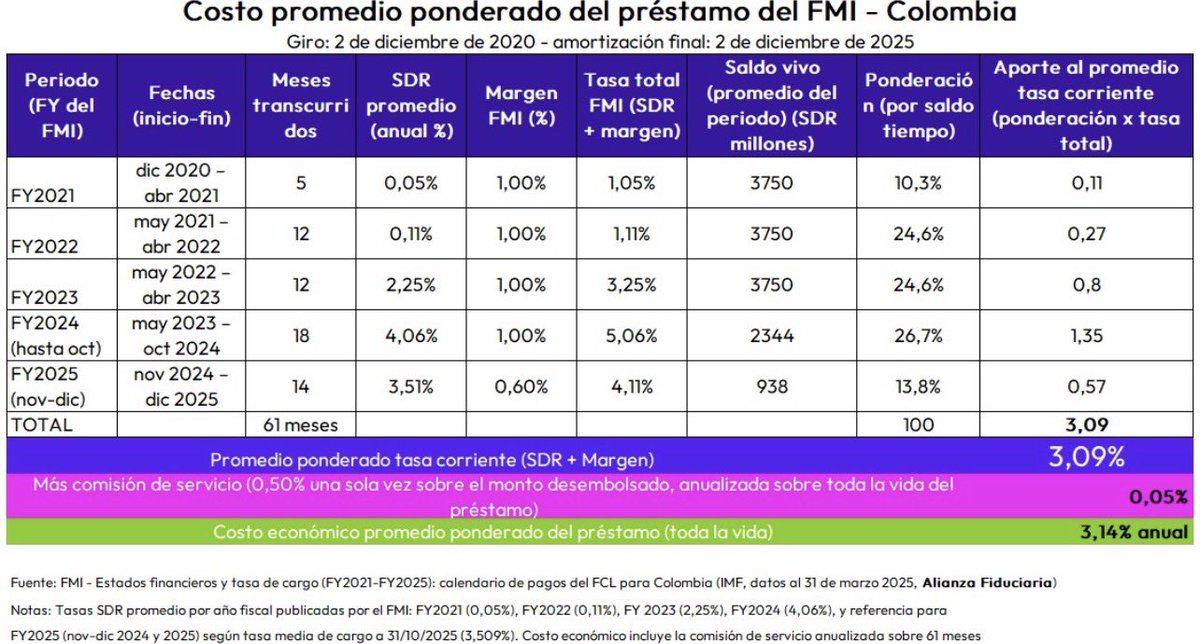
Hola León. Voy explicar cómo si fueras un estudiante mío de primer semestre de economía: La deuda total (🟡61,2% del PIB) es igual a la deuda interna (🔵43,7) + deuda externa (🟥17,5) Sí, la azul baja (-0,9pp) pero la roja sube más (+4,7pp). Y “FMI” mira las tasas y lo que pesa👇
Diego Montañez-Herrera tweet mediaDiego Montañez-Herrera tweet mediaDiego Montañez-Herrera tweet media
León Fredy Muñoz@LeonFredyM

.@petrogustavo entrega un país más soberano y menos endeudado con el mundo. Se pagó el crédito de @IvanDuque con el @FMInoticias, y la deuda externa hoy llega a MÍNIMOS HISTÓRICOS Tenemos una economía menos vulnerable a las crisis internacionales y con mayor capacidad para decidir su propio rumbo. Tendremos un segundo gobierno de cambio para asegurar nuestra dignidad y soberanía

Español
11
60
154
9K
Mauricio Salazar-Saenz retweetledi
Observatorio Fiscal
Observatorio Fiscal@ofiscalpuj·
(1/N) #NuevoInformeFiscal A tres días de las elecciones, analizamos las propuestas fiscales de los tres candidatos que lideran las encuestas: Cepeda, De la Espriella y Valencia. Hay visiones fiscales distintas, pero todas requieren mayor desarrollo. Va 🧵 ofiscal.org/_files/ugd/d2e…
Español
1
2
1
354
Mauricio Salazar-Saenz retweetledi
Angélica María Gómez
Angélica María Gómez@Ang_MGomez·
Esta noche estaremos hablando un rato de nuestro presente y nuestro futuro con @ribarcodi y @msalazsa . No se lo pierdan!!!
Angélica María Gómez tweet media
Español
1
3
7
459
Mauricio Salazar-Saenz retweetledi
Zhu Jingyang
Zhu Jingyang@zhu_jingyang·
Un proceso serio, sin improvisar, sin impulsos ni caprichos. 😉
Español
4
17
393
6.2K
Mauricio Salazar-Saenz retweetledi
Jose Ignacio Lopez
Jose Ignacio Lopez@JoseILopez·
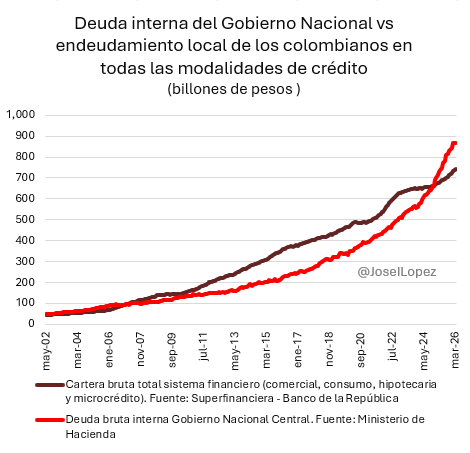
La deuda interna del Gobierno ya supera en 125 billones la deuda de TODOS los colombianos con el sistema financiero en todas las modalidades (comercial, consumo, hipotecario y microcrédito). Desde agosto de 2022 hasta la fecha, la cartera bruta de crédito ha crecido 142 billones, mientras la deuda interna del Gobierno ha aumentando en 386 billones. No sorprende que la presión de la deuda pública en el mercado local financiero haya elevado y mantenga las tasas de interés altas.
Jose Ignacio Lopez tweet media
Español
4
125
180
21K
Mauricio Salazar-Saenz
Mauricio Salazar-Saenz@msalazsa·
En la sociedad de conocimiento deberíamos tener algunos autores en este ranking y al menos entender de qué está hablando el mundo en la frontera. Por ahora tenemos los diseños en Paint de cuando estaremos en los primeros puestos...
Robert Lauko@robert_lauko

See the top ranked papers in AI, ML, Robotics, Quantum Physics, and more on @kurateorg. Hundreds of arXiv preprints ranked daily by scientific impact through pairwise tournaments judged by Claude, GPT, and Gemini.

Español
0
0
0
47
Mauricio Salazar-Saenz retweetledi
Observatorio Fiscal
Observatorio Fiscal@ofiscalpuj·
(1/N) #NuevoInformeFiscal Entre 2022 y 2026, el gasto del empleo público aumentó 31%, mientras los cargos crecieron solo 4%. El hallazgo más importante está aquí: más gasto rígido, menos margen fiscal. Va🧵con todos los detalles👇 ofiscal.org/_files/ugd/d2e…
Español
1
1
1
276
Mauricio Salazar-Saenz retweetledi
Freddy Vega
Freddy Vega@freddier·
Corruption hasn't improved in Latin America in the past decade. No matter if people vote right or left. Education scores are down globally, but worse in the region. Violent crime is higher than anywhere else in the world. Economy growth has stalled for 10 years. On top of that...
Freddy Vega tweet media
English
8
29
196
12.2K
Mauricio Salazar-Saenz retweetledi
Our World in Data
Our World in Data@OurWorldInData·
How much do countries reduce income inequality through taxes and transfers? Most countries reduce income inequality through taxes and transfers — taxing higher incomes more, and redistributing through benefits like pensions, unemployment support, and family allowances. But how much each country reduces inequality varies a lot, as you can see in the chart. This data comes from the OECD Income Distribution Database (IDD), one of the few internationally harmonized sources that measures income inequality both before and after taxes and transfers. Our colleague @parriagadap recently updated our charts with the latest release from the OECD. It now covers 45 countries (OECD members plus select non-members) with annual data going back to 1976. The OECD updates the IDD on a rolling basis, and we plan to refresh our charts annually.
Our World in Data tweet media
English
6
84
208
29.4K
Laura Ardila Arrieta
Laura Ardila Arrieta@Laura_Ardila_A·
Sí se dijo, Luz María. Textualmente afirman que Cepeda es "heredero de una dinastía política" porque a lo largo de más de 100 años personas con las que comparte tronco familiar crearon distintas estructuras de poder político, muchas de las cuales no tienen nada que ver entre sí. Además, se atreven a asegurar que por esa consanguinidad todas esas personas constituyen "un mismo clan". Eso es absolutamente incorrecto. La información hay que darla, pero fiel al contexto y sin inventar conclusiones.
Luz María Sierra@LuzMaSierra

@Laura_Ardila_A Laura eso no se dijo en el artículo. Simplemente se dijo cuáles son sus ramas familiares. Es información y hay que darla.

Español
34
521
1.8K
51.3K
Mauricio Salazar-Saenz
Mauricio Salazar-Saenz@msalazsa·
Lo que se ve en otros lados: "Ya hemos visto lo que sucede cuando el Ejecutivo se mete en el rol del BCR. Lo vivimos en los 80s. El lamentable ataque del presidente de Colombia a su banco central debería ser una advertencia aquí." ¿Quiénes no aprendieron la lección en los 80s?
Diego Macera@dmacera

Conversamos entre economistas sobre el rol del BCRP y su futuro en un espacio de El Comercio. Algunas ideas: - El BCR funciona excepcionalmente bien bajo cualquier métrica razonable de su misión institucional. No es buena idea andar cambiando irresponsablemente lo poco que sí funciona. - El banco tiene una misión única -mantener el valor de la moneda-, y la cumple. Si le empiezas a dar muchos objetivos, no va a poder cumplir bien ninguno. - Ya hemos visto lo que sucede cuando el Ejecutivo se mete en el rol del BCR. Lo vivimos en los 80s. El lamentable ataque del presidente de Colombia a su banco central debería ser una advertencia aquí. - MP: "No es casualidad que tengamos la moneda más estable de Latinoamérica. El Perú no es un país mágico donde la inflación se maneja sola". Por eso, quizá, pecamos de soberbios, como si hubiera un derecho divino a tener inflación controlada. Pero detrás de eso hay un enorme esfuerzo institucional del día a día. - Con las reservas internacionales no se juega. Son el respaldo del sol, que es la base de nuestra economía. Por ejemplo, con la elección de Castillo en el 2021, salieron cerca de US$17.000 millones de la economía, y un movimiento así puede generar una crisis instantánea, pero aquí se pudo manejar con la intervención del BCR. De lo contrario el tipo de cambio tranquilamente se podría haber ido a S/5 o S/6 por dólar. elcomercio.pe/economia/peru/…

Español
0
1
1
257