When I design an investment plan for clients, I like to walk through "expectations".
Because the best investment plan is the one you can stick with.
I built this interactive tool with Claude to help educate on different allocations and create more realistic expectations.
Still a work in progress, but it's looking pretty good!
I continue to think $HROW is one of the most undervalued / mispriced growth stocks in the entire market.
$HROW is down -33% in the past couple weeks, now trading at 15x NTM ev/ebitda... despite management saying CY2026 revenues will be up +32% YoY (midpoint of guidance) and ebitda will be up +45% YoY (midpoint of guidance).
Management said multiple times in the shareholder letter and the earnings call that this guidance is conservative.
If you are interested in $HROW or already have a position, I strongly encourage you to listen to the CEO from yesterday's presentation at the Leerink Healthcare conference... event.summitcast.com/view/mT9poctHD…
During this presentation, Mark (founder & CEO) said their current guidance is "base case" for CY2026.
I used to tell my subs that I'm always looking for breadcrumbs... Mark dropped some big ones during this presentation. I'm listening to it for the second time right now.
Not only is $HROW expecting approval next month on a new indication, but he said they're presenting data in July for Izeeho that he thinks can 4x their market share.
Then he said G-Melt could be in market within the next 18-24 months and has the potential to become their biggest revenue product ever.
CEO also said they are doubling the size of their sales teams over the next 3-6 months because the ROI of having better coverage in more markets is just too obvious.
Mark continues to say they can get to $250M in quarterly revenues by CY2027 Q4, which implies approx $1B in CY2028 revenues.
Right now $HROW is expecting CY2026 ebitda margins of 26%, if anyone knows biopharma companies and margins... as they scale revenues from here, those margins will get much better. It's very possible $HROW has 35-40% ebitda margins in CY2028 at which point they could be generating $350-400M of ebitda... right now the current enterprise value is $1.5B... so it's possible that $HROW is currently trading at just 4x CY2028 ev/ebitda not including all the cash they'll generate over the next few years.
I honestly think $HROW has the potential to be a 5-bagger over the next 3 years.
NFA.
DYOR.
*We own $HROW at @FirstWaveFund; as of this morning it's now a top 8 position.
I sold five contracts. I sold the puts. I received the premium for selling the contract. If $RKLB finishes in the money at expiration, I'll get to own the shares at the strike price. If not, I just keep the premium. Join our Discord, it's free to try and you can see how we do it daily.
$2,376.47 collected today, selling options! 🥳
(5) $RKLB 3/13/26 $66.00 Cash Sec Put--->$1060.00
(200) $EOSE 3/20/26 $8.50 Covered Call-->$199.49
(1) $RTX 3/20/26 $195.00 Cash Sec Put----->$217.49
(60) $EOSE 7/17/26 $15.00 Covered Call---->$899.49
We trade live, daily right here on X available in my subscribers section, or link to my Discord, in my profile.
whop.com/selling-option…
I have clients receiving $300k-$500k+ in stock compensation every year.
And most of them are still holding 50-80% of their net worth in a single company.
That's not an investment strategy. That's concentration risk.
Here are 5 ways to fix it while keeping your tax bill as low as possible...
@markcecchini Congrats!
Thoughts on options overlay managers for income & protection for vested employer stock? Working with a google employee where this could be a good fit to keep exposure. They’re in the top bracket though. Checking out Jersey city manager-McMillan.
I don’t have nearly as much time anymore to write new content…
That’s unfortunate.
Between time crunch + a layer of compliance review, the bespoke long form stuff and graphics have taken a real back seat.
On the plus side, today we crossed $100k/month in recurring revenue.
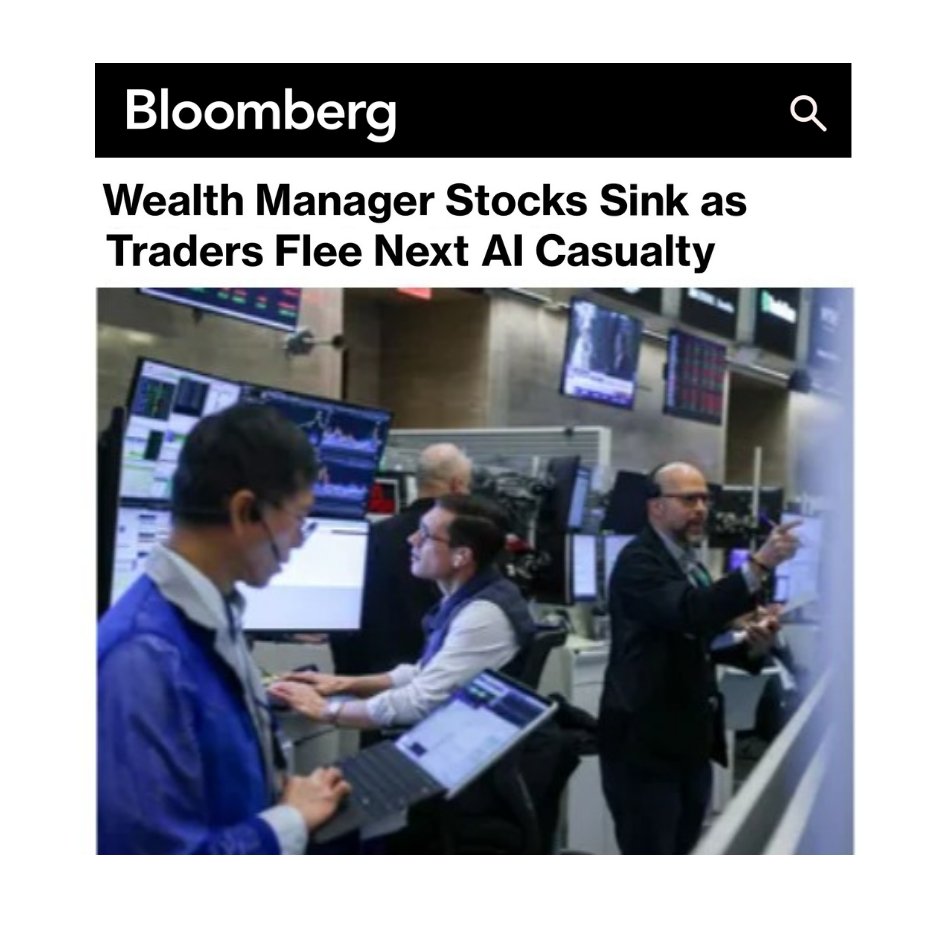
The biggest threat to the wealth management model isn’t AI.
It’s clients doing the math.
The next wave is coming
Not automation of advice
Fee awareness
Why pay an uncapped 1% of your net worth every year…
For advice that has nothing to do with how much your portfolio grew?
Your CPA doesn’t charge 1% of your income
Your attorney doesn’t charge 1% of your house
But in wealth management?
The bigger your account gets
The bigger their raise
Automatic
Forever
And here’s the part that stings:
Most of the real value in financial planning isn’t managing money
It’s tax strategy
Cash flow design
Deferred comp elections
Equity comp timing
Retirement distribution sequencing
None of which scale with your portfolio size
Yet the fee does
Index funds killed stock pickers
Hourly and flat fee planners are coming for the 1% crowd
This won’t flip overnight
It never does
It’s gradual
Then all at once
Incentives don’t lie
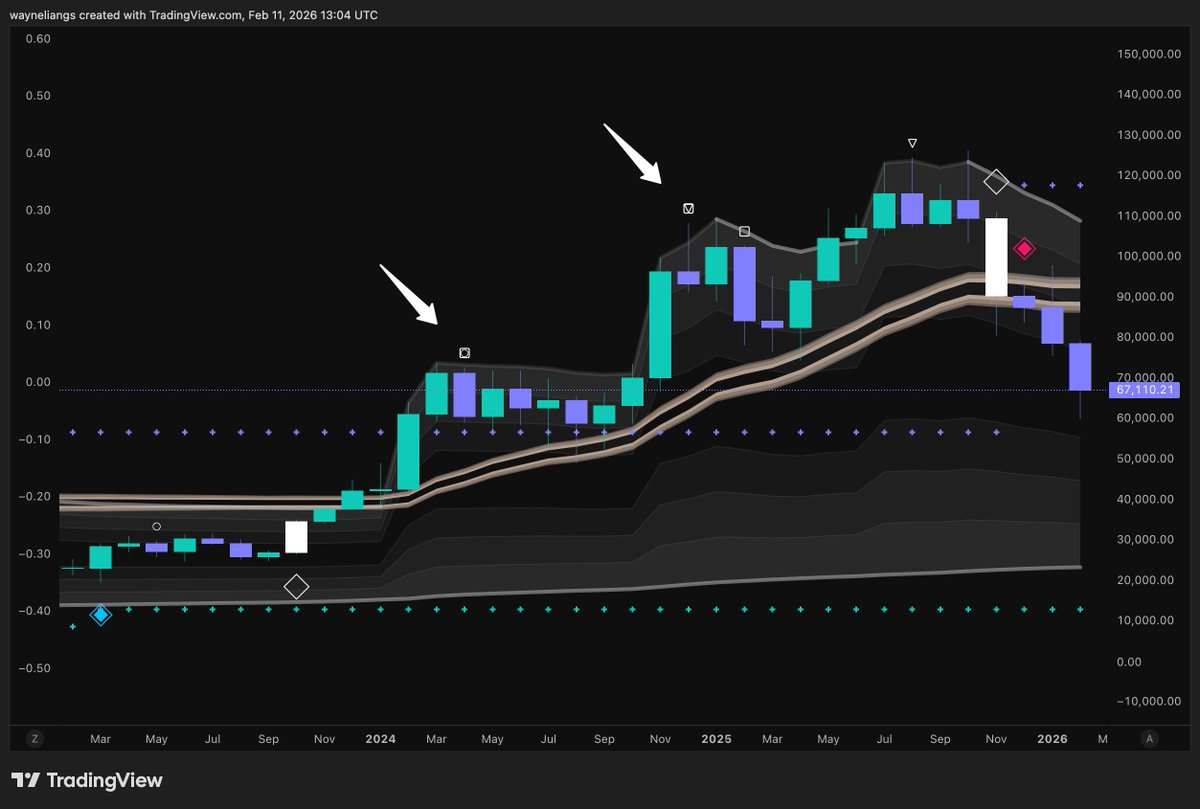
One of the easiest & safest ways to DCA into $BTC or $MSTR is when confluence symbols appear beneath a candle (they often nail the local highs/lows), saving your largest entry for the Monthly BD.
Last Monthly BD took us from $23,000 to $125,000. The next one will not disappoint.
@bryanhasling What are some of the pros/cons?
Is the setup hard with Schwab?
What's the better alternative for a client already with a foundation that just needs to offset a large tax liability for this year only?
I have no affiliation, but I really can't stop raving about Daffy - for managing Donor-Advised Funds.
And I say this as an advisor who manages wealth in Schwab, which also offers a DAF.
There are pros/cons to using either. But I've been impressed with the User Experience, and little touches that make clients want to keep using (and giving!) to their DAFs through Daffy.
Just donated more highly-appreciated stock to a client's account who will get the full charitable deduction.
I have a simple and profitable holiday ritual this time of year:
1. I login to my brokerages and see my net capital gains for the year
2. I sell a couple of losing positions to net out to zero net gains for the year
3. I rebuy strategically, keeping my portfolio neutral
@CaesarsSports Warning do not play blackjack online with Caesars. They have a glitch in the software and they won't credit you if you have a high percentage hand. Please see screenshots below and contact me for more info.
@PAGamingControl that isn't possible at a real casino, it can't just magically change the cards like online can. There's no way it can be legal to do that. The way their BJ is right now makes it a slot, not a table game.
@PAGamingControl You guys need to seriously look at Caesars Palace online. I have an appeal going, but I hardly hear from Chris. The blackjack is rigged so that when you bet more the players win chance is lowered
@nickmeals We've got a fantastic spreadsheet that includes all the taxes beyond the brackets...taxable SS, IRMAA, NIIT, state taxes and more. It creates a roadmap for distributions through the years to minimize lifetime taxes.
Trying to convince a client that converting everything to a Roth ASAP isn't necessarily the greatest idea in the world given his age.
This spreadsheet is going to be something to behold.
The IRS officially released 2026 contribution limits:
Solo 401k: $72,000
Employee 401k: $24,500
Catch-up 401k (if above 50): $8,500
IRA: $7,500
HSA: $4,400 (single) / $8,750 (family)
You could do almost $80K into your Roth IRA next year with the mega backdoor loophole!
I wish I just managed money.
It would make my day-to-day a hell of a lot easier.
If I just managed money, I wouldn't need to:
• Vet P&C insurance agents because a client's closing is in 48 hours and their current coverage is inadequate
• Jump on urgent calls during tender offers, walking clients through tax implications while they're sitting in their car between meetings
• Host 14 client planning meetings in a week, each one requiring custom prep because everyone's situation is different
• Negotiate with estate attorneys on how to bill a client and collect info because we already have 90% of what they would ask for
• Review beneficiary designations across all insurance policies and retirement accounts because someone just remembered they never updated them after their divorce
• Model complex liquidity events across tech, small business, and medicine (pre, during, and post-liquidity and proceeds)
• Coordinate with CPAs during tax season who all want information yesterday and don’t have a constant line to the client the same way we do
• Talk someone off the ledge when their ISO exercise triggers an AMT situation they didn't see coming
• Build a relationship with every professional in your client's life (attorneys, CPAs, insurance agents, bankers) because you're in a position quarterback that nobody else can be
Don't get me wrong, I love investing.
The markets are fascinating.
I'm 2/3 of the way done with the CFA program. Say what you want about that, but you don't subject yourself to that level of self-torture if you don't like digging into the investment side.
Portfolio management and account management are some of the biggest value-added functions we provide.
I wish this job were as easy as the naysayers say it is. Click a few buttons, place a few trades.
Claiming that we just manage money for a hefty fee and don’t add any value is just not ground truth.
Tax Planning is one of the biggest value adds I provide
But that doesn't mean the goal is to achieve zero taxes owed
Rather to reduce lifetime taxes and not leave the IRS a tip
But even so, no decision should solely be made on the basis of, "it's tax deductible"
Many people have been comparing the current market to 1999. In my opinion, public markets are not in a bubble, but private equity is. Public markets are moving higher due to PROFITABLE companies growing and showing tremendous earnings growth. Private credit, however, is in a bubble similar to 1999. Back then, everyone was investing in high-growth, unprofitable companies that eventually blew up. This is precisely what is happening in private equity. They are investing in high-growth, unprofitable AI companies at insane valuations. This will not end well for the Private markets.