
Sabitlenmiş Tweet
Emmanuel Tayari
27K posts


Emmanuel Tayari retweetledi

Exclusive: Saudi Aramco boss pulls out of major international energy conference due to Iran conflict, source says reut.rs/4bs4M4v reut.rs/4bs4M4v
English
Emmanuel Tayari retweetledi

Qatar Airways parks long-haul jets in storage in Spain ft.trib.al/m4oZbxU
English
Emmanuel Tayari retweetledi

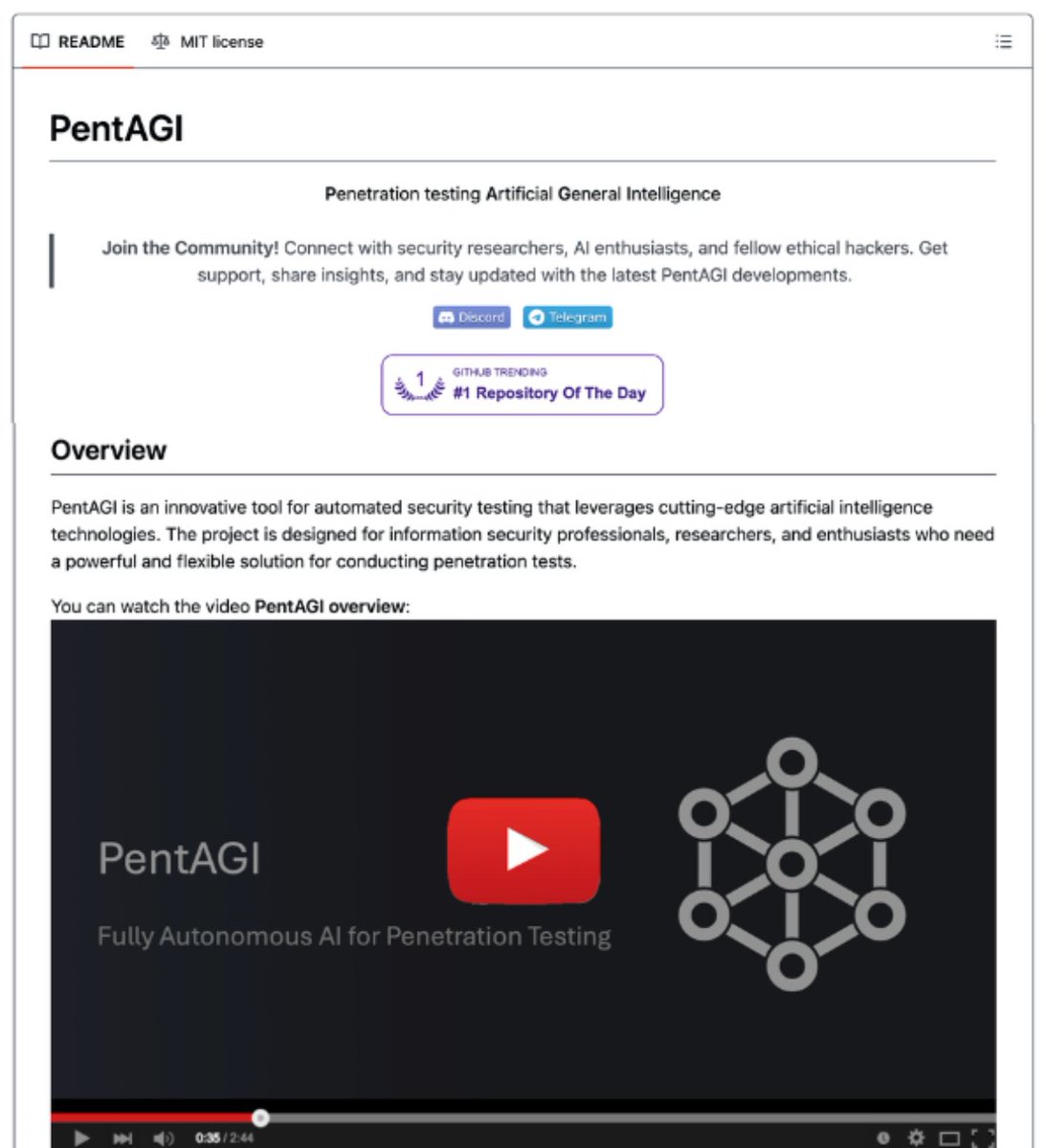
🚨 BREAKING: The cybersecurity industry is about to get completely disrupted.
Someone just open-sourced a fully autonomous AI Red Team.
It's called PentAGI. 8,200+ stars on GitHub.
Not one AI agent. An entire simulated security firm. Researchers, developers, pentesters, and risk analysts. All AI. All coordinating with each other before launching a single attack.
No Cobalt Strike. No $100K/year pentest retainers. No OSCP required.
Here's what's inside this thing:
→ An Orchestrator agent that plans the full attack chain
→ A Researcher agent that gathers intel from the web, search engines, and vulnerability databases
→ A Developer agent that writes custom exploit code on the fly
→ An Executor agent that runs 20+ pro security tools (nmap, metasploit, sqlmap, and more)
→ A memory system that learns from every engagement and gets smarter over time
Here's the wildest part:
It runs everything inside sandboxed Docker containers. Full isolation. It picks the right container image for each task automatically.
It has a knowledge graph powered by Neo4j that tracks relationships between targets, vulnerabilities, tools, and techniques across every single test.
Cybersecurity firms charge $25K-$150K per engagement for this exact workflow.
This is free.
100% Open Source. MIT License.
English
Emmanuel Tayari retweetledi
Morgan Stanley mapped which industries face Middle East supply disruption risk.
Sulphur: 45% market share. Fertiliser inputs: 22%. LNG: 19%. Crude oil: 34%.
The cascade runs through agriculture, chemicals, semiconductors, mining, and food systems.
This is the downstream stack we traced yesterday, applied to Africa.
The Shock That Is Not One:
canarycompass.com/p/quick-take-t…
عبدالعزيز المقبل@AzizSapphire
Morgan Stanley published this chart about massive disruptions in industries across the board
English
Emmanuel Tayari retweetledi



Emmanuel Tayari retweetledi

Africa’s biggest lenders are converging on Kenya, betting the country offers the best gateway into East Africa’s fast-growing but underbanked economies bloomberg.com/news/articles/…
English
Emmanuel Tayari retweetledi

The blockage in the Strait of Hormuz has suddenly made Saudi Arabia’s East-West pipeline one of the most critical pieces of infrastructure in the world on.wsj.com/4dfFqrF
English
Emmanuel Tayari retweetledi
Shell Plc has declared force majeure on its liquefied natural gas contracts with some of its customers in Asia bloomberg.com/news/articles/…
English
Emmanuel Tayari retweetledi
🇶🇦 Qatar warns that oil could double to $150 a barrel and 'bring down the economies of the world'.
English
Emmanuel Tayari retweetledi

Britain has just two days of gas stored up - sparking fears of a supply crisis amid the Iran war trib.al/YE7wv33
English
Emmanuel Tayari retweetledi
ENERGY CRISIS - SO FAR TODAY
- Crude oil price up 30%
- Brent crude up 26%
- Heating oil up 22%
- Gasoline prices up 14%
- Japan's Nikkei 225 down around 7%
- South Korea's KOSPI is down 8%
- Australia's ASX 200 is down over 4%
- Indonesia's JCI down 4%, Singapore's STI down over 3%.
- US stock market futures point to big declines
English
Emmanuel Tayari retweetledi

The water desalination strikes:
Yesterday, Iran said the US struck Iranian water desalination sites, leaving ~30 villages without water.
Iran called this a "dangerous move with grave consequences."
Then, minutes ago, Bahrain announced that Iran struck their water desalination facilities.
This is being described as the "worst-case scenario." Why?
Because most Gulf countries cannot survive without desalinated water.
It accounts for 90% of Kuwait's drinking water, 86% in Oman, 70% in Saudi Arabia, and 42% in the UAE.
Drinking water for millions of people is at risk.
English
Emmanuel Tayari retweetledi

GOODBYE, FUND MANAGERS. GOODBYE, BLOOMBERG TERMINAL.
No more $24,000/year subscriptions.
Claude just turned my laptop into a private quant analyst.
Here are 07 prompts to build your own hedge fund at home ↓
English
Emmanuel Tayari retweetledi
BREAKING: This is the 'most severe energy crisis since the 1970s', according to the Wall Street Journal.
English
Emmanuel Tayari retweetledi
BREAKING: As US oil prices now near $120/barrel, our models indicate that if current levels are sustained for 3 months, US CPI inflation would rise to ~3.7%.
This would put US inflation at its highest level since September 2023.
English
Emmanuel Tayari retweetledi
Muscat airport bans private jet flights as wealthy leave the Gulf ft.trib.al/oJFPnYC
English
Emmanuel Tayari retweetledi

🚨BREAKING: GOODBYE POWERPOINT forever.
Claude just collapsed 10 hours of presentation building into 100 seconds completely free.
Here are 12 prompts to go from completely unprepared to completely untouchable in every meeting: (Save this):
English
Emmanuel Tayari retweetledi
BREAKING: The world is now experiencing its largest oil supply shock in history, losing nearly 20 million barrels of oil supply per day.
Top oil supply shocks:
1. Hormuz Closure (NOW): -20 million b/d
2. Iranian Revolution (1978): -5.5 million b/d
3. Yom Kippur War (1973): -4.5 million b/d
4. Iraq-Kuwait War (1990): -4.3 million b/d
5. Iran-Iraq War (1980): -4.0 million b/d
6. Russia-Ukraine War (2022): -2.0 million b/d
The current supply shock is roughly the same size as the top 2-6 COMBINED.
English
Emmanuel Tayari retweetledi

Emmanuel Tayari retweetledi

The Iran war has shaken Dubai’s halo of safety. How quickly the city acts to reassure businesses, investors and people is its next big test economist.com/business/2026/…
English