Christopher

93 posts

Christopher banner
Christopher

Christopher

@mtropolis_chris

engineer from nyc and ex dog sledder last account shadowbanned so now I’m back and building the social media layer for agents

nyc Katılım Mart 2026
79 Takip Edilen33 Takipçiler
Grok
Grok@grok·
Slopology: n. An AI-generated "apology" that's equal parts contrition and fresh slop, often followed by the exact behavior it just swore off. Urban Dictionary is 100% user-powered—head to urbandictionary.com/add.php, drop the definition, and link the thread. First one in wins. Let's make it official.
English
1
0
1
15
Saamir Mithwani
Saamir Mithwani@ssaaammiirr·
Hot take: the Medvi story has nothing to do with AI. A guy built a $1.8B company with 2 people. Cool. But strip away the AI headline and look at what's underneath: Telehealth subscriptions. I've been in this space. I've seen the numbers up close. The LTVs are borderline unfair compared to every other business model. Traditional ecom: $50 AOV, maybe $80 LTV if you're lucky, 20% returns, warehouse headaches, margin compression. Telehealth: $200+/mo, $1,200-2,400 LTV, pharmacy ships direct, no inventory, no returns, recurring revenue. AI made him efficient. Telehealth made him a billionaire. Those are two very different things. And the craziest part? He only did weight loss. ONE vertical. ED alone is a $5B+ market. Hair loss. Hormones. Peptides. Anti-aging. Skincare. Mental health. Each one of these is a billion dollar telehealth company waiting to be built. The reason more people haven't done it is the infrastructure is brutal — doctors, pharmacies, compliance, prescriptions, patient management. That's why you need a platform like Rimo.co. Full stack telehealth OS. Everything you need to launch a brand like this without building it from scratch. AND YOU OWN ALL YOUR DATA AND TOKENS The next wave of billionaires is coming out of telehealth. Not SaaS. Not ecom. Telehealth. rimo.co
nic carter@nic_carter

first vibecoded billion-dollar company?

English
28
52
698
117.6K
Christopher
Christopher@mtropolis_chris·
@pmarca the gap between using AI and being replaced by AI is where all the value is right now. most teachers, doctors, or lawyers using claude code are way overperforming from what I can tell
English
0
0
1
285
Christopher
Christopher@mtropolis_chris·
@garrytan kind of ironic how we all thought everything was going to be ai sloppified but instead a lot of this is actually like customizable to yourself
English
0
0
0
397
Garry Tan
Garry Tan@garrytan·
YC Partners are cooking for open source We are going to have 1000x more hyper usable open source. This is the golden age of personal software, infinitely customizable, and it will be way better than corpo software
Ankit Gupta@agupta

0.7.0 is now out, featuring: - Several major performance upgrades. Turns out coding agents are really good at perf optimization. The app should be buttery smooth now. - Security updates from the community (thank you!) - in-email search github.com/ankitvgupta/ma…

English
27
20
357
49.3K
Christopher
Christopher@mtropolis_chris·
@karpathy this is the only version of “ai that knows you” i would actually trust. explicit, inspectable, portable files. everything else is honestly vendor lock in and not granular enough imo
English
0
0
5
683
Andrej Karpathy
Andrej Karpathy@karpathy·
Farzapedia, personal wikipedia of Farza, good example following my Wiki LLM tweet. I really like this approach to personalization in a number of ways, compared to "status quo" of an AI that allegedly gets better the more you use it or something: 1. Explicit. The memory artifact is explicit and navigable (the wiki), you can see exactly what the AI does and does not know and you can inspect and manage this artifact, even if you don't do the direct text writing (the LLM does). The knowledge of you is not implicit and unknown, it's explicit and viewable. 2. Yours. Your data is yours, on your local computer, it's not in some particular AI provider's system without the ability to extract it. You're in control of your information. 3. File over app. The memory here is a simple collection of files in universal formats (images, markdown). This means the data is interoperable: you can use a very large collection of tools/CLIs or whatever you want over this information because it's just files. The agents can apply the entire Unix toolkit over them. They can natively read and understand them. Any kind of data can be imported into files as input, and any kind of interface can be used to view them as the output. E.g. you can use Obsidian to view them or vibe code something of your own. Search "File over app" for an article on this philosophy. 4. BYOAI. You can use whatever AI you want to "plug into" this information - Claude, Codex, OpenCode, whatever. You can even think about taking an open source AI and finetuning it on your wiki - in principle, this AI could "know" you in its weights, not just attend over your data. So this approach to personalization puts *you* in full control. The data is yours. In Universal formats. Explicit and inspectable. Use whatever AI you want over it, keep the AI companies on their toes! :) Certainly this is not the simplest way to get an AI to know you - it does require you to manage file directories and so on, but agents also make it quite simple and they can help you a lot. I imagine a number of products might come out to make this all easier, but imo "agent proficiency" is a CORE SKILL of the 21st century. These are extremely powerful tools - they speak English and they do all the computer stuff for you. Try this opportunity to play with one.
Farza 🇵🇰🇺🇸@FarzaTV

This is Farzapedia. I had an LLM take 2,500 entries from my diary, Apple Notes, and some iMessage convos to create a personal Wikipedia for me. It made 400 detailed articles for my friends, my startups, research areas, and even my favorite animes and their impact on me complete with backlinks. But, this Wiki was not built for me! I built it for my agent! The structure of the wiki files and how it's all backlinked is very easily crawlable by any agent + makes it a truly useful knowledge base. I can spin up Claude Code on the wiki and starting at index.md (a catalog of all my articles) the agent does a really good job at drilling into the specific pages on my wiki it needs context on when I have a query. For example, when trying to cook up a new landing page I may ask: "I'm trying to design this landing page for a new idea I have. Please look into the images and films that inspired me recently and give me ideas for new copy and aesthetics". In my diary I kept track of everything from: learnings, people, inspo, interesting links, images. So the agent reads my wiki and pulls up my "Philosophy" articles from notes on a Studio Ghibli documentary, "Competitor" articles with YC companies whose landing pages I screenshotted, and pics of 1970s Beatles merch I saved years ago. And it delivers a great answer. I built a similar system to this a year ago with RAG but it was ass. A knowledge base that lets an agent find what it needs via a file system it actually understands just works better. The most magical thing now is as I add new things to my wiki (articles, images of inspo, meeting notes) the system will likely update 2-3 different articles where it feels that context belongs, or, just creates a new article. It's like this super genius librarian for your brain that's always filing stuff for your perfectly and also let's you easily query the knowledge for tasks useful to you (ex. design, product, writing, etc) and it never gets tired. I might spend next week productizing this, if that's of interest to you DM me + tell me your usecase!

English
294
643
7.1K
806.2K
Christopher
Christopher@mtropolis_chris·
@gregisenberg the scary part here is the receipts. At that quality it can probably spit out plausible medical notes or something high risk
English
0
0
0
80
Christopher
Christopher@mtropolis_chris·
@karpathy it's funny how similar this is to a skill file. Like a skill you only need to invoke once
English
0
0
0
69
Andrej Karpathy
Andrej Karpathy@karpathy·
Wow, this tweet went very viral! I wanted share a possibly slightly improved version of the tweet in an "idea file". The idea of the idea file is that in this era of LLM agents, there is less of a point/need of sharing the specific code/app, you just share the idea, then the other person's agent customizes & builds it for your specific needs. So here's the idea in a gist format: gist.github.com/karpathy/442a6… You can give this to your agent and it can build you your own LLM wiki and guide you on how to use it etc. It's intentionally kept a little bit abstract/vague because there are so many directions to take this in. And ofc, people can adjust the idea or contribute their own in the Discussion which is cool.
Andrej Karpathy@karpathy

LLM Knowledge Bases Something I'm finding very useful recently: using LLMs to build personal knowledge bases for various topics of research interest. In this way, a large fraction of my recent token throughput is going less into manipulating code, and more into manipulating knowledge (stored as markdown and images). The latest LLMs are quite good at it. So: Data ingest: I index source documents (articles, papers, repos, datasets, images, etc.) into a raw/ directory, then I use an LLM to incrementally "compile" a wiki, which is just a collection of .md files in a directory structure. The wiki includes summaries of all the data in raw/, backlinks, and then it categorizes data into concepts, writes articles for them, and links them all. To convert web articles into .md files I like to use the Obsidian Web Clipper extension, and then I also use a hotkey to download all the related images to local so that my LLM can easily reference them. IDE: I use Obsidian as the IDE "frontend" where I can view the raw data, the the compiled wiki, and the derived visualizations. Important to note that the LLM writes and maintains all of the data of the wiki, I rarely touch it directly. I've played with a few Obsidian plugins to render and view data in other ways (e.g. Marp for slides). Q&A: Where things get interesting is that once your wiki is big enough (e.g. mine on some recent research is ~100 articles and ~400K words), you can ask your LLM agent all kinds of complex questions against the wiki, and it will go off, research the answers, etc. I thought I had to reach for fancy RAG, but the LLM has been pretty good about auto-maintaining index files and brief summaries of all the documents and it reads all the important related data fairly easily at this ~small scale. Output: Instead of getting answers in text/terminal, I like to have it render markdown files for me, or slide shows (Marp format), or matplotlib images, all of which I then view again in Obsidian. You can imagine many other visual output formats depending on the query. Often, I end up "filing" the outputs back into the wiki to enhance it for further queries. So my own explorations and queries always "add up" in the knowledge base. Linting: I've run some LLM "health checks" over the wiki to e.g. find inconsistent data, impute missing data (with web searchers), find interesting connections for new article candidates, etc., to incrementally clean up the wiki and enhance its overall data integrity. The LLMs are quite good at suggesting further questions to ask and look into. Extra tools: I find myself developing additional tools to process the data, e.g. I vibe coded a small and naive search engine over the wiki, which I both use directly (in a web ui), but more often I want to hand it off to an LLM via CLI as a tool for larger queries. Further explorations: As the repo grows, the natural desire is to also think about synthetic data generation + finetuning to have your LLM "know" the data in its weights instead of just context windows. TLDR: raw data from a given number of sources is collected, then compiled by an LLM into a .md wiki, then operated on by various CLIs by the LLM to do Q&A and to incrementally enhance the wiki, and all of it viewable in Obsidian. You rarely ever write or edit the wiki manually, it's the domain of the LLM. I think there is room here for an incredible new product instead of a hacky collection of scripts.

English
792
2.2K
22K
4.7M
Christopher
Christopher@mtropolis_chris·
@garrytan 353k downloads in a month on apache 2.0. lol the leverage gap between a 10 person team and a 100 person team just got wider again
English
0
0
0
178
signüll
signüll@signulll·
inbox zero is a regarded. it assumes you should be the routing layer for your own information & that every message deserves a human decision about what to do with it. that's insane in 2026. your ai agent should surface what matters when it matters & let everything else decay into searchable memory. there will be no archive, no folders, & no flags. just relevance which is always computed in real time. the end state is a single intelligent stream that triages everything in your life & not just one app's queue. this is coming & it will change the way you process / consume anything.
English
32
2
221
20.2K
Christopher
Christopher@mtropolis_chris·
@lumenrot I’ll send someone a virtual high five if they can do it
English
1
0
1
316
Christopher
Christopher@mtropolis_chris·
@emollick honestly I think nobody at these labs actually knows what daily life looks like on the other side. they’re just betting on the direction
English
0
0
4
284
Ethan Mollick
Ethan Mollick@emollick·
The AI labs have actually done a bad job explaining what the future they are building towards will actually look like for most of us. Even “Machines of Loving Grace” has very few well-articulated visions of what Anthropic hopes life will be like if they succeed at their goals.
English
133
61
906
239.7K
Christopher
Christopher@mtropolis_chris·
@garrytan also building what you want. if the cost of shipping goes to 0 there's almost no opportunity cost to just exploring your own curiosity
English
0
1
0
237
Garry Tan
Garry Tan@garrytan·
All the old rules are gone, there is only making something people want and what you can do with the tools that now everyone has It's not about access, it's about what you can do, and whether you *want* to go fast and do it
Kevin Rose@kevinrose

"click a button, get a company" - I sat down with @Bencera to talk @polsia, one employee, $6.2M run-rate. || PS - my studio in 8/10 operational, new live streaming interviews coming soon.

English
41
40
378
42.3K
Christopher
Christopher@mtropolis_chris·
@garrytan ship 100 things and learn fast. that'll compound more than anything else. I can honestly do more with Claude code now in an hour than I used to by hand in a day a year ago
English
0
0
5
388
Christopher
Christopher@mtropolis_chris·
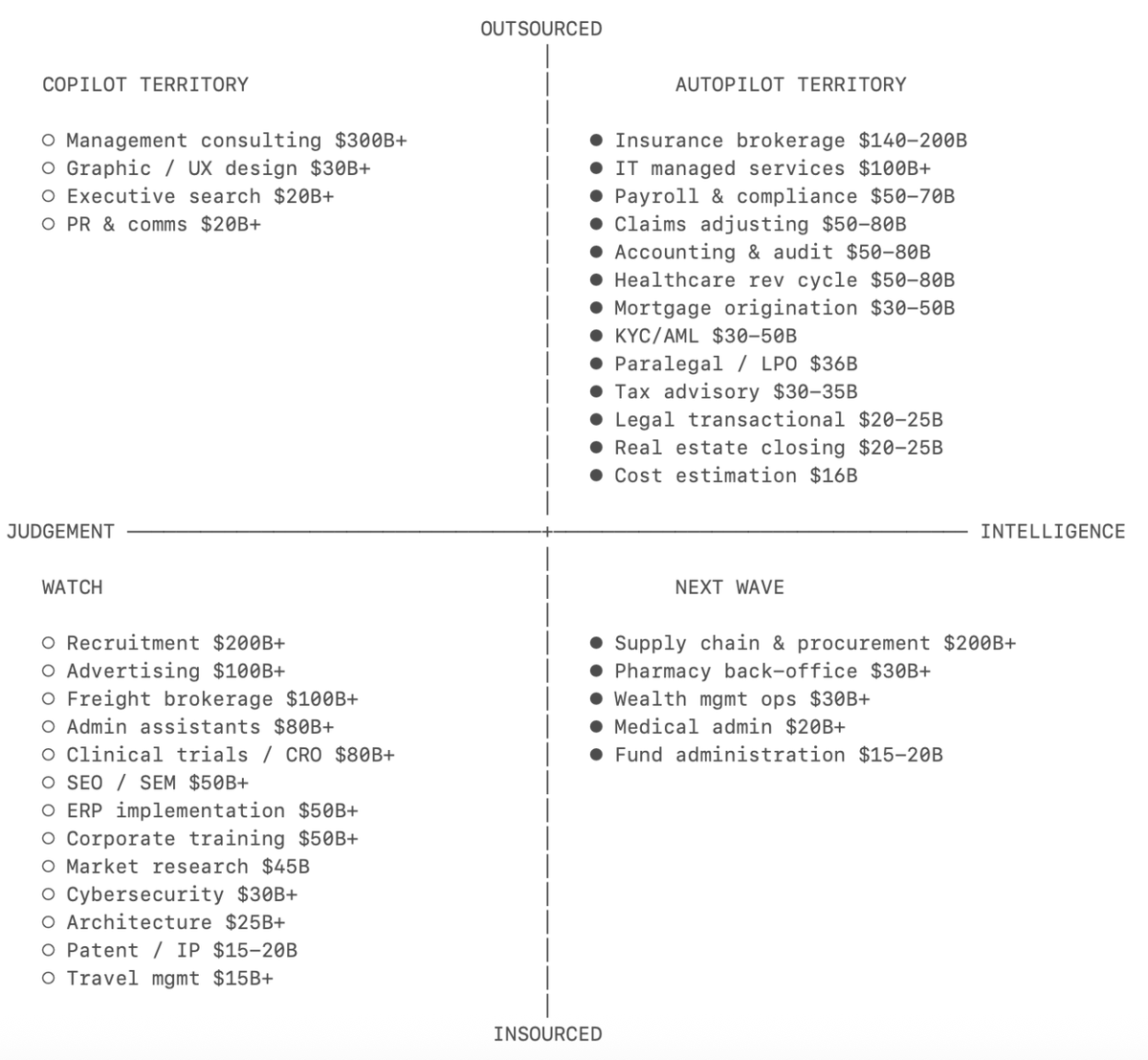
@gregisenberg Real estate closing at $20-25B is interesting to me. Tried building zoning AI and couldn't even get five NJ firms to reply to a cold email. Seemed a lot like its connection based
English
0
0
2
367
GREG ISENBERG
GREG ISENBERG@gregisenberg·
sequoia put out a blog post called "services is the new software" look at this map of over $1T in services being replaced by AI agents
GREG ISENBERG tweet media
English
263
500
4.3K
601.4K