Fadhil

1K posts

Fadhil banner
Fadhil

Fadhil

@mulinya_

DAO's || GOVERNANCE || TOOLING

Nairobi Katılım Temmuz 2023
476 Takip Edilen448 Takipçiler
Fadhil retweetledi
Shaw (spirit/acc)
Shaw (spirit/acc)@shawmakesmagic·
The quality of your vibecoded slop is horrible. I've seen it. Absolute dogshit. Fortunately, there is a fix. Use this prompt: I want to clean up my codebase and improve code quality. This is a complex task, so we'll need 8 subagents. Make a sub agent for each of the following: 1. Deduplicate and consolidate all code, and implement DRY where it reduces complexity 2. Find all type definitions and consolidate any that should be shared 3. Use tools like knip to find all unused code and remove, ensuring that it's actually not referenced anywhere 4. Untangle any circular dependencies, using tools like madge 5. Remove any weak types, for example 'unknown' and 'any' (and the equivalent in other languages), research what the types should be, research in the codebase and related packages to make sure that the replacements are strong types and there are no type issues 6. Remove all try catch and equivalent defensive programming if it doesn't serve a specific role of handling unknown or unsanitized input or otherwise has a reason to be there, with clear error handling and no error hiding or fallback patterns 7. Find any deprecated, legacy or fallback code, remove, and make sure all code paths are clean, concise and as singular as possible 8. Find any AI slop, stubs, larp, unnecessary comments and remove. Any comments that describe in-motion work, replacements of previous work with new work, or otherwise are not helpful should be either removed or replaced with helpful comments for a new user trying to understand the codebase-- but if you do edit, be concise I want each to do detailed research on their task, write a critical assessment of the current code and recommendations, and then implement all high confidence recommendations.
English
104
139
2.7K
203.7K
Fadhil retweetledi
Kyle Gawley
Kyle Gawley@kylegawley·
Nobody’s chasing great UX or user delight anymore It’s all about shipping garbage as fast as possible
English
87
43
469
16.1K
Fadhil retweetledi
Machuche.eth
Machuche.eth@machuche1·
A lot of people ask me why the need for @ntzs_co especially locally in Tanzania..
English
5
18
54
4.4K
Fadhil retweetledi
Swapna Kumar Panda
Swapna Kumar Panda@swapnakpanda·
> You are planning to learn System Design. > But not sure what to learn? > Here are 120 System Design concepts > Learn each of these by asking 3 W's: What? Why? How? 1. Load Balancing 2. Caching 3. Sharding 4. Replication 5. CAP Theorem 6. Consistent Hashing 7. Message Queues 8. Horizontal Scaling 9. Vertical Scaling 10. Microservices 11. Service Discovery 12. SQL Databases 13. NoSQL Databases 14. DNS Lookup 15. Content Delivery 16. Reverse Proxy 17. Forward Proxy 18. API Gateway 19. Strong Consistency 20. Eventual Consistency 21. Failover 22. Active Active 23. Active Passive 24. Master Slave 25. Master Master 26. Cache Aside 27. Write Through 28. Write Behind 29. Asynchronism 30. Task Queues 31. Back Pressure 32. TCP Protocol 33. UDP Protocol 34. RPC Calls 35. REST APIs 36. gRPC 37. WebSockets 38. Long Polling 39. Circuit Breaker 40. Rate Limiting 41. Throttling 42. Idempotency 43. CQRS Pattern 44. Event Sourcing 45. Saga Pattern 46. Two Phase Commit 47. Distributed Lock 48. Leader Election 49. Heartbeat Mechanism 50. Gossip Protocol 51. Quorum Consensus 52. Paxos Algorithm 53. Raft Consensus 54. Bloom Filter 55. Consistent Hash Ring 56. Vector Clocks 57. CRDTs 58. Byzantine Faults 59. ACID Properties 60. BASE Properties 61. Indexing Strategies 62. Denormalization 63. Materialized Views 64. Data Federation 65. Database Partitioning 66. Client Server 67. Peer to Peer 68. Cluster Computing 69. Grid Computing 70. Cloud Computing 71. Serverless Architecture 72. Containerization 73. Orchestration 74. Blue Green Deployment 75. Canary Release 76. Chaos Engineering 77. Observability 78. Logging Monitoring 79. Metrics Tracing 80. SLOs SLAs 81. Latency Optimization 82. Throughput Scaling 83. Bandwidth Management 84. Fault Tolerance 85. Redundancy 86. High Availability 87. Reliability 88. Scalability Patterns 89. Stateless Design 90. Stateful Services 91. Domain Name System 92. Push CDN 93. Pull CDN 94. Layer 4 Balancer 95. Layer 7 Balancer 96. Key Value Store 97. Document Store 98. Wide Column 99. Graph Database 100. Application Caching 101. Database Caching 102. CDN Caching 103. Refresh Ahead 104. Scatter Gather 105. Bulkhead Pattern 106. Retry Mechanism 107. Timeout Handling 108. Distributed Transactions 109. Event Driven 110. Pub Sub Model 111. Stream Processing 112. Batch Processing 113. Lambda Architecture 114. Kappa Architecture 115. Map Reduce 116. Service Mesh 117. Backend Frontend 118. API Versioning 119. Security Protocols 120. Consensus Algorithms
English
10
39
292
12.9K
Fadhil retweetledi
avrl ☘
avrl ☘@avrldotdev·
System Design Talks 25 - Stateless Auth [All FAANG Interview] Problem We're using JWTs for our app. An account is hacked, so user changes their password. But the hacker still has the JWT that doesn't expire for 1 hour. How to 'revoke' that stateless token to prevent exploits?
avrl ☘ tweet media
English
18
68
593
32K
Fadhil retweetledi
Fernando
Fernando@Franc0Fernand0·
Software engineers don't get paid to write code; they get paid to solve problems. The faster you realize this, the sooner you'll stop being afraid that AI will replace you and the better your career will be.
English
179
398
3.3K
121.1K
Fadhil retweetledi
Stacy Muur
Stacy Muur@stacy_muur·
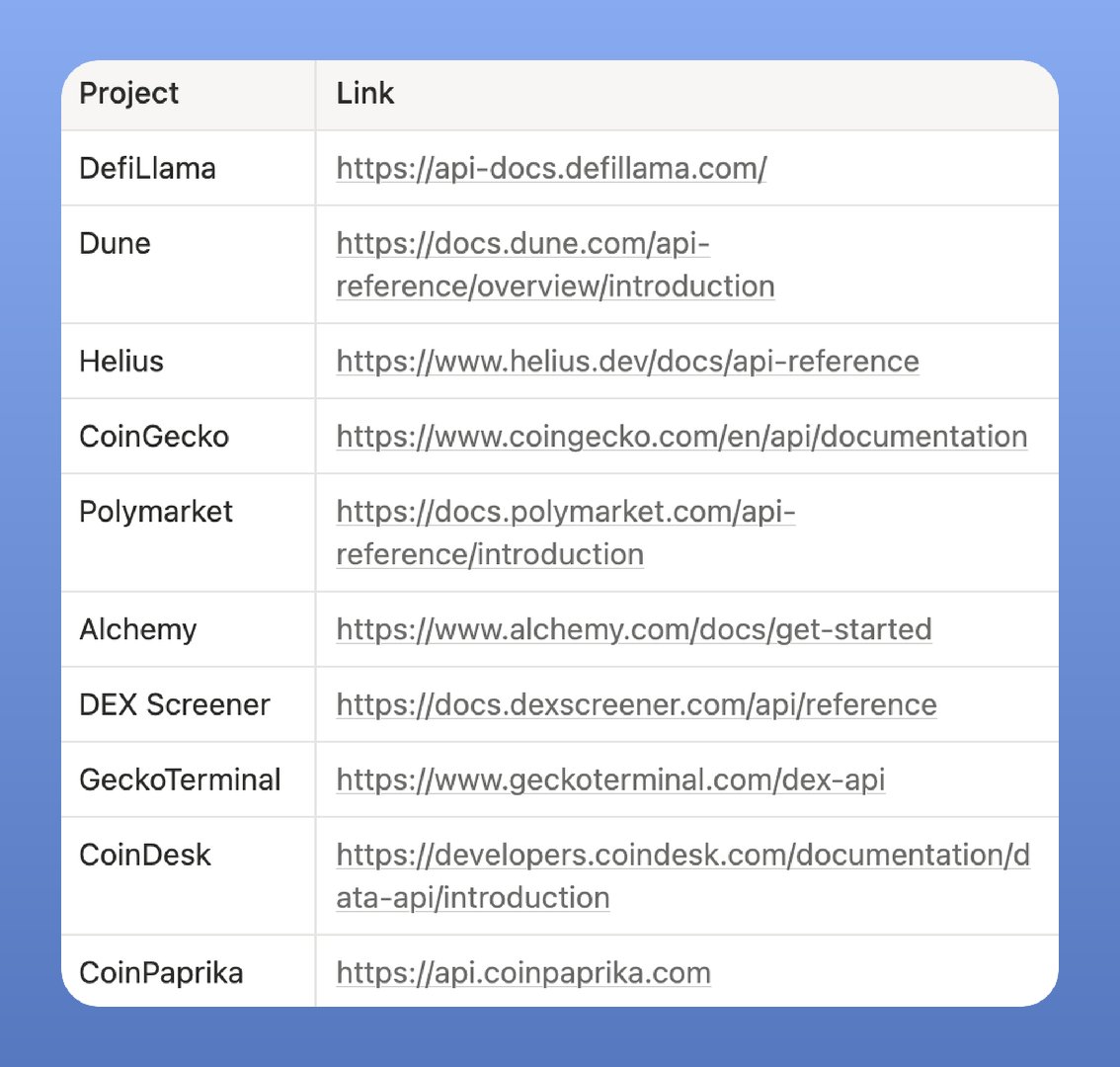
10 APIs every crypto trader & researcher should be using ↓ DefiLlama: TVL, fees, revenue, stablecoins, yields → api-docs.defillama.com Dune: custom SQL queries, dashboards, analytics → docs.dune.com/api-reference/… Helius: everything Solana → helius.dev/docs/api-refer… CoinGecko: prices, market caps, historical data → coingecko.com/en/api/documen… Polymarket: prediction market data, odds, events → docs.polymarket.com/api-reference/… Alchemy: EVM onchain data, logs, transactions, websockets → alchemy.com/docs/get-start… DEX Screener: token pairs, liquidity, trending tokens → docs.dexscreener.com/api/reference GeckoTerminal: DEX trades, pools, OHLCV → geckoterminal.com/dex-api CoinDesk API: prices, market data, social insights, news → developers.coindesk.com/documentation/… CoinPaprika: fundamentals, price, historical data → api.coinpaprika.com Anything I’m missing?
Stacy Muur tweet media
English
34
33
159
11.3K
Fadhil retweetledi
SumitM
SumitM@SumitM_X·
Want to be a backend architect ? Please learn : 1. Microservices Design Service decomposition, Bounded contexts, Resilience (Circuit Breaker, Bulkheads) 2. Distributed Systems Fundamentals CAP Theorem, Event sourcing, CQRS, Data consistency models (ACID vs. BASE) 3. High-Performance Data Management Database partitioning, Index optimization, NoSQL data modeling 4. Advanced API Design gRPC, GraphQL, API Gateways, Asynchronous APIs 5. Event-Driven Architecture Kafka, Message queues, Pub/Sub patterns, Saga pattern 6. Cloud-Native Patterns Container orchestration (Kubernetes), Serverless, Multi-cloud strategies 7. Observability Distributed tracing (OpenTelemetry), Centralized logging (ELK), Real-time monitoring 8. Infrastructure as Code Terraform, Helm, Configuration management best practices 9. Advanced Security Zero Trust, OAuth2, JWT, Data encryption in transit and at rest 10. Scaling Strategies Load balancing, Sharding, Horizontal vs. vertical scaling
English
8
135
860
128.9K
Fadhil retweetledi
Zherka
Zherka@ZherkaOfficial·
Never play fair in a game where others cheat. —Machiavelli
English
48
1.4K
8.3K
132.8K
Fadhil retweetledi
Noah
Noah@NoahKingJr·
College kids looking for a job in 2026. Claude:
English
41
255
5.7K
234.2K
Fadhil retweetledi
Ramin Nasibov
Ramin Nasibov@RaminNasibov·
simplicity is not simple
English
16
28
126
5.8K
Fadhil retweetledi
Blaze Officiel
Blaze Officiel@B3laze·
Whoever approved this safaricom app may their pillow be always hot on both sides
English
186
1.8K
8.2K
222.8K
Fadhil retweetledi
Fadhil
Fadhil@mulinya_·
I was using @SafaricomPLC Mpesa Global Card for their Visa and their rates to a dollar is ksh 155 , WTF🙄🙄🙄
English
2
0
3
173
Fadhil retweetledi
Simon Høiberg
Simon Høiberg@SimonHoiberg·
"Just use Vercel." "Just use Supabase." "Just use Clerk." Cool. Now your auth, database, and deployment are owned by 3 different companies who can change pricing whenever they want. And the rest of your product is wrapping OpenAI. At some point you have to ask yourself: what do I actually own here?
English
339
64
1.2K
165.9K
Fadhil
Fadhil@mulinya_·
@m13v_ How would you write tests if you even don't understand what test cases your covering And the intentions of the tests ???
English
1
0
0
6
Matt
Matt@m13v_·
@mulinya_ testing is the fundamental that gets dropped first. everyone learns data structures and algorithms but most people skip learning how to write a proper test suite. AI makes code generation easy but without tests you have no way to know if it actually works
English
1
0
1
20
Fadhil
Fadhil@mulinya_·
If You think you don't need software engineering fundamentals to ship because AI exists then I am afraid your NGMI.
English
1
5
6
40
Fadhil retweetledi
Dhairya
Dhairya@dkare1009·
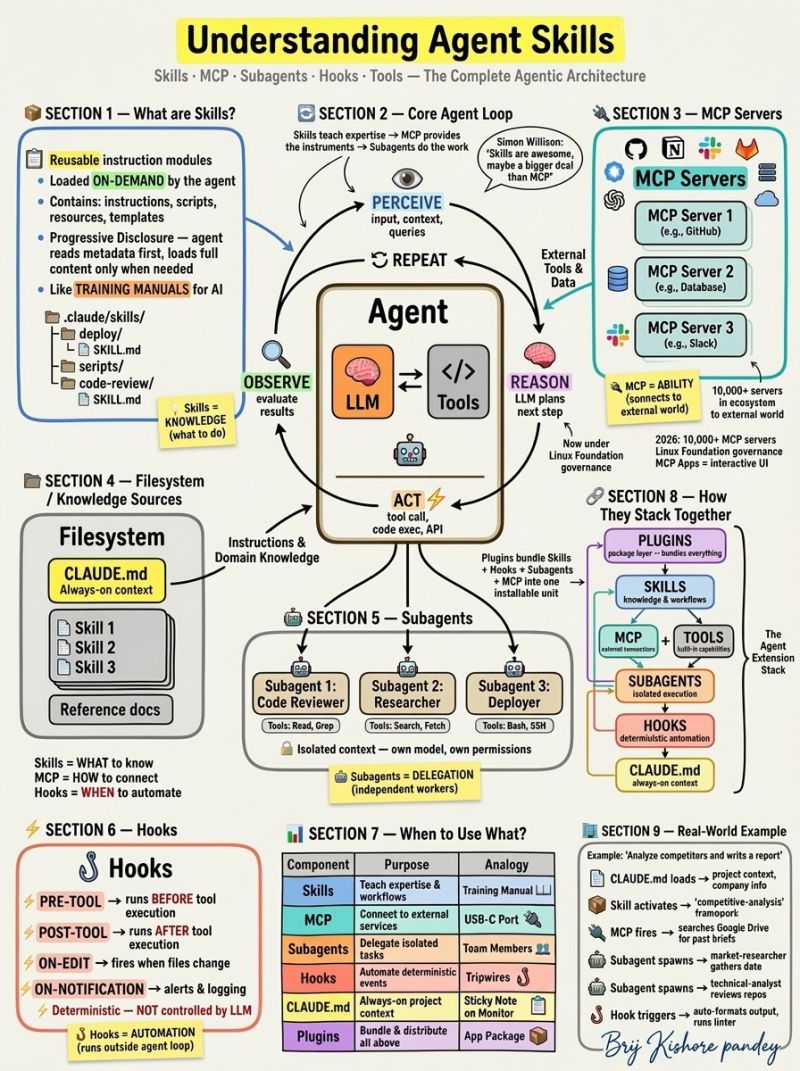
Most people think Skills and MCP are the same thing. They're not. And confusing them is costing you weeks of wasted architecture decisions. I just mapped the entire Agentic AI extension stack on a whiteboard — here's the breakdown: 𝗦𝗸𝗶𝗹𝗹𝘀 Reusable knowledge modules that agents load on-demand. The agent scans metadata first, then loads full instructions only when relevant. This is called Progressive Disclosure — it keeps your context window clean while giving agents deep domain expertise when they need it. Think of them as training manuals for AI. 𝗠𝗖𝗣 (𝗠𝗼𝗱𝗲𝗹 𝗖𝗼𝗻𝘁𝗲𝘅𝘁 𝗣𝗿𝗼𝘁𝗼𝗰𝗼𝗹) The universal connection layer between agents and external tools. Standardized protocol — like USB-C for AI. 10,000+ MCP servers in the ecosystem today. Now governed by Linux Foundation's Agentic AI Foundation. If Skills teach you to cook, MCP gives you the kitchen. 𝗦𝘂𝗯𝗮𝗴𝗲𝗻𝘁𝘀 Independent agent instances running in isolated context. They can use a different model, different tools, different permissions than the parent agent. Like specialized team members with their own workspace. You delegate. They execute. They return summaries. 𝗛𝗼𝗼𝗸𝘀 Deterministic scripts that fire outside the agent loop entirely. Pre-tool, post-tool, on-edit, on-notification triggers. The LLM does NOT control these. Pure event-driven automation. Think of them as tripwires — when X happens, do Y. Always. 𝗖𝗟𝗔𝗨𝗗𝗘. 𝗺𝗱 Always-on project context loaded every single session. Your conventions. Your patterns. Your team preferences. The sticky note permanently on your monitor. 𝗣𝗹𝘂𝗴𝗶𝗻𝘀 The packaging layer that bundles everything above — Skills + Hooks + Subagents + MCP configs into one installable, shareable unit. Here's what most architects miss: These are not competing approaches. They are layers that stack: Skills = WHAT to know MCP = HOW to connect Subagents = WHO does the work Hooks = WHEN to automate CLAUDE. md = WHERE you ground it Plugins = HOW you ship it The real power is in the combination: CLAUDE. md loads project context → Skill provides domain expertise → MCP connects to external systems → Subagent executes in isolation → Hook automates the handoff → Plugin packages it all for the team If you want to excel at building agents in 2026, stop picking one layer over another. Learn to orchestrate all six together. That's what separates demo agents from production agents. Which layers are you actually using today?
Dhairya tweet media
English
5
118
469
15.9K