Nam Chu Hoai ⏩
2.9K posts

Nam Chu Hoai ⏩
@nambrot
Co-Founder @hyperlane. We are hiring! Previously @CeloOrg, @Wellframe


TRON DAO announced TRON Network’s integration into @hyperlane, a leading permissionless cross-chain messaging protocol. This integration expands TRON’s interoperability by enabling developers to seamlessly build and scale applications across multiple blockchains. Through Hyperlane’s open interoperability framework, TRON is now connected to over 150 chains. Unlike traditional bridges that are limited to token transfers, Hyperlane enables smart contracts to send not just assets, but also data and instructions across chains. This allows developers to build applications that operate seamlessly across multiple ecosystems. More details from @Cointelegraph 👇 cointelegraph.com/press-releases…


A new, unified stack for Base Chain Excited to share that we are evolving our technical roadmap, consisting of our own spec, code, and infra to accelerate the foundation of Base. This shift gives us the autonomy to ship protocol improvements more frequently and focus our resources on scaling to 1 gigagas/s. What this means for builders: - Higher Velocity: Targeting 6 hardforks per year to get you new features and fixes faster. - Massive Scale: Targeting 1 gigagas/s to support high-throughput apps without congestion. - Extreme Reliability: Targeting 99.99% non-empty blocks and predictable, low fees. - Simpler Design: A maximally simple spec that’s easier to audit and build on. Along with this, we will take a more active role in managing our own upgrade schedule and stack: allowing us to build what the ecosystem needs, at the speed it needs, while remaining deeply aligned with Ethereum. Read the full technical breakdown here: blog.base.dev/next-chapter-f…


There have recently been some discussions on the ongoing role of L2s in the Ethereum ecosystem, especially in the face of two facts: * L2s' progress to stage 2 (and, secondarily, on interop) has been far slower and more difficult than originally expected * L1 itself is scaling, fees are very low, and gaslimits are projected to increase greatly in 2026 Both of these facts, for their own separate reasons, mean that the original vision of L2s and their role in Ethereum no longer makes sense, and we need a new path. First, let us recap the original vision. Ethereum needs to scale. The definition of "Ethereum scaling" is the existence of large quantities of block space that is backed by the full faith and credit of Ethereum - that is, block space where, if you do things (including with ETH) inside that block space, your activities are guaranteed to be valid, uncensored, unreverted, untouched, as long as Ethereum itself functions. If you create a 10000 TPS EVM where its connection to L1 is mediated by a multisig bridge, then you are not scaling Ethereum. This vision no longer makes sense. L1 does not need L2s to be "branded shards", because L1 is itself scaling. And L2s are not able or willing to satisfy the properties that a true "branded shard" would require. I've even seen at least one explicitly saying that they may never want to go beyond stage 1, not just for technical reasons around ZK-EVM safety, but also because their customers' regulatory needs require them to have ultimate control. This may be doing the right thing for your customers. But it should be obvious that if you are doing this, then you are not "scaling Ethereum" in the sense meant by the rollup-centric roadmap. But that's fine! it's fine because Ethereum itself is now scaling directly on L1, with large planned increases to its gas limit this year and the years ahead. We should stop thinking about L2s as literally being "branded shards" of Ethereum, with the social status and responsibilities that this entails. Instead, we can think of L2s as being a full spectrum, which includes both chains backed by the full faith and credit of Ethereum with various unique properties (eg. not just EVM), as well as a whole array of options at different levels of connection to Ethereum, that each person (or bot) is free to care about or not care about depending on their needs. What would I do today if I were an L2? * Identify a value add other than "scaling". Examples: (i) non-EVM specialized features/VMs around privacy, (ii) efficiency specialized around a particular application, (iii) truly extreme levels of scaling that even a greatly expanded L1 will not do, (iv) a totally different design for non-financial applications, eg. social, identity, AI, (v) ultra-low-latency and other sequencing properties, (vi) maybe built-in oracles or decentralized dispute resolution or other "non-computationally-verifiable" features * Be stage 1 at the minimum (otherwise you really are just a separate L1 with a bridge, and you should just call yourself that) if you're doing things with ETH or other ethereum-issued assets * Support maximum interoperability with Ethereum, though this will differ for each one (eg. what if you're not EVM, or even not financial?) From Ethereum's side, over the past few months I've become more convinced of the value of the native rollup precompile, particuarly once we have enshrined ZK-EVM proofs that we need anyway to scale L1. This is a precompile that verifies a ZK-EVM proof, and it's "part of Ethereum", so (i) it auto-upgrades along with Ethereum, and (ii) if the precompile has a bug, Ethereum will hard-fork to fix the bug. The native rollup precompile would make full, security-council-free, EVM verification accessible. We should spend much more time working out how to design it in such a way that if your L2 is "EVM plus other stuff", then the native rollup precompile would verify the EVM, and you only have to bring your own prover for the "other stuff" (eg. Stylus). This might involve a canonical way of exposing a lookup table between contract call inputs and outputs, and letting you provide your own values to the lookup table (that you would prove separately). This would make it easy to have safe, strong, trustless interoperability with Ethereum. It also enables synchronous composability (see: ethresear.ch/t/combining-pr… and ethresear.ch/t/synchronous-… ). And from there, it's each L2's choice exactly what they want to build. Don't just "extend L1", figure out something new to add. This of course means that some will add things that are trust-dependent, or backdoored, or otherwise insecure; this is unavoidable in a permissionless ecosystem where developers have freedom. Our job should make to make it clear to users what guarantees they have, and to build up the strongest Ethereum that we can.





FLOW NETWORK INCIDENT: Forensic Fund Tracking Report FindLabs is publishing the following analysis in collaboration with the Flow Foundation's security and engineering teams, who conducted the primary forensic investigation. • INCIDENT CONFIRMATION On December 27, 2025, an attacker exploited a vulnerability in Flow's execution layer. The attacker then moved assets off-network — primarily through bridges to Ethereum — before validators executed a coordinated network halt. Confirmed funds exited to date total approximately $3.9M, with forensic analysis ongoing. Critically, this exploit did not access or affect existing user balances. All user deposits remain intact. The vulnerability has been identified and isolated. A full technical post-mortem will be published within 72 hours. • ATTACKER WALLET (ETHEREUM) 0x2e7C4b71397f10c93dC0C2ba6f8f179a47F994e1 All confirmed exit transactions route through this address. Freeze requests have been submitted to exchanges and stablecoin issuers. • CONFIRMED EXIT TRANSACTIONS The following exit paths have been identified and verified. Confirmed funds exited to date: ~$3.9M USD equivalent. Forensic analysis is ongoing and this report will be updated as additional transactions are identified. CELER BRIDGE — 297.69 ETH - 74.422 ETH — etherscan.io/tx/0xbf3f95b0f… - 74.422 ETH — etherscan.io/tx/0xe6f55f204… - 74.422 ETH — etherscan.io/tx/0x106b8db43… - 74.422 ETH — etherscan.io/tx/0x9d6684f6f… DEBRIDGE — 479.35 ETH (includes USDC conversions) - 49.359 ETH — etherscan.io/tx/0x2d347295a… - 151.781 ETH — etherscan.io/tx/0x1eae85eed… - 123.30 ETH — etherscan.io/tx/0x3b5671861… - 14.932 ETH — etherscan.io/tx/0x9d6684f6f… - [+ 10 additional transactions ranging 11-17 ETH each] DIRECT WITHDRAWALS — 109.19 ETH - 90.299 ETH (Binance) — etherscan.io/tx/0xcf20b2c7f… - 18.89 ETH (Binance) — etherscan.io/tx/0x6e5b6fb95… RELAY BRIDGE — 39.44 ETH - 39.44 ETH — etherscan.io/tx/0x6bc988300… STARGATE — 9.98 ETH - 4.99 ETH — etherscan.io/tx/0x22a55360d… - 4.99 ETH — etherscan.io/tx/0x4378c6988… WBTC — 9.8 WBTC (~$930K) - 4.9 WBTC — etherscan.io/tx/0xe00dee9da… - 4.9 WBTC — #tokentxns" target="_blank" rel="nofollow noopener">etherscan.io/address/0x2e7c…
PYUSD — 339K PYUSD (converted to ~261 ETH) - 279K PYUSD — etherscan.io/tx/0x52580ac81… - 60K PYUSD — etherscan.io/tx/0xeb3f5cf06… • ACTIVE LAUNDERING DETECTED The attacker is actively attempting to launder funds through privacy-preserving protocols: THORCHAIN (ETH → BTC conversion) - 250 ETH — etherscan.io/txs?a=0x2e7c4b… - 248 ETH — etherscan.io/tx/0x83099b48a… - 287 ETH — etherscan.io/tx/0x82276037a… CHAINFLIP (ETH → BTC conversion) - 50.6 ETH — etherscan.io/tx/0x74330ac39… - 258.14 ETH — etherscan.io/tx/0x6d250dc07… - 258.82 ETH — etherscan.io/tx/0x3c18a6daf… • CONTAINMENT STATUS ✅ Flow network halted — no further unauthorized activity possible ✅ Exit transactions identified to date mapped above ✅ Freeze requests submitted to Circle, Tether, Binance, Coinbase, Kraken ✅ Forensic partners and law enforcement engaged ✅ User funds unaffected — exploit did not access existing balances • NEXT STEPS The protocol fix has been developed and is entering final validation. → Target restart: Within 4-6 hours, pending successful testnet validation → Next status update from Flow Foundation: Within 2 hours → Full technical post-mortem: Within 72 hours This report will be updated as fund movement continues.

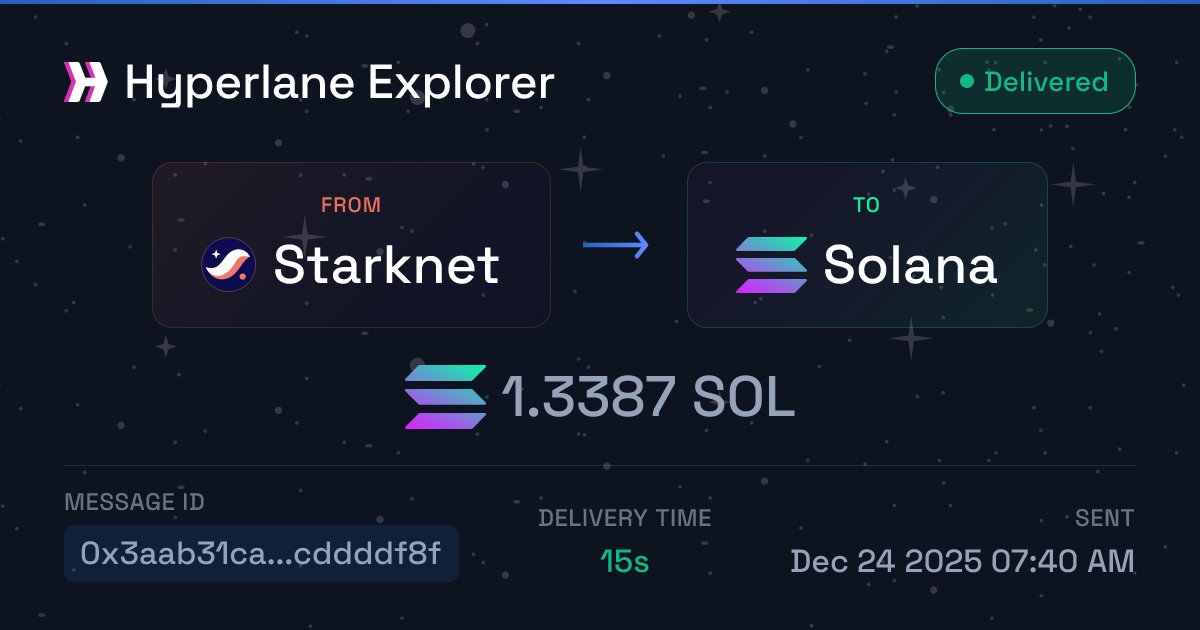
Social previews on the Tempo Explorer are next level.

The future of on-chain settlement is here. ⚡️ Today we launched SoFiUSD, a fully reserved #stablecoin issued by SoFi Bank, N.A., positioning us as a stablecoin infrastructure provider for other banks, fintechs, and enterprise platforms. We are the first nationally chartered retail bank to issue a stablecoin on a public, permissionless blockchain, combining our regulatory strength as a national bank with transparent, fully reserved on-chain technology. SoFiUSD is available now for internal settlement activity and coming soon to all SoFi members! investors.sofi.com/news/news-deta…

Introducing Coinbase Custom Stablecoins. Create a branded stablecoin for your business, backed 1:1 by collateral custodied by Coinbase. → Earn rewards on activity → Seamless interoperability across chains → Tap into Coinbase’s global distribution