
Nancy Ilochi-Ikpeme
1.1K posts

Nancy Ilochi-Ikpeme
@Nancy_i_i
Communicator. Strategist. Advocate. Using words & media to shift narratives — for such a time as this.
Abuja, Nigeria Katılım Haziran 2022
1.3K Takip Edilen6.8K Takipçiler

Celebrate with who got the win. Leave politics out of this. My only concern is the said Nancy don't turn to mini god around this.
abolanle@AjirowoB58812
@bukolasaraki Government officials supporting Japa🤣🤣🤣 if them explain Nigeria to you and u understand am, na lie them lie for you😊😏
English
Dear Blessing,
I just came across your tweet, and it truly inspired me.
To graduate with a First Class in Mathematics from UNILORIN and then earn a fully funded Master's admission in Italy is an extraordinary achievement. You have demonstrated excellence and the promise that exists in so many young Nigerians.
No young person who has worked this hard should have such an opportunity limited by the cost of getting there. It would be my privilege to support your journey by covering what is left in the cost of your relocation.
@nancy_i_i from my office will reach out to you today.
Congratulations once again. Go, excel, and continue to make Nigeria proud.
Blessing Oluwafikayo Adisa@Fikkmaths
Help Make My Scholarship Dream Come True 🙏 I'm Adisa Blessing Oluwafikayo, a First-Class Mathematics graduate (CGPA: 4.76/5.0) from UNILORIN. I'm happy to have been awarded a fully funded Master's scholarship in Mathematics at the University of Calabria, Italy.
English
@bukolasaraki Hi @Fikkmaths, trying to reach you, please send me a DM
English
Correct me if I'm wrong, but didn't KO already say he wouldn't campaign for any ticket without a Southeasterner as President or VP?
Punch Newspapers@MobilePunch
𝗔𝘁𝗶𝗸𝘂 𝗮𝗽𝗽𝗼𝗶𝗻𝘁𝘀 𝗞𝗲𝗻𝗻𝗲𝘁𝗵 𝗢𝗸𝗼𝗻𝗸𝘄𝗼 𝗮𝘀 𝘀𝗽𝗼𝗸𝗲𝘀𝗽𝗲𝗿𝘀𝗼𝗻 𝗥𝗲𝗮𝗱 𝗠𝗼𝗿𝗲: punchng.com/atiku-appoints…
English



Dear Bashir Ashura,
Happy Birthday, and congratulations on the greater heights you have attained in recent times. From the very beginning, you have been a hardworking, dedicated, and resilient individual whose commitment continues to inspire many.
On this special occasion of my birthday, I celebrate myself and the journey so far. I wish myself all the very best that life has to offer—good health, happiness, success, and endless blessings.
Happy Birthday, Bashir Ashura!


English
Nancy Ilochi-Ikpeme retweetledi
JUNE 28, 2026
PRESS STATEMENT
Saraki Joins Global Leaders in Italy, Says Africa Needs Strategic Partnerships, Not Aid Dependency
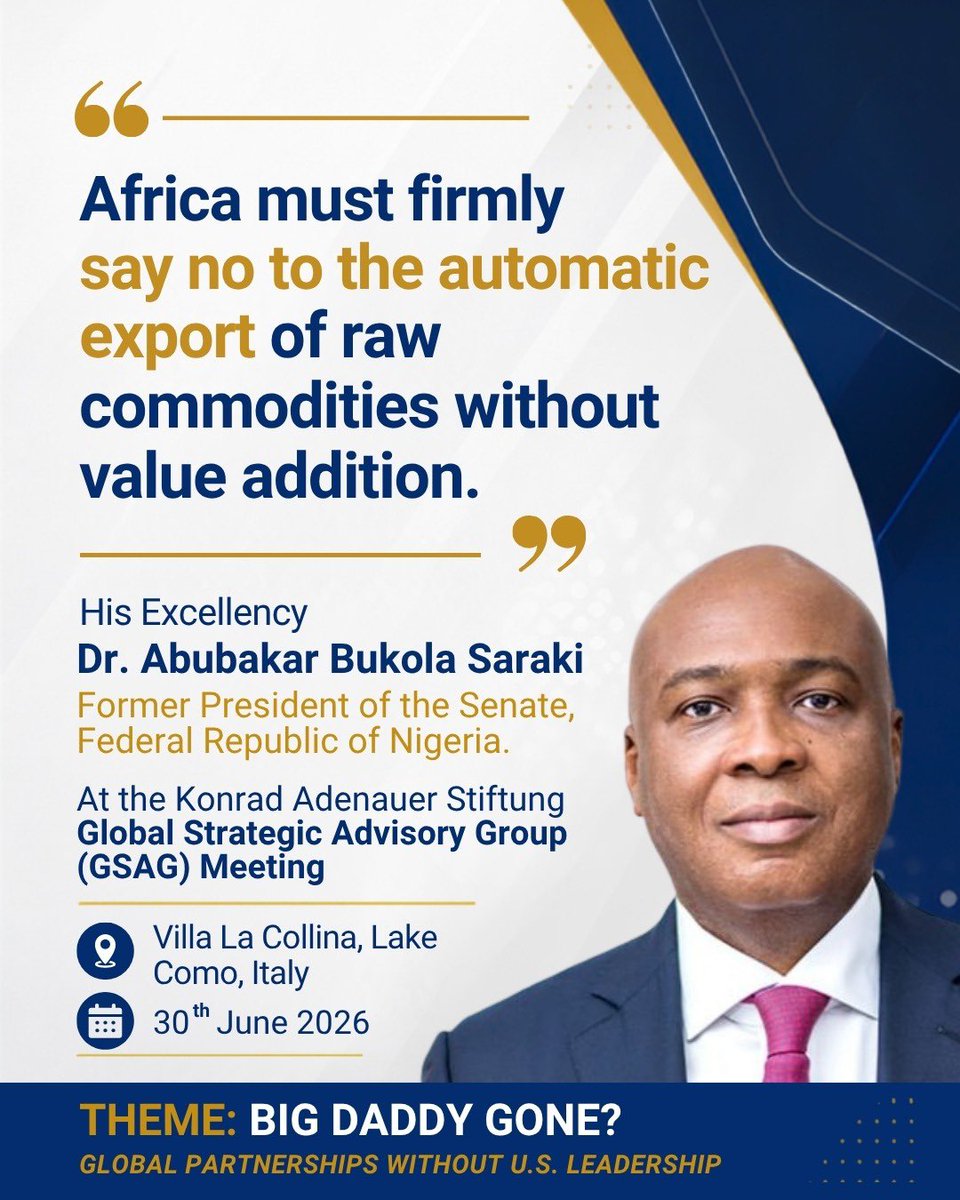
Former President of the Senate, Dr. Abubakar Bukola Saraki, has arrived in Lake Como, Italy, to join global leaders, policymakers, scholars, and strategic thinkers at an international experts workshop where he is expected to make a strong case for Africa to move beyond aid dependency and embrace strategic partnerships anchored on trade, investment, industrialisation, stronger institutions, domestic resource mobilisation, and African agency.
The gathering, organised by the Konrad-Adenauer-Stiftung (KAS), the foundation named after former German Chancellor Konrad Adenauer, has as its central theme: “Big Daddy Gone? Global Partnerships Without U.S. Leadership.”
Speaking ahead of his session, Saraki said: “This is a question that will define the coming decade. What does global partnership look like when it is no longer led by Washington? For too long, Africa’s relationship with the world has been framed around aid. The real opportunity is partnership — trade, investment, and mutual interest that treat Africa as an equal, not a recipient. A shifting global order is not a vacuum to fear. It is an opening to build something better.”
At the workshop, which will begin on Monday, June 29, and end on July 1, Saraki will address the gathering as part of the fifth panel on Tuesday afternoon, where he will present the African perspective on “Development Policies: Withdrawal of the United States from International Development — Opportunities and Challenges.”
While there are two Africans among the 22 participants, Saraki has been selected to present the African perspective based on his experience in the private and public sectors, as well as his engagements during his tenure as Nigeria’s President of the Senate, Chairman of the Nigeria Governors’ Forum, and Governor of Kwara State.
He will be part of a panel consisting of Dr. Paola Bautista de Alemán, Vice President for Training and Programmes, Primero Justicia, Venezuela, and Prof. Christian Leuprecht, Professor at the Royal Military College, Canada. The session will be chaired by Dr. Tilmann Feltes, Policy Advisor, Division Analysis and Consulting, Konrad-Adenauer-Stiftung, Germany.
Other sub-themes to be explored during the conference include “The United States in 2030: Western Hemisphere First — Indo-Pacific Second? Strategic Priorities of the United States of America,” “Germany’s Priorities for Strong International Partnerships,” “Partners, Competitors, Rivals — New Alliances Around the Globe,” the fireside chat titled “The Western Hemisphere and the US — Back to 1823?”, “Strategic (Inter-)Dependencies and New Opportunities,” as well as “New Defence Partnerships.”
The workshop, which will end on Wednesday, includes participants from Germany, the United Kingdom, the United States of America, Israel, Italy, Nigeria, Saudi Arabia, Canada, Australia, India, Argentina, Venezuela, the Philippines, Chile, Liberia, and Poland.
Signed
Yusuph Olaniyonu
Head, Abubakar Bukola Saraki Media Office
Abuja
English
@Hidden4rmTruth @neo_officialll Whhaaaatttt?? 🤣😩🏃♀️➡️
Indonesia

@neo_officialll Mama @Nancy_i_i why you no buy two? This thing wry you dey do me e good? Abeg buy all your gadgets from @neo_officialll e de deliver like Hebrew women
English

Dear Nancy,
We have received your order for the Bajaj Twister Mixer Grinder.
We will dispatch first thing tomorrow morning.
Thank you for trusting neostore.ng .
We do not take it for granted.❤️

Neo Officiall@neo_officialll
Dear Sharon, We have received your order for the HP EliteBook 830 G6. We will go ahead and dispatch right away. Thank you for trusting neostore.ng . We do not take it for granted.❤️
English
I don't think Kanu's case was about "insults". No. The court actually reviewed recordings allegedly inciting violence against security personnel. The prosecution presented video and audio recordings, where Kanu allegedly incited violence against Nigerian security forces and key figures.
Daily Post Nigeria@DailyPostNGR
Biafra: I’ll free Nnamdi Kanu as president, no reason imprisoning him over insults – Peter Obi dailypost.ng/2026/06/13/bia…
English

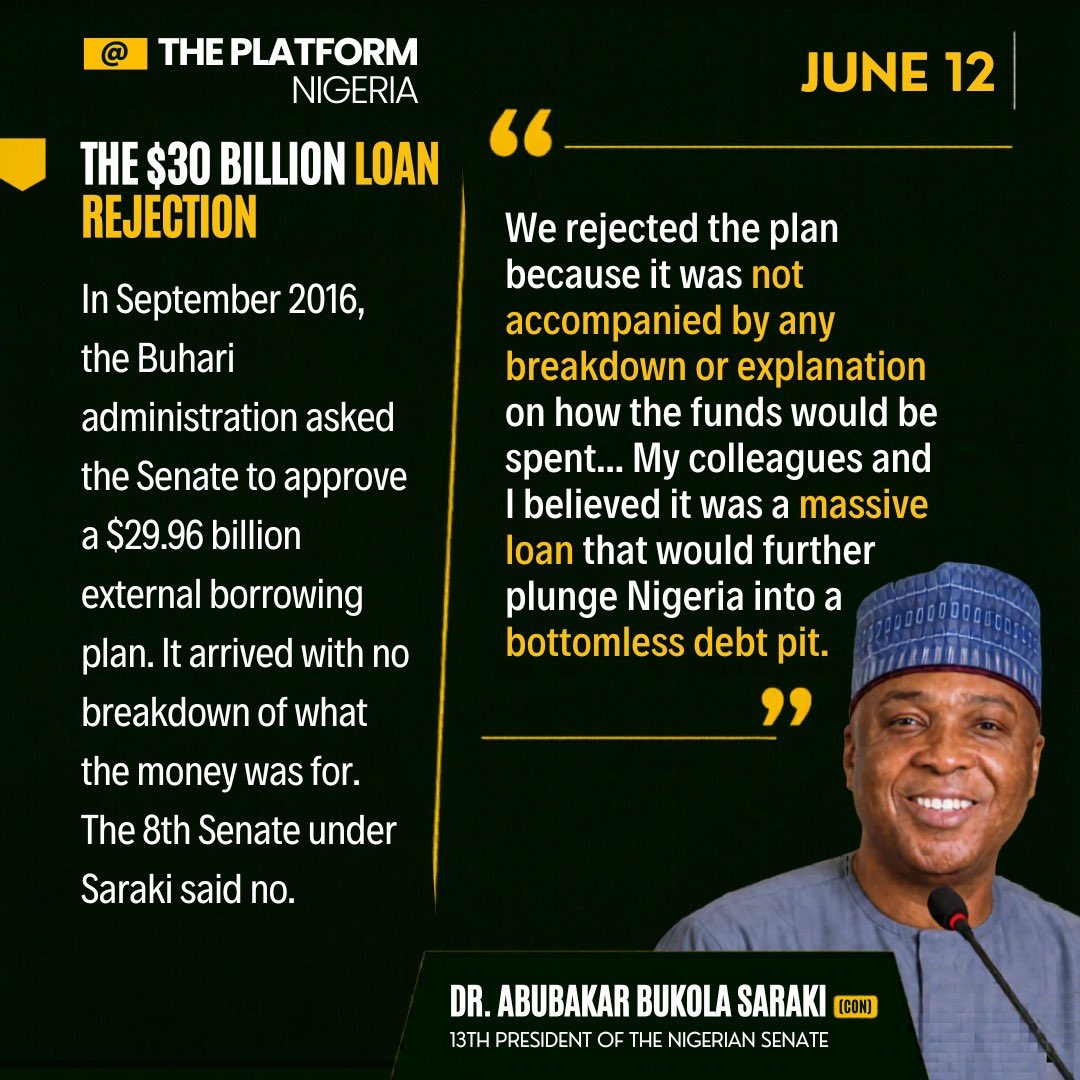
Key Quotes from Dr. Abubakar Bukola Saraki’s Keynote Address at The Platform, June 12, 2026


English




The counterargument is always "6 years is too long for a bad leader." But Nigeria's real problem has never been leaders who overstayed; I actually believe it has been leaders who spent their first term preparing for their second and their second term protecting their first.
Imran Muhammad@Imranmuhdz
One of the first set of bills that I look forward to moving when we come back for the 11th senate is a bill that makes it possible for anyone who wants to be president or governor to spend only one term of 6 years. - Senator Opeyemi Bamidele, Leader of the 10th Senate.
English
Nancy Ilochi-Ikpeme retweetledi
When people ask me why I still believe in sports as a pathway for youth development, stories like this are part of my answer.
Somebody sent me the Zadok Yohanna story this morning and honestly, I had to read it twice.
Born in Bauchi. Moved to Kaduna on his own as a young boy to chase a football dream. Flew to Sweden less than a year ago. And today, at just 18 years old, Brighton have reportedly signed him for £21.5 million, beating some of the biggest clubs in world football to secure his signature.
Think about that for a moment.
A teenager from northern Nigeria, armed with little more than talent, discipline and determination, has forced his way into one of the most competitive talent markets on earth.
This is why I will always believe in investing in young people. Not because every child will become a professional footballer, but because talent exists everywhere in this country. What is often missing is opportunity, structure, support and belief.
My vision in establishing the Kwara Football Academy and @ABSIlorinFC was rooted in this same belief, and it has given opportunities to players like Dennis Emmanuel Bonaventure, Olusegun Oakunle, Benjamin Frederick, Mubarak Gata, David Okoromi and a host of others now plying their trade in both local and international clubs.
Nigerians are an extraordinarily talented people. That has never been in question. What stories like Zadok’s remind us is what can happen when talent meets opportunity.
I encourage the Nigeria Football Federation @thenff, the National Sports Commission @NatSportsComm, and the National Institute for Sports, to look into creating the enabling environment for more football academies aimed at discovering more talents like Zadok Yohanna, as the global searchlight beams on Nigeria as the football destination for Africa.
To every young person chasing a dream that seems impossible today: keep going. Your current circumstances do not have to define your future.
And to Zadok: Congratulations! The whole world can now see your talent, but this is only the beginning. Keep working, stay grounded, and never forget the journey that brought you here. As you said yourself, “I know where I came from.” Hold on to that mindset.

English

Section 77 of the Electoral Act 2026 requires party membership registers to be submitted to INEC at least 21 days before primaries, and only names on that register are eligible to contest. If Omo-Agege was already an NDC member before the APC primaries, it only means he was simultaneously registered in two parties. Under the new law, dual membership voids both registrations, meaning he technically had no valid party membership at the time of the APC primary he just contested.
Prosperity@yeripros
Omo-Agege was already a member of NDC before the APC Primaries. He played both teams to score.😃
English