Natalya St. Clair

558 posts

Natalya St. Clair banner
Natalya St. Clair

Natalya St. Clair

@natalyastclair

Tech + EdTech | @TED_Ed Author

East Bay Area, CA Katılım Mart 2014
282 Takip Edilen226 Takipçiler
Natalya St. Clair retweetledi

Evrim Kanbur
Evrim Kanbur@WhileTravelling·
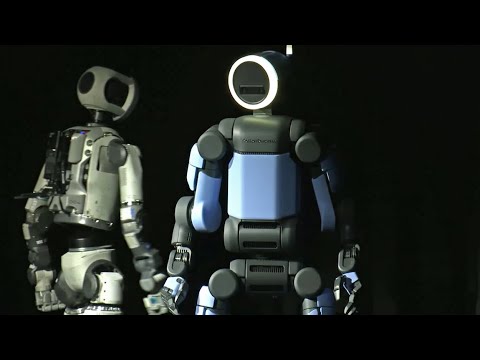
Are you watching the Chinese New Year Gala? The Robot Kungfu show is mind blowing!!! They just executed a coordinated martial arts routine with spatial precision, rhythm control, and dynamic balance adjustments in real time. Kung fu, one of China’s most iconic traditional art forms , performed by machines built with cutting-edge AI control systems, advanced actuators, and high-speed feedback loops. Ancient discipline meets algorithmic precision. Last year, humanoid robots stepped onto the Spring Festival Gala stage for the first time. This year, they held synchronized kung fu stances with balance that would humble half of us after leg day. And they did it live!!! On the most-watched television event on the planet. The progress in just one year is magical. That’s what we call China speed. What makes it even sweeter is where this happened. I love how the progress is integrated in culture. In celebration. In a Lunar New Year gala watched by hundreds of millions. It’s music to my ears. The robots didn’t look like they were “trying” anymore. They looked like they belonged. Their joint articulation was smoother. Their formation timing tighter. Their balance recovery almost elegant. Their choreography is expressive. That’s what happens when AI models improve, control systems get smarter, hardware stabilizes, and iteration cycles compress. One year in robotics today is not the same as one year ten years ago. It’s compounding. If this is what 12 months looks like, imagine 36. The Chinese New Year Robot Kungfu Gala is just futuristic. It was quite the statement! The future is getting better very, very fast. It was so beautiful to watch. What do you think?
English
751
2.7K
10.7K
1.5M
Natalya St. Clair retweetledi
Lee Robinson
Lee Robinson@leerob·
My biggest worries about coding with AI: 1. Beginners not actually learning 2. Atrophy of skills I’m seeing #1 happen and I don’t have a good answer yet. Leveling up as an engineer requires grinding and it’s not always fun. If AI can solve most of the problems for you, when do you lean into the healthy friction? When do you embrace the suck? Coupled with fewer opportunities for pair programming, it’s definitely tougher for those starting their engineering career. It’s not all bleak though. Those with high agency are figuring it out and learning extremely fast. I just worry about the industry as a whole outside these folks. We need better products and better education. I’m hoping to try and do my part here. For #2, I’m definitely paranoid about this for myself. What will it feel like to build software in 5 years? Will I have forgotten someone of the skills I used to rely on? Maybe that won’t even matter because we will truly be operating at a higher level of abstraction. Even if that pans out, it’s always been important to deeply understand the systems/dependencies you’re building on. I normally talk about the stuff I’m optimistic for but think it’s good to have a healthy skepticism here.
English
571
267
3.4K
486.8K
Natalya St. Clair retweetledi
Kate from Kharkiv
Kate from Kharkiv@BohuslavskaKate·
I can't stop laughing 😆 This is a presentation of Russia’s first AI robot. I think it learned to walk from alcoholics.
English
3.5K
3.2K
25.4K
1.7M
Natalya St. Clair retweetledi
Barack Obama
Barack Obama@BarackObama·
The arc of the moral universe is long, but it bends towards justice. Except it doesn’t bend on its own—it bends because we pull it in the direction of justice. What keeps me hopeful during times like these is being surrounded by people who are doing just that.
English
15.9K
21.9K
122K
9.6M
Natalya St. Clair retweetledi
Chrome
Chrome@googlechrome·
ICYMI: We just announced some exciting AI features coming to Chrome 🦖 See all the highlights from Behind the Browser: AI Edition now. Watch here: goo.gle/4nzwXBv
English
183
190
1K
497.3K
Natalya St. Clair retweetledi
World Labs
World Labs@theworldlabs·
Generate persistent 3D worlds from a single image, bigger and better than ever! We’re excited to share our latest results and invite you to try out our world generation model in a limited beta preview.
English
205
510
3.6K
833.2K
Natalya St. Clair retweetledi
PHD Comics
PHD Comics@PHDcomics·
Writing: just add coffee
PHD Comics tweet media
English
5
51
314
22.1K
Natalya St. Clair retweetledi
Rohan Paul
Rohan Paul@rohanpaul_ai·
This is MarsWalker Robot vacuum that climbs stairs. Its tracked base grips steps while 4 articulated arms probe the next riser, lift the nose, and keep the center of mass stable to avoid tipping on climbs or descents.
English
9
15
80
13.4K
Natalya St. Clair retweetledi
Data Science 4 Everyone (DS4E)
Data Science 4 Everyone (DS4E)@dsforeveryone·
📉 12th grade math scores just hit their lowest since 2005. 📈 The first-ever K–12 Data Literacy & Data Science Progressions launched. One class period today produces more data than the entire 20th century—our schools need a new roadmap. 👉 datasciencelearning.org
Data Science 4 Everyone (DS4E) tweet media
English
0
1
0
82
Natalya St. Clair retweetledi
Edward Frenkel
Edward Frenkel@edfrenkel·
🚨 In the new episode of my AfterMath series, I ask: Can a computer reach the full capacity of the human mind? With the recent advances in AI, this has become a hot topic for debate. I focus on the area I know best: mathematics. And I further narrow it down to the question: Can a computer be as good as a human in dealing with natural numbers? (Numbers like 0,1,2,3,4, and so on.) I make an important distinction between Type I and Type II statements about natural numbers. Statements of Type I are about specific numbers (here computers excel), and statements of Type II are GENERAL statements that apply to ALL NUMBERS at once (such as Fermat's Last Theorem). Mathematics is about Type II statements, and in this domain computers hit a wall, which I'd like to call the "Turing Wall." The problem is that Type II statements can't be reduced to Type I statements as computer's memory is finite. To handle Type II statements, one has to use FORMAL SYSTEMS, in which we symbolically encode properties of natural numbers, so they could be programmed on a computer. Once we choose the axioms and the rules of inference, we can run a computer, and it will produce many true statements about natural numbers. However, Tarski's Undefinability Theorem, which I introduce in this episode (it is closely related to Gödel's Incompleteness Theorems but is even more relevant to these issues, in my opinion), shows that this way we can NOT get all true statements about natural numbers. In fact, the notion of "true statement" is not contained in a formal system. To introduce this notion in a given formal system, one has to choose a model of this formal system, and there are many inequivalent models. Large Language Models give mathematicians a great tool for research, but they can't be used effectively for the kinds of foundational questions of mathematics we are discussing here. At the end of the episode, I go back to the 3-dimensional sphere I talked about in Episode 2. I give a 4-dimensional spacetime demonstration of it, using... a balloon. 😃 In a future video, I am planning to discuss the 3-dimensional sphere in more detail with my friend @ericweinstein. See the links to the entire episode below.⤵️⤵️
English
18
21
146
106.7K
Natalya St. Clair retweetledi
Elizabeth Warren
Elizabeth Warren@SenWarren·
Students were eating lunch when they heard the gunshots. It’s yet another horrific school shooting, and every time my heart breaks for the kids, parents, and communities shattered by gun violence. We can’t stop demanding change. Congress can and must pass gun safety legislation.
CBS News@CBSNews

BREAKING: At least three students were wounded Wednesday in a shooting at a high school in the Denver metro area. cbsn.ws/41Ica6w

English
2.9K
1.7K
9.8K
514.6K
Brett Adcock
Brett Adcock@adcock_brett·
When I launched Figure three years ago, I couldn’t have guessed how far we’d come The big question at the time: would neural networks actually work on a humanoid this complex? We’ve shown they do. Now it’s all about scaling
English
247
248
2.7K
240.7K
Natalya St. Clair retweetledi
Felix Haas
Felix Haas@felixhhaas·
Ultimate AI Prompt Directory 🔥 Over the past weeks I collected my favorite prompts and turned them into one "master directory" so you can just copy + paste what you need. Prompts you'll find: 👉 Foundation (auth, users, settings) 👉 Core UX & UI (dashboards, file uploads, realtime) 👉 Collaboration & Growth (teams, invites, notifications) 👉 Monetization (Stripe, PayPal, billing) 👉 Integrations (Slack, Resend, Maps, Calendly) 👉 Advanced Systems (feature flags, analytics, cron jobs) 👉 AI Superpowers (chatbots, semantic search, rec engines) Built for Lovable. In Lovable. Want access? Comment “Directory” and I’ll send you the link. LFG 🚀
English
1.5K
207
1.7K
292.7K
Natalya St. Clair retweetledi
Google Workspace
Google Workspace@GoogleWorkspace·
Skip the camera and the coordination. AI avatars in Google Vids can help deliver your message instead. Just write a script and choose an avatar to deliver polished content. Perfect for trainings, demos, and more. Available today: vids.new
English
25
77
481
45.4K
Brett Adcock
Brett Adcock@adcock_brett·
Here's a F.02 in my home, using Helix to do my laundry
English
1.3K
1.7K
12.9K
2.9M