
Neil

5.9K posts

Neil banner
Neil

Neil

@ncameron

Builder, starter, tinkerer, consultant. ⛑️ ResponseHub (AI automation for security questionnaires) 👨🏻‍✈️ Operations automation 👷 Product development

London Katılım Aralık 2008
2.2K Takip Edilen1.3K Takipçiler
Neil
Neil@ncameron·
Millwright, an open source cloud based software factory, now supports naming specific models for specific tasks so you can queue up your Fable tasks. #v0100--2026-07-13" target="_blank" rel="nofollow noopener">github.com/njcameron/Mill…
English
0
0
1
58
Sam Parr
Sam Parr@thesamparr·
Have anyone use ai to crack copywriting? Specifically, longform sales copy. Landing pages, sale decks, brochures, emails, etc. I've asked this last year and the answer was no. Personally, I don't use ai to write copy. But I do use it to brainstorm. But I wanna do a pulse check and see if anyone has truly nailed it (or close to nailed it) and what did you do to make it great?
English
182
6
262
71.1K
Neil
Neil@ncameron·
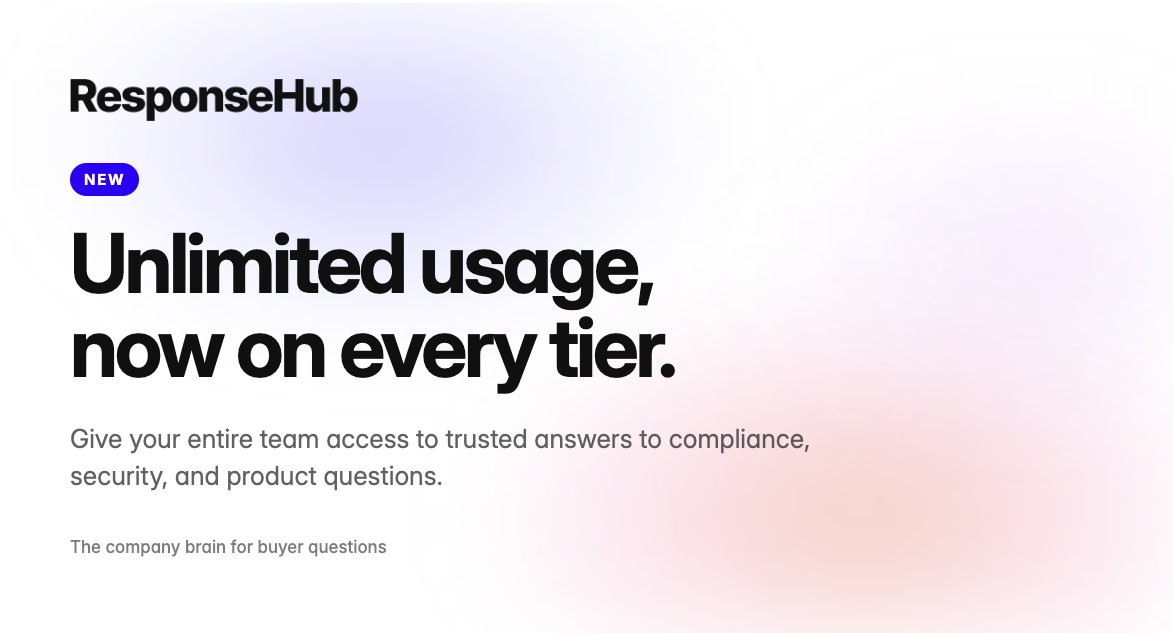
This week we're rolling out a huge change to how we charge for ResponseHub. When we started, I took inspiration from products like Fin, the customer service agent, which did something revolutionary: it only charged for successful outcomes. I wanted to do something similar for ResponseHub and only charge for successful answers to security questionnaire questions. It felt like it would be win-win: customers only pay when they get a result. The reality was more complicated. What if I regenerate an answer? What if the answer comes straight from the knowledge base? But most importantly, it was disincentivising product usage. I was hearing from customers that they wanted to onboard users from Sales and Customer Success teams so they could get answers to buyer and customer questions about security, compliance, legal and product. So this week we're making three big changes: 1. Every plan now includes unlimited usage. 2. We've introduced a new role, "Viewer", who can ask questions and view content. Every plan includes unlimited Viewer seats. 3. We're now charging by "Editor" seats, the folks who manage the knowledge base and work on RFPs and security questionnaires. The most exciting thing about this change is that it moves ResponseHub away from being a tool for security questionnaires and towards being a company brain that your whole organisation can use to answer buyer questions about security, compliance and product.
Neil tweet media
English
1
0
0
139
farez 🇵🇸
farez 🇵🇸@farez·
Interestingly, I've just started experimenting with running LLMs locally instead of moving into the cloud. At this time, local LLMs just feels to slow compared to using cloud LLMs (whether that's on your own VPS or hosted like Claude). So I'd move back to cloud LLMs. And I like this idea of actually having the harness (eg Claude Code or OpenCode) in the cloud too. It just makes sense. For now anyway. But it does depend on me being connected. Not great for when I travel. And I travel a lot. And to places with bad signal. So we may see it swing back again to running dev work locally some in future, once laptops/devices can run LLMs fast enough.
@levelsio@levelsio

✨ I think I've been coding almost solely on my VPS with Claude Code for almost a year now All I can say it's just fantastic: - no need to keep laptop open ever - no laptop battery drain - can switch to phone or any other device you like whenever you want to continue (like when you're outside) - it just keeps going all night while you sleep (esp with /goal) - you can start hacky projects from scratch and go live in seconds because you're already on the server which is great to ship things and get it used by people fast (not stuck on your local laptop webserver) - it just feels like living in the future I used to code on my laptop, test locally, then push to GitHub, then it auto pulled and deploy to production, that'd take me ~1 minute to get a new feature out But then when I bought a new Mac Book Pro a few years ago I was too lazy to install a local Nginx environment, so I just started pushing to prod and everything went fine, and I sped up deploying to about 3 seconds from laptop to server, which people called me crazy for too But now with Claude Code on my VPS in the last year, it just live edits on my production server, which sounds like it should go wrong but it just doesn't, it's very careful and only twice in 12 months messed up which meant my site didn't load for 10 seconds which is OK If I wasn't working solo, like at a big company, I' think I'd recommend the same workflow but with a staging server, so it wouldn't touch production, for safety and regulatory reasons etc. but for me it's fine I agree with @theo completely, it's clear to me this is where it's going, also seeing @karpathy with Claude moving to the cloud (via Slack etc), I think AI "agents" and AI coding will operate on servers / from the cloud first P.S. I have 3-2-1 backups, multiple on-site and off-site backups which you should also even if you wouldn't code with AI, safety first!
English
1
0
0
166
Neil
Neil@ncameron·
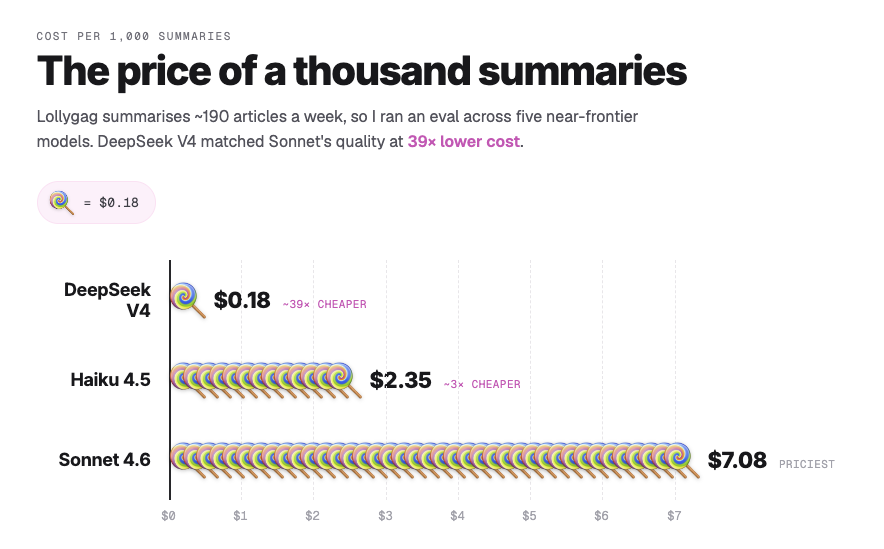
Building lollygag.news was the perfect opportunity to experiment with some of the new, near-frontier models. Lollygag summarises around 190 articles from 50 different sources each week. Since this is (currently) a non-revenue-generating project, I didn't want to end up with a huge token bill. To compare options, I set up an eval in Promptfoo across several models (Sonnet, Haiku, DeepSeek, Gemma, GPT-OSS), and used Opus 4.8 as the LLM judge to review the summaries for accuracy and style (i.e. avoiding sounding like an LLM). Here's the interesting thing: DeepSeek's performance was as good as Sonnet, but 39x cheaper. It's totally exploded my assumption that using (near-)frontier intelligence in a product adds significant variable cost, and therefore impacts how you charge (usage-based vs fixed-fee) and how you go to market (freemium vs free trial). Another way to think about it: Lollygag's hosting costs are $5.50 per month. If it relied on Sonnet, inference cost would be 1.3x the server cost; with DeepSeek it's 0.03x. If you're a tokenmaxxing org spending six or seven figures on Anthropic tokens, I don't think you can afford to ignore these new models.
Neil tweet media
English
2
0
3
120
Neil
Neil@ncameron·
The Open Weight Models that Matter: June 2026 DeepSeek V4 Flash is the first open-weight model teams dropped into real agentic pipelines as a plausible substitute for frontier models, scoring 79% on SWE-bench Verified at $0.14 per million input tokens, roughly 150x cheaper than GPT-5.5. GLM 5.2 leads open weights on Artificial Analysis’s Intelligence Index at 51, just five points below Claude Fable 5, and matches GPT-5.5 on agentic benchmarks for planning and long-horizon coding. MiniMax M3 is the only open-weight model in the group that natively handles image and video input, with a 1M-token context and competitive pricing, but carries a restrictive community license.
English
1
0
0
104
Neil
Neil@ncameron·
Anthropic has accused Alibaba of orchestrating the largest known campaign to illicitly clone its Claude AI model, generating more than 28.8 million interactions through almost 25,000 fraudulent accounts between April 22 and June 5. lollygag.news/a/637
English
0
0
2
59
Neil
Neil@ncameron·
@robinbortlik Great to hear that! Hope you enjoy it
English
0
0
0
10
Robin Bortlík
Robin Bortlík@robinbortlik·
@ncameron I love the idea. I'm actually suffering with same problem, so lollygag.news will be my new destination. :-) Thanks for that.
English
1
0
1
15
Neil
Neil@ncameron·
I got tired of doomscrolling Twitter while my agent was working, so I built Lollygag (link in comments). Now instead of brain-rotting on Twitter, I can keep up with the latest AI news, straight from the labs, builders and outlets. Next time you've got 60s to kill, head over to Lollygag and do some swiping. Lollygag aggregates and summarises AI news from 50 different sources. It uses a 100% local algorithm to surface the news you're interested in and remembers your progress, so you're always getting fresh content. 🔗 link in comments
Neil tweet media
English
2
1
6
222
Neil
Neil@ncameron·
@Ed_Forson Thanks for organising and rubbing the initiative, I always get a lot out of these dinners.
English
0
0
1
35
Eddie Forson
Eddie Forson@Ed_Forson·
The restaurant lost our booking. Eleven of us, left on the pavement for twenty minutes. And it was still one of the best AI Mavericks dinners we've had. 🍕 They sorted a table eventually. One guest turned up so late he missed the introductions entirely (you know who you are :) ). Returning faces, a few first-timers, and the usual brilliant mix of people building with AI for fun and profit. We got through an absurd amount of ground. Far more than I can fit here. But a few threads stuck with me: 🧠 The gap between "we want AI" and an actual problem worth solving. Several people round the table see it weekly with clients: the demand is loud, the problem statement is missing. 💸 The economics of inference at scale. One guest cut a summarisation job from ~$40 a month to ~$2. Same quality, just by switching to a cheaper model. At that volume, which model you pick is as much a finance question as an engineering one. 🔓 Whether open-weight models are ready to displace the frontier yet, and the data-sovereignty reasons some companies will move regardless of the benchmarks. But the topics are only half of it. What I enjoy most is watching people who'd never met start swapping ideas, numbers, and the odd "wait, you're building that too?!" by the end of the night. More connections got made this time than we had time to chase. A detailed recap is going out to everyone who came, and to all our previous guests. (Joined a Mavericks dinner before but not getting the newsletter? Ping me.) What's next: 📅 One more gathering in July. 🌐 A members' website, so there's a proper home for the community between events. 💼 And I'm exploring working with companies hiring AI engineers, posting roles straight to the Mavericks community. I'll keep thinking about how to add more value for the people in this community. But there's one rule that won't change: keeping it human first. The AI is just what gets us all in the same room. Watch this space.
Eddie Forson tweet media
English
3
0
10
369
Alan Chang
Alan Chang@alanchanguk·
Today we're starting something new at Fuse. We're building robots. First, why this matters, because it's easy to get wrong. Skilled trades are ageing out faster than they're being replaced. The average electrician is over 45, the average plumber is over 50, and every year we lose more of them to retirement than we train. At the same time the world needs far more of them, not fewer, to build for the surge in energy demand ahead of us. You cannot build power plants, grid and AI data centres without them, and there are not enough of them. So we're attacking this from both ends. We're building a training centre in Birmingham, the first of many: untrained human in, skilled tradesperson out. We grow the workforce. And we're building robotics to amplify what our technicians can do. We don't have enough skilled people as it is. The goal is to make them more productive. Our technicians are at the core of Fuse's mission of acheiving low cost energy and energy abundance. Why we think we'll win where standalone robotics companies have struggled: 1. We already generate the data robots need. Robotics is bottlenecked on real-world physical data, and you cannot scrape it off the internet. Our technicians do real physical work every day across building power plants, electrical work and energy hardware installs. Only a handful of companies have real physical data. Rarer still to have it across this breadth of skilled trades, on sites you own. 2. We can deploy fast, and we learn faster. Standalone labs spend years convincing big customers to let them deploy on site, often against legacy resistance. We own the worksites, so we build, test and deploy on real Fuse jobs from day one. Continuous deployment means an extremely fast learning rate: more deployment, more data, faster improvement. This is greenfield. Everything is open for the new team to define, from initial use case to policy choice to the embodiment itself, including whether we build in-house or partner. We're open to working with the best robotics and world model companies out there. The team will work directly with me. Energy is the bottleneck for AI. Our goal is to unleash it, and robots are how we make sure it never becomes one again. We're hiring the founding team now. If you want to build robots that ship into the real world from week one and make skilled trades more productive, come talk to us.
English
45
25
454
61K